Bootes Void: A Hole in Space So Big It Hides Entire Galaxies
The Bootes Void is 330 million light-years of near-nothing. Would a civilization inside it ever know other galaxies exist? Astronomers aren't so sure.
1981. A team of astronomers is mapping the distances to galaxies, expecting more of the usual: galaxies sprinkled across the sky the way stars dust a clear night. Then they turn their attention toward Bootes, the Herdsman. And they find almost nothing.
A region of space roughly 330 million light-years across was holding a tiny fraction of the galaxies it should have. The team had blundered into one of the emptiest places anyone has ever found. We call it the Bootes Void.
Here is a line that has chased the void around ever since, attributed to the astronomer Greg Aldering, meant to make the emptiness land in your gut: if the Milky Way had sat at the center of the Bootes Void, we would not have known there were other galaxies until the 1960s. Maybe the quote is word-for-word, maybe it is not. The point holds anyway. The void is so vast and so empty that a civilization living inside it could have spent decades convinced its galaxy was the only one in existence.
Finding a hole by accident
The discovery came out of a redshift survey led by Robert Kirshner and colleagues, who were trying to build a three-dimensional map of the local universe. The trick they relied on is elegant. A galaxy's redshift, the amount its light gets stretched toward longer wavelengths by the expansion of space, doubles as a yardstick for distance. Measure the redshifts of enough galaxies and you can reconstruct not just where they sit on the flat sky, but how far back they go in depth.
When the team plotted their results toward Bootes, a yawning under-dense region opened up in the data. Their 1981 paper in The Astrophysical Journal carried a title that says it plainly: "A million cubic megaparsec void in Bootes." And here is the part that gives the find its bite. It was partly an accident, a byproduct of a survey built for other reasons. Nobody went looking for the emptiness. It ambushed them, which is exactly why it is remembered as a genuine surprise instead of a tidy confirmation of theory.
Follow-up work in the years after sharpened the picture, and it turned out the void is not flawlessly empty. It holds a modest scattering of galaxies, many of them strung along a tube-like filament threading through the middle. The tally lands at roughly 60 galaxies inside a region where the normal density of the universe would predict closer to 2,000. So the Bootes Void is no perfect vacuum. It is a place where galaxies have gone extraordinarily scarce, down to a tenth or less of the cosmic average.
Just how big, just how empty
A few numbers anchor the scale:
- Diameter: about 330 million light-years across, putting it among the largest known voids. Some sources reach for a bigger word and call it a "supervoid."
- Distance: roughly 700 million light-years from Earth, off in the direction of the constellation Bootes.
- Galaxy count: on the order of 60 confirmed galaxies inside, against the roughly 2,000 a comparable, well-populated volume would carry.
It is worth being careful about what "empty" actually means here. The void is under-dense, not stripped of all matter. Diffuse gas drifts through it. Dark matter is there. So are those few dozen galaxies. What stuns you is the contrast with everything around it, not some absolute absence of stuff.
Why voids exist in the first place
Here is the twist that dramatic retellings tend to bury: a void this big is not a mystery at all. It is a prediction. Modern cosmology fully expects the universe to look like this.
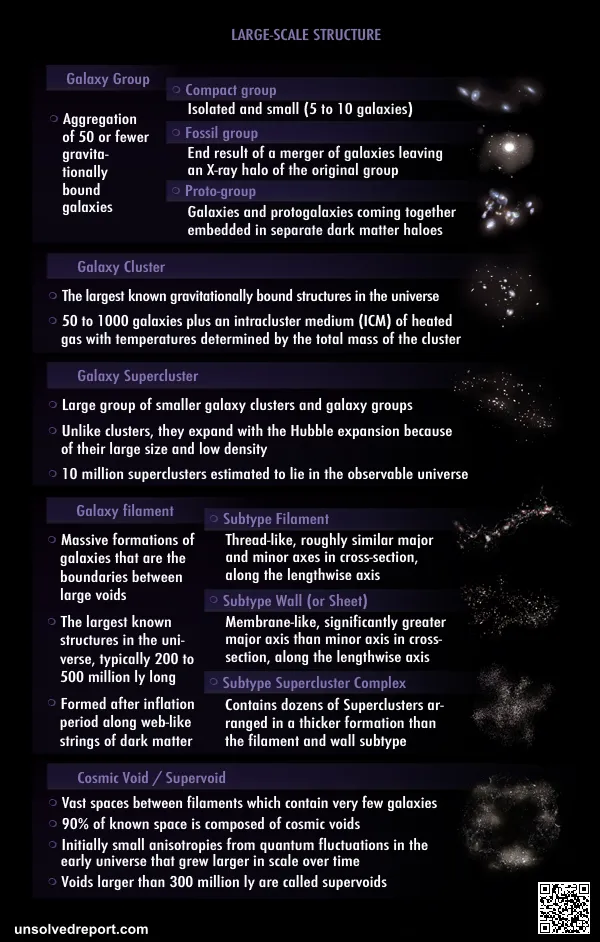
In the standard model, known as Lambda-CDM, the cosmos started out nearly smooth, carrying only faint density ripples stamped into it in the earliest moments. Then gravity went to work. Across billions of years it amplified those ripples. Slightly denser patches pulled in more matter and grew denser still; slightly thinner patches bled matter to their neighbors and grew emptier. The end product is what astronomers call the cosmic web: a spongelike structure of dense filaments and sheets of galaxies wrapped around enormous, nearly hollow bubbles.
The voids are those bubbles. They are not glitches in the picture. They are the natural other half of the filaments, the empty room between the strands. Run a cosmological simulation forward from the early universe, let gravity do its slow work, and voids fall out reliably, big ones included.
So why does the Bootes Void still earn so much attention? Mostly its sheer size, which sits toward the large end of what the models comfortably churn out. A void this big is not impossible under Lambda-CDM, just uncommon, and that makes it a handy stress test for how well our theory of structure formation matches the real sky. Study the biggest voids and you help calibrate the models.
What is nailed down, and what is still up for grabs
It pays to separate the rock-solid from the genuinely open.
Established:
- The Bootes Void is real, confirmed again and again by multiple surveys since 1981.
- It is severely under-dense, carrying far fewer galaxies than average.
- The broad existence of large cosmic voids is well explained by the gravitational growth of structure in Lambda-CDM.
Still discussed:
- Whether the Bootes Void's size is fully typical for the standard model, or whether it sits out on the rare tail of the distribution.
- The fine-grained properties of the few galaxies inside, including the question of whether void galaxies build stars differently because they grow up in relative isolation.
That last question is the kind that keeps researchers busy. Galaxies raised inside voids have almost no neighbors to mingle or merge with. Using big surveys like the Sloan Digital Sky Survey, astronomers have probed whether void galaxies run bluer, hold more gas, or forge stars at different rates than galaxies packed into denser neighborhoods. The differences they find are real but generally modest, which hints that environment nudges galaxies without rewriting what they fundamentally are.
What the void is not
Because the Bootes Void is so dramatic, it tends to attract overreach. A few things to set straight:
- It is not a black hole or a tear in space. It is just a region with very little matter in it. Nothing is being swallowed.
- It is not evidence of alien engineering. There is no scientific footing for that idea, and nothing about the void demands an exotic explanation. Ordinary gravity grinding away over billions of years covers it.
- It does not break physics. If anything, large voids are confirmation that our broad picture of how cosmic structure forms actually works.
The honest mystery, to the degree there is one, is quantitative rather than qualitative. The question is not "how can a void exist?" but "is a void this large fully consistent with the statistics our best models predict?" That is a matter of fine detail, the kind cosmologists chase by stacking many voids across huge surveys and holding them up against simulations.
How do you map nothing?
It sounds backward to talk about measuring a place defined by what is missing from it. But cosmologists have built careful tools for exactly that. The first ingredient is a galaxy survey: a catalog of positions and redshifts for hundreds of thousands, even millions, of galaxies. Projects like the Sloan Digital Sky Survey, and the earlier galaxy redshift surveys before it, took the flat two-dimensional sky and gave it depth, with redshift standing in for distance.
Once you have that map, void-finding algorithms go hunting for regions where the galaxy density plunges well below the cosmic average. Different algorithms draw the boundaries differently. Some grow spheres outward from empty points until they bump into galaxies; others read the geometry of the galaxy distribution itself. That is one reason quoted void sizes wander a bit from study to study. The Bootes Void's headline figure of roughly 330 million light-years comes out of this kind of analysis aimed at a strikingly under-dense patch of sky.
One subtlety to keep in mind: redshift is not a flawless distance measure. Galaxies carry their own motions on top of the overall cosmic expansion, and that smears their apparent positions in depth a little. Astronomers correct for these "redshift-space distortions" when they characterize a void, and those corrections are well understood. None of them make the Bootes Void vanish. They only refine its shape and its edges.
Bubbles all the way out
The Bootes Void is the most famous, but it is far from the only one. The universe is riddled with voids of every size, and together they account for most of its volume. Galaxies, by contrast, crowd into the thin walls and filaments running between them. Zoom out far enough and the cosmos stops looking like a sea of galaxies and starts looking like a froth of bubbles, with galaxies tracing the soap films stretched between them.
That froth-like architecture is precisely what gravity, acting on tiny early-universe ripples, is expected to produce. Other very large under-dense regions have been catalogued across different stretches of sky, and surveys keep turning up more. The takeaway is simple: voids are a generic, expected feature of the cosmos. The Bootes Void is best read not as a unique enigma but as a particularly large and well-studied example of something entirely ordinary.
Why any of it matters
Voids are not just curiosities to gawk at. They are turning into serious cosmological tools. Because a void is under-dense, the way light and matter behave inside it is unusually sensitive to the properties of dark energy and to the laws of gravity on the very largest scales. The expansion history inside a void runs subtly differently from the cosmic average, and the gravitational dent a void carves into space can leave a faint fingerprint on the cosmic microwave background as light passes through.
That last effect ties the study of voids to other frontier questions, including the anomalies hiding in the microwave background itself. Map voids in detail, compare how many there are and how big they grow against the predictions, and you get an independent check on a model that already leans on supernovae, the microwave background, and galaxy clustering.
The Bootes Void, stumbled upon by accident in 1981, turned out to be an early window onto the real architecture of the cosmos: not a uniform sprinkle of galaxies, but a vast, structured web wound around enormous bubbles of near-emptiness. That architecture is one of the genuine triumphs of modern cosmology. And the hole in Bootes was one of the first dramatic hints that the universe is built exactly this way. The next question writes itself. If the biggest voids are this ordinary, what does the rest of the froth still have hidden in it?
The void by the numbers
Everything below is drawn from the sources already cited on this page.
| Property | Figure | Source |
|---|---|---|
| Discovery year | 1981 | Kirshner et al. 1981, ApJ |
| Discovery paper | "A million cubic megaparsec void in Bootes" | Kirshner et al. 1981, ApJ |
| Lead discoverer | Robert Kirshner and colleagues | Wikipedia |
| Diameter | ~330 million light-years | Article body |
| Distance from Earth | ~700 million light-years | Wikipedia |
| Galaxies confirmed inside | ~60 | Wikipedia; article body |
| Galaxies expected at cosmic density | ~2,000 | Article body |
| Constellation | Bootes (the Herdsman) | Article body |
| Governing framework | Lambda-CDM (gravitational growth of structure) | Lambda-CDM |
How the galaxy count was filled in
The often-repeated "roughly 60 galaxies" figure was not the number from the 1981 discovery. It was assembled step by step across follow-up surveys, which is why the void that first looked all but empty is now known to hold a thin population strung along an internal filament. The sequence below is drawn from the NED/Bothun source already cited here.
- 1981 — Kirshner, Oemler, Schechter and Shectman report the void from a redshift survey, giving it an overall scale of roughly 7,500 km/s in redshift velocity. Kirshner et al. 1981, ApJ
- 1987 — A follow-up survey examines 240 bright galaxies across the region; essentially none fall at the void's redshift, sharpening just how under-dense the interior is. NED / Bothun
- 1997 — Aldering and collaborators, drawing on IRAS satellite data, locate 53 galaxies inside the void's boundaries — the bulk of the modern tally, and the work behind the Greg Aldering name attached to the void's most quoted line. NED / Bothun
The through-line is worth holding onto: the count crept upward not because the void filled in, but because deeper surveys could see the faint galaxies that were always there. Even the fuller tally lands at a tenth or less of the cosmic average.
Sources & further reading
- Wikipedia - Bootes Void - https://en.wikipedia.org/wiki/Bo%C3%B6tes_Void
- Kirshner et al. 1981, A million cubic megaparsec void in Bootes, The Astrophysical Journal - https://ui.adsabs.harvard.edu/abs/1981ApJ...248L..57K/abstract
- NASA/IPAC Extragalactic Database - The Void in Bootes - https://ned.ipac.caltech.edu/level5/Bothun2/Bothun3_5_3.html
- BBC Sky at Night Magazine - The Bootes Void - https://www.skyatnightmagazine.com/space-science/bootes-void
- Wikipedia - Void (astronomy) - https://en.wikipedia.org/wiki/Void_(astronomy)
- Wikipedia - Lambda-CDM model - https://en.wikipedia.org/wiki/Lambda-CDM_model

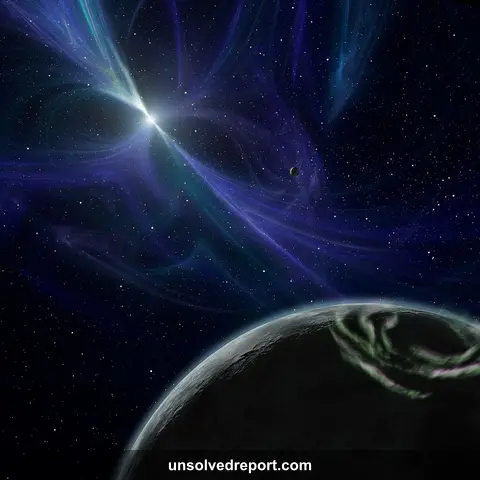
PSR B1257+12: The Pulsar Planets Mystery Nobody Can Explain
PSR B1257+12: the first exoplanets ever confirmed orbit a corpse star, not a sun. So how did they survive the blast that made it? Nobody fully knows.
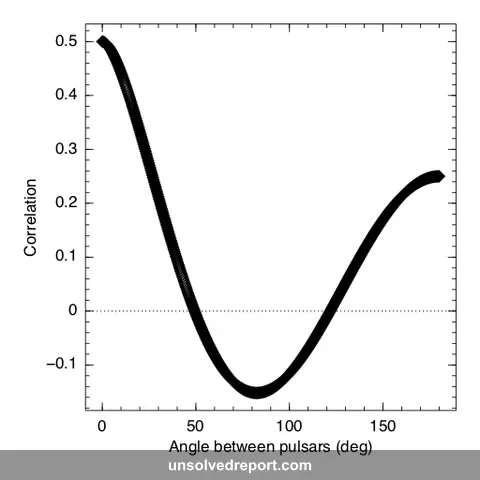
Nanohertz Gravitational Wave Background: The Hum Nobody Can Name
In 2023, dead stars across the sky drifted out of step together in a pattern no noise can fake. What's making them do it? Scientists still aren't sure.
511 keV Positron Annihilation: The Galaxy's Antimatter Fountain Nobody Can Explain
The Milky Way's core glows with antimatter dying by the trillion-trillion every second, at exactly 511 keV. Fifty years of data and still no source. Here's why.