The 520-Ton Stone Aksum Couldn't Stand Up
A 33-meter, 520-ton stone—the heaviest humans ever tried to raise—lies shattered in Ethiopia. Nobody knows how Aksum moved it, or why it fell.
Picture a single block of stone as tall as a ten-story building, lying broken in pieces across a windswept field in northern Ethiopia. Stand it up and it would reach roughly 33 meters into the sky. It weighs an estimated 520 tons. Archaeologists call it "likely the largest single monolith which people have ever attempted to erect" (Simon Fraser University, Museum of Archaeology & Ethnology).
Here's the strange part: it never quite stood. Someone quarried it, dragged it, and tried to lift it skyward—and it came crashing down. How the Aksumites moved stones on this scale, and why their boldest one failed, is one of Africa's great engineering puzzles.
Who Built These Giants
Aksum (also spelled Axum) was rich. A trading kingdom in what is now northern Ethiopia and Eritrea, it rose around the 1st century CE and grew into a hinge of the ancient world—linking Roman, Mediterranean, and Indian Ocean trade routes, minting its own coins, and controlling commerce across the Red Sea (Britannica). This was no backwater. It was a power that talked to empires.
Then, in the 4th century CE, something remarkable happened. Under King Ezana, Aksum became one of the first states on Earth to adopt Christianity—converted with the help of Frumentius, who became its first bishop (Britannica).
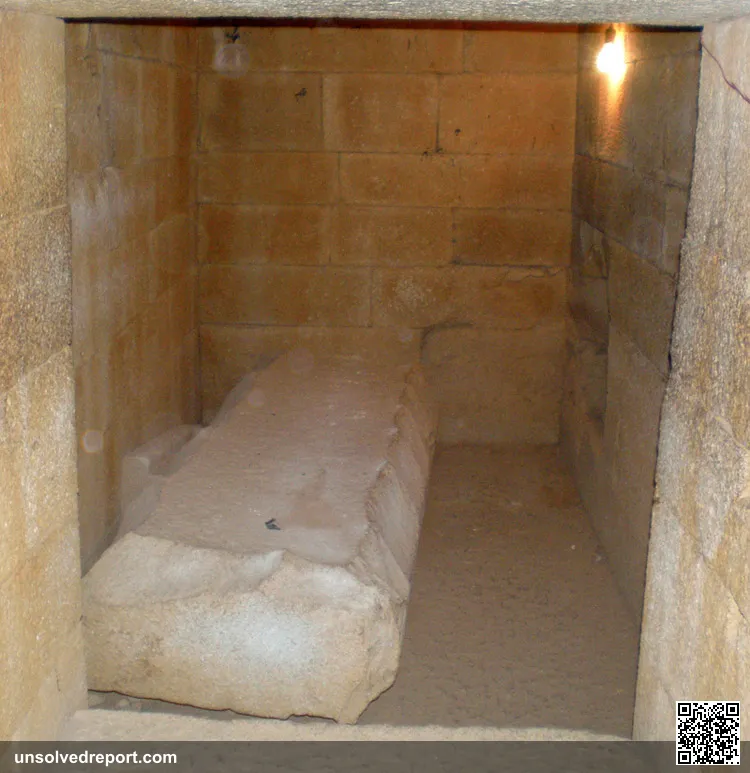
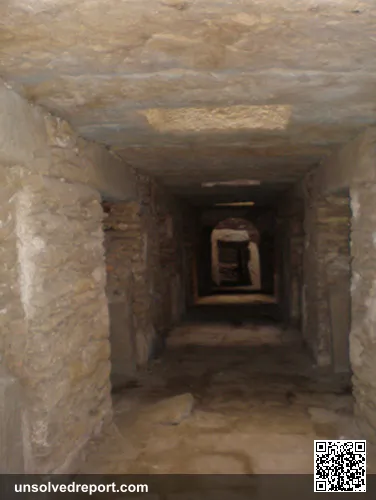
The stelae mark the high-water line of all that wealth and ambition. These tall, carved monoliths went up mainly between the 3rd and 4th centuries CE, and they weren't just decoration—they were tombstones. Each giant stood above an underground tomb holding the kingdom's elite and royalty (The Metropolitan Museum of Art). Every one was carved from a single block of nepheline syenite—a hard, weather-resistant stone that looks a lot like granite—hauled from hills about 4 kilometers west of the city, including a quarry at Gobedra (Simon Fraser University).
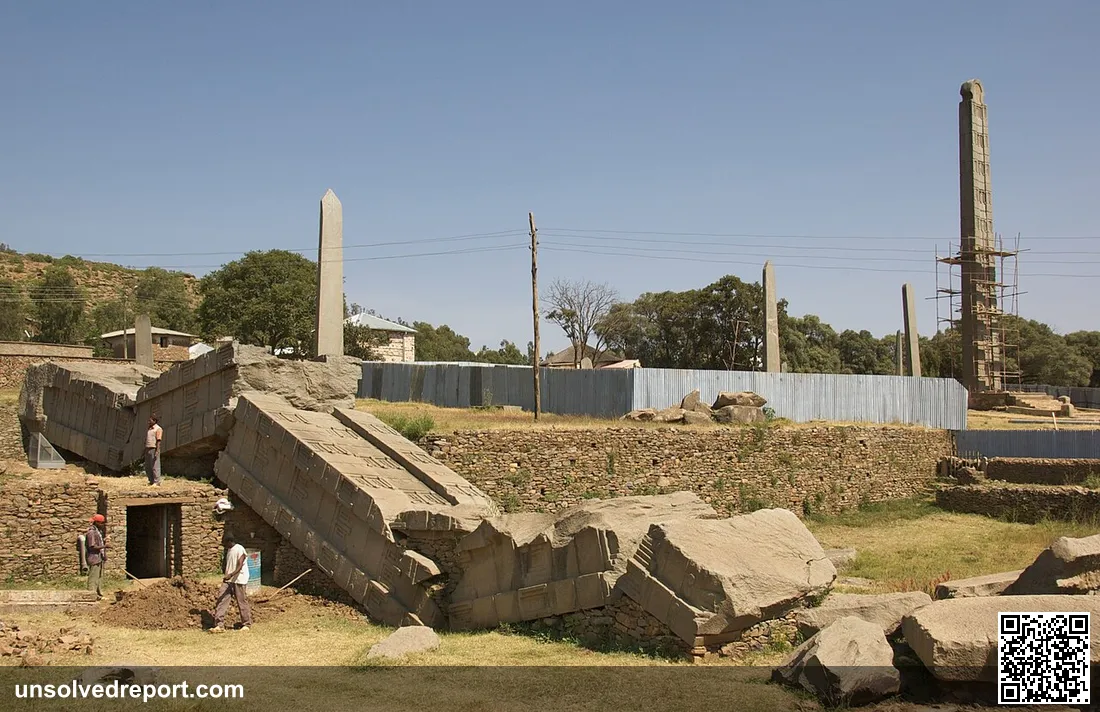
Now look closer, and the stelae get genuinely eerie. The finest ones are carved in low relief to mimic tall buildings—false doors at the base, rows of windows climbing each face like floors of an apartment block. The Great Stele "represents" a thirteen-storey building. The second-largest, nine storeys (Met Museum). Ancient skyscrapers in stone, frozen against the sky.
Three of them dominate the field:
- The Great Stele (Stele 1): roughly 33 meters and about 520 tons. It lies broken in several pieces and probably fell during or shortly after the attempt to raise it (Simon Fraser University).
- The Obelisk of Axum (Stele 2, the "Rome Stele"): about 24 meters and roughly 160 tons. Italian forces sliced it into three pieces and carried it off during the 1937 occupation. It stood in Rome for decades, came home to Ethiopia in 2005, and was re-erected at Aksum in 2008 (Wikipedia: Obelisk of Axum).
- King Ezana's Stele (Stele 3): about 21 meters, carved from a single piece of stone, and the largest of the giants still standing intact (Simon Fraser University).
In 1980, UNESCO put Aksum on the World Heritage list, naming the stelae among the ruins that mark the heart of ancient Ethiopia.
The Question Nobody Can Answer
So how did they do it? Here's the honest answer: we don't know. Not a single Aksumite text survives explaining how these monoliths were quarried, moved, or hauled upright. One scholarly summary says it flat out—"No one knows exactly when or how they were quarried and erected" (EBSCO Research Starters).
Sit with the numbers for a second, because they're staggering. A 520-ton block had to be split cleanly off solid bedrock with no explosives and no steel tools. Then dragged several kilometers across uneven ground. Then tilted from flat to vertical and dropped precisely over a tomb. To put that in perspective: the Great Stele is far heavier than the biggest standing stones at Stonehenge, and it dwarfs the moai of Easter Island in both height and mass. Even the best-guess methods we can reconstruct leave gaping questions about the workforce, the ropes and rigging, and the foundations all this required.
And the failure? It only deepens the mystery. When the Great Stele came down, it didn't fall onto empty ground—it smashed into Nefas Mawcha, a nearby megalithic tomb. According to UNESCO documentation cited in coverage of the site, the falling stele shattered and its impact caved in that tomb's central chamber, which was sheltered by a single roofing slab weighing on the order of 360 tons (Silk Road Coffee Co. summary of UNESCO findings). Most scholars think that catastrophe ended Aksum's tradition of raising giant stelae for good. But the timing? Still unsettled. Did the Great Stele topple mid-lift, or did it stand for a moment before the earth gave way beneath it? Nobody can say.
What Might Have Happened
The ramp-and-lever idea (the mainstream view). Most archaeologists picture a familiar pre-industrial toolkit: large, organized work gangs, wooden sledges and rollers to drag the stones from the quarry, and earthen ramps paired with levers to walk each stele upright and slot it into a waiting socket (EBSCO Research Starters). It fits how comparable monoliths were moved elsewhere in the ancient world. But be clear about what it is—an educated reconstruction, not a recorded method.
The war-elephant legend (folklore, unverified). A favorite local and tourist-brochure story says Aksum's famous war elephants helped haul the stones. Could draft animals have pitched in? Sure, that's plausible. But the elephant tale has no archaeological backing, and it should be read as legend, not fact.
Why it fell (a leading theory). Many researchers suspect the Great Stele was simply too much—too heavy for the ground and the tomb chambers beneath it to bear. Ambition outran engineering. The way it slammed into and crushed the Nefas Mawcha chamber reads, to some, as proof the substructure couldn't carry the load. It's a reasonable inference from the wreckage. But the exact sequence of the collapse remains unproven.
One thing isn't up for debate, though: the sheer achievement. Whoever raised the 24-meter Obelisk of Axum and the 21-meter Ezana stele—both still standing today—solved a problem of weight and balance that would test a modern crew. (When the returned Obelisk went back up in 2008, it took heavy modern machinery to do it—a quiet measure of how good the original builders were.) Seen that way, the shattered Great Stele isn't really a story of failure. It's a record of how far an African civilization dared to reach. Exactly how they reached it stays an open question—and that, more than anything, is what keeps people standing on that windswept field, looking up at stones that look like buildings, wondering who looked up before them.
Sources & Further Reading
- Britannica: Aksum, ancient kingdom of Africa
- The Metropolitan Museum of Art: The Monumental Stelae of Aksum (3rd–4th Century)
- Simon Fraser University, Museum of Archaeology & Ethnology: Aksumite Stelae
- Wikipedia: Obelisk of Axum
- EBSCO Research Starters: Giant Stelae Are Raised at Aksum
- UNESCO World Heritage Centre: Aksum (inscribed 1980)
The Dancing Girl of Mohenjo-daro: Nobody Knows Who She Really Is
A four-inch bronze girl has stared down 4,000 years of silence. Nobody knows her name — and archaeologists can't even agree she was really dancing.
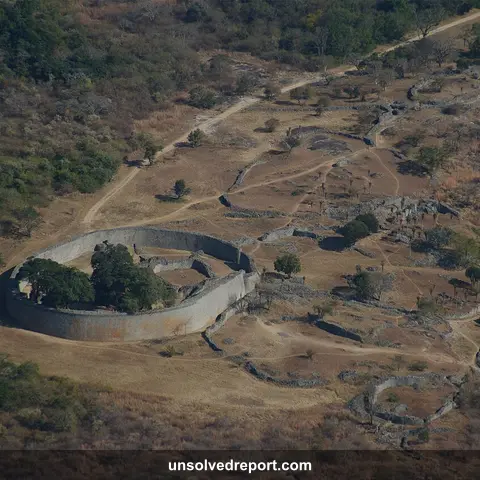
Great Zimbabwe: The Stone City a Lie Tried to Steal
Great Zimbabwe: an 11-meter stone city no mortar holds up - and the racist lie colonial rulers invented to explain who built it. What the walls prove.

Göbekli Tepe: The Temple That Came 6,000 Years Too Early
Göbekli Tepe: hunter-gatherers raised 7-ton carved pillars 11,500 years ago — before farming, pottery, or the wheel existed. So who taught them to build? The evidence, and the open question.