Easter Island Moai Walking Mystery: The Legend Science Mocked
Elders swore the moai walked to their platforms. Scientists dismissed it as myth — until 18 people, 3 ropes, and a 4-ton replica proved something startling.
"They walked."
That was the answer the people of Rapa Nui kept giving, generation after generation, whenever an outsider pointed at the giant stone heads scattered across their island — not unlike the puzzle posed by the Olmec colossal heads half a world away — and asked the obvious question: how on earth did those things get all the way out here? Not dragged. Not rolled. They walked. To Western ears it sounded like a fairy tale — a polite way of saying we don't really know anymore. Then archaeologists tied a multi-ton replica to a few ropes and made it step across open ground. Suddenly the fairy tale read like an instruction sheet.
What We Actually Know
Start with the loneliness of the place. Rapa Nui — you might know it as Easter Island — is a chip of volcanic rock in the southeastern Pacific, roughly 2,300 miles from the Chilean coast, one of the most isolated inhabited spots on the planet. Polynesian settlers reached it anyway, and between roughly the 10th and 16th centuries they raised ceremonial platforms and carved the colossal stone figures called moai — the same tradition behind Hoa Hakananai'a, the carved moai now sitting in the British Museum — per UNESCO, which added the area to the World Heritage List as Rapa Nui National Park in 1995.
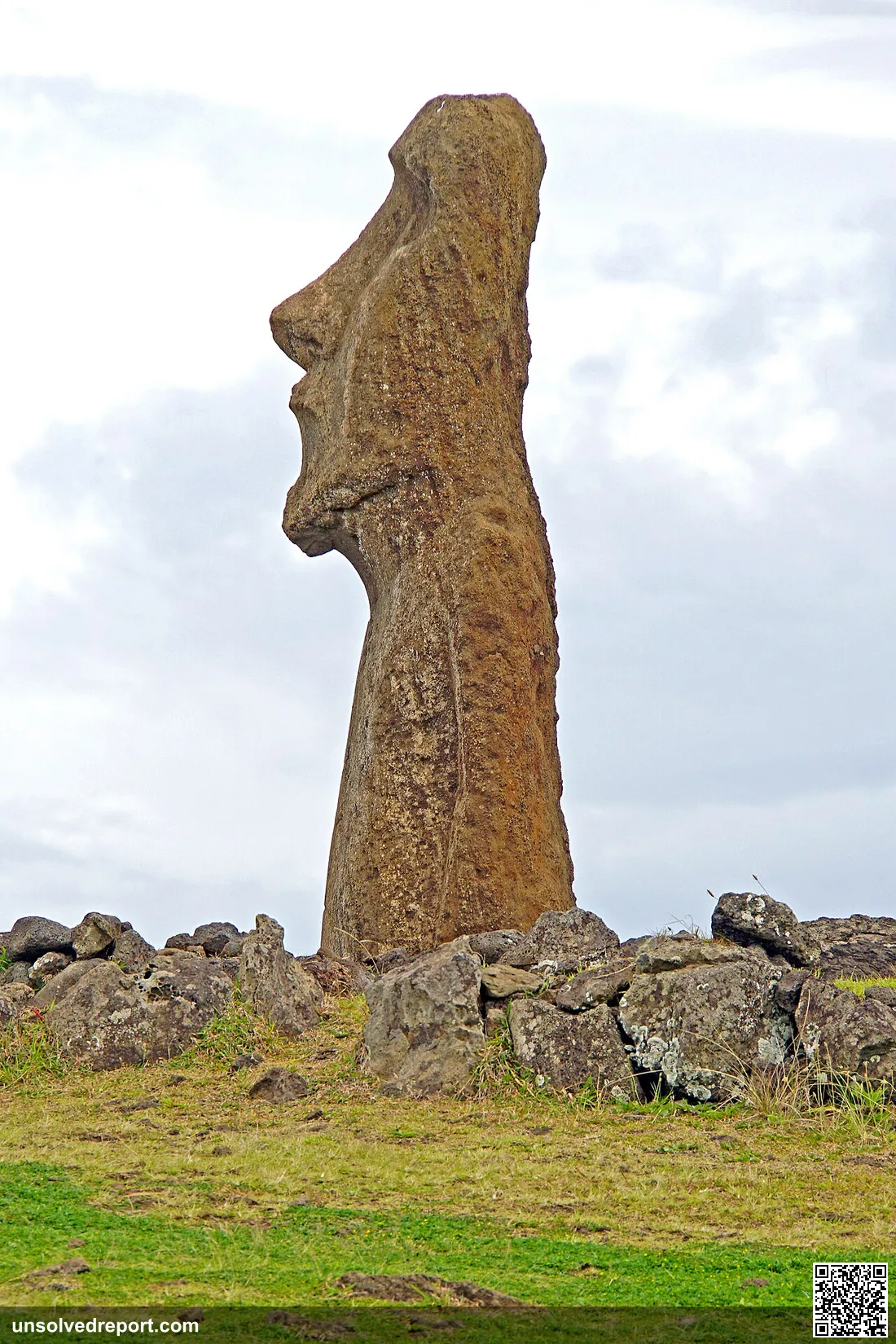
Now the scale. There are something like nine hundred of these things — UNESCO cites 887 statues, while a 2025 peer-reviewed survey systematically logged 962. Around 95% were chiseled out of one place: the volcanic tuff of Rano Raraku, a quarry where hundreds of half-finished giants still sit, frozen at the exact moment the carving stopped. The average moai stands about 13 feet tall. The biggest one ever raised onto a platform weighs in around 80 tons.
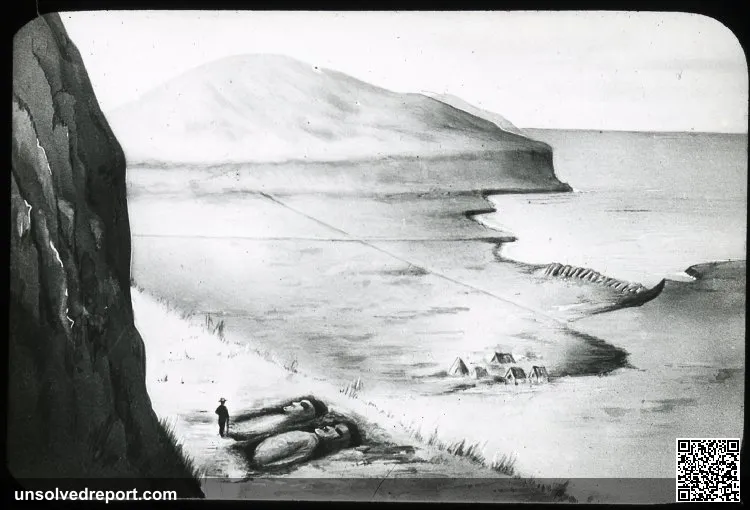
Here's the part that should stop you cold. Every one of those multi-ton monoliths was carved at a single quarry — yet they ended up miles away, standing on stone platforms called ahu dotted around the coast. That wasn't some minor logistics problem on the side of Rapa Nui life. Moving the moai may have been the single hardest thing this civilization ever did — the kind of stone-moving puzzle that also haunts Sacsayhuamán's 100-ton Inca walls.
And the biggest clue had been lying in the open the whole time. Dozens of moai are sprawled along the island's ancient roads, stranded, having never reached a platform at all. In their 2025 paper, "The Walking Moai Hypothesis," published in the peer-reviewed Journal of Archaeological Science, archaeologists Carl Lipo of Binghamton University and Terry Hunt of the University of Arizona zeroed in on 62 of these "road statues." What they found is telling. As Binghamton University reports, the road moai are shaped differently from the ones standing on platforms: wide, D-shaped bases and a distinct forward tilt, as if caught leaning into a step. The statues that made it onto an ahu were re-carved afterward to stand straight, on flat, stable bottoms.
Then they looked at the roads. According to the sci.news write-up of the study, the prehistoric roads run about 4.5 meters wide with a concave, channel-like cross-section — a shallow groove. That's the opposite of what you'd want for dragging something flat. It's exactly what you'd want for cradling something upright and keeping it from tipping while it moves.
Which brings us to the experiment, the moment the legend stopped being a legend. Lipo, Hunt, and their team built a 4.35-ton concrete replica and walked it about 100 meters in 40 minutes. The crew? Eighteen people and three ropes — two looped near the head to rock it side to side, one at the back to stop it pitching face-first into the dirt. "Once you get it moving, it isn't hard at all — people are pulling with one arm," Lipo told reporters. The motion is a controlled waddle: tilt, pivot, tilt, pivot, the statue inching forward with every rock. It's the same trick you've used to "walk" a heavy fridge across the kitchen — just scaled up to four and a half tons of stone.
So Why Isn't It Settled?
Because proving a moai can walk is not the same as proving every moai did walk, this exact way, moved by the hands that carved it. Worth saying plainly.
The replica experiments are a gorgeous proof of concept — but they're reconstructions, not eyewitness footage. Nobody filmed the Rapa Nui moving a real statue. The road statues lean hard in the walkers' favor, with those telltale D-bases and forward tilt fitting the model almost too neatly — yet shape alone can't fully shut the case. And the truly enormous moai, far heavier than 4.35 tons, push any method right to its breaking point. So here's the honest scientific read: walking is now the best-supported explanation for how many statues traveled, not a sealed verdict for all of them.
There's also a real fight among the experts. Jo Anne Van Tilburg, who directs UCLA's Easter Island Statue Project, has long backed a different model, and she's been openly unconvinced by the walking demos — describing them in press coverage as more showmanship than rigorous proof. Tellingly, the 2025 paper is framed in part as a "response to critics." That phrase tells you everything: the argument is live, not buried. Replicable physics on one side, methodological caution on the other — and that standoff is the real mystery. A healthy one, too.
Three Ways to Read the Evidence
Theory 1: The statues walked upright — the front-runner. This is the Lipo–Hunt model, and it now carries the combined weight of experiment, road evidence, and physics. The read: those forward-leaning, D-based road statues were transport-stage objects, "walked" upright down purpose-built concave roads, then re-carved to stand vertically once they reached their ahu. It fits the documented clues better than anything else on the table — though, as noted, it isn't formally proven for every single statue.
Theory 2: Horizontal transport on sleds or rollers — the old guard. For decades, the leading idea — tied to Van Tilburg and others — held that moai were laid on their backs, lashed to wooden A-frame sleds, and hauled over log rollers or rails by big crews. This is no debunked relic; it's a serious, still-debated alternative. Its defenders argue it handles the heaviest statues better and dodges the very real risk of cracking a fragile carving while tipping it upright.
Theory 3: The oral tradition was telling the literal truth all along. Rapa Nui accounts say the moai "walked" to their platforms, sometimes crediting the mana — spiritual power — of chiefs or priests. The supernatural framing is legend, cultural memory rather than a controlled claim, and it should be read as such — much like rongorongo, the island's own undeciphered script, which may be quietly encoding history nobody has learned to read yet. But notice how eerily well "walking" matches the actual mechanical motion the experiments produced. One fair interpretation: the tradition preserved a precise engineering description, dressed in the language of the sacred.
What makes this one so satisfying is the direction it keeps moving — straight back toward the islanders' own words. The descendants of Rapa Nui always said their ancestors made stone walk. Centuries later, armed with rope and rhythm, researchers showed how that sentence could be literally true — while the honest ones among them leave the final page unturned.
And that's the thread worth pulling: how often does the "primitive myth" turn out to be the accurate field report, and the skeptics the ones who have to catch up?
Sources & Further Reading
- UNESCO World Heritage Centre — Rapa Nui National Park: https://whc.unesco.org/en/list/715
- Binghamton University News — "Easter Island's statues actually 'walked' — and physics backs it up": https://www.binghamton.edu/news/story/5830/easter-islands-statues-actually-walked-and-physics-backs-it-up
- Sci.News — "New Research Confirms 'Walking' Moai Hypothesis": https://www.sci.news/archaeology/walking-moai-hypothesis-14269.html
- Lipo & Hunt, "The Walking Moai Hypothesis," Journal of Archaeological Science (2025): https://www.sciencedirect.com/science/article/abs/pii/S0305440325002328
- Nature News — "Easter Island statues 'walked' out of quarry" (2012): https://www.nature.com/articles/nature.2012.11613
Taos Hum: The Sound Only 2% Can Hear—Machines Found Nothing
Only 2% of people near Taos, New Mexico can hear a strange low drone nobody else can — and government scientists never found where it comes from. Why?
Strangest Historical Events: 12 Real Moments Nobody Can Explain
A town danced itself to death. A crew vanished from a seaworthy ship. Twelve strangest historical events — all documented, all still unsolved. Which one breaks your logic?
Roopkund Skeleton Lake: 500 Dead, One Question Nobody Can Answer
Roopkund Skeleton Lake: 500+ frozen bodies at 16,000 feet. DNA proved they died 1,000 years apart, some from the Mediterranean. Nobody knows why.