Hoa Hakananai'a: The Easter Island Statue Hiding a Second Face
Hoa Hakananai'a's front is one religion. Its back, carved centuries later, is another. No one can say exactly when the switch happened — or why.
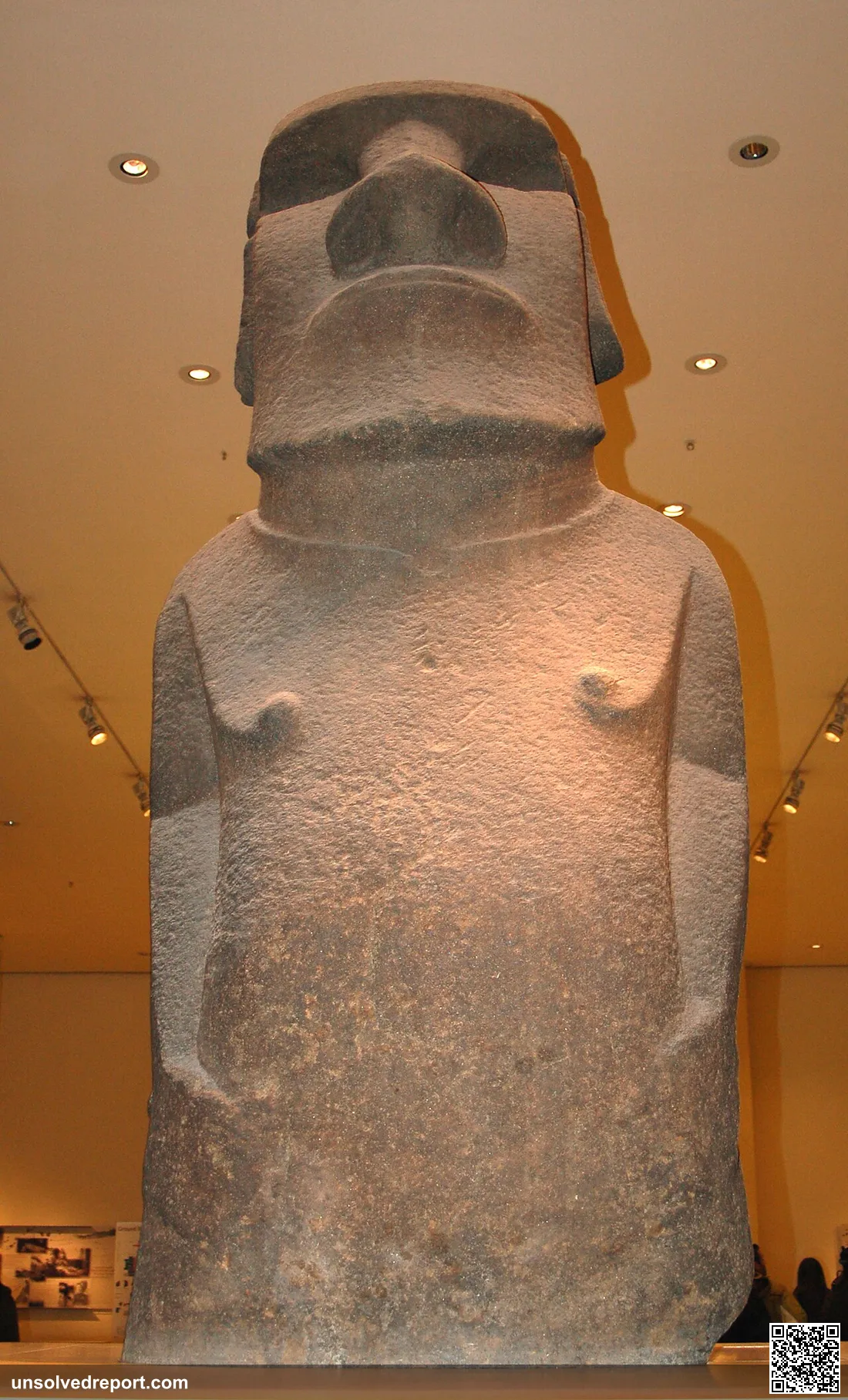
He has been staring at the wall of a London gallery for over 150 years. Four tons of dark grey stone. A heavy brow. A face you cannot read, set against more than a century and eight thousand miles of ocean. His name is Hoa Hakananai'a, and the name is the first chill of this story. People have translated it as "breaking wave." They have also translated it as "lost or stolen friend." He is one of the most famous Easter Island statues on Earth. And turn him around, away from the visitors, and you find a second story carved into his back that almost nobody came to see: a tangle of birdmen, paddles, and strange ritual marks left by a cult that rose long, long after his face was first cut from the rock. How did one statue end up holding two completely different worlds? That question is one of the genuine open puzzles of Pacific archaeology.
What we actually know
Start with the solid ground. Hoa Hakananai'a is a moai, one of the giant ancestor figures carved by the Polynesian people of Rapa Nui (Easter Island). And here is the first odd thing about him. The island holds roughly 1,000 statues, and almost all of them were cut from soft volcanic tuff, a stone you can shape fast. Not this one. He was worked from dense grey-brown basalt or flow lava (Wikipedia; British Museum) — far harder, far slower, far more deliberate. He stands about 2.42 meters (7.9 feet) tall, measures roughly 96 centimeters across, and tips the scale at an estimated 4.2 tonnes (Wikipedia).
How old is he? The usual answer is around 1000–1200 CE. But sit with this part, because it matters more than it sounds: not a single Rapa Nui moai has ever been directly, scientifically dated. That number is a careful guess, built from comparing carving styles and the wider timeline of the island's great statue-building age (Wikipedia). The whole landscape these figures belong to — Rapa Nui National Park, with its nearly 1,000 moai, its roughly 300 ceremonial platforms (ahu), and its thousands of petroglyphs — was named a UNESCO World Heritage Site in 1995 (UNESCO).
Now, the strange part. Most moai were raised on coastal platforms, often turned to face inland, watching over their living communities. Hoa Hakananai'a was not. They found him inland, up near the cliff-top village of Orongo on the rim of the Rano Kau crater — and he was buried to the shoulders inside a stone house (Wikipedia; British Museum). Why would an ancestor figure be standing there, packed into a house on the edge of the world?
Because Orongo was the beating heart of the birdman cult, the tangata manu. Picture the contest. Every year, champions raced down sheer sea cliffs, swam out to the islet of Motu Nui through shark water, and waited — sometimes for weeks — to grab the very first egg of the nesting sooty tern (manutara). It was all done to honor the creator god Makemake. Whoever sponsored the winning swimmer became the sacred "birdman" for the entire year (Heritage Daily; UNESCO). Historians generally place the cult's golden age between roughly 1680 and the 1860s, when missionaries finally shut it down.
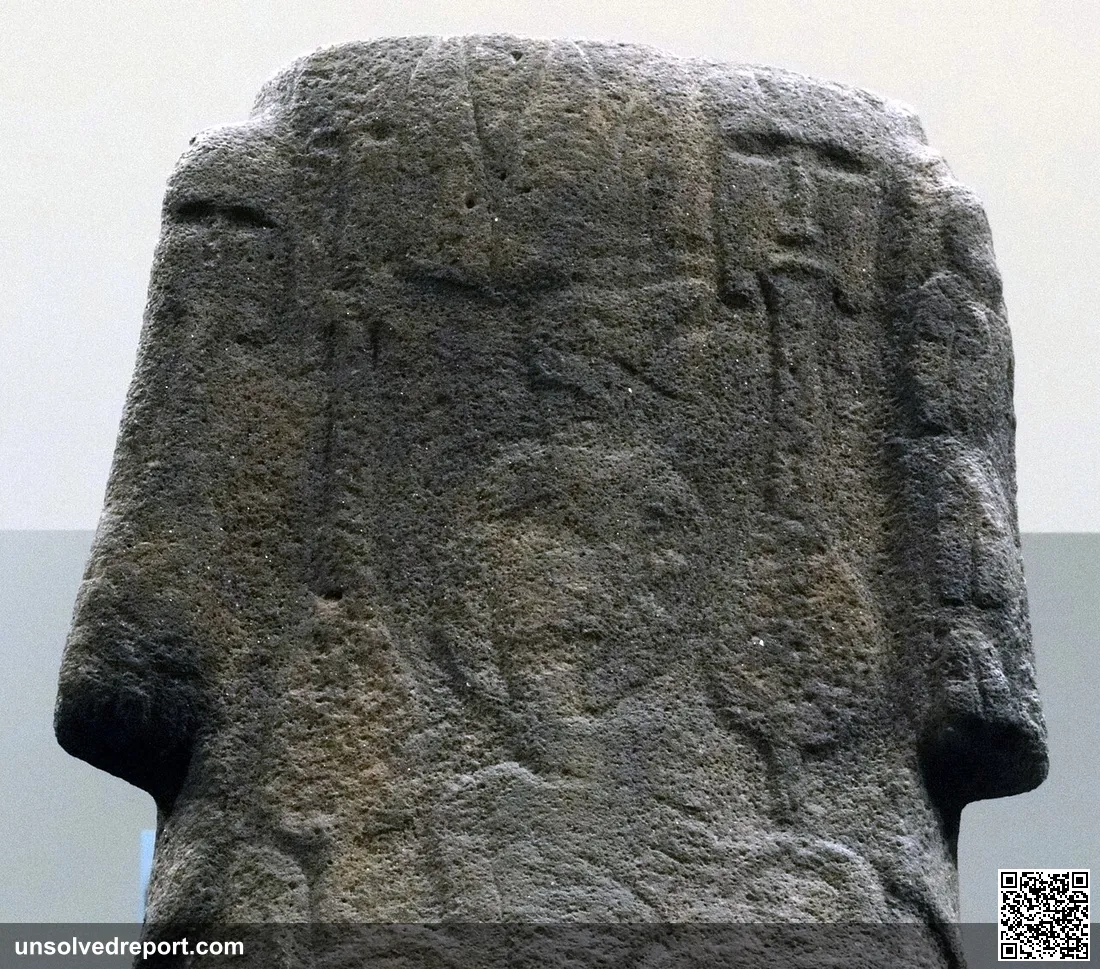
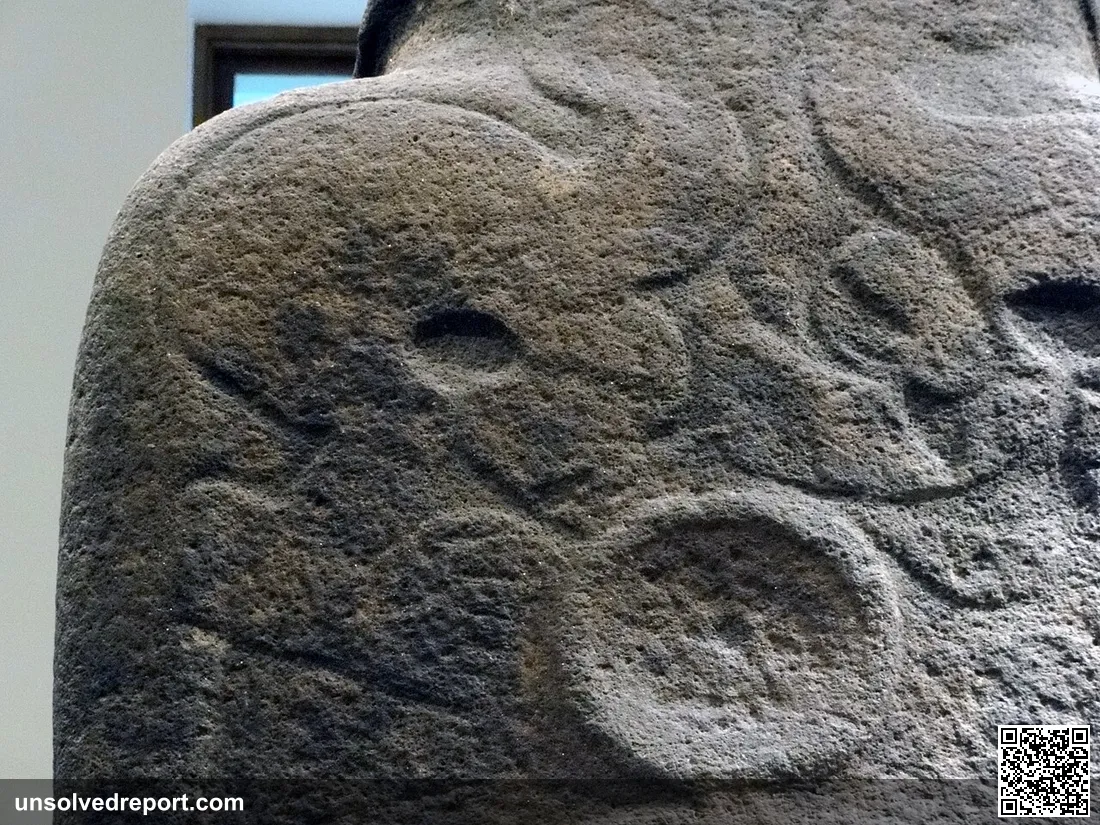
And that cult is carved right into the statue's back. Between the band at his lower back (the maro) and the crown of his head, relief carvings show two birdmen facing each other, beaked heads and all, plus a small bird often read as a sooty tern, ceremonial dance paddles (ao), and vulva motifs (komari) (Wikipedia). The same images appear, almost like a signature, scratched into the living rock all around Orongo.
Then came the night everything changed. November 1868. The crew of the British frigate HMS Topaze, under Commodore Richard Ashmore Powell, found the statue sealed inside its Orongo house. They tore the house apart. They dragged the four-ton figure down to the shore on a sledge and rafted him out to the ship — along with a smaller moai later named Hava (Wikipedia). The Topaze reached Plymouth on 16 August 1869. The statue was offered to Queen Victoria, who sent him on to the British Museum, where he has lived ever since under the registration number 1869,1005.1 (Wikipedia).
In November 2018, his people came for him. A Rapa Nui delegation, led by the island's governor, Tarita Alarcón Rapu, flew to London to ask for the statue back. "Give us a chance so he can come back," she said through tears. "You have our soul" (CNN; Smithsonian Magazine). To the Rapa Nui, a moai is not a thing in a case. It is a living ancestor. The British Museum, calling itself one of the world's leading lenders, has hinted it might agree to a loan — but has stopped short of giving him back for good (Smithsonian Magazine).
The mystery no one can solve yet
Here's the question that keeps the experts up at night. When — and in what order — did Hoa Hakananai'a become two things at once?
Look at his front. The body and face follow the classic moai tradition, likely carved centuries before the birdman cult ever took hold. Now look at his back. Those birdman reliefs belong, in style, to the Orongo world after 1680. So scholars say the carvings on his back were added "at an unknown time after the statue was made" (Wikipedia). Read that again. Between the face and the back, there may be a gap of several hundred years. That gap is the whole mystery.
So what happened in it? Did someone take an old, sacred ancestor figure and deliberately re-carve his back with the symbols of a brand-new religion? If they did, then Hoa Hakananai'a may be something almost unheard of: a single block of stone that caught one belief system being painted over by another — the old moai world bowing to the rising birdman cult, frozen mid-handover.
And the gaps don't stop there. We don't actually know where the statue first stood before he ended up inside that Orongo house. Was he moved there to serve the cult, or had he always belonged to that spot? Nobody can say. And since no moai has ever been directly dated, even that tidy "1000–1200 CE" is an educated estimate, not a fact you can carve in stone.
Theories worth chewing on
The most talked-about idea is the "repurposing" theory, raised in serious academic studies of the statue: that Hoa Hakananai'a was an existing ancestor moai whose back got the birdman treatment later, as Orongo grew in power — an old god quietly drafted into a new faith. It fits the style of the carvings nicely. But the exact timing is still unproven, and that should be said plainly: this is a strong reading, not a settled answer.
A close cousin of that idea goes further. Maybe he wasn't repurposed so much as treasured — a bridge object, holy in both eras, kept and re-decorated instead of thrown away. There's a tantalizing detail here. An 1868 photograph seems to show the carvings outlined in paint, now long gone, which hints the surface was being looked after and ritually "refreshed." How long that care went on? Unknown.
Then there's the name itself, which practically begs you to speculate. If "Hoa Hakananai'a" really does carry that sense of "stolen or hidden friend," when did it earn that meaning? Maybe the name is older than 1868, born in some earlier moment when the statue was tucked away inside his stone house. Or maybe the heartbreaking translation only took on its haunting weight after the British carried him off. The language is genuinely murky, and honest people land on different answers. Treat all of this as informed speculation, not proof.
What is not up for debate is this: Hoa Hakananai'a still means everything to the people of Rapa Nui — and the questions carved into his back have outlived every single person who once knew the answers. Somewhere, in a quiet gallery, a stolen friend is still keeping his secret. And he is far from the only silent stone with a story it refuses to give up — Rapa Nui also left behind an entire script no one has ever deciphered.
Sources & further reading
- British Museum, "Moai" (Contested Objects of the Collection): https://www.britishmuseum.org/about-us/british-museum-story/contested-objects-collection/moai
- Wikipedia, "Hoa Hakananai'a": https://en.wikipedia.org/wiki/Hoa_Hakananai'a
- UNESCO World Heritage Centre, "Rapa Nui National Park": https://whc.unesco.org/en/list/715
- Smithsonian Magazine, "Rapa Nui Representatives Visit British Museum to Discuss Repatriation of Moai Statue": https://www.smithsonianmag.com/smart-news/british-museum-hosts-rapa-nui-representatives-discuss-repatriation-easter-island-statue-180970878/
- CNN, "'You have our soul': Easter Island pleads with British for statue's return": https://edition.cnn.com/style/article/easter-island-british-museum-moai-return/index.html
- Heritage Daily, "Orongo – The Birdman-Cult Centre on a Volcano": https://www.heritagedaily.com/2021/08/orongo-the-birdman-cult-centre-on-a-volcano/139822
10 Ancient Artifacts That Shouldn't Exist
From a Greek geared computer to Roman nanoparticle glass, ten real artifacts that sit in the wrong slot in history and still leave experts stumped.
Kaspar Hauser: The Lost Prince DNA Couldn't Name
Kaspar Hauser claimed 16 years locked in the dark, then died from a wound he may have inflicted himself. In 2024, DNA answered one question about the 'lost prince' — but not the one everyone wanted.
Oc Eo Lost City: The Funan Port That Traded With Rome
A farmer's plough hit gold in a Vietnamese rice paddy—then archaeologists found Roman coins buried beside it. What was Oc Eo, and why did it vanish?