10 Ancient Artifacts That Shouldn't Exist
From a Greek geared computer to Roman nanoparticle glass, ten real artifacts that sit in the wrong slot in history and still leave experts stumped.
Something comes out of the ground that looks like it fell through a crack in time. Not a fake. Not somebody's mistake. A real, catalogued object — and the trouble is its craftsmanship, or its material, or its whole reason for being feels wrong for the people who supposedly made it. Archaeologists have a name for these: "out of place artifacts." And the honest ones all share a strange flavor. The object is real and well-documented. But one specific question about it just won't close.
Forget aliens. Forget lost continents and secret super-civilizations. The truth is quieter, and honestly, weirder. Ancient people were sharper, stranger, and far more inventive than we give them credit for — and a handful of objects they left behind simply refuse to sit still in the tidy timeline. Here are ten of them. Every single one comes with a fact you can check and a mystery scholars are still arguing over today. Let's begin with the one that broke the rules of its own century.
1. The Greek Computer From 2,000 Years Ago
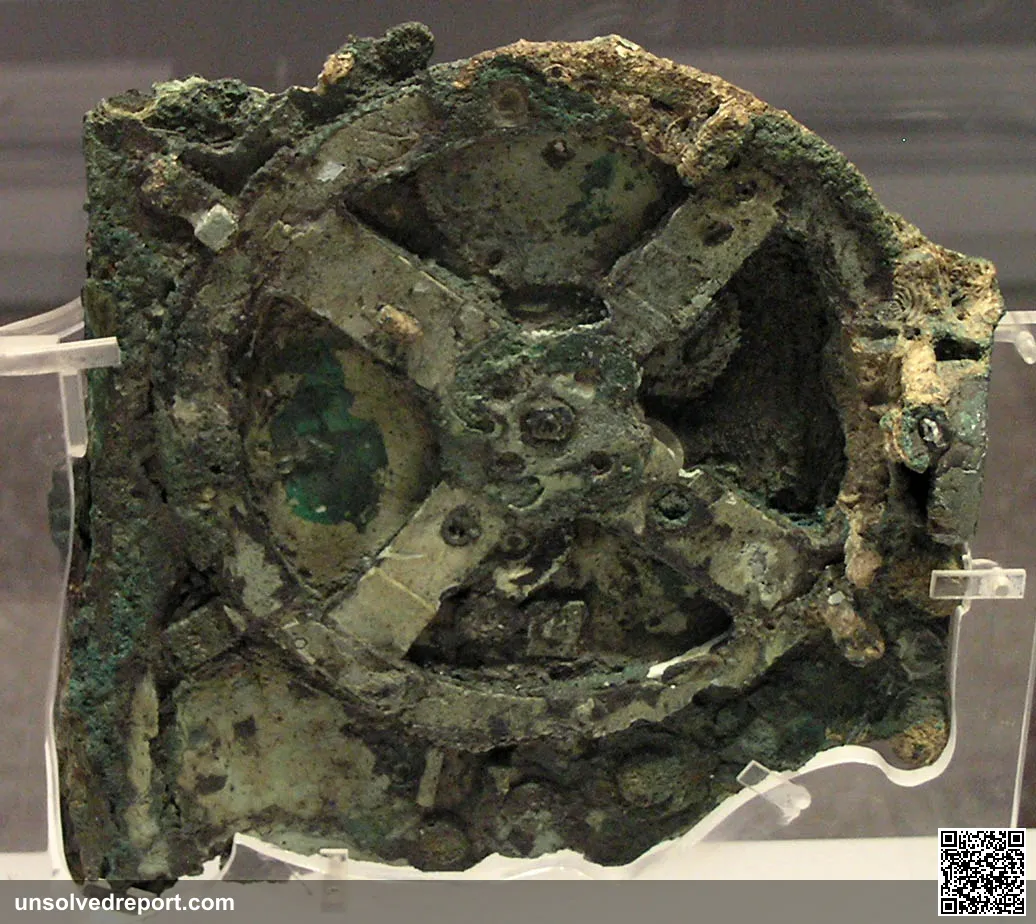
1901. Sponge divers haul a corroded green lump of bronze out of a Roman-era shipwreck off the Greek island of Antikythera. Just a rock, basically. Except it wasn't. Inside that lump were more than thirty interlocking gears, and the thing is now dated to roughly the second or first century BCE.
Here's where it gets uncanny. Modern imaging confirmed what it actually was: the Antikythera Mechanism, a hand-cranked astronomical calculator. Turn the crank, and it tracked the Sun, the Moon, eclipse cycles, and probably the planets. A computer. In bronze. Before Caesar.
And the open question is the part that gives historians chills. How did a machine this sophisticated exist with no ancestors and no descendants? Nothing close to its gearing complexity shows up anywhere in the archaeological record for over a thousand years afterward. It appears, dazzles, and vanishes — as if someone left a smartphone in a Bronze Age tomb and walked away.
2. The Clay Jar That Might Be a Battery
Near Baghdad, in the 1930s, a plain little clay jar turns up in layers tied to the Parthian era — roughly 250 BCE to 224 CE. Inside: a copper cylinder and an iron rod. Boring, right?
Then in 1938, German archaeologist Wilhelm König looked closer and noticed something that stopped him cold. Fit those parts together, add an acidic liquid, and you've basically got a simple galvanic cell — the bones of a battery, capable of producing a small voltage. People built replicas. The replicas made electricity. That's how the nickname stuck.
But picture the scene 2,000 years ago and the holes start to show. No wires. No gadget it was clearly powering. Not one ancient text mentioning anything electrical. So was it ever really a battery? A container for scrolls? Something else entirely? Nobody can say for sure — and that "maybe" has been buzzing for nearly a century.
3. The Bronze Shapes Nobody Can Explain
More than a hundred of them have come out of the ground across what used to be Roman Europe: small, hollow, twelve-sided bronze objects, most from the first through fourth centuries CE. Each one has circular holes of different sizes punched into its faces and little knobs at every corner. Pretty. Precise. Completely baffling.
Here's the strange part. The Romans wrote down everything — and they wrote down nothing about these. No text. No inscription. No drawing. Not a single mention of what the things were for, anywhere.
So the theories pile up. Knitting tools. Surveying instruments. Calendar devices. Dozens of guesses — and not one of them explains every example. These dodecahedra sit in museum cases right now, perfectly real, perfectly silent, daring you to figure out the point of them.
4. The Iron Pillar That Won't Rust
In the Qutb complex near Delhi stands a column of wrought iron more than seven meters tall, forged around the fourth or fifth century CE during the Gupta era. That's about 1,600 years of monsoon rain, blazing heat, and open air beating against it.
And it has barely rusted.
Let that sink in. Most iron left outside for a few decades turns to flaking orange ruin. This pillar has shrugged off sixteen centuries. Metallurgists eventually cracked the "why": an unusually high phosphorus content, which forms a thin protective film across the surface and seals it against decay.
But cracking the why only deepened the how. Ancient smiths had zero understanding of corrosion chemistry — none of the science existed yet. So how did they keep producing and assembling iron this clean, this consistent, at this colossal scale? They built a rustproof monument by feel, and we still can't fully reconstruct the recipe.
5. The Bronze Age Map of the Sky
Dug out of the ground in Germany and tied to a Bronze Age context generally placed in the early second millennium BCE, this bronze disc — the Nebra Sky Disc — is inlaid with gold, and it's often called the oldest known concrete picture of the cosmos that humans ever made.
Look at it and you can read it. There's the Sun, or maybe a full Moon. A crescent. A scatter of stars that seems to include the Pleiades cluster, that tight little smudge of light hunters and farmers have watched for thousands of years.
But the unsettling thing isn't the picture. It's the brains behind it. Features of the disc may actually encode knowledge for reconciling the solar and lunar calendars — serious astronomy, hammered into metal. How did a Bronze Age community work that out, and then record it? Researchers are still arguing. Someone up there was paying very close attention to the sky.
6. The Wooden Bird That Looks Like It Could Fly
Egypt, 1898. Inside a tomb at Saqqara, archaeologists find a small carving of sycamore wood — a bird-like body with outstretched wings spanning about 18 centimeters. It's dated to around the third century BCE.
Most Egyptologists read it the calm way: a ceremonial or symbolic object, maybe a votive figure, maybe a weathervane. And to be clear, tests do not back the wilder claim that it was a working aerodynamic glider. So set that fantasy aside.
Still — look at the shape. It's oddly streamlined, almost like an airfoil, and it's missing a tail feature you'd expect on a normal bird carving. That's what keeps the conversation alive. The real open question is simpler and stranger than "could it fly": what was it meant to be? Because its form looks nothing like the usual bird imagery of its time.
7. The Disc Printed Before Printing Existed
From Crete comes the Phaistos Disc, a disc of fired clay generally dated to the Minoan Bronze Age around the second millennium BCE. Both sides are covered with 241 symbols, marching in a spiral toward the center.
Now here's the detail that should make your jaw drop. Each symbol was pressed in with an individual stamp — the same stamp reused over and over. That makes this little clay disc one of the earliest known examples of movable-type-style printing. Thousands of years before the printing press. Someone in the Bronze Age had the core idea and then... it went nowhere.
The catch? Nobody has convincingly cracked the script. And no other text in the same system has ever turned up — not one. Hymn? Game? Calendar? Shopping list? Completely, maddeningly open. One disc, 241 symbols, and total silence.
8. The "Lightbulbs" on an Egyptian Wall
On the walls of the Hathor temple complex at Dendera in Egypt, there are carved reliefs showing large, bulb-shaped forms. Some popular writers took one look and thought: electric lamps. Ancient Egyptian lightbulbs.
Pump the brakes. Mainstream Egyptologists read the same carvings far more plainly — a lotus flower giving rise to a serpent, an image rooted in creation mythology. No hidden wiring. No lost electricity. And the reliefs themselves are completely real; you can walk up and look at them.
So the genuine puzzle isn't secret technology. It's the imagery itself. This iconography has no close parallel anywhere, and scholars still pitch competing symbolic readings of what it actually means. The mystery was never the lightbulb. The mystery is the picture nobody else ever carved.
9. The Roman Cup That Changes Color
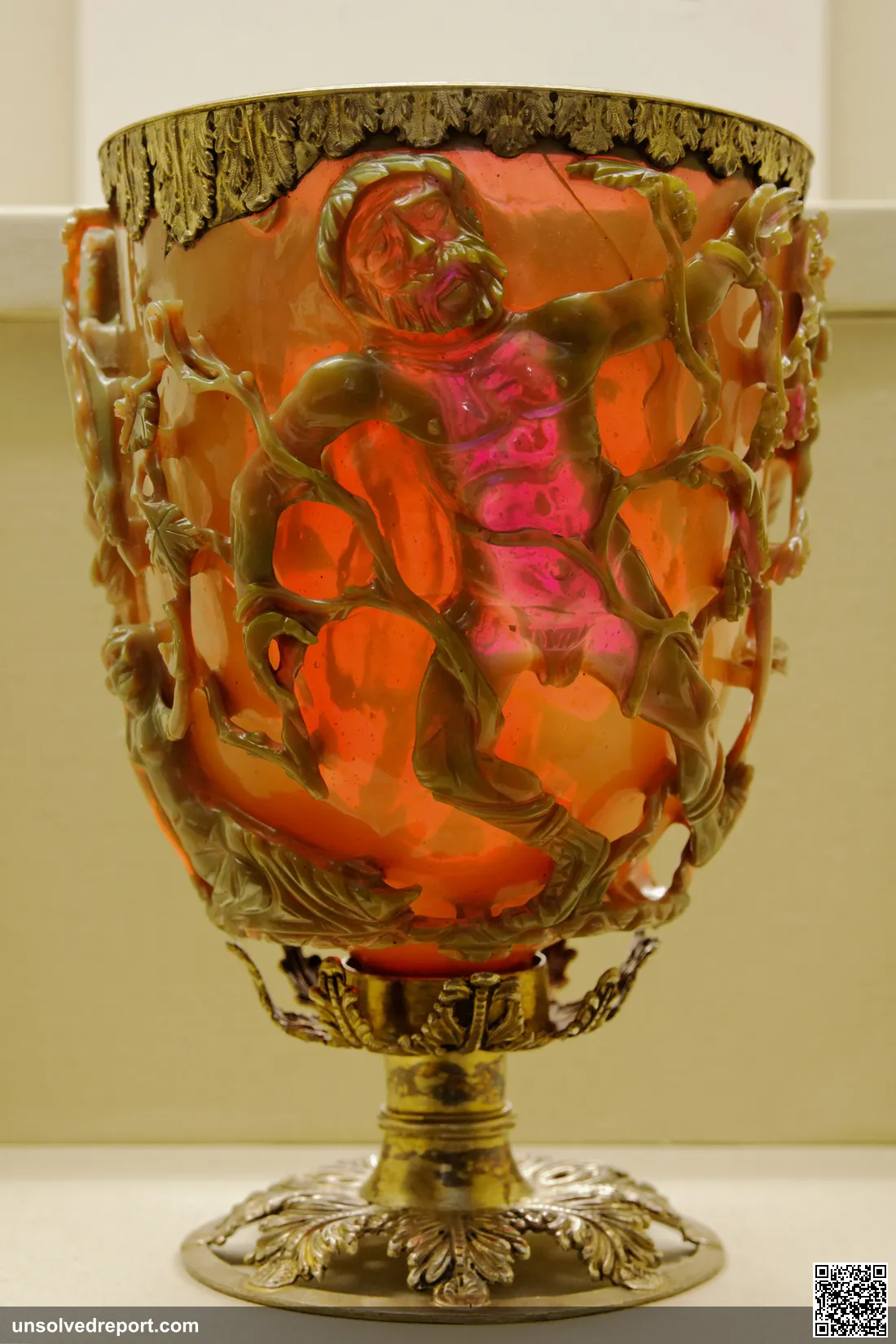
The Lycurgus Cup lives in the British Museum, and it dates to Roman times around the fourth century CE. From the front, lit normally, the glass glows a cool green. But shine a light through it — and the whole cup blushes a deep, glowing red.
Same cup. Two colors. Like a trick.
Modern analysis found the secret hiding inside the glass: tiny embedded particles of gold and silver, only tens of nanometers across. Tens of nanometers. That is, genuinely, an early and astonishing case of nanotechnology — done by hand, in a Roman workshop, more than 1,500 years before anyone had a word for it.
And the mystery is all about intent. Did Roman craftsmen pull off this dichroic effect on purpose, knowing how to repeat it? Or did one of them stumble into it by sheer luck? We don't know — because surviving examples are vanishingly rare. Maybe they were geniuses. Maybe they got lucky once. We can't tell which.
10. The Viking Coin in the Wrong Country
1957. At a Native American archaeological site in Maine — nowhere near any European settlement of the era — a single coin turns up. Out of place doesn't begin to cover it.
It was later identified as the real thing: a genuine Norse silver penny, minted in Norway in the late eleventh century, during the reign of Olaf Kyrre. An authentic Viking coin. On the coast of Maine.
Yes, the Norse reached North America — that's documented at L'Anse aux Meadows. But here's the snag: that site sits far to the north, in Newfoundland. So how did a Viking penny travel all the way down to coastal Maine? Direct contact? Or hand to hand, down long Indigenous trade networks running across a continent? It remains a genuinely open archaeological question — one small silver coin, very far from home.
What Ties Them All Together
None of these ten objects break the laws of physics. None of them need ghosts or gods or visitors from the stars. What they do is something subtler and more thrilling: each one stretches our lazy assumptions about a particular time and place until something cracks. A Bronze Age sky map. Roman nanoparticle glass. A Greek geared computer. Every entry is a reminder that the past was never a slow, steady climb toward us.
It was full of dead ends. Lost knowledge. Lone geniuses who told no one. Craft traditions that flared up bright and then blew out without leaving a manual behind.
And that's exactly why these artifacts reward a sharp eye instead of a gullible one. The best mysteries aren't the ones somebody made up — they're the ones where the facts are rock solid and the gap in our understanding is real and specific. We know exactly what the Antikythera Mechanism does. We just can't explain why it stood alone. We can measure the Iron Pillar's chemistry down to the phosphorus. We still can't fully rebuild the know-how behind it. Holding the hard evidence and the open question in the same hand at the same time — that's the whole pleasure of it.
Every one of these ten deserves its own full case file: the dig records, the lab tests, the rival theories laid out side by side. So pick the one that won't leave you alone. The cup that bleeds red. The bird that almost flies. The computer that should not exist. Then follow the evidence as far as it goes — and see where it stops.
The ten at a glance: what's actually unsolved
Line these ten up and a pattern jumps out — the "mystery" is rarely the same kind of mystery twice. Some objects have a fully explained how and only an unexplained why they stand alone. Some are technically understood but functionally silent — we know what they're made of, not what they were for. And a few carry a popular myth that the evidence has already knocked down, leaving a smaller but genuinely open question underneath. Here is where each one actually sits:
| Artifact | The core open question | Best-supported status | Type of mystery |
|---|---|---|---|
| Antikythera Mechanism | Why does gearing this complex have no ancestors or descendants for ~1,000 years? | Function solved: a geared astronomical calculator; its isolation in the record is unexplained | Orphaned technology |
| Baghdad Battery | Was it ever an electrical cell, or a scroll jar? | Replicas make small voltages, but no wiring, device, or text supports electrical use | Debunked myth, open function |
| Roman dodecahedra | What were the twelve-sided bronze objects for? | 100+ found; no Roman text mentions them; no single theory fits every example | Unexplained function |
| Iron Pillar of Delhi | How did smiths mass-produce such clean, corrosion-resistant iron by feel? | Rust resistance explained (high-phosphorus protective film); the ancient method is not fully reconstructed | Lost know-how |
| Nebra Sky Disc | How did a Bronze Age community encode solar–lunar calendar knowledge? | Widely read as the oldest concrete image of the cosmos; the astronomy behind it is still debated | Precocious knowledge |
| Saqqara Bird | What was the streamlined bird carving meant to be? | Read as ceremonial/symbolic; tests do not support the "working glider" claim | Debunked myth, open meaning |
| Phaistos Disc | What do the 241 stamped symbols say? | An early movable-type-style print; the script is undeciphered and unique | Undeciphered text |
| Dendera "lightbulbs" | What does the unparalleled bulb-and-serpent relief actually depict? | Egyptologists read a lotus-and-serpent creation image, not electric lamps; the iconography has no close parallel | Debunked myth, open meaning |
| Lycurgus Cup | Did Romans make the dichroic effect on purpose and repeatably? | Cause known (nanoscale gold/silver particles); intent unknown because surviving examples are vanishingly rare | Intent unknown |
| Maine penny | How did an 11th-century Norse coin reach coastal Maine? | Coin is authentic; route (direct contact vs. long Indigenous trade networks) is unresolved | Provenance unsolved |
Read down the last column and the ten sort into four honest camps. Three of them — the Baghdad Battery, the Saqqara Bird, and the Dendera relief — are cases where the sensational version (a battery, a glider, an electric lamp) is the weakest-supported reading, and the real puzzle is the quieter one left behind. Two of them — the Antikythera Mechanism and the Lycurgus Cup — are fully explained as objects and unsolved only in context: we can describe exactly what they do and still can't say why nothing like them survives around them. The Iron Pillar and Nebra Disc share a third shape: the science is understood, but the human achievement behind it resists reconstruction. And the dodecahedra, the Phaistos Disc, and the Maine penny are the truly open files — a function, a script, and a route that no evidence has yet closed. That spread is the point of the whole list: none of these needs the supernatural, and not one of them is mysterious in quite the same way as the one beside it.
Sources & further reading

Kaspar Hauser: The Lost Prince DNA Couldn't Name
Kaspar Hauser claimed 16 years locked in the dark, then died from a wound he may have inflicted himself. In 2024, DNA answered one question about the 'lost prince' — but not the one everyone wanted.
Oc Eo Lost City: The Funan Port That Traded With Rome
A farmer's plough hit gold in a Vietnamese rice paddy—then archaeologists found Roman coins buried beside it. What was Oc Eo, and why did it vanish?
The Voynich Manuscript: The Book No One Can Read
The Voynich Manuscript sits in a Yale vault, fully photographed and free to read online — yet in 600 years, not one word has ever been decoded. Why not?