Phaistos Disc: We Have It. We Just Can't Read It.
The Phaistos Disc: 4,000 years old, fully cataloged, completely unread. Every symbol is counted, every theory tested — so why can't anyone crack it?
A summer evening in 1908. An Italian archaeologist crouches in the dirt of a Cretan basement and lifts out a small clay disc, no bigger than a saucer. He has no idea what he is holding. None of us did. More than a hundred years later, the Phaistos Disc still hasn't given up its secret.
And here's the thing that makes it so maddening. We're not missing the disc. We have it. You can stand in front of it, count every mark, photograph every curl of every symbol. We know its exact size, its exact weight, the exact number of signs on it. There is just one small problem: nobody alive can read a single word it says — earning it a permanent spot among the texts and codes nobody on Earth can read. The more you learn about this object, the deeper the silence gets. That gap — total knowledge of the thing, total ignorance of its meaning — is the whole mystery.
What We Actually Know
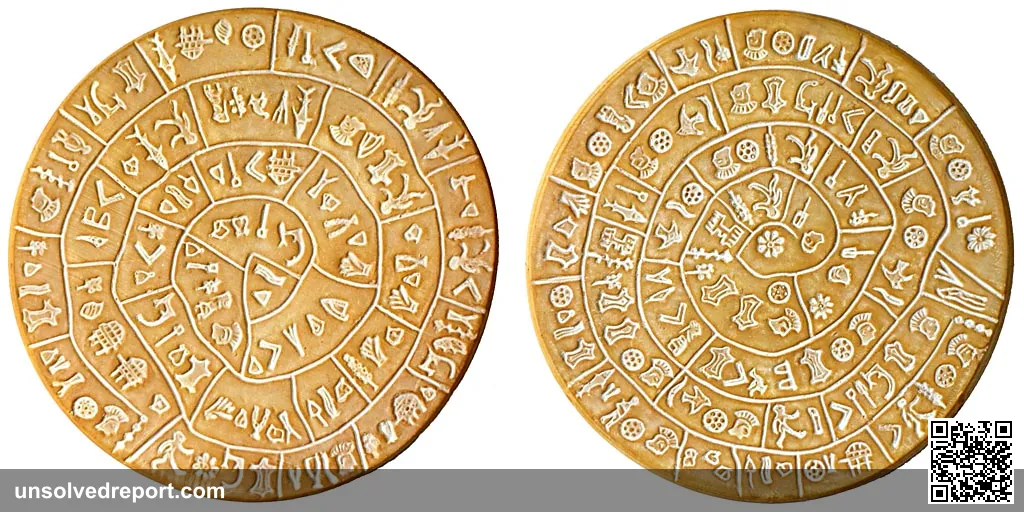
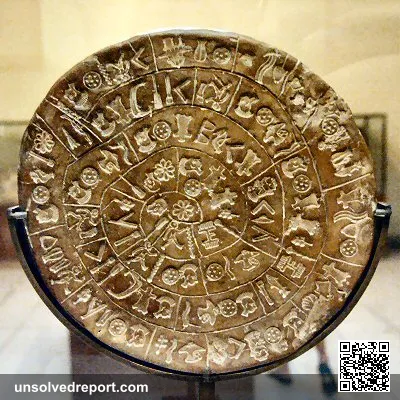
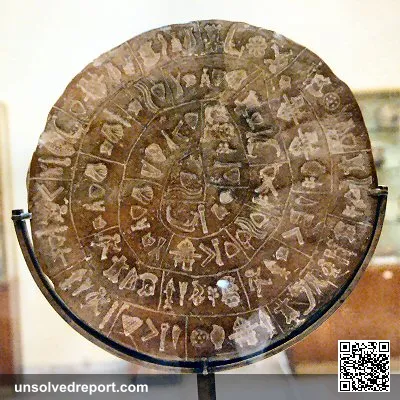
Start with the moment it came out of the ground. July 3, 1908. Italian archaeologist Luigi Pernier pulled the disc from the basement of a room in the Minoan palace complex at Phaistos, on the south coast of Crete (National Geographic; Wikipedia). It's fired clay, roughly 16 centimeters across — about 6.3 inches, so it sits comfortably in two hands — and close to 2 centimeters thick. Slightly egg-shaped. One face dips in a little, the other bulges out a touch (Wikipedia).
Now flip it over in your mind. Both faces are crawling with symbols, and they don't run in tidy lines. They spiral. In total there are 242 sign-impressions — around 123 on one side and 119 on the other — pulled from a set of 45 distinct signs that Sir Arthur Evans later numbered 01 through 45 (Wikipedia; National Geographic). And these aren't abstract scratches. They're little pictures you'd almost recognize: human heads, walking figures, animals, plants, tools, everyday objects. Short vertical lines chop them into 61 clusters — call them "words" — each holding two to five signs (National Geographic).
But the strangest part isn't what the signs are. It's how they got there. Nobody scratched these symbols in by hand, one stroke at a time. Each one was pressed into the soft clay with a pre-made stamp — a punch carved in advance, then used over and over to print identical signs (National Geographic; Live Science). Read that again. Reusable stamps to reproduce the same character again and again. That's why the disc is so often called the earliest known example of movable-type printing — a trick the rest of the world wouldn't stumble onto for roughly three thousand more years.
So how old is it? Honest answer: a range, not a number — because where exactly it sat when it was found is still argued over. The estimates land in the Bronze Age, somewhere in the second millennium BCE. The linguist Yves Duhoux proposed roughly 1850–1600 BCE; other specialists push for later dates; and popular accounts love to cite a round figure around 1700 BCE (Wikipedia; National Geographic). Whatever the year, you can go see it for yourself today — it lives in the Heraklion Archaeological Museum on Crete (National Geographic).
Two last details, and they matter, because both pour fuel on the fire. First: the scribe made mistakes. Look closely and you can spot signs that were smoothed away and re-stamped — corrections, in clay, four thousand years old (Wikipedia). Someone cared enough to fix this thing. Second: this script appears almost nowhere else on Earth. A handful of signs look like marks on a bronze double-axe found in a cave at Arkalochori, and a few faintly echo Crete's other Bronze Age writing — but the disc's full set of signs is, for all practical purposes, one of a kind (Live Science).
Why It May Never Be Cracked
Let's be blunt about where things stand. Nobody knows what the Phaistos Disc says. And there are real, hard reasons to suspect nobody ever will, not for certain.
The first wall is simply size. The pioneering script analyst Alice Kober pointed out the brutal math: the disc gives you only 241 or 242 sign-instances spread across 45 different signs — a laughably tiny sample for anyone trying to break a code (Biblical Archaeology Society). Aegean-scripts specialist Thomas G. Palaima of the University of Texas at Austin put it flatly: "very little can be done with it at present." Linguist Elizabeth Barber drives the same nail in — there is simply "not enough statistical information" to prove or disprove any reading anyone proposes (Biblical Archaeology Society). You can't crack a cipher from a single index card of text.
The second wall is worse. Even if we had more text, we wouldn't know the language. Crete had two related scripts — Cretan hieroglyphic and Linear A — and both are still undeciphered to this day, in the same club as holdouts like the Indus Valley script and Easter Island's Rongorongo. Only Linear B, which turned out to spell an early form of Greek, has ever been cracked (National Geographic). And there's no Rosetta Stone here — no bilingual text pairing the unknown words with a known language, the way that famous slab unlocked Egyptian hieroglyphs. Picture it this way: the disc is one short, unique sentence, written in a one-of-a-kind alphabet, in a language nobody has spoken for thousands of years. Three locked doors, and not a single key.
There's one more thread we have to pull, in fairness. Some have questioned whether the disc is even real — the same accusation that has long dogged other undeciphered curiosities like the Voynich Manuscript. Antiquities dealer Jerome M. Eisenberg argued back in 2008 that the whole thing is a modern forgery. Most archaeologists don't buy it. They point to those in-clay corrections — a weirdly elaborate detail to fake — and to the signs that match the Arkalochori axe, which wasn't even discovered until decades after the disc came to light (National Geographic; Live Science). How do you forge a match to an artifact that hasn't been dug up yet? The consensus says: you don't. It's real.
So What Could It Say?
Everything from here on is interpretation, not fact. No one has reached agreement on any of it — so treat each idea below as a guess, however clever.
Maybe it's a prayer. One popular guess reads the disc as a hymn or sacred text, perhaps dedicated to a Minoan mother goddess. Linguist Gareth Owens, working with phonetician John Coleman, has argued he can read much of it that way, proposing words such as a term for a "great lady" (National Geographic; GreekReporter). It's a romantic idea — a 4,000-year-old prayer waiting to be heard. But mainstream specialists wince. Brent Davis of the University of Melbourne notes that Owens borrows sound-values from Linear A — which is itself undeciphered, with only shaky guesses for its sounds — and then assumes that signs which look alike must sound alike, an assumption other scripts flatly break (Biblical Archaeology Society). Build a reading on guesses stacked on guesses, and the whole tower wobbles.
Maybe it's not the language we think. Researcher Gia Kvashilava has proposed the text is an early Georgian-related language, again dedicated to a fertility goddess. Like the goddess-hymn idea, it hasn't won the field over (National Geographic).
Or maybe it's something much more ordinary. Because the signs repeat in patterns, some have wondered whether the disc is an astronomical or lunisolar calendar, a board game, or just paperwork — a decree, an inventory, an administrative list (National Geographic; Live Science). Imagine spending a century chasing a sacred riddle only to find out it was a shopping list.
What every serious voice shares, in the end, is humility. The disc might be a hymn. It might be a contract, a list, a story. But with one short inscription, a lost language, and no key, the most honest thing anyone can say is this: the code from Crete still keeps its secret. And there's something quietly beautiful in that — a voice four thousand years old, still talking, still patient, still waiting for the one person who will finally understand. Maybe that person hasn't been born yet. Maybe it's you.
Sources & Further Reading
- National Geographic — "This ancient script has remained unsolved for over a century": https://www.nationalgeographic.com/history/article/phaistos-clay-disk-minoans-mystery
- Live Science — "Phaistos Disk: inscriptions from Crete that have never been deciphered": https://www.livescience.com/archaeology/phaistos-disk-3-000-year-old-inscriptions-from-crete-that-have-never-been-deciphered
- Biblical Archaeology Society — "Phaistos Disk Deciphered? Not Likely, Say Scholars": https://www.biblicalarchaeology.org/daily/archaeology-today/phaistos-disk-deciphered/
- Wikipedia — "Phaistos Disc" (with cited dating and sign-count scholarship): https://en.wikipedia.org/wiki/Phaistos_Disc
- GreekReporter — "Has the Mystery of the Ancient Phaistos Disc Been Solved?": https://greekreporter.com/2026/02/01/phaistos-disk-mystery/
Niya: The Silk Road Town the Desert Ate Alive
Niya ruins: a Silk Road town frozen mid-life in the Taklamakan Desert—houses standing, letters still legible after 1,700 years. So why did everyone just... walk away?
9 Megalithic Sites Nobody Can Fully Explain
Stones too heavy, too precise, too ancient. From Gobekli Tepe to Baalbek, here are 9 megalithic sites that still leave the experts genuinely stumped.

Nan Madol: The 750,000-Ton Stone City Nobody Can Explain
90+ man-made islands, no mortar, no metal tools, 750,000 tons of basalt stacked on a coral reef. Who built Nan Madol — and how did they actually move the stone?