Nan Madol: The 750,000-Ton Stone City Nobody Can Explain
90+ man-made islands, no mortar, no metal tools, 750,000 tons of basalt stacked on a coral reef. Who built Nan Madol — and how did they actually move the stone?
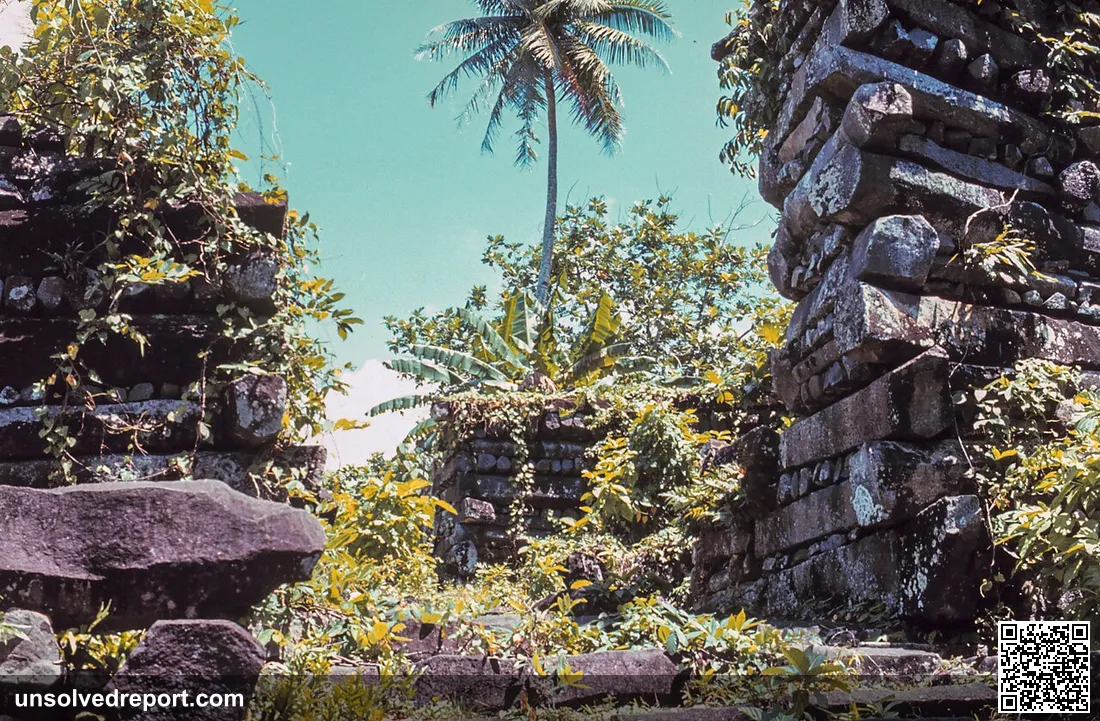
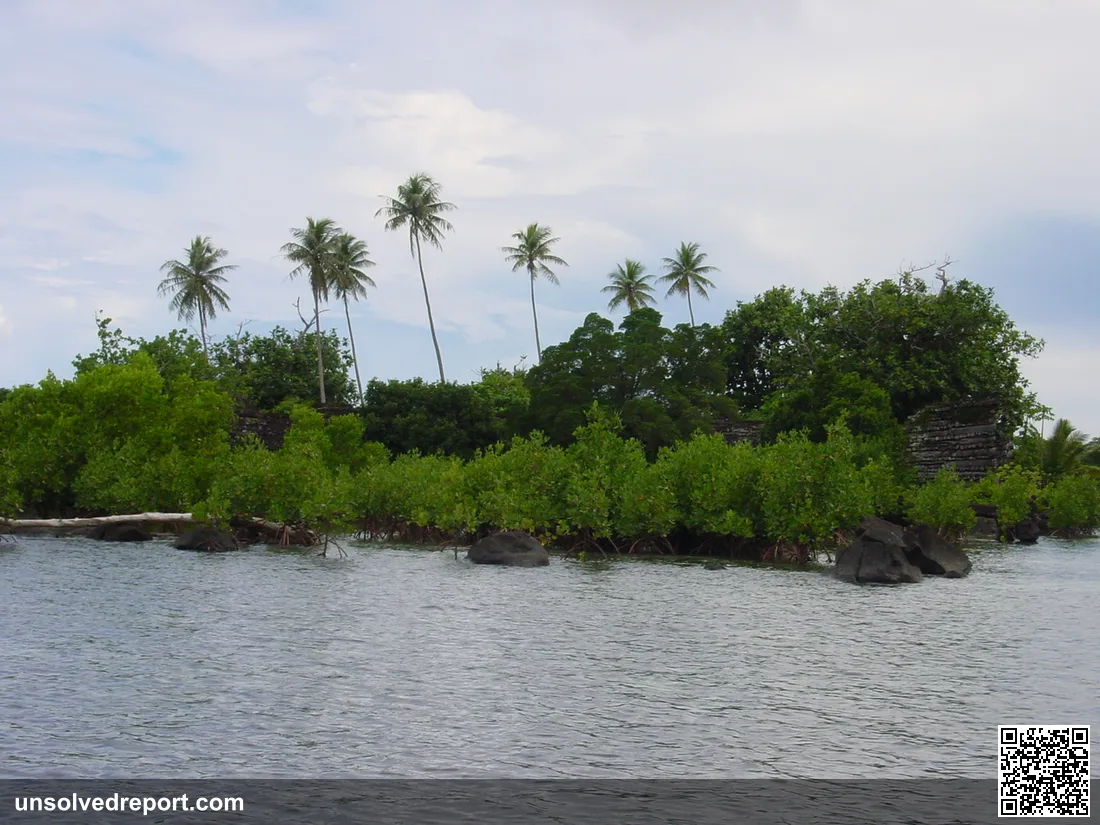
Push through the jungle on the eastern edge of Pohnpei, a green volcanic island in the Federated States of Micronesia, and the trees suddenly stop. In front of you is a thing that has no business being there: a whole city of man-made islands, sliced apart by tidal canals, its walls built from giant logs of black volcanic stone stacked like firewood. Roughly ninety of these islets sit in the open lagoon, raised on a living coral reef. Some walls climb several meters into the air. And here's the part that should give you chills — not a drop of mortar holds any of it together, the same dry-stone trick that keeps the walls of Great Zimbabwe standing a continent away. It has stood for some eight centuries while the Pacific hammered at it. The locals call it Nan Madol, and there is nothing else like it: the only ancient city on Earth built right on top of a coral reef.
People call it the Venice of the Pacific. And like Venice, it slaps you with one obvious question the second you lay eyes on it: why would anyone build a stone city out on the water — and how on earth did they pull it off?
The parts we can actually prove
Let's get the solid ground out of the way first, because there's plenty of it. According to the Wikipedia entry on Nan Madol, the complex sits off Temwen Island in the Madolenihmw district of Pohnpei. The name means, roughly, "within the intervals" — a nod to the canals that slice between the islets. There are about 92 of these artificial islets, each one a platform of stone and coral fill, ringed by tidal canals. The whole core sprawls across an area of about 1.5 by 0.5 kilometers.
Now the headline: the building material. The walls are made of columnar basalt — long, naturally many-sided prisms of volcanic rock that form when certain lavas cool slowly. Add it all up and the total stone runs into the hundreds of thousands of tons, the number most often quoted being around 750,000 tons. All of it was quarried from volcanic outcrops elsewhere on Pohnpei and somehow dragged out to the reef. Some single stones weigh several tons. The heaviest are estimated far higher.
The jewel of the whole place is Nandauwas, the royal mortuary islet. Its outer walls reportedly rise somewhere between 5.5 and 7.5 meters, wrapped around a central tomb. This was never a sleepy village. It was a place of the dead, and of power.
It's worth pausing on the basalt itself, because the rock practically wrote the engineering plan. When a thick lava flow cools slowly and contracts, it cracks into long prismatic columns — often five- or six-sided — the same way a drying mud puddle splits into polygons, except on a colossal scale and in three dimensions. In other words, nature pre-cut the building blocks. The builders of Nan Madol didn't have to chisel out neat rectangular blocks the way Egyptian or Inca masons sweated to do. They harvested ready-made stone beams and stacked them in alternating header-and-stretcher courses, crisscrossing the columns like the logs of a log cabin so the walls locked themselves together — no mortar required. It's a beautifully clever use of a gift the local geology happened to leave lying around.
Who built it, and when
Here's where Nan Madol breaks the rules of a proper "unsolved mystery": we actually have a pretty good answer. It's anchored in hard dating and in oral tradition.
Nan Madol was the ceremonial and political capital of the Saudeleur dynasty — a line of rulers who pulled all of Pohnpei's population, estimated at around 25,000 people, under a single thumb. They held that power for roughly five centuries. Then, around 1628, according to Pohnpeian tradition, a warrior named Isokelekel overthrew the last Saudeleur and tore the whole order down to start a new one.
And the timeline isn't just storytelling. The physical dating backs it up. Radiocarbon and uranium-thorium dates show monumental construction at Nan Madol kicking off around AD 1180, with serious building rolling on into the early 1600s — even though people had been busy on the site long before that. Sit with that for a second. This is a medieval city by the world's clock. While stonemasons in Europe were raising Gothic cathedrals, Pacific Islanders were assembling a stone capital on a reef.
The world agrees it matters. Nan Madol was named a U.S. National Historic Landmark in 1985 and inscribed as a UNESCO World Heritage Site in 2016 — where, in the same breath, it was added to the List of World Heritage in Danger, threatened by silt clogging the canals and mangroves creeping in to swallow it.
That medieval date deserves a spotlight, because it flips the whole story. Nan Madol isn't some relic from the dawn of time. It's a contemporary of the high middle ages everywhere else. While masons in Europe were finishing cathedrals and the kings of Cambodia were extending Angkor, a Pacific Island dynasty was raising a stone capital on a reef. Look at it that way and Nan Madol stops being a freak anomaly. It becomes a striking local answer to the same worldwide medieval urge — toward big, centralized, monument-building states — just built with a completely different toolkit.
The real riddle: how did they move the stone?
Here's the question that actually keeps experts up at night. It's not magic. It's logistics.
How does a society with no metal tools, no draft animals, no wheels — the same missing-wheel puzzle that haunts the builders of Ġgantija — and no pulleys quarry hundreds of thousands of tons of heavy basalt, haul it across an island, float it out onto a reef, and then stack it into walls taller than a house?
The honest answer: nobody knows for certain. But the leading, evidence-based ideas all lean on low-tech methods we understand perfectly well:
- Rafting the columns by sea. Basalt is brutally heavy on land — but lash it to rafts or canoes and float it at high tide, and a giant stone suddenly becomes far easier to handle. Ferrying the columns around the coast by raft is the explanation most researchers favor.
- Levering and sliding the columns up inclined ramps or palm-log rollers, building the walls up one course at a time.
- And sheer, organized muscle, sustained over generations — a coordinated workforce under a powerful central authority. Which is exactly the kind of society the Saudeleur dynasty was.
No single method has been nailed down by excavation, and hands-on experimental archaeology at the site has been limited. So the "how" stays partly open. But make no mistake: this is an engineering puzzle, not a supernatural one.
Let's get concrete about just how big the challenge was, because the scale is what turns this from a shrug into a genuine head-scratcher. Some of those basalt columns are estimated at several tons each, and a few of the biggest weigh far more. Pohnpei is dense forest and steep mountains, with no navigable rivers running down to the quarry sites — so hauling overland would have meant dragging multi-ton logs of stone straight through the jungle. The sea route around the coast makes far more sense, and it fits a culture of expert canoe builders and navigators — the same seafaring know-how that lets some researchers argue Easter Island's moai actually "walked" to their platforms rather than being dragged. But even rafting heavy basalt has its limits. A raft has to displace enough water to float its load, and losing a stone overboard in the lagoon could be a disaster. Skeptics make a fair point, too: nobody has mapped a big graveyard of dropped or failed stones along any obvious sea route — which leaves the exact method wide open, and waiting for someone to figure it out.
What the old stories say
Pohnpeian oral history has its own version of events, and it deserves a seat at the table — even where it isn't literal fact. The tradition says two brothers, the sorcerers Olosohpa and Olosihpa, arrived to build a place of worship, and that they raised Nan Madol with magic, flying the great stones through the air with the help of a dragon.
Stories of floating, levitating stones turn up at megalithic sites all over the world, and they usually carry a real memory buried inside them: that the work was so far beyond ordinary human effort, only extraordinary power could possibly explain it. The myth isn't a blueprint. It's a measure of how jaw-dropping the achievement looked to the people who saw it.
The oral tradition also holds onto something no shovel can dig up — the meaning of the place. Pohnpeian accounts cast Nan Madol as a sacred center, a seat of priests and rulers where the living and the ancestral dead were kept side by side. The layout itself backs this up: islets reportedly set aside for specific jobs — food preparation here, canoe building there, the keeping of sacred eels, and the burial of the elite at Nandauwas. Read the stone city through these stories and a heap of basalt turns back into a living political and religious landscape. It's a reminder that the descendants of its builders still carry knowledge about this site that no excavation alone could ever recover.
What this is NOT
Naturally, Nan Madol attracts the usual fringe crowd — claims that it's impossibly ancient, the leftover of a sunken continent like the mythical Mu or Lemuria, the handiwork of a lost global super-civilization, or, of course, visitors from somewhere else — the same reflex that fuels endless debate over the Yonaguni Monument beneath the waves off Japan. The dating evidence flattens the "impossibly old" idea on contact: the monumental city is medieval, built between roughly the 12th and 17th centuries. And handing the credit to outsiders does a genuine disservice to the Pohnpeian people, whose ancestors demonstrably planned it, organized it, and built it with their own hands. This is a triumph of Pacific Islander engineering and statecraft. It doesn't need a lost continent to be astonishing.
Why it still matters
Nan Madol quietly demolishes an old, snobbish assumption — that monumental architecture only ever sprang up in a tiny handful of "cradle" civilizations. Here, on a remote Pacific island, a centralized society marshaled enormous resources to build a ceremonial capital on the water, complete with a royal necropolis, and did it without a single one of the technologies we usually treat as prerequisites. The mystery was never who, or whether. It's exactly how — and that question still has experimental archaeologists scratching their heads today.
The bottom line
Nan Madol is a real ancient wonder with a known builder — the Saudeleur dynasty — and a solid medieval date. The legitimate open question is the engineering one: how its builders quarried and moved hundreds of thousands of tons of basalt with almost no technology. It's a puzzle of logistics and labor. Not lost continents. Not aliens. Just a question we haven't fully cracked — yet.
Sources & further reading
- Wikipedia - Nan Madol - https://en.wikipedia.org/wiki/Nan_Madol
- UNESCO World Heritage Centre - Nan Madol: Ceremonial Centre of Eastern Micronesia - https://whc.unesco.org/en/list/1503/
- Pohnpei State Historic Preservation Office - Nan Madol Site - https://hpo.pohnpeistate.gov.fm/nan-madol-site/
- Smithsonian Magazine - The Mysterious Stone City of Nan Madol - https://www.smithsonianmag.com/history/nan-madol-ancient-city-built-coral-reef-180962279/
- All That's Interesting - 33 Photos Of Nan Madol, The Ancient Micronesian City Built Atop A Coral Reef - https://allthatsinteresting.com/nan-madol
Derinkuyu: The 18-Story City Hidden Behind a Basement Wall
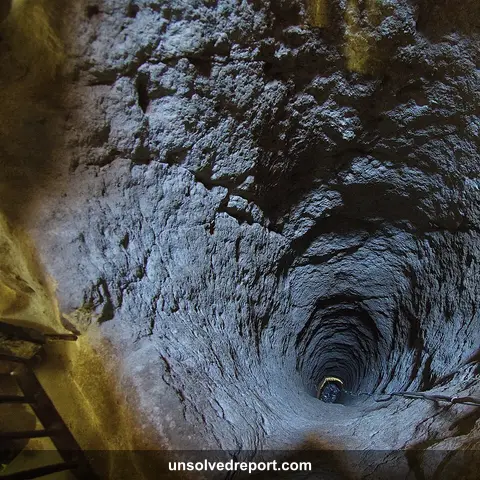
A Turkish man smashes a basement wall and cold air pours from the rock: a city plunging 85m down, built to hide 20,000 people. Who really carved Derinkuyu?
Newgrange Winter Solstice: The Trap Built to Catch One Sunrise
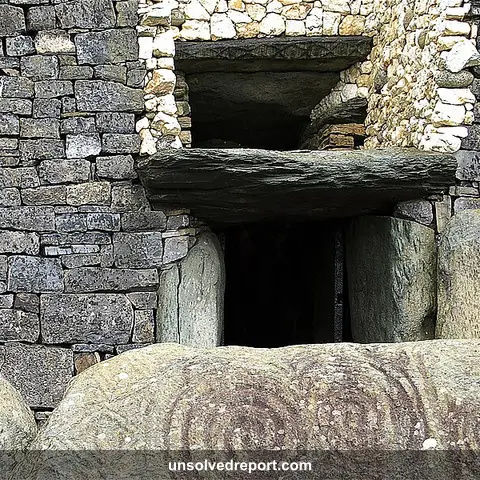
Newgrange traps a single sunrise inside a 5,000-year-old Irish tomb through a secret slot called the roof box. How did Stone Age farmers pull it off?

Royal Cache: The Cliff Tomb That Hid 50 Pharaohs
A goat chase uncovered 50 lost pharaohs stacked in one hidden shaft. Inside the Royal Cache: who moved the kings, and the question still unanswered.