Royal Cache: The Cliff Tomb That Hid 50 Pharaohs
A goat chase uncovered 50 lost pharaohs stacked in one hidden shaft. Inside the Royal Cache: who moved the kings, and the question still unanswered.
A goat went missing. That's how the story goes, anyway. Sometime around 1871, a man from the village of Qurna scrambled up the cliffs above Deir el-Bahari, chasing a runaway animal, and stopped dead at the mouth of a hole in the rock. He looked down. He did not find his goat. He found a corridor packed with coffins—and inside those coffins lay some of the most powerful kings who have ever lived. Pharaohs who had been dead for three thousand years. Empire-builders. Conquerors. All of them stacked together in one cramped little cave like library books shoved back onto a single shelf.
How do the men who ruled the ancient world end up sharing one anonymous grave? Three thousand years later, we still can't fully answer that.
What we actually know
Let's start with the solid ground. The tomb has a dull modern label: TT320 (it used to be called DB320). It sits in the cliffs of the Theban Necropolis near Deir el-Bahari, just across the Nile from modern Luxor. And here's the first surprise—it was never meant for kings at all. It was a family tomb. According to the British Museum and Wikipedia's sourced overview, the place was originally cut as the resting spot of Pinedjem II, a Twenty-first Dynasty High Priest of Amun, along with his wife Neskhons and a few close relatives (Wikipedia, "Royal Cache").
Then, at some point, that quiet family tomb turned into a hiding place.
By the time it was officially opened in 1881, it held the remains of more than 50 kings, queens, and royal family members of the New Kingdom (National Geographic). And the guest list is staggering. Read it slowly. Among the pharaohs crammed into that shaft were Seqenenre Tao of the Seventeenth Dynasty; Ahmose I, Amenhotep I, and Thutmose I, II, and III of the Eighteenth; Ramesses I, Seti I, and Ramesses II of the Nineteenth; and Ramesses III and Ramesses IX of the Twentieth (Wikipedia, "Royal Cache"). That's not a tomb. That's a roster of legends.
But none of them were born to lie here. Every single king had been carried in from somewhere else. They were moved. A 2021 peer-reviewed study in Frontiers in Medicine, which CT-scanned the mummy of Amenhotep I, says it flat out: "the officials of the 21st Dynasty hid the mummies of several New Kingdom kings" at the Deir el-Bahari cache, and the inked notes scrawled on the coffins—hieratic dockets—"recorded the rewrapping of the mummy after being damaged by grave robbers" (Saleem & Hawass, Frontiers in Medicine, 2021).
Here's the eerie part. That same scan showed Amenhotep I had been rewrapped twice by Twenty-first Dynasty priests—once under the High Priest Pinedjem I, then again about a decade later under his son Masaharta. Imagine the care of it: fractured bones splinted with resin-soaked linen, amulets lifted out and set back exactly where they belonged. These weren't grave robbers in a hurry. These were people working with files. Officials labeled the coffins, noted the dates, and tracked where each body had been and where it was going next. The reburials were a real, recorded operation.
The rediscovery is a story all its own—and it's a good one. Members of the local Abd el-Rassul family found the tomb around 1871, and for about ten years they kept it secret, quietly selling treasures out of it on the Luxor antiquities market, one piece at a time (Wikipedia, "Royal Cache"). It was a near-perfect heist. The problem? When museum-quality royal objects start showing up for sale, people who know better start asking questions. The Antiquities Service got suspicious.
The director, Gaston Maspero, happened to be away in France, so the case landed on his assistant Émile Brugsch and the Egyptian Egyptologist Ahmed Kamal. Then a family argument cracked everything open: in 1881, Mohammed Abd el-Rassul gave up the location. On July 6, 1881, Brugsch climbed down into the shaft (the-past.com). What followed was less excavation than evacuation. The whole tomb was emptied in roughly 48 hours, and the mummies and thousands of funerary objects were loaded onto boats and sent downriver to the Bulaq Museum in Cairo (National Geographic)—not far from where an entire Egyptian port city had already slipped beneath the sea.
And it turns out this wasn't even the only hideout. In 1898, Victor Loret found a second royal cache—this one tucked inside the tomb of Amenhotep II (KV35) in the Valley of the Kings, with nine more relocated royal mummies, among them Thutmose IV, Amenhotep III, Merenptah, and several Ramesside kings (Wikipedia, "KV35"). The priests, it seems, had more than one secret address, and Egypt is still turning up new ones—elsewhere, the hunt for Cleopatra's tomb has run two decades without finding her. Many of the Deir el-Bahari kings have since moved one final time, to the National Museum of Egyptian Civilization, carried there in the televised 2021 Pharaohs' Golden Parade (Wikipedia, "Pharaohs' Golden Parade").
The question nobody can answer
So we know an enormous amount. And yet the one thing that matters most stays locked.
We know the kings were gathered. We know who ordered some of the moves, and roughly when. The dockets are right there, written in ink. But they never say why. Why bring dozens of pharaohs together into one obscure cliff? What were the priests actually thinking?
Picture it from their side. Was this a rescue—loyal priests sneaking their honored ancestors out of harm's way during a dangerous, chaotic age? Or was it something colder, something with a hand in the king's gold? The inscriptions record every movement and rewrapping in patient detail. On the matter of motive, they go completely silent. That silence—the gap between what the priests did and why they did it—is the real mystery. Everything else is just set dressing.
So why did they do it?
Theory one: they were saving the kings. This is the oldest explanation, and it fits the evidence best. By the late New Kingdom, Egypt was fraying—weak central power, money troubles, and a documented epidemic of tomb robbery. We even have the receipts: the famous tomb-robbery papyri show that looting of royal burials in western Thebes had gotten completely out of hand (HubPages/Owlcation summary of scholarship). So the priests did the sensible thing. They pulled the kings out of their fancy, target-rich tombs and tucked them into one plain, hidden, easy-to-guard shaft. And the tender rewrapping we see in the Amenhotep I scans? On this reading, that's exactly what it looks like: respect.
Theory two: they were also robbing them. Here's where it gets uncomfortable—and to be clear, this is interpretation, not proven fact. A number of scholars now argue that the great reburial project may have doubled as a quiet payday for the priests themselves. The logic is hard to shake. The High Priests of Amun basically ruled southern Egypt, and they piled up astonishing wealth during exactly this period. Opening royal bodies, "restoring" them, and reburying them gave someone the perfect cover to pocket the gold, the amulets, and the precious fittings from the original tombs (Owlcation). And there's a tell. Officials were obsessive about getting the right name onto each mummy—but weirdly relaxed about whether a king ended up in his own coffin. Why the mismatch? Maybe because the valuable original coffins had already walked off somewhere. It's a damning pattern. It's also still just a theory, not a verdict.
Theory three: both, at once. Most Egyptologists settle somewhere in the middle, and honestly, that's where the smart money sits. The same operation could have been a heartfelt effort to protect revered ancestors and a sanctioned cleanup of recyclable royal gold during a broke and desperate age. To a priesthood that saw itself as the rightful keeper of both the dead and their treasure, saving the bodies and reclaiming the gold wouldn't have felt like a contradiction at all. It would have felt like good stewardship.
And the goat? One last thing, with a soft asterisk. That charming goat-down-the-shaft story—the one that opens nearly every telling of this tale, including this one—is folklore. The Abd el-Rassul family told it, and later told it different ways, and historians treat the goat as a lovely legend rather than something that actually happened. What's documented and certain: the family found the tomb, made money off it for years, and finally gave it up in 1881. The goat is optional. The pharaohs are not.
Whatever the priests were really after, the ending lands like a riddle. A cliff so humble it was nearly forgotten became the safest address in all of Egypt—the one place where kings who could no longer protect themselves were, at the very last, kept together. And if there were two caches, and the priests guarded their secrets this well, you have to wonder what else is still waiting in the rock above the Nile, the way a 100-foot void still waits inside the Great Pyramid.
Sources & further reading
- Wikipedia, "Royal Cache" (TT320/DB320): https://en.wikipedia.org/wiki/Royal_Cache
- Saleem SN & Hawass Z, "Digital Unwrapping of the Mummy of King Amenhotep I," Frontiers in Medicine (2021), peer-reviewed: https://pmc.ncbi.nlm.nih.gov/articles/PMC8748262/
- National Geographic, "Inside the Royal Cache": https://www.nationalgeographic.com/premium/article/mystery-mummies-pharaoh-tomb-ancient-egypt
- The Past, "The Royal Cache at Deir el-Bahri, 1881": https://the-past.com/shorts/the-picture-desk/the-royal-cache-at-deir-el-bahri-1881/
- Wikipedia, "KV35" (second royal cache, 1898): https://en.wikipedia.org/wiki/KV35
- Wikipedia, "Pharaohs' Golden Parade" (2021): https://en.wikipedia.org/wiki/Pharaohs%27_Golden_Parade
- Owlcation/HubPages, "The Royal Cache of Deir el-Bahri: Priests as Tomb Robbers" (overview of scholarly debate): https://owlcation.com/humanities/Royal-Cache
Oxus Civilization: The Bronze Age Empire With No Name
Oxus Civilization (BMAC): a lost Bronze Age empire dug from the desert sand. It traded across Asia, left no name or writing behind. So who were they?
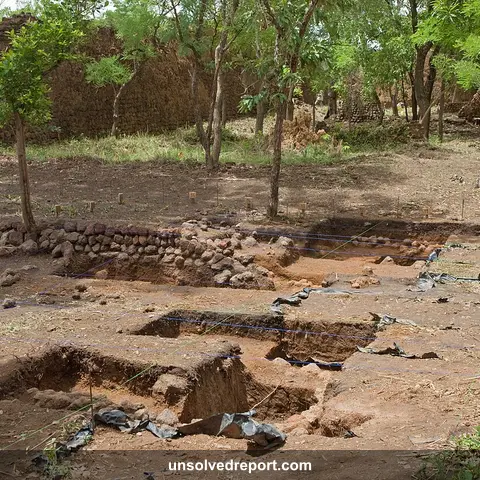
Loropéni Ruins: The 6-Meter Fortress With No Door In or Out
A six-meter stone fortress in Burkina Faso has no door, no known builder, and most of it has never been dug up. So how did anyone get inside Loropéni?
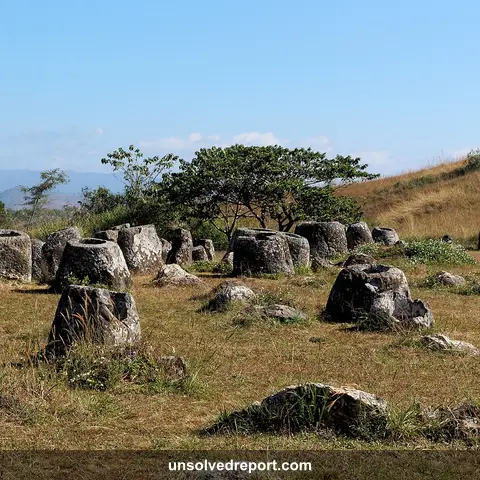
Plain of Jars: 3,000 Stone Vessels Nobody Can Explain
Plain of Jars: thousands of stone vessels, no inscriptions, no tools, no known builders. 2021 dating tests only made the mystery stranger. Here's why.