Loropéni Ruins: The 6-Meter Fortress With No Door In or Out
A six-meter stone fortress in Burkina Faso has no door, no known builder, and most of it has never been dug up. So how did anyone get inside Loropéni?
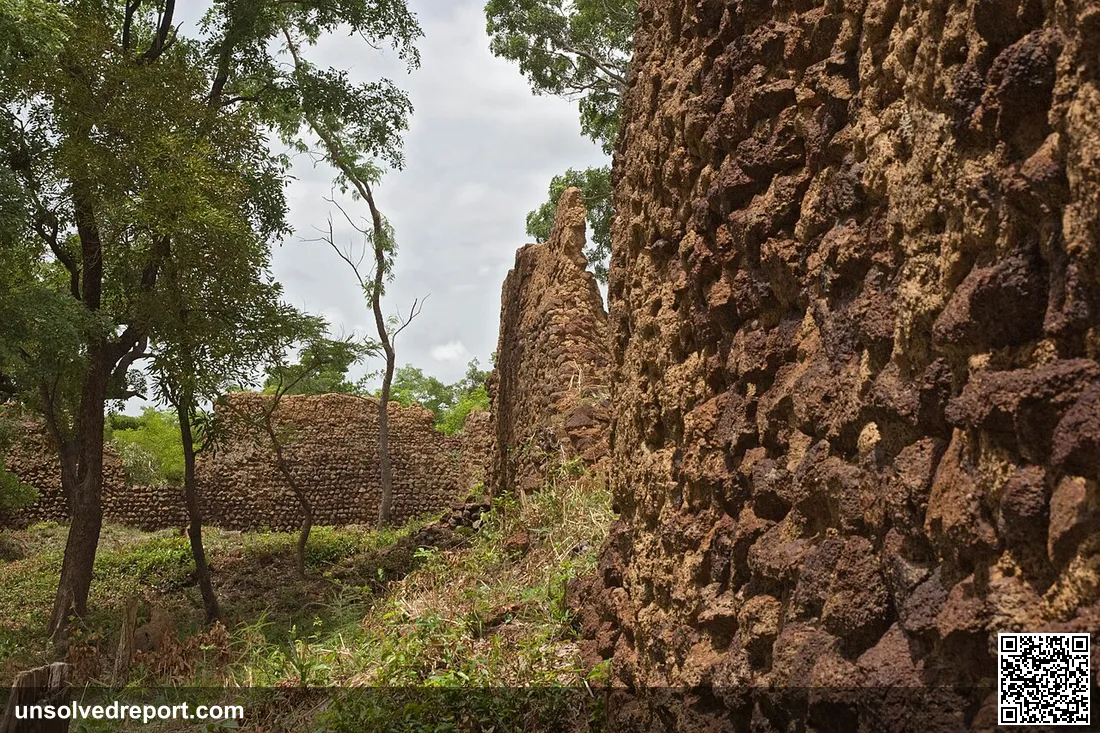
A wall of stone rises out of the trees. Not a low garden wall — a curtain of laterite about six meters tall, taller than two grown adults stacked head to foot, and more than a meter thick. You're in the wooded savanna of southwestern Burkina Faso, about 40 kilometers from the town of Gaoua, and this thing bends in a hard square, sealing off a hushed interior of collapsed rooms and broken partitions. This is Loropéni, the best-preserved of a scattered family of stone fortresses in West Africa. In 2009 it became the first site in all of Burkina Faso ever written into the UNESCO World Heritage List (UNESCO World Heritage Centre).
Now here's the strange part. The experts who study it will tell you, flat out, that they don't know what they're looking at. "We don't know who constructed the ruins of Loropéni, why they were made, nor when they were built," archaeologist Lassina Simporé told French science outlet CNRS (CNRS News). A monument this big, this carefully made — and three of the simplest questions you could ask about it come back blank.
What We Actually Know
Let's stand on solid ground first, because the solid ground is impressive enough. The wall runs in a quadrangle of local laterite stone, wrapping around roughly 11,000 square meters — about 2.5 acres of ground. In places it climbs to about six meters high and runs around 1.2 meters thick (UNESCO; African World Heritage Sites). The stones were fitted together by hand, and here and there someone smoothed them over with mud plaster.
And Loropéni isn't alone. It's the best preserved of about ten such fortresses in the Lobi region — and those ten belong to a much bigger crowd of roughly 100 stone enclosures scattered across the land near where the borders of Côte d'Ivoire, Ghana, and Togo run today (UNESCO). A hundred stone strongholds, dotted across the bush, echoing other dry-stone African fortifications like Great Zimbabwe and Khami further south. Archaeologists read them all as the physical fingerprint of one thing: the trans-Saharan gold trade.
How old? Older than you'd guess — and recent digging has shoved the date back hard. Radiocarbon results from the excavations point to the walled enclosure reaching back at least to around the 11th century AD. That's at least a thousand years old. The settlement hit its peak, its apogee, somewhere between the 14th and 17th centuries (UNESCO; African World Heritage Sites). During that golden stretch, the wider settlement is tied to the Lohron (or Lorhon) and Koulango peoples, who held the keys to the region's gold — pulling it from the ground and turning it into wealth (UNESCO).
The money story is the clearest part of all. The Lobi region sat upstream of the great trade hubs of the western Sudan, where the gold caravans gathered — the same trans-Saharan gold economy that later let a ruler like Mansa Musa reshape entire foreign markets with his wealth. Then the world shifted. Ships along the Atlantic coast slowly siphoned commerce away from the overland Saharan routes. The inland empires that had run that trade fell into decline. The wealth that fed places like Loropéni dried up — and the site was finally abandoned in the early 19th century (Wikipedia, Ruins of Loropéni, drawing on the UNESCO nomination file).
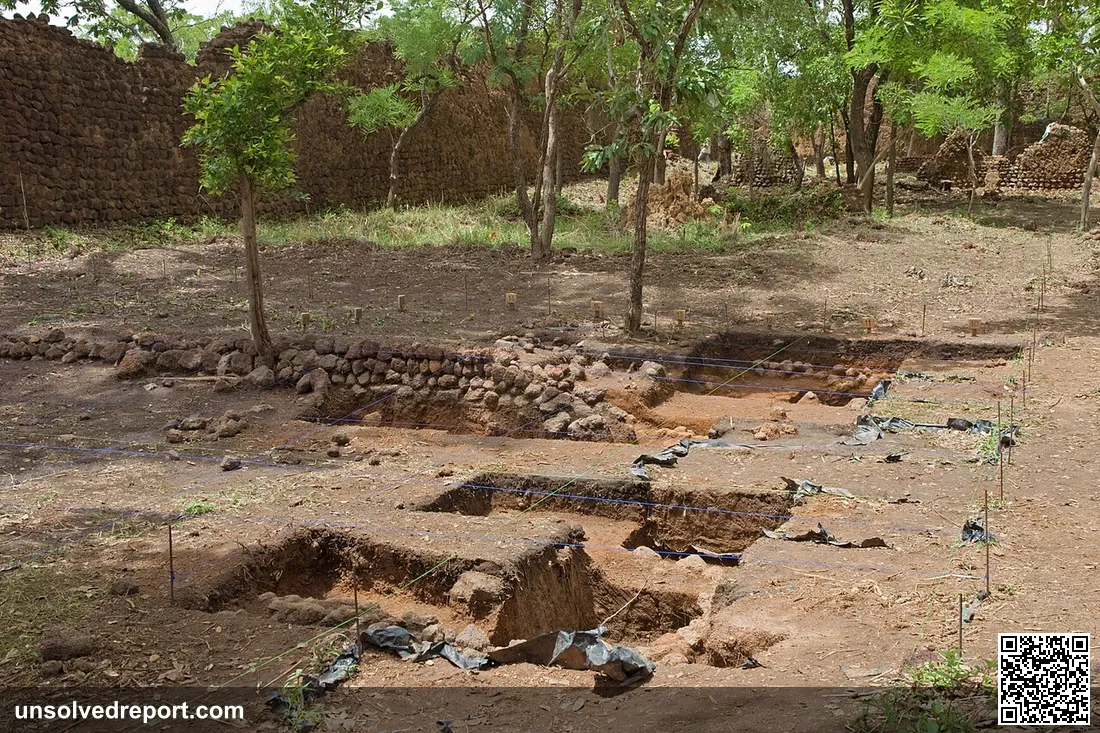
Hold onto one more detail, because it changes everything: most of the site has never been dug up. Since 2015, an international team spanning institutions in France, Burkina Faso, and Côte d'Ivoire has been working the ground there, with researchers including Fabrice Monna, anthropologist Quentin Mégret, and archaeologist Rodrigue Guillon (CNRS News). Their trowels have turned up internal walls slicing the space into rooms — some apparently stacked in successive building phases — heaps of ceramics that might point to water storage, and signs that whole sections were torn down and rebuilt across different eras. The savanna is still hiding most of its secrets.
The Question Nobody Can Answer
Here's where it gets eerie. A fortress this massive — and no one can say for certain who raised it. Worse: no one can say for certain how anyone got inside.
Read that again, because it's the detail that stops you cold. As the structure stands today, there is no clearly identifiable original gateway through the great curtain wall — a problem researcher Fabrice Monna has called, simply, "an unanswered problem" (CNRS News). Six meters of stone, wrapping a square, and no obvious door — a puzzle not unlike the entryways at Çatalhöyük, the ancient town where people climbed in through the roof instead. So how did people walk in and out of a place they lived in? Were the entrances built deliberately narrow, or removable, or made of wood that long ago rotted into nothing? Did they sit high up the wall, reached by ladders or wooden platforms now vanished? The honest answer: nobody has cracked it.
The purpose is just as foggy. The leading idea ties Loropéni to controlling and processing gold during the trans-Saharan trade — a vault with walls. But researchers have floated more than one reason for all that wealth and all that heavy fortification. One possibility is a broader role in commerce. Another is darker: a hand in the trade in enslaved people. The CNRS team is careful to say neither has been confirmed (CNRS News). Even the basic nature of the place is up for grabs — a permanent town, or a refuge people fled to in times of danger? A military stronghold, or somewhere with a ceremonial pull?
And then there's the builder. Yes, the Lohron and Koulango are bound up with the site's golden age. But the link between the Lorhon specifically and the original construction has been called vague. The walls may have stood long before the gold-trading peoples we name today ever arrived. Until far more of the enclosure is excavated and dated, layer by careful layer, the simplest question of all — who laid the first stone — stays blank.
Theories, Legends, and Buried Gold
Everything below is interpretation and oral memory, kept clearly apart from the hard facts above.
The Gan story — passed down by mouth. The French researcher Madeleine Père recorded a tradition among the Gan (Kaan) people: that Loropéni was built by Tokpã Farma, a king of the Gan dynasty, late in his life, meaning to move the capital there from Obiré. Some versions even spell out the order of the work — outer ramparts first, then the inner partitions, then the buildings themselves (Wikipedia, Ruins of Loropéni). It's precious cultural memory. But it's a story handed down through generations, not a documented blueprint — and later readings suggest the Gan may have moved into the fortifications and then left them, rather than building them in the first place. Treat it as speculation, not record.
The gold-vault idea — the mainstream scholarly read. The most widely accepted picture casts Loropéni and its sister enclosures as fortified hubs of the gold economy: places to dig out, refine, store, and guard a precious thing on its long journey toward Saharan and, later, coastal markets. It lines up with the dating, the local geology, and the very shape of the fortress. The catch? What any single room or wall at Loropéni was actually for is still being worked out.
The hidden-treasure tales — folklore, not proof. Locally, stories still circulate that gold is tucked away somewhere inside the ruins. Archaeologists call ideas like this circumstantial at best — atmospheric, the stuff of campfire wonder rather than anything you can put a date on.
That gap — between the rock-solid and the totally unknown — is exactly what makes Loropéni grip you. The walls are real, ancient, monumental, standing right there in the savanna. But the hands that first stacked those stones, and the doorway they surely once walked through, still haven't stepped back into the light. Somewhere under that unexcavated ground, the answer is waiting for whoever digs next.
Sources & Further Reading
- UNESCO World Heritage Centre — Ruins of Loropéni: https://whc.unesco.org/en/list/1225/
- CNRS News — "The Mysterious Ruins of Loropéni": https://news.cnrs.fr/videos/the-mysterious-ruins-of-loropeni
- African World Heritage Sites — Ruins of Loropéni: https://africanworldheritagesites.org/cultural-places/ancient-sub-saharan-civilisations/ruins-of-loropeni.html
- Wikipedia — Ruins of Loropéni (citing the UNESCO nomination dossier and the work of Madeleine Père): https://en.wikipedia.org/wiki/Ruins_of_Lorop%C3%A9ni
Plain of Jars: 3,000 Stone Vessels Nobody Can Explain
Plain of Jars: thousands of stone vessels, no inscriptions, no tools, no known builders. 2021 dating tests only made the mystery stranger. Here's why.
Unexplained Ancient Artifacts: 10 Objects That Baffle Scientists
Unexplained ancient artifacts that are real, studied, and still unsolved — a 2,000-year-old computer, a glowing Roman cup, a disc no one can read. What were they for?
Meroe Pyramids: How Kush Out-Built Egypt by 100+ Tombs
Sudan has more pyramids than Egypt — 200+ steep stone spikes hiding a looted queen's gold and a script scholars can read aloud but still can't translate. Why?