Khami Ruins Zimbabwe: The Stone City With a Cross Nobody Can Explain
Great Zimbabwe fell, and 250km west a new stone city rose, traded with three continents, then fell to a warlord — leaving one granite cross nobody has ever explained. Why?
Great Zimbabwe was dying. Its famous stone capital, the largest in southern Africa, emptied out in the mid-15th century, and you might think that was the end of an entire civilization's craft. It wasn't. About 250 kilometers to the west, on a granite ridge above a quiet river near what is now Bulawayo, a brand-new capital was rising. It would stand, rich and busy, for more than two hundred years. And it would leave behind something nobody has ever fully explained: a cross, laid out in loose granite blocks, sitting on a stone platform in the heart of Africa. This is Khami, one of the continent's most fascinating ruins. Here is what we know for certain, what we genuinely don't, and how careful people have tried to fill the gap.
What we actually know
Start with the where. Khami sits about 22 kilometers west of Bulawayo, on the west bank of the Khami River in southwestern Zimbabwe. This is no obscure local curiosity. UNESCO put it on the World Heritage List in 1986, under cultural criteria (iii) and (iv), calling it a site of "great archaeological interest" whose European and Chinese imports prove it was "a major centre for trade over a long period of time" (UNESCO World Heritage Centre). It is the second-largest stone-built monument in all of Zimbabwe. Only Great Zimbabwe itself is bigger.
So who built it? Khami was the capital of the Torwa state, the rulers of the Kingdom of Butua, and it dates to roughly 1450 to the 1680s. Here's where the two stories connect. UNESCO records that Khami "developed after the capital of Great Zimbabwe had been abandoned in the mid-16th century," which makes it a successor, a new seat of power picking up where the old one left off (UNESCO). One common reconstruction tells it like a family breakup: succession fights and exhausted land weakened Great Zimbabwe's ruling elite, the state cracked apart, and the pieces scattered. One faction went north and founded the Mutapa state. Another went west and built the Torwa state at Khami (Wikipedia: Khami).
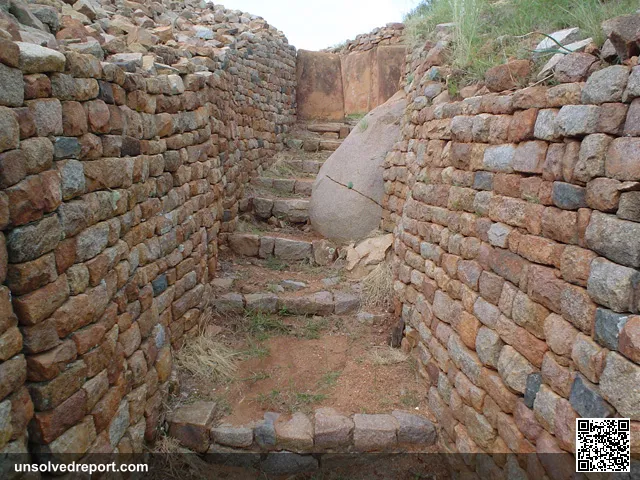
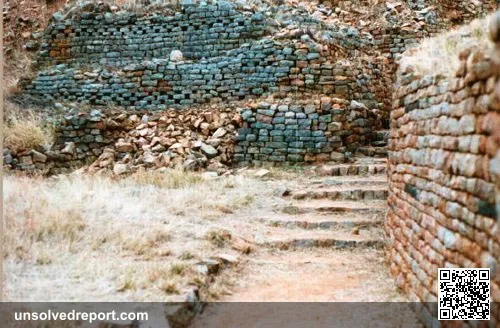
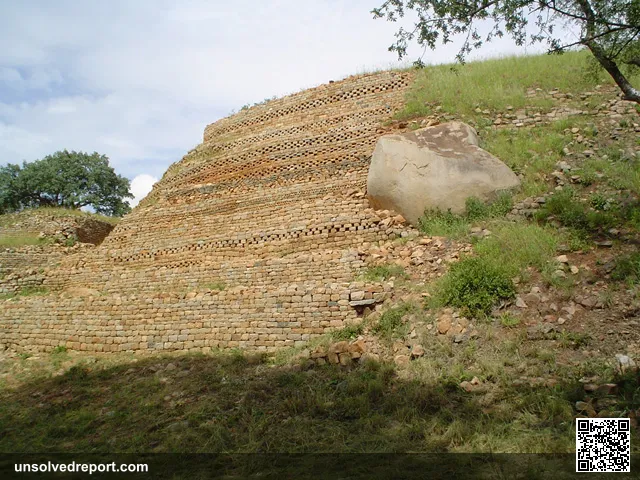
Now picture the city itself, because this is where Khami stops copying its parent and becomes its own thing. Great Zimbabwe built freestanding dry-stone walls, great curving enclosures standing on their own. Khami's masons did something cleverer. They built straight into the granite hills, using stone walls as revetments, retaining walls, to carve flat artificial terraces out of the slope. On those terraces they set clay (dhaka) houses and courtyards. The platforms climb between roughly 2 and 7 meters, and the longest decorated retaining wall runs about 75 meters and stands over 6 meters tall. And these walls aren't plain. They're dressed in geometric patterns, checkerboard, herringbone, and cord designs worked right into the stone (Wikipedia: Khami). Scholars often point out that retaining walls of this kind, decorated this richly, first came into their own in the region right here.
Building like that costs money. Khami had it, and the cash came from trade that stretched halfway around the planet. Dig into the site and you pull out a treasure list that reads like an early-modern world map: 16th-century Rhineland stoneware from Germany. Ming dynasty Chinese porcelain from the reign of the Wanli emperor. Portuguese ceramics. 17th-century Spanish silver. Sitting right alongside locally made carved ivory and worked metal (UNESCO; Wikipedia: Khami). In return, Khami sent gold and ivory flowing out into the Indian Ocean trade routes that reached the Swahili coast and far beyond, the same gold-for-glass network that had already enriched the Kingdom of Mapungubwe further south. We know all this because the site was dug systematically by K. R. Robinson for the Commission for the Preservation of Natural and Historical Monuments and Relics, work carried out between 1947 and 1955 and published in 1959 (American Journal of Archaeology review).
And then it ended. Around 1683, Rozvi forces under the warlord Changamire Dombo are recorded as sacking Khami and toppling the Torwa dynasty. The Rozvi built their own capital instead, at Danangombe (Danamombe). The excavation evidence tells the rest in silence: after the Rozvi takeover, nobody moved back in. In the 19th century the whole region was overrun again during Ndebele incursions under Mzilikazi (Wikipedia: Khami; UNESCO). A city that traded with three continents went quiet, and stayed quiet.
The cross nobody can explain
Here's the strange part. Among Khami's platforms there is one that stops every archaeologist cold. On what is now called the Cross Platform lies a cross, laid out in loose granite blocks. Where did it come from? Nobody knows for sure.
One popular idea is that it marks contact with Christian missionaries, and you'll sometimes hear it called a "Dominican cross." Another says it might be a victory marker or a claim stamped on the land by the Portuguese, who had a hand in the civil war that helped bring Khami down in the mid-17th century. Both are tempting. Both run into the same wall. The surviving Portuguese chronicles contain no clear record of their people ever reaching this far west, even though the Portuguese are very much on record as players in the region's wars (Zimbabwe Field Guide). And it gets murkier. The cross was cemented into its current spot only in 1938, centuries after the city fell. So even the question "where was it originally?" is harder to answer than it should be.
There's a second, quieter argument too, less spooky but just as unsettled. It's about time itself: when, exactly, was Khami built, and was it really first? The old view, from Robinson's 1959 report, treated Khami as the founding center of a whole "Khami phase" of related stone sites scattered across southwestern Zimbabwe. Newer historical archaeology pushes back. Were sites like Danangombe truly successors to Khami, or were they rivals living at the same time? And does the tidy Great Zimbabwe-to-Khami "migration" story actually match the dirt? (Historical Archaeology, Springer) The big picture holds. The fine print, who built what, when, and in what order, is still being argued over with trowels.
So what's the best guess?
These are interpretations, not settled fact, and the serious sources hedge them carefully. Here's how they stack up.
The strong one: Khami was Great Zimbabwe's western heir. This is the leading reading, the one baked into the UNESCO listing. Khami inherited Great Zimbabwe's building tradition, then adapted it, trading freestanding enclosures for decorated retaining walls that suited the harder local granite. It's the best-supported story we have, anchored in shared architectural style and overlapping trade goods (UNESCO).
The plausible one: the cross means missionaries. The idea that the granite cross signals a Christian missionary presence is appealing and easy to picture. But it leans on circumstantial reasoning, not on any documented mission at Khami. Call it an attractive hunch, not a proven fact.
The long shot: the cross is a Portuguese trophy. The notion that Portuguese mercenaries laid the cross during the 17th-century fighting is speculation that smacks straight into the documentary wall, because the chronicles simply don't put them at Khami. Worth naming. Nothing more.
But strip away the mysteries and one thing stands rock-solid. Khami is the work of local builders who, as Great Zimbabwe faded, engineered a terraced stone city against the grain of stubborn granite, dressed it in confident geometric art, and wired themselves into a trade web spanning three continents. The cross may hold onto its secret. The exact order of the sites may take more digging to settle. But the bigger lesson is already clear, and it's a hopeful one: the stone-building world of southern Africa didn't die with one capital. It packed up, moved west, adapted, and rose all over again.
Sources & further reading
- UNESCO World Heritage Centre, Khami Ruins National Monument (List no. 365): https://whc.unesco.org/en/list/365/
- Wikipedia, Khami: https://en.wikipedia.org/wiki/Khami
- American Journal of Archaeology review of K. R. Robinson, Khami Ruins (excavations 1947-1955, pub. 1959): https://www.journals.uchicago.edu/doi/10.2307/502545
- Historical Archaeology (Springer), Landscapes and Ethnicity: An Historical Archaeology of Khami-Phase Sites in Southwestern Zimbabwe: https://link.springer.com/article/10.1007/s41636-020-00259-z
- Zimbabwe Field Guide, Khame (Khami) Ruins UNESCO World Heritage Cultural Site: https://zimfieldguide.com/bulawayo/khame-previously-khami-ruins-unesco-world-heritage-cultural-site
Lake Titicaca Underwater Ruins: The Gold Divers Can't Explain
Lake Titicaca underwater ruins hide real gold, carved shell, and sacrificed llamas divers pulled from the deep. So why is a sacred reef submerged at all?
Thonis-Heracleion: The Sunken City Nobody Can Explain
Thonis-Heracleion vanished under Egypt's sea for a thousand years until a 2000 dive proved it real. Temples, anchors, a stele—so how did it actually sink?
Sao Civilization: The Lake Chad Giants Nobody Can Explain
Bronze masks, giant warriors in legend, and 2,000 years of mystery: what happened to the Sao civilization of Lake Chad — and why did it just disappear?