Sao Civilization: The Lake Chad Giants Nobody Can Explain
Bronze masks, giant warriors in legend, and 2,000 years of mystery: what happened to the Sao civilization of Lake Chad — and why did it just disappear?
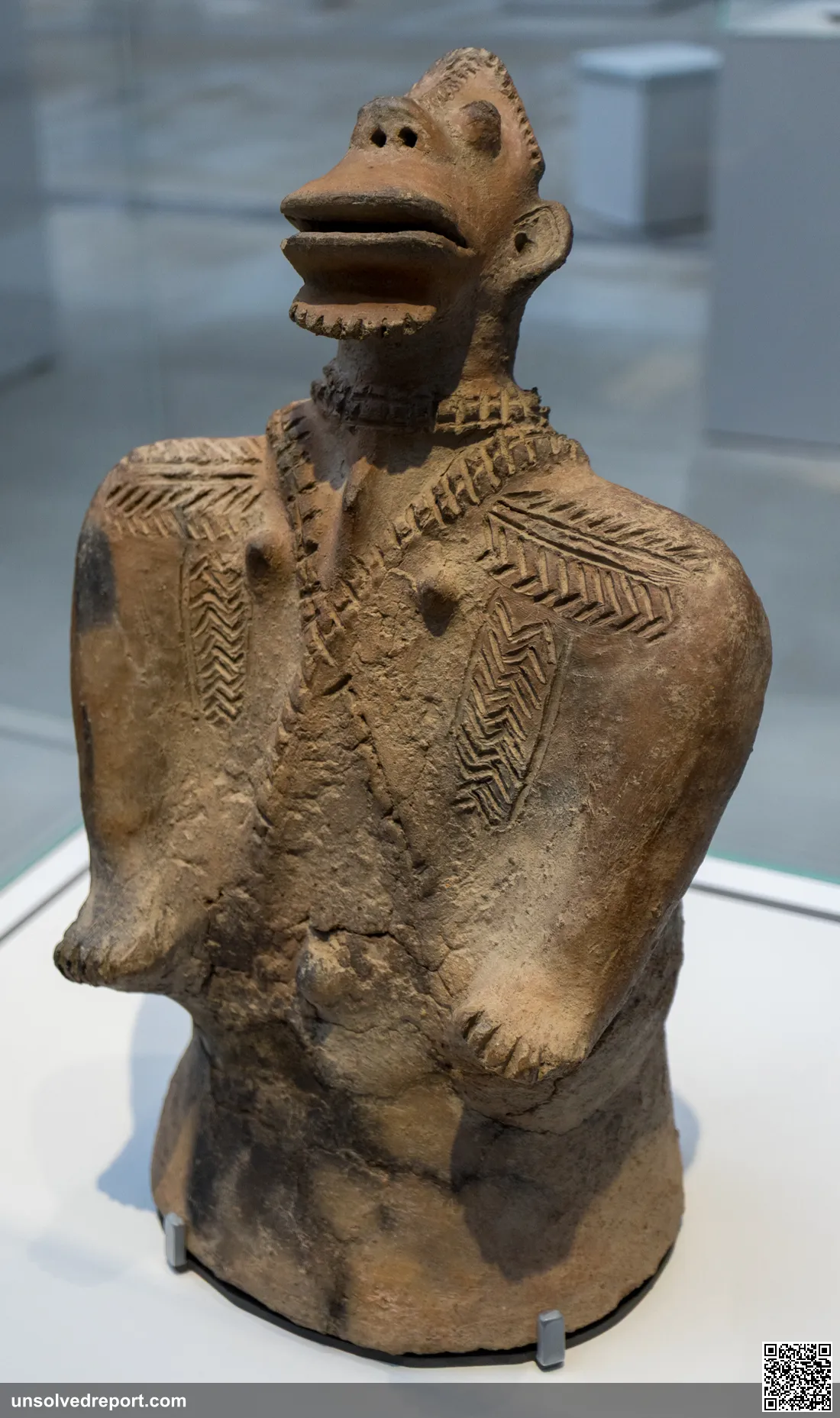
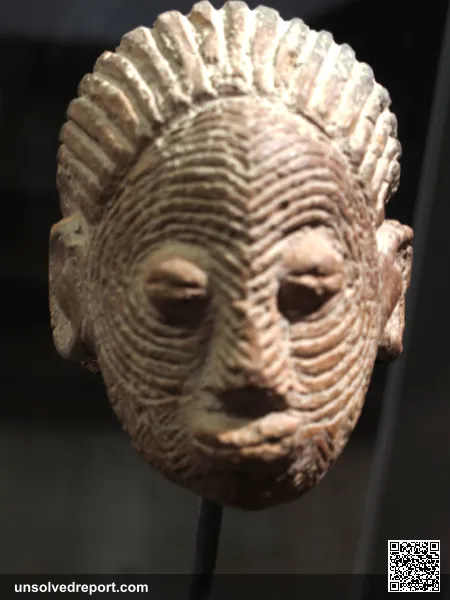
Push a spade into one of the low earthen mounds south of Lake Chad and the past pushes back. Out come broken funerary urns. Copper-alloy ornaments. And small terracotta heads — bulging eyes, pursed lips, a face like almost nothing else made anywhere in Africa.
This is farmland now. Cattle graze it. The Chari and Logone rivers braid lazily through the savanna. But the mounds are not natural hills. People built them, layer by layer, over centuries. And the people who lived here have a name in local memory: the Sao. A race of giants, the stories say. Towering warriors whose drinking bowls were big enough to seat two grown men.
The archaeology is real. Carefully dug, carefully recorded. The giants are legend. The true mystery lives in the gap between the two — and that gap is where things get strange.
What we actually know
Start with the bones of the story, the parts no one disputes.
The Sao culture grew up in the Lake Chad Basin, on land now split between three countries — Chad, Cameroon, and Nigeria — with the richest finds turning up south of the lake along the Chari River (Britannica; Wikipedia, "Sao civilisation"). It didn't spring from nowhere. Its roots reach back into the earlier Gajiganna culture of the same basin, a tradition that thrived from roughly the 18th to the 9th century BCE, with something recognizably Sao taking shape in the centuries that followed (Wikipedia). All told, the Sao run from around the 6th–5th century BCE down to as late as the 16th century CE, hitting their cultural and political high point in the medieval centuries before the end — a golden age that overlapped with the fabled riches of Mansa Musa's Mali Empire far to the west (Britannica).
That is a staggering stretch of time. And it isn't folklore — it's dated.
Take Zilum, a Gajiganna-tradition settlement just over the line in northeastern Nigeria. German-led excavations by Peter Breunig, Carlos Magnavita and colleagues uncovered a fortified, proto-urban community covering 10–13 hectares, with radiocarbon dates clustering around 600–400 BCE — proof of walled, organized towns in the basin far earlier than anyone used to think — echoing the same rewritten timeline found at Dhar Tichitt in Mauritania (Archaeology of Zilum, Wikipedia; Magnavita et al., "New evidence of proto-urban settlements in the Lake Chad area," via academia.edu). Walls. Planning. Centuries before the textbooks expected them.
Here's the catch: the Sao left no books, no inscriptions, nothing written by their own hand. We know them almost entirely through their mounds and the things they buried inside. More than 350 Sao sites have been mapped across Chad and Cameroon, many of them artificial hills raised up over generations of living and rebuilding on the same spot (Lumen Learning, "Sao"). From them, diggers have pulled bronze and copper-alloy sculptures, terracotta figures of people and animals, funerary urns, jewelry, decorated pottery, iron tools, and weapons — the Sao worked bronze, copper, and iron — a level of metalworking skill echoed further west by the Igbo-Ukwu bronzes of Nigeria (Britannica; Wikipedia). And those figurines, often boiled down to a single stylized head with exaggerated features, have no close cousin anywhere else on the continent. Today you can find "Sao bronzes" and terracottas in collections at the Louvre and the University of Michigan, among others (Lumen Learning).
The hunt for the Sao began with French ethnographers. Marcel Griaule — the man who led the famous Dakar–Djibouti expedition — came back to the Chad Basin in 1936–37 with Jean-Paul Lebeuf, and between them they basically invented the "Sao civilization" as a thing you could name (Marcel Griaule, Wikipedia). Lebeuf, often working alongside Annie Lebeuf, spent decades on Chadian archaeology. From 1960 to 1968 he dug the Mdaga mound about 17 km north of Fort-Lamy (today's N'Djamena), turning up fine incised pottery, human and animal figurines, polished axes, carnelian beads, and metalwork (Persée biographical record for J.-P. Lebeuf).
These were not scattered villages, either. The Sao are described as builders of walled towns — not unlike the mysterious earthworks of Sungbo's Eredo further south in Nigeria — run by an elaborate hierarchy under a divine or sacred ruler (Wikipedia). So what ended them? Not a meteor, not a plague — a rival. As the Kanem–Bornu Empire rose, the Sao faded. By the 16th century they had ceased to exist as a culture of their own, their towns swallowed up as Bornu expanded (Britannica). And yet — this is the part that gives the whole story a pulse — they never really vanished. Several peoples alive today claim the Sao as ancestors. Above all the Kotoko of Cameroon, Chad, and Nigeria, who see themselves as the heirs of the old Sao city-states, along with the Kanembu, Buduma, Musgum, and Sara (Britannica, "Kotoko"; Wikipedia).
The question that won't go away
Now for the riddle that still keeps archaeologists up at night. It's quieter than a legend, but sharper: how unified was the "Sao civilization" — and how much of it is a name pinned on from the outside?
Think about what Griaule and Lebeuf did. They handed a single label to a sprawling, centuries-long patchwork of mound-building communities. But the basin was crowded with overlapping cultures, and newer scholarship — including the regional surveys drawn together in work like "Burial Practices, Settlement and Regional Connections around the Southern Lake Chad Basin, 1500 BC–AD 1500" — stresses diversity and slow continuity, not one neat nation with one neat border (ResearchGate listing). So which is it? Did a single, coherent "Sao" people really exist? Or did French researchers gather up several distinct traditions and stitch them together under one romantic banner? The honest answer is uncomfortable: the edges of the Sao — when they began, where they reached, who counted as one of them — are still genuinely up for grabs.
And there's a second mystery sitting right under the first: what did the figurines mean? The Sao wrote nothing down. The oldest texts that even mention them come from outsiders — including the 16th-century chronicles of the Bornu imam Ahmad ibn Furtu, who cast the Sao as fearsome enemies of his expanding empire (Wikipedia). So we meet the Sao secondhand, through their rivals and through objects that can't speak. Whatever the masks and urns were for — honoring ancestors, crowning kings, working some ritual — we're guessing. Educated guessing, but guessing all the same.
The stories people tell
This is where the legends come back in. Tell them apart from the facts and you can enjoy them for what they are.
The "Naga" giants (folklore, not fact). All across the basin, oral tradition makes the Sao giants and mighty warriors — so tall, one version goes, that their gateways were whole palm trunks and a single bowl could hold two seated men (Ancient Origins). The serpent-and-giant-warrior imagery that has earned them the nickname "Naga of West Africa" is just that — a poetic comparison to the giant serpent-spirits of South Asian myth. It is not evidence of any real link between the two regions. There's no documented connection at all, so treat the "Naga" tag as metaphor and nothing more. The far more likely root of the giant motif is wonderfully ordinary: big pots, oversized funerary jars, and the plain awe later people felt standing before impressive ruins built by ancestors they could no longer name.
The Jerusalem twins (legend). Another recorded tradition says the Sao came from twins born to a woman of Jerusalem (Ancient Origins). That's the fingerprint of Islamic and Near Eastern genealogical storytelling working its way into Sahelian oral history. It's a charter myth — a story about belonging — not a record of any migration.
What the evidence actually points to (best-supported). Strip away the romance and the picture is local and home-grown: communities rooted in the area's own Gajiganna tradition, growing into walled, craft-making towns, thriving for centuries, then folding gradually into Kanem–Bornu rather than dying out in some dramatic fall (Britannica; Wikipedia). The Sao didn't disappear. They flowed into the people who still remember them.
Maybe that's the most haunting thing about the Sao: their story has no clean ending. Beneath the farmland south of Lake Chad, hundreds of mounds sit only half-explored — and every careful dig doesn't close the question of who the Sao really were. It opens it wider.
Sources & further reading
- Britannica — Sao (people): https://www.britannica.com/topic/Sao-people
- Britannica — Kotoko: https://www.britannica.com/topic/Kotoko
- Wikipedia — Sao civilisation: https://en.wikipedia.org/wiki/Sao_civilisation
- Wikipedia — Archaeology of Zilum: https://en.wikipedia.org/wiki/Archaeology_of_Zilum
- Wikipedia — Marcel Griaule: https://en.wikipedia.org/wiki/Marcel_Griaule
- Lumen Learning / SUNY — World Civilization: Sao: https://courses.lumenlearning.com/suny-hccc-worldcivilization/chapter/sao/
- Persée — Jean-Paul Lebeuf (1907–1994) authority record: https://www.persee.fr/authority/255566
- Magnavita et al., New evidence of proto-urban settlements in the Lake Chad area (academia.edu): https://www.academia.edu/23442639/New_evidence_of_proto_urban_settlements_in_the_Lake_Chad_area
- Burial Practices, Settlement and Regional Connections around the Southern Lake Chad Basin, 1500 BC–AD 1500 (ResearchGate): https://www.researchgate.net/publication/333922753_Burial_Practices_Settlement_and_Regional_Connections_around_the_Southern_Lake_Chad_Basin_1500_BC-AD_1500
- Ancient Origins — Lost in the Mists of Time: The Ancient Sao Civilization (used only for labeled legend/folklore): https://www.ancient-origins.net/ancient-places-africa/lost-mists-time-ancient-sao-civilization-central-africa-003978
Ban Chiang Bronze Age: The 1,000-Year Fight Nobody Can Settle
A Harvard student's trip over a tree root uncovered a lost civilization — but top archaeologists still can't agree when its bronze age began. Off by 1,000 years. Why?
Igbo-Ukwu Bronzes: The 9th-Century Metal Too Perfect to Believe
A farmer's well uncovered Igbo-Ukwu bronzes cast so flawlessly that scholars accused the dates of lying. What actually happened 1,000+ years ago?
Cochno Stone: Scotland Buried It on Purpose. Twice.
Scotland deliberately buried the Cochno Stone in 1965, briefly dug it up in 2016, then reburied it. What do its 90 carved rings actually mean?