Newgrange Winter Solstice: The Trap Built to Catch One Sunrise
Newgrange traps a single sunrise inside a 5,000-year-old Irish tomb through a secret slot called the roof box. How did Stone Age farmers pull it off?
For about seventeen minutes a year, a building older than the Great Pyramid pulls off a trick that should not be possible. Just after dawn on the darkest mornings of the year, a thin blade of sunlight squeezes through a small stone slot above a doorway in Ireland's Boyne Valley. It crawls down a 62-foot tunnel of stone. And it reaches the deepest, blackest part of a tomb that sits in total darkness every other day of the year.
The building is Newgrange. The slot is called the "roof box." And here's the part that gives people chills: farmers built this light show more than five thousand years ago. No writing. No metal tools. Not even the wheel. They aimed a tomb at the sky and caught a single sunrise — and it still works.
What We Actually Know
Start with the cold, checkable facts, because they are strange enough on their own.
Newgrange sits inside Brú na Bóinne in County Meath. In 1993 that whole landscape was added to the UNESCO World Heritage List as home to "the largest and most important group of passage tombs in Europe" (UNESCO World Heritage Centre). The great mound went up around 3200 BC, back in the Neolithic period — some sources nudge it closer to 3100 BC. Either way, it is older than Stonehenge in England, and older than the pyramids at Giza (Newgrange / Brú na Bóinne, knowth.com; Wikipedia: Newgrange).
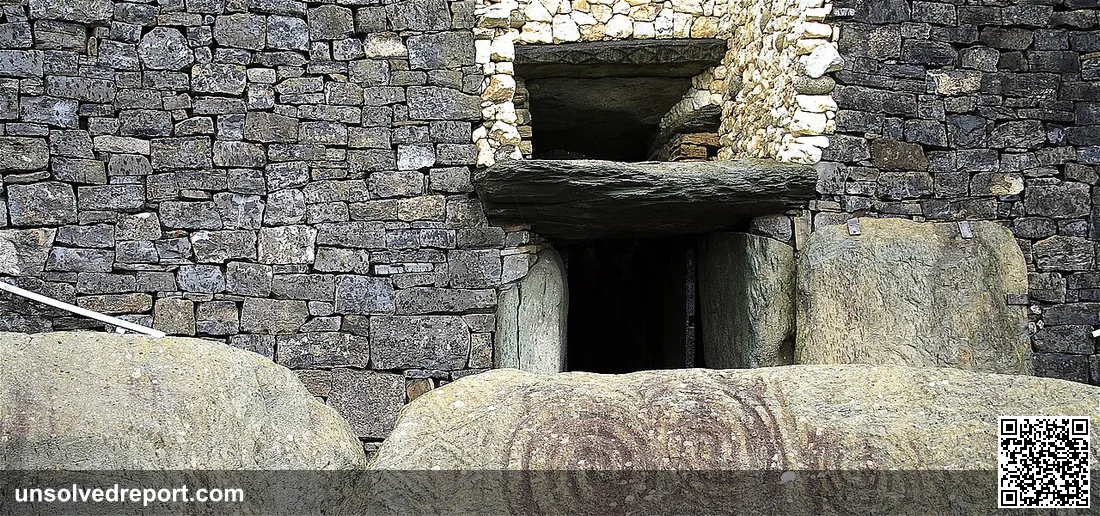
Now picture the size of the thing. A round mound roughly 85 meters (279 feet) across and about 12 to 13 meters high — covering more than an acre — ringed by 97 massive kerbstones, some of them carved with spirals and lozenges (knowth.com). Step inside and a stone passage about 19 meters (62 feet) long carries you to a cross-shaped chamber. Its corbelled roof climbs nearly six meters overhead. And here's the kicker: that roof has stayed watertight for more than five thousand years (knowth.com). Five millennia of Irish rain, and not a drip in the heart of the tomb.
Above the doorway sits the feature that made Newgrange famous: a built-on-purpose slot called the roof box, about a meter wide and 90 centimeters high. On the mornings around the winter solstice — the show peaks on December 21, give or take a day or two — the dawn does something deliberate. The light doesn't pour through the doorway. It threads through that raised slot instead, runs along the passage floor, and floods the back chamber for roughly 17 minutes, weather permitting (National Museum of Ireland).
So who first stood inside and watched it happen in modern times? We know the exact day. Professor Michael J. O'Kelly of University College Cork dug out and conserved the monument between 1962 and 1975, and on December 21, 1967, he became the first person in recorded modern history to wait in that chamber and see the solstice beam arrive (National Museum of Ireland; RTÉ Brainstorm). By his account the light hit the floor about four and a half minutes after dawn, then crept slowly inward.
Here's the eerie part. O'Kelly didn't stumble onto this by luck. Local people had told him of an old tradition — that the rising sun would, at some hour nobody could pin down, light up a carved stone deep inside the chamber. That whisper of folklore is what pointed him toward the discovery in the first place (RTÉ Brainstorm).
And the stone he was looking for? It's still there. Deep in the chamber sits the tri-spiral, or "triple spiral," carved on a slab about 12 inches across — often called the single most famous symbol in all of Irish megalithic art (knowth.com).
The Real Mystery Isn't How — It's Why
Here's where it gets uncomfortable. We can prove, with engineering certainty, that the builders meant to catch the solstice. The roof box was made on purpose. The passage points southeast, straight at the midwinter sunrise. None of that is up for debate.
What we cannot say is what any of it meant to them.
The people who raised Newgrange left no writing. Not a single word. So we genuinely don't know if this place was mainly a tomb, a giant calendar, a temple for honoring ancestors, a stage to mark the sun "coming back" — or something so foreign to us we don't even have a word for it. Cremated and unburned human remains were found inside, so yes, burial was part of the story. But think about it: this thing took hundreds of workers, possibly many years, all engineered to grab one sunrise a year. Nobody builds that for a grave alone. The honest answer is that the reason behind all that precision is lost, and it may never come back.
There's a second, quieter argument worth telling you straight. In 2016, archaeologist Michael Gibbons publicly questioned how old the roof box really is — suggesting that the feature visitors see today owes a lot to 20th-century rebuilding (The Irish Times, via reporting summarized here). Archaeologist Dr. Robert Hensey pushed back hard, calling it "not correct" to brand the roof box a modern invention. He pointed out that a string of studies dated it to around 5,000 years old, and that O'Kelly only raised the box at all as a side effect of straightening leaning passage stones — working to the conservation standards of his time (Irish Times reporting). The mainstream view stands firm: the solstice alignment is ancient and deliberate. But the spat is a healthy reminder — even our most iconic ruins carry a hidden history of repair.
The Theories People Whisper About
The "rebirth of the sun" idea. This is the reading you'll hear most — and it's an interpretation, not a proven fact. Midwinter is when the sun sinks to its lowest, weakest point and the year finally turns back toward light. So maybe these farmers marked that moment as a cosmic do-over: the chamber lighting up as life clawing its way back out of the dark. It fits the alignment beautifully. The catch? We have zero written record of what the builders actually believed.
The "cosmic calendar" theory. Recent work by archaeologist Joe Fenwick of the University of Galway, published in a 2025 essay collection honoring John Waddell, makes a bolder claim — and it's a scholarly argument still being weighed, not settled. Fenwick suggests the Brú na Bóinne tombs worked as a team of solar observatories: Newgrange tuned to the solstices, Knowth to a "perceived" equinox, and Dowth to the winter-solstice sunset — together forming a far richer Neolithic "cosmic calendar" than anyone had recognized (University of Galway). He even reads the spirals on the entrance stone as a map of the sun's path shrinking and stretching across the year. It's a haunting idea — and, to be plain, it's his interpretation of those carvings.
The folklore-memory theory. Then there's the most romantic possibility, the one that's legend-adjacent and impossible to prove. What if that old local tradition O'Kelly heard was a real folk memory — passed mouth to mouth for thousands of years — of the light event itself? It's a lovely thought. But a story can't survive five thousand years of retelling without us being able to check it, and the tale may simply come from people living a long, long time beside a monument that faces the dawn.
What nobody disputes is the skill. Whatever these people believed, they read the sky well enough to freeze one sunrise inside a mountain of stone — and to leave it waiting there, perfectly aimed, for anyone willing to stand in the dark 5,000 winters later and watch the light come home.
Sources and Further Reading
- UNESCO World Heritage Centre — Brú na Bóinne
- National Museum of Ireland — The Winter Solstice at Newgrange
- RTÉ Brainstorm — How Newgrange's solstice light show was rediscovered
- University of Galway — Passage tombs as solar observatories (2025 research)
- Brú na Bóinne / Newgrange — knowth.com
- The Irish Times — debate over the roof box's age
- Wikipedia — Newgrange
Royal Cache: The Cliff Tomb That Hid 50 Pharaohs
A goat chase uncovered 50 lost pharaohs stacked in one hidden shaft. Inside the Royal Cache: who moved the kings, and the question still unanswered.
Oxus Civilization: The Bronze Age Empire With No Name
Oxus Civilization (BMAC): a lost Bronze Age empire dug from the desert sand. It traded across Asia, left no name or writing behind. So who were they?
Loropéni Ruins: The 6-Meter Fortress With No Door In or Out
A six-meter stone fortress in Burkina Faso has no door, no known builder, and most of it has never been dug up. So how did anyone get inside Loropéni?