Derinkuyu: The 18-Story City Hidden Behind a Basement Wall
A Turkish man smashes a basement wall and cold air pours from the rock: a city plunging 85m down, built to hide 20,000 people. Who really carved Derinkuyu?
1963. A man in the Anatolian town of Derinkuyu swings a sledgehammer at a wall in his own home, mid-renovation, and something wrong happens. Cold air pours out of the gap. Not a draft from a crack. A steady, breathing exhale of cold, from somewhere that shouldn't exist behind a basement wall.
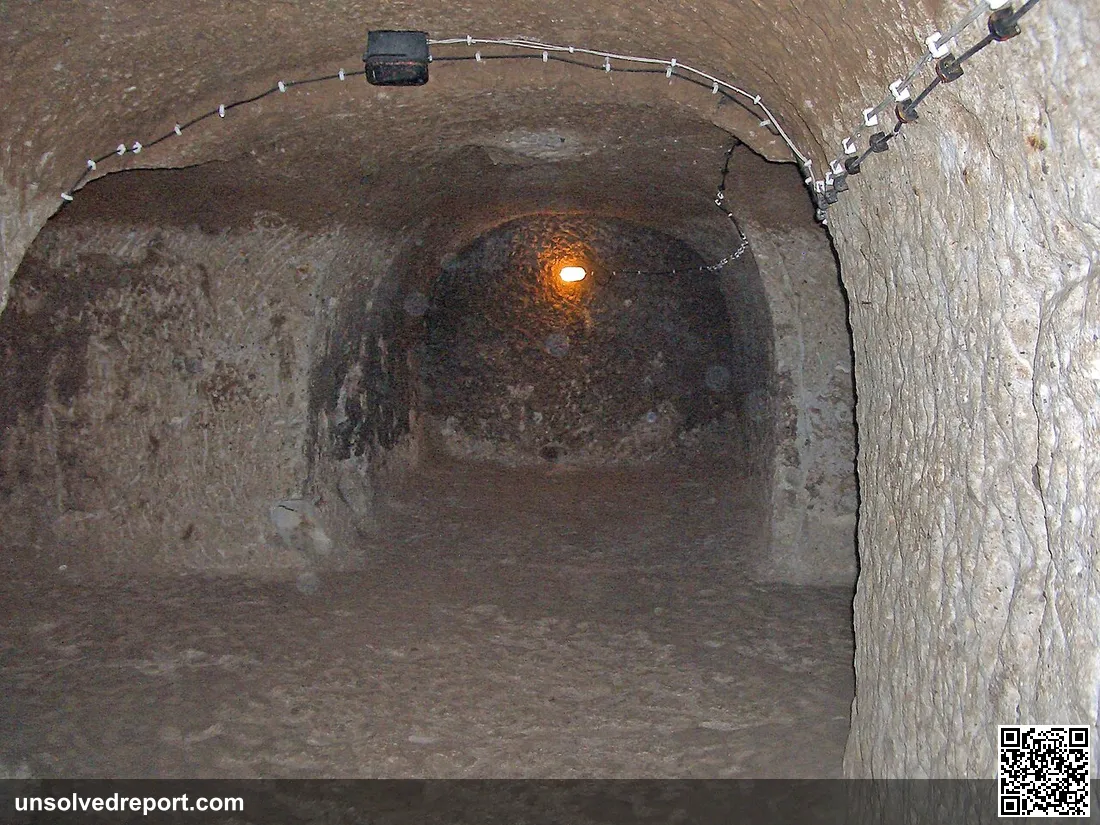
He keeps going. Behind the wall is a room. Behind the room is a passage. And behind the passage is a city - one that drops dozens of meters straight down into the volcanic rock under his feet, with chapels, stables, kitchens, wine presses, and air shafts threading into the dark. Without meaning to, he had just reopened Derinkuyu: the deepest excavated underground city in Cappadocia, a place that may once have hidden as many as twenty thousand people and their animals.
That story gets told everywhere, and it picks up new flourishes every time. So let's do the thing this site exists to do. Let's pull apart the proven, the genuinely unknown, and the flat-out nonsense.
What we can actually prove
Start with the rock, because the rock is the whole story.
Derinkuyu sits in Cappadocia, a stretch of central Turkey famous for landscapes of soft volcanic tuff. Here's why that matters: tuff is soft enough to carve with hand tools, yet it hardens once it meets the air. Dig a room, and the walls firm up around you. That single quirk of geology is an open invitation to live underground - and people took it. Cappadocia is honeycombed with these places. More than two hundred underground settlements of at least two levels have been mapped across the region - a habit of hollowing out the earth that shows up elsewhere too, like the enigmatic Longyou Caves in China. Derinkuyu just happens to be the deepest one anyone has dug back out.
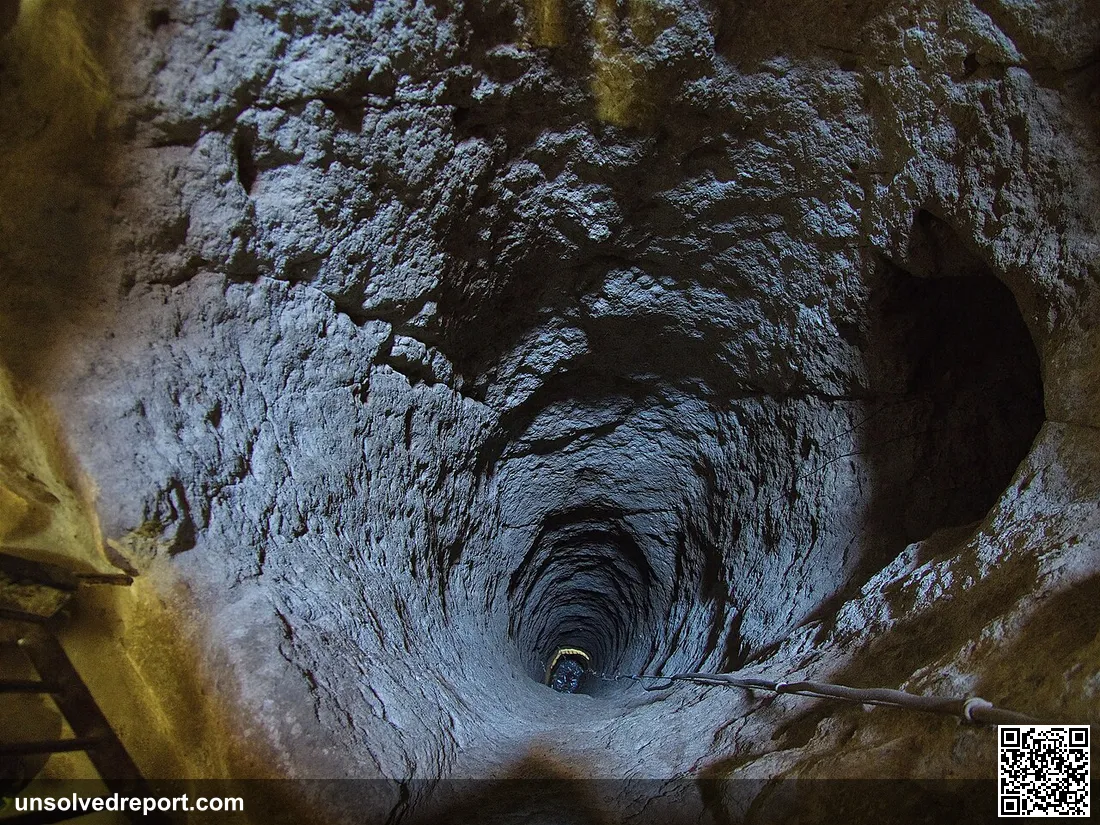
According to the Wikipedia entry on Derinkuyu, the site sinks roughly 85 metres - about 280 feet - and is usually described as having around 18 levels, though only a slice of it is open to visitors today. It could reportedly hold up to 20,000 people, plus their food stores and their livestock. Inside: a 55-metre ventilation shaft that doubled as a well, barrel-vaulted rooms, a cruciform church on a lower level, presses for wine and oil, stables, refectories, storage cellars. An entire town, sealed underground.
Now the part that should make the hair on your neck stand up: the doors.
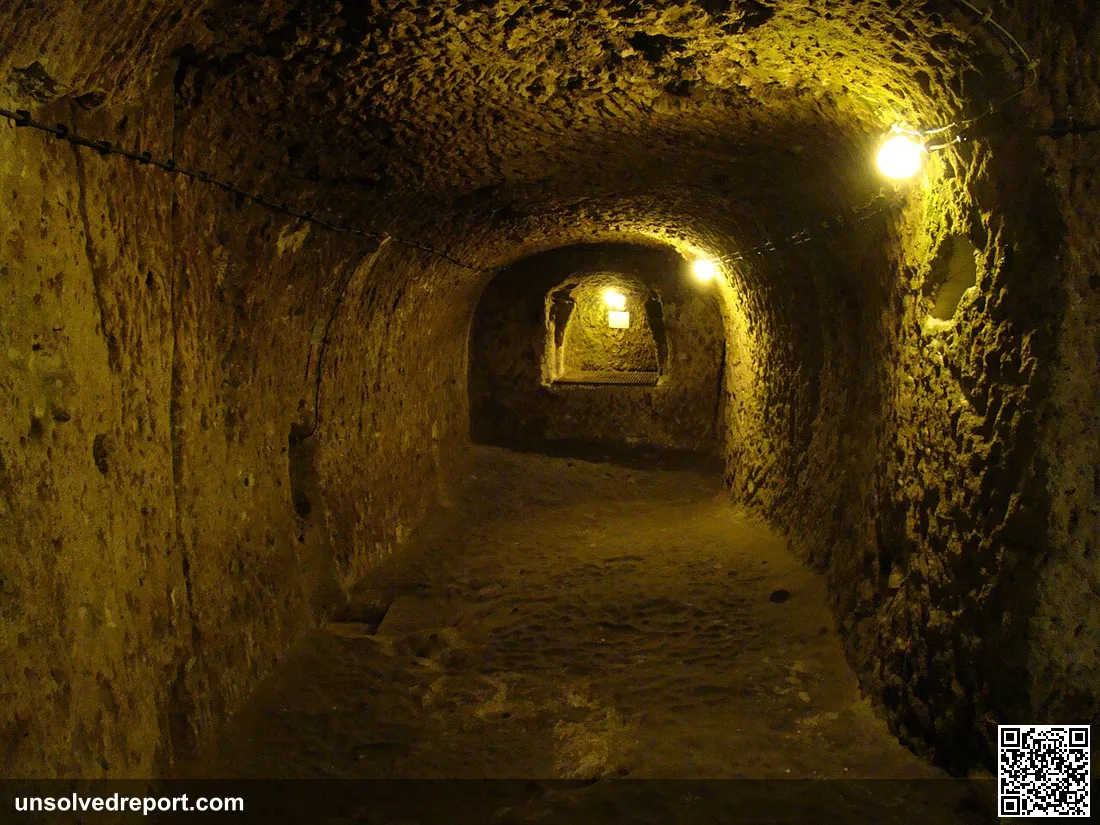
Derinkuyu's signature defense is a series of huge round stone doors. These rolling stones - some weighing several hundred kilograms - could be heaved across a passage from the inside and locked in place, sealing off a whole level. And they were brilliantly lopsided by design. From behind, a defender could move one with relative ease. From the far side, an attacker had nothing to grab and no leverage to push, and the corridors were so tight that only one or two people could even get close at a time. Some doors had a small hole bored through the center - just wide enough, it seems, to ram a spear through at anyone trying to shoulder the stone aside. Best of all, each floor could be shut independently. Breach the top level, and the people below simply rolled their own door shut and kept fighting.
And Derinkuyu doesn't stand alone. Several kilometers of tunnels connect it to the nearby underground city of Kaymakli, and the wider region around the modern town of Goreme is a UNESCO World Heritage Site, recognized for its rock-cut architecture - the same tradition of carving sacred spaces directly out of stone that produced Ethiopia's Lalibela churches centuries later. That context matters. Derinkuyu isn't some freak one-off - it's the deepest, most elaborate member of an entire tradition of underground living, born of the same soft tuff that sculpted Cappadocia's famous fairy chimneys up top. Above ground, the rock made towers. Below it, the rock made hideouts.
How do you hide a whole city underground?
The real genius of Derinkuyu isn't the stone doors. It's keeping everyone alive once those doors swing shut.
Air is the obvious killer. Tens of thousands of people and animals, all breathing inside a sealed warren of rock - they'd suffocate fast. The builders' answer was a network of vertical ventilation shafts. More than fifty of them are reported, pulling fresh air down through every level and reaching deep enough to draw water from the aquifer below. The wells were placed so people could reach them from inside, without ever stepping into view of anyone up above. And some, reportedly, were sealed off from the surface entirely - so an enemy couldn't creep up and poison the water.
Read the layout and you're basically reading a town that's been stood on end:
- Upper levels: stables and living quarters, where ceilings ran lower and the air moved easiest.
- Middle levels: communal spaces - a reported religious school with a barrel-vaulted ceiling, churches, storage.
- Lower levels: wells, a dungeon, and a large cruciform church.
But here's the thing - nobody lived down here full time. This was a refuge, not a home. People lived in the sunlight above and dropped into the earth only when danger came, rolling the stone doors shut behind them. Carbon dioxide creeping up, food going bad, the slow psychological grind of total darkness - all of it put a ceiling on how long anyone could last below. And the design admits it. Every priority points the same way: this is architecture built to survive a siege of days or weeks, not to be comfortable for a lifetime.
Just think about what keeping twenty thousand people and their animals alive underground actually demands, even briefly. Air. Water. Food storage. Sanitation. Light. And some way to stop livestock from losing their minds in the pitch black. Derinkuyu has an answer for each. The deep shafts handled air and water. The cool, steady underground temperature kept grain, oil, and wine from spoiling. Stables sat near the surface, where ventilation was strongest. Oil lamps gave light - and in places the ceilings are still stained black with their soot, a fingerprint of every long night spent waiting underground. It's a complete life-support system, carved out of solid rock. A grim one, but complete.
The question nobody can answer: who built it?
This is where the confident histories start to wobble. And it's exactly where being honest matters most.
The line you'll hear most often is that the Phrygians, an Iron Age people, started the digging around the 8th to 7th century BC. It's a reasonable guess. The Phrygians were active in Anatolia - the same region that later produced Catalhoyuk, one of the world's oldest known towns - and they were skilled at cutting rock, so the attribution fits. But fitting isn't the same as proven. Dating carved rock is genuinely brutal: carving takes material away instead of laying it down, so there's barely any organic matter to radiocarbon date - and every later wave of occupants reused and reshaped what came before. Some scholars push the earliest workings back toward the Hittite era. Others throw up their hands and call the deep origins simply uncertain.
What we can pin down is the later chapter. The site was massively expanded in the Byzantine period, when Christian communities in Cappadocia were weathering raids during the Arab-Byzantine wars. The chapels, the cross-shaped church, the Greek inscriptions on the walls - all of it points straight to Byzantine Christians using these depths as a place to vanish when armies came. And it didn't stop there. Centuries later, local Cappadocian Greeks reportedly still ducked into the underground cities to escape bouts of persecution, right up until the population exchanges of the early 20th century.
So here's the responsible version, stripped of bravado: Derinkuyu was very likely begun in antiquity, possibly by Phrygians, and was demonstrably enlarged and lived in by Byzantine-era Christians. Who swung the first pick, and exactly when - that stays unsolved, much like the builders of Gobekli Tepe further south, another Anatolian site whose true age kept rewriting the textbooks.
And there's a deeper reason the mystery refuses to die. Most archaeology dates things one of two ways: by stratigraphy, reading the layers of material that pile up over time, or by radiocarbon-dating organic remains. An underground city defeats both. Carving is subtractive - it strips rock away instead of stacking up datable layers. Any charcoal or grain you find inside tells you when someone used a room, not when it was first hollowed out. And since each generation recut what the last one made, the very oldest surfaces may have been carved clean off the wall. Derinkuyu is a palimpsest in stone: the original writing scraped away to make room for the next, over and over, until the first hand is gone.
What the evidence flatly rules out
Derinkuyu draws speculation like a magnet, and some of it needs a firm, fair shove back.
You'll read that the city is impossibly ancient - tens of thousands of years old. That it was built by a lost advanced civilization. That it's tied to aliens, or to some prehistoric cataclysm people fled underground. There is no evidence for any of it. Nothing. Everything pulled from the site - the architectural style, the Christian chapels, the Greek inscriptions - sits comfortably inside known Anatolian history. The engineering is impressive, sure. But it's human-impressive. Ventilation shafts and rolling stone doors are clever. They are not anachronistic, and they don't need a single visitor from anywhere.
Even that famous 1963 discovery gets dressed up. The broad story holds, but locals in Cappadocia had known about underground spaces for a very long time before that sledgehammer ever swung. What the renovation actually uncovered was a major new section of the network, not the network itself. The town's own name gives it away - Derinkuyu means roughly "deep well" in Turkish. Those deep shafts were never entirely forgotten. They were right there in the name the whole time.
Why it still grips us
Strip away the fairy dust and Derinkuyu gets more impressive, not less.
It's a monument to one of the oldest human needs there is: the need to disappear. For people living along contested frontiers - where armies and raiders showed up without warning - being able to make an entire community vanish underground, with water and food and livestock and even a place to pray, was the thin line between surviving and being wiped off the map.
So the real mystery isn't who carved it with the help of some impossible lost technology. It's quieter than that, and far more human: exactly how many centuries of fear and ingenuity it took to hollow a city out beneath a plain - and how many times those rolling stone doors thudded shut while death passed by overhead, just out of earshot.
The bottom line
Derinkuyu is real, it's deep, and it's genuinely extraordinary - and almost none of the wild claims about it are needed. The documented engineering and the Byzantine refuge history are astonishing entirely on their own. The one honest open question is who its first builders were, and exactly when they began - a question the soft, undatable rock may simply refuse to answer.
And if a whole city can hide in plain sight beneath a Turkish plain for centuries, with its secret tucked right into the town's name, it's worth wondering what else is still down there in the dark, waiting for the next wall to come down.
Derinkuyu at a glance
Every number below comes from the sources cited in this article - mostly the Wikipedia entry on Derinkuyu. Where a figure is an attribution rather than a proven fact, the table says so.
| Item | Figure | Status |
|---|---|---|
| Depth | ~85 m (280 ft) | Documented |
| Levels | Commonly described as around 18; only a portion is excavated and mapped | Reported estimate |
| Capacity | Up to 20,000 people, plus livestock and food stores | Reported estimate |
| Main ventilation shaft | 55 m (180 ft), doubling as a well | Documented |
| Tunnel link to Kaymakli | 8-9 km (5.0-5.6 mi) of connecting tunnels | Documented |
| First builders | Phrygians, 8th-7th century BC | Attribution, not proven |
| Fully formed | Byzantine era | Documented |
| Last use as refuge | Local Christian communities, until their 1923 expulsion from Turkey | Documented |
| Modern rediscovery | 1963, during a home renovation | Documented |
| Opened to visitors | 1969; about half of the city accessible as of 2016 | Documented |
| Regional context | One of 200+ multi-level underground settlements in Cappadocia; the Goreme rock sites became a UNESCO World Heritage Site in 1985 | Documented |
The verifiable timeline
Strip out the legends and here is the dated skeleton of what the cited record actually supports:
- 8th-7th century BC - The traditional starting point: the Phrygians are credited with the first excavations into the soft volcanic rock (Wikipedia). As discussed above, this is an attribution that fits, not a date anyone has proven - some scholars argue for earlier, Hittite-era origins.
- Byzantine era - The city reaches its full form, expanded by Christian communities using it as a refuge during the raids of the Arab-Byzantine wars (Wikipedia).
- 1923 - The region's Christian inhabitants are expelled from Turkey in the population exchange, ending the underground city's long use as a hiding place (Wikipedia).
- 1963 - The tunnels are rediscovered when a resident's renovation breaks through into the network (Wikipedia).
- 1969 - The site opens to visitors; as of 2016, about half of the underground city is accessible (Wikipedia).
- 1985 - Goreme National Park and the Rock Sites of Cappadocia are inscribed as a UNESCO World Heritage Site (Wikipedia).
Notice the shape of that list: a two-and-a-half-millennium span with exactly one truly soft date in it - the first one.
Weighing the origin theories
Since the only honest open question here is who dug first, it's worth laying the candidate answers side by side - not as a menu of equally good options, but ranked by what actually supports them. No new facts below; this is just the evidence already on the table, sorted.
Phrygian origin (8th-7th century BC). The mainstream attribution. Its strength: the Phrygians were demonstrably present in Iron Age Anatolia and demonstrably skilled rock-cutters, so the fit is real. Its weakness: fit is all it is - the soft tuff preserves no datable layers, and later occupants recut whatever the first diggers left. What would settle it: securely stratified artifacts or datable organic material from a sealed, never-recut context in the earliest workings - exactly the kind of context this site is worst at providing.
Hittite-era or earlier origin. Some scholars push the first workings back before the Phrygians. Its strength: nothing about the rock rules it out, and Anatolia's underground-carving habit is old. Its weakness: it inherits every dating problem the Phrygian theory has, plus a longer span of subsequent recutting to erase the evidence. What would settle it: the same sealed-context finds - just older ones.
"Simply uncertain." The least satisfying answer and, on the current evidence, the most defensible. As the article's dating discussion shows, subtractive carving destroys its own history: any charcoal or grain dates a room's use, not its creation. Until a method emerges that can date the carving of tuff surfaces directly, the first swing of the pick may stay permanently out of reach.
What no version of the evidence supports: the tens-of-thousands-of-years claims, lost civilizations, or anything anachronistic. Every architectural and inscriptional trace recovered from the site sits inside known Anatolian history.
Sources & further reading
- Wikipedia - Derinkuyu underground city - https://en.wikipedia.org/wiki/Derinkuyu_underground_city
- Wikipedia - Goreme National Park and the Rock Sites of Cappadocia (UNESCO) - https://en.wikipedia.org/wiki/G%C3%B6reme_National_Park_and_the_Rock_Sites_of_Cappadocia
- UNESCO World Heritage Centre - Goreme National Park and the Rock Sites of Cappadocia - https://whc.unesco.org/en/list/357/
- HISTORY - Why Is There a Massive Ancient City Hidden Beneath Turkey - https://www.history.com/articles/derinkuyu-turkey-underground-city
- Big Think - Derinkuyu: Mysterious underground city in Turkey found in man's basement - https://bigthink.com/strange-maps/derinkuyu-underground-city/
Newgrange Winter Solstice: The Trap Built to Catch One Sunrise
Newgrange traps a single sunrise inside a 5,000-year-old Irish tomb through a secret slot called the roof box. How did Stone Age farmers pull it off?
Royal Cache: The Cliff Tomb That Hid 50 Pharaohs
A goat chase uncovered 50 lost pharaohs stacked in one hidden shaft. Inside the Royal Cache: who moved the kings, and the question still unanswered.
Oxus Civilization: The Bronze Age Empire With No Name
Oxus Civilization (BMAC): a lost Bronze Age empire dug from the desert sand. It traded across Asia, left no name or writing behind. So who were they?