Lalibela's Rock-Hewn Churches: Carved Downward, No One Knows How
Ethiopia's Lalibela churches were carved downward into solid rock with zero room for error. So how did they do it, and when? Experts still can't agree.
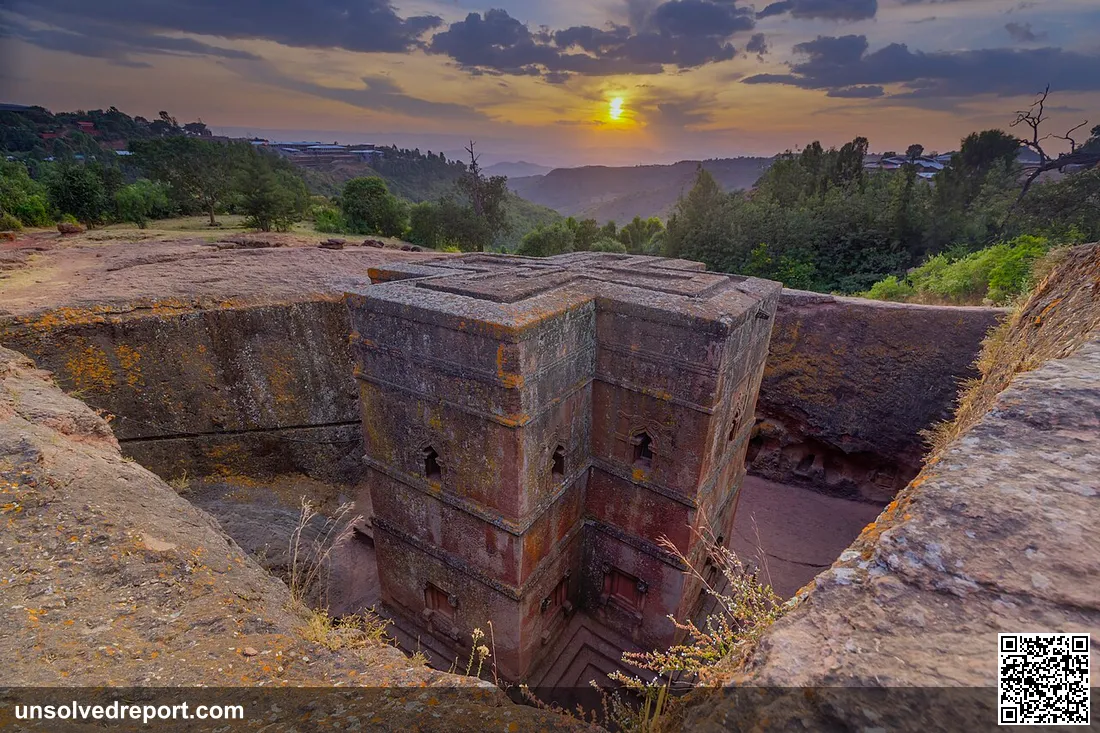
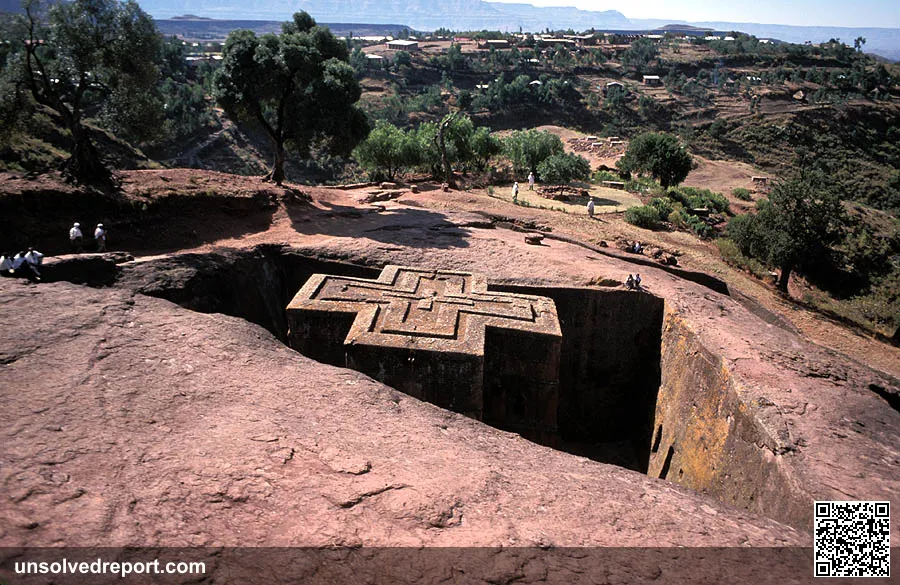
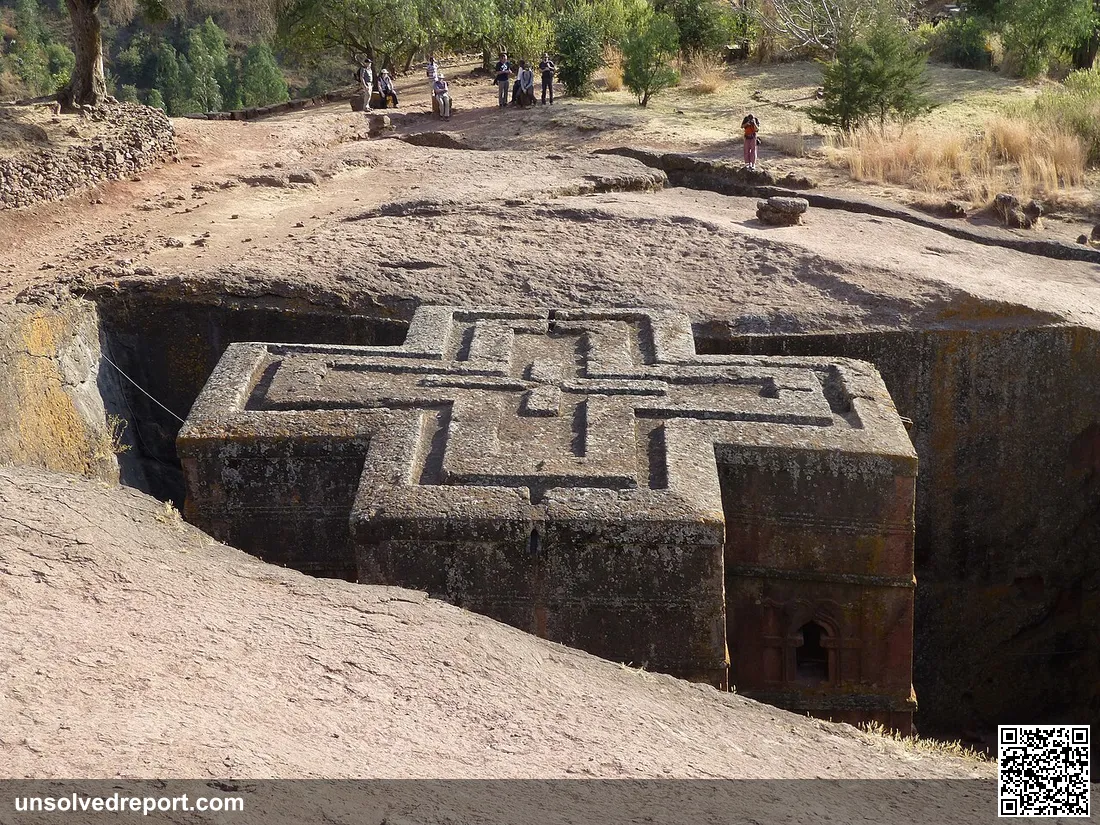
A perfect cross-shaped church sits at the bottom of a pit, sunk into the bedrock of the Ethiopian highlands. No foundation holds it up. No mortar binds it. There isn't a single joint anywhere, because there are no blocks at all. The whole thing is one piece of living rock. And here's the part that turns your brain inside out: the people who made it didn't build upward from the ground. They started at ground level and carved down, peeling away the mountain until a building emerged from inside it, as if it had been waiting there all along. How medieval hands pulled this off, and exactly when, is a riddle that still pulls archaeologists to a town called Lalibela.
What We Actually Know
Eleven churches. All carved straight out of the rock, monolithic and semi-monolithic, clustered in Ethiopia's Amhara Region. UNESCO put them on its World Heritage List back in 1978 (UNESCO). Tradition gives the credit to King Lalibela of the Zagwe dynasty, who ruled roughly 1181 to 1221. The story goes that after Muslim conquests cut off Christian pilgrims from the Holy Land, he decided to bring the Holy Land home, carving a "New Jerusalem" out of his own mountains (UNESCO; The Metropolitan Museum of Art).
The raw material was a sloping slab of soft red volcanic rock, often called scoria or tuff, sitting on top of a harder layer of grey basalt (UNESCO). Now think about how you'd normally make a building: you stack things. Lalibela's builders did the exact opposite. They didn't add. They subtracted, much like the underground excavators of Derinkuyu carved space out of solid rock rather than building up from a floor. As the Met Museum's essay lays it out, workers first drew the outline of a church onto the bare rock face, then chiseled down and around it to free a standing block, and only then hollowed out the inside. Every column, every arch, every window, every line of the roof is simply what they chose not to cut away (The Metropolitan Museum of Art). The building is the leftover.
And the scale is staggering. Biete Medhani Alem, with five aisles and a ring of carved pillars, is generally counted as the largest monolithic church on Earth, running about 33 meters long and 23 meters wide (Wikipedia: Biete Medhane Alem). The crown jewel, though, is Bete Giyorgis, the Church of Saint George, cut downward into the shape of a Greek cross from volcanic tuff. It's dated to the late 12th or early 13th century, during the reign of King Gebre Mesqel Lalibela, and it stands at the bottom of an artificial trench roughly 25 by 25 meters across and as much as 30 meters deep (Wikipedia: Church of Saint George, Lalibela). Picture a building the depth of a ten-story drop, all of it carved, none of it stacked.
But here's what really gets you: these aren't eleven separate objects scattered around. They're one designed landscape. A northern group and a southern group, split by a channel the locals call the Yordannos, the Jordan River, echoing the map of Jerusalem itself. Trenches, tunnels, and passages thread between the churches like veins, linking up with hermit caves and catacombs, and someone cut drainage channels straight into the stone to carry off the rain (UNESCO; The Metropolitan Museum of Art). And Lalibela isn't a ruin. People still worship here. It remains one of the most important pilgrimage sites in Ethiopian Orthodox Christianity, and its mortarless, stacked-nothing construction puts it in rare company with sites like Great Zimbabwe, where entire walls stand without a drop of binding mortar.
The Question Nobody Can Settle
Here's the strange part. After all the study, scholars still can't agree on when the complex was made, or in how many stages, a dating fight not unlike the one still raging over Gunung Padang on the other side of the world.
The traditional account is gloriously tidy: it all happened in the reign of one king, and angels worked the night shift alongside the human masons to finish the whole thing in about 24 years. That story is woven deep into Lalibela's living faith. The trouble is, the archaeology won't squeeze into one short burst of work. As the Met Museum puts it plainly, the precise dating of the complex and its individual churches "has yet to be determined," and many scholars suspect the site grew over several phases stretching across centuries, not a couple of decades (The Metropolitan Museum of Art).
And the deepest questions aren't about kings. They're about hands and sweat. How did medieval masons hit such precise geometry while carving downward and inward, with absolutely no way to put rock back if they cut one stroke too far? One mistake, and there's no undo. How many people, working how long, did it take to haul out that mountain of stone? And how much of what you see today was the original vision versus a later patch and tweak? Nobody has nailed these down. That open space, that "we genuinely don't know yet," is exactly what keeps Lalibela a live case instead of a closed one.
Theories and Interpretations
Theory 1: A site built in stages, partly older than King Lalibela (scholarly hypothesis). Cambridge archaeologist David W. Phillipson has argued that the churches weren't all cut in one go, but in roughly four or five phases somewhere between the 7th and 13th centuries. In his reading, some of them, including Merkorios, Gabriel-Rufael, and Danagel, may have started life as much as half a millennium earlier, and not as churches at all, but as fortifications or other structures from the late Aksumite period, only later widened and converted into places of worship. The finest basilica-style churches, the ones still carrying architectural details borrowed from ancient Aksum, would come from a later phase (World Archaeology; British Academy / Phillipson). Phillipson is careful to say he isn't tearing down the tradition, just sharpening it: the traditions are right to credit King Lalibela with the complex "in its present form and symbolism," even if much of the stone was carved long before him. This is one scholar's interpretation, not a settled verdict, and the dating work is still going.
Theory 2: One grand royal project of the early 13th century (the traditional historical view). The long-standing version says all eleven churches were dreamed up and executed as a single coordinated program under King Lalibela, a symbolic New Jerusalem built on Ethiopian soil, complete with its own Jordan River and place names lifted straight from the Holy Land (UNESCO). On this reading, the way everything fits together, the shared layout and shared symbolism, points to one mind behind it all.
Theory 3: The angels who carved by night (faith tradition, told as legend). Local tradition holds that the work raced ahead with the help of angels, who took over the carving after dark so the churches rose at impossible, superhuman speed. This is a treasured piece of religious heritage and a window into how the community feels about where its sacred places came from. To be clear, it's offered here as devotional legend, not as a claim about engineering or history.
Whatever the final timeline turns out to be, the churches are facing something more urgent than any dating debate: they're wearing away. UNESCO and conservation partners have documented weathering, water seeping into the stone, and structural decay in that soft volcanic rock, and protective shelters have been raised over several churches to slow the damage (UNESCO). It's a cruel irony. The very softness that let medieval carvers shape these buildings from the ground down is now the thing experts are racing to protect, so that Lalibela's beautiful unanswered questions can stay open a little longer.
Sources & further reading
- UNESCO World Heritage Centre, Rock-Hewn Churches, Lalibela: https://whc.unesco.org/en/list/18/
- The Metropolitan Museum of Art, The Rock-hewn Churches of Lalibela: https://www.metmuseum.org/essays/the-rock-hewn-churches-of-lalibela
- World Archaeology, Lalibela, Ethiopia, Rock-Hewn Churches: https://www.world-archaeology.com/features/lalibela-ethiopa-rock-hewn-churches/
- David W. Phillipson (British Academy), research on the chronology of Lalibela: https://www.thebritishacademy.ac.uk/documents/499/10-Phillipson.pdf
- Wikipedia, Church of Saint George, Lalibela: https://en.wikipedia.org/wiki/Church_of_Saint_George,_Lalibela
- Wikipedia, Biete Medhane Alem: https://en.wikipedia.org/wiki/Biete_Medhane_Alem

Lead Masks Case: 2 Men Dead, Masked, and No One Knows Why
A kite snagged in the grass led a teen to two dead men wearing homemade lead masks, a cryptic note about "capsules" and a "signal" — and zero answers since 1966.

Tsodilo Hills: The Cave Behind a 70,000-Year Ritual Claim
In Tsodilo Hills, a six-meter stone python hides in a cave — and one scientist called it humanity's oldest ritual. Why do her own colleagues disagree?

Baghdad Battery Debunked: The Myth Archaeologists Never Bought
The Baghdad Battery fooled the world for 80 years — but archaeologists never bought the electricity story. So what was inside that jar, really?