Tsodilo Hills: The Cave Behind a 70,000-Year Ritual Claim
In Tsodilo Hills, a six-meter stone python hides in a cave — and one scientist called it humanity's oldest ritual. Why do her own colleagues disagree?
The Kalahari in northwest Botswana is flat. Brutally, endlessly flat. And then, out of nowhere, four quartzite hills punch straight up into the sky.
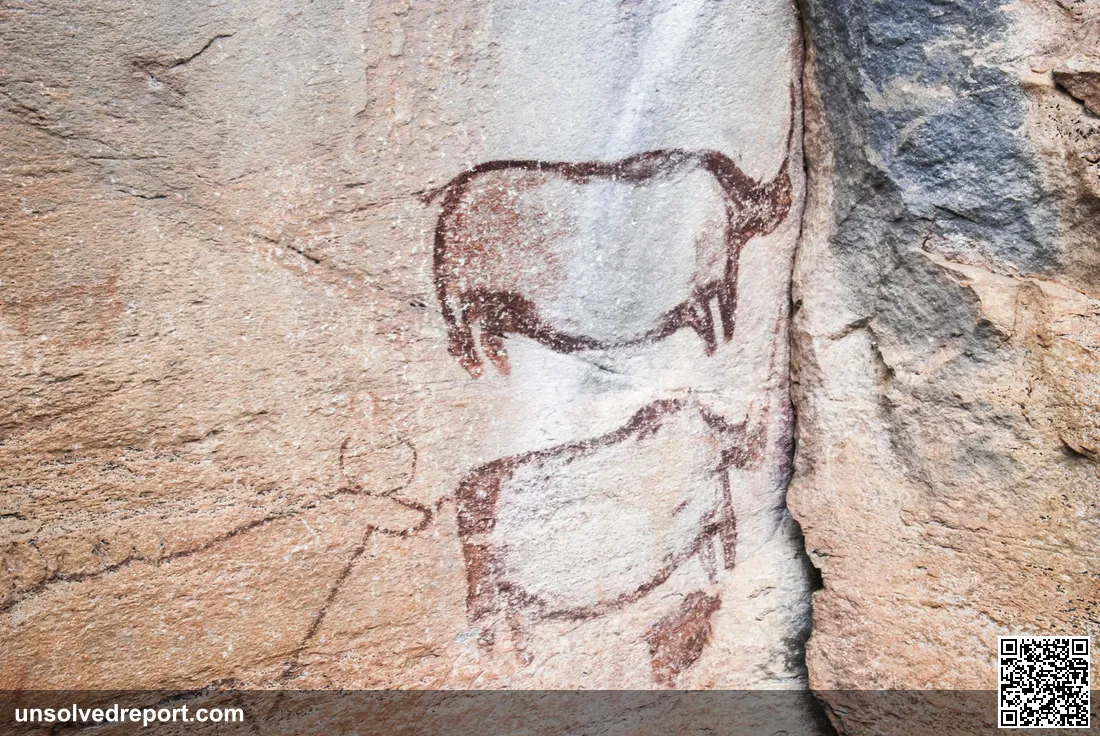
To the San and Hambukushu peoples who live nearby, these hills are not just rocks. They are alive. Ancestral. Sacred. To archaeologists, they are something else entirely: one of the densest galleries of ancient art anywhere on Earth, with thousands of paintings stacked across the stone over many thousands of years.
And then there's the cave. Deep inside one shadowed cavern on Female Hill sits a six-meter slab of stone, pocked with hundreds of marks. One researcher looked at it and told the world she had found the oldest known ritual in human history.
That single sentence took a quiet World Heritage Site and turned it into a scientific brawl that has never fully ended. So let's do the thing the headlines never do. Let's separate what we actually know from what is still wide open.
What we know for sure
In 2001, the world made it official: Tsodilo joined the UNESCO World Heritage List, honored both for its art and for the deep spiritual meaning it still holds for local communities (UNESCO). The place is tiny. The numbers are not. Pack it into roughly 10 square kilometers and you'll find hundreds of separate rock-art locations and more than 4,500 individual paintings crammed in, a concentration rivaled by few places beyond Bir Hima in Saudi Arabia. That density earned Tsodilo a nickname that has stuck for decades: "the Louvre of the Desert" (British Museum, African Rock Art; The Metropolitan Museum of Art).
The hills have names, and the names come straight from local tradition. There's the towering Male Hill, the broad Female Hill, the smaller Child Hill, and a fourth, unnamed knoll (Tsodilo, Wikipedia summary of UNESCO data). People have been coming here for an almost unthinkable span of time. Dig into the rock shelters and you hit layer after layer of human presence going back tens of thousands of years, from Stone Age tools deep down to, much later, Iron Age villages like Divuyu and Nqoma, where people once hammered iron and copper into tools and jewelry — the same Iron Age surge that, farther east, raised the stone walls of Great Zimbabwe (British Museum).
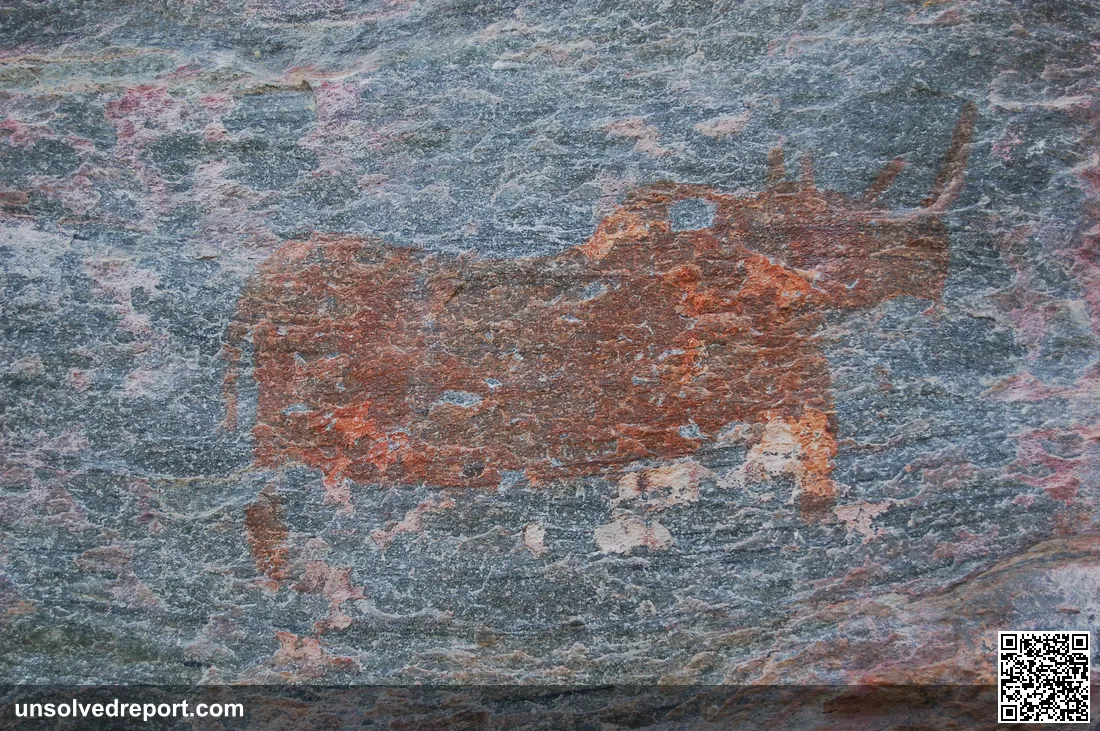
Here's something strange about the art itself. Across most of southern Africa, San paintings are famous for being delicate, fine, brush-drawn lines. Not here. At Tsodilo, the images were mostly painted with fingers, most of them in red ochre, with a separate batch of white images made by later artists (British Museum). And what did those fingers draw? Giraffe. Eland. Rhino. Cattle. Human figures. Strange geometric shapes that don't look like anything at all. Most scholars trace the older red paintings to ancestral San communities, with some of the later work linked to Khoe herders.
But to the people who hold Tsodilo sacred right now, none of this is a museum exhibit. In San tradition, this is the place of first creation, where the spirits of the very first animals pressed their tracks into the stone (Metropolitan Museum of Art). The hills are still used today, for hunting, for water, for ritual. That living connection is exactly why UNESCO leaned so hard on the site's spiritual weight.
The real question
So what's the mystery? It is not whether the hills are ancient. They are. It is not whether they're sacred. They are.
The mystery is about one cave. And one claim.
Did Stone Age people deliberately carve a snake into the rock, and then hold organized rituals in front of it, far, far earlier than anywhere else we've ever found — earlier, even, than the ritual site at Göbekli Tepe?
In 2006, the University of Oslo dropped a bombshell. An archaeologist named Sheila Coulson, working in a hidden cavern on Female Hill called Rhino Cave, said she had found "mankind's oldest ritual" (University of Oslo, Apollon).
Picture what she described. A six-meter rock slab, shaped like the head of a giant python. She counted three to four hundred indentations punched across its surface, marks she believed could only have been made by human hands. In daylight, they read like reptile scales. And by firelight? She said the rock seemed to ripple, as if the serpent itself were starting to move (ScienceDaily).
It gets stranger. Inside that cave, excavators pulled out more than 13,000 stone artifacts, mostly finely worked spearheads. Some were made from colorful stone hauled in from hundreds of kilometers away. And one detail jumped out: only the red spearheads showed signs of being burned. To Coulson, that wasn't wear and tear. That was deliberate ritual destruction. Behind the stone, she spotted a small hidden chamber with a worn-down entrance, and she wondered aloud whether a shaman could have crouched in there, hidden, seeming to speak with the snake's own voice (University of Oslo). The whole reading drew its power from San mythology, in which humankind itself is said to descend from the python, the same python that supposedly carved the region's dry riverbeds as it circled, endlessly, looking for water.
It was an electrifying story. And almost immediately, serious scientists started tearing into it.
That fight is the real mystery here. Not a ghost or a curse. A question of evidence, and how far you're allowed to stretch it.
Theories and interpretations
The "world's oldest ritual" case (a published idea, not a settled fact). Coulson and colleagues went on to lay out their argument in the peer-reviewed literature, making the case for ritual behavior in the Middle Stone Age at Rhino Cave (Coulson & Staurset, Ritualized Behavior in the Middle Stone Age: Evidence from Rhino Cave, Tsodilo Hills). Their evidence: the oddly specialized pile of artifacts, the spearpoints carried in from far away and then selectively burned, and the deliberate-looking work on the rock panel itself. Important to be clear here: this is a published hypothesis. It is not the agreed-upon answer.
The takedown (also peer-reviewed). The people who had originally excavated the cave were not impressed, and they said so in print. In a paper with a title that practically rolls its eyes, "World's Oldest Ritual Site? The 'Python Cave' at Tsodilo Hills" (Robbins, Campbell, Brook & Murphy, PaleoAnthropology, 2011), they argued the eye-popping 70,000-year figure simply wasn't backed by the cave's own layers of sediment. By their reading, the relevant radiocarbon and luminescence dates didn't actually pin down the panel, and the Middle Stone Age deposits looked a lot younger than that dramatic number suggested (summary via Smithsonian Libraries record; PaleoAnthropology). And those depressions on the rock? They weather very differently from one another. Some look fresh. Others look ancient and worn. To these critics, that points to marks piling up slowly over a very long time, not one big ritual moment buried deep in the past.
The "don't read today into yesterday" warning. There's a deeper objection running underneath all of it. A lot of archaeologists get nervous when modern San beliefs are used to explain what people were thinking tens of thousands of years ago. You can't just assume a culture stayed unchanged across that staggering stretch of time. The python symbolism is powerful, yes. But powerful is not the same as proof.
The "it's just a rock" possibility. Then there's the most deflating reading of all. Maybe a naturally snake-shaped quartzite ridge, plus some cup-like marks, plus flickering firelight, is all you need to conjure a convincing serpent. That's pareidolia, our brain's stubborn habit of finding faces, animals, and meaning in shapes that have none.
So here's the honest bottom line. There is no scholarly consensus that Rhino Cave was the world's oldest ritual site, and the sharpest attacks on the idea come from the very people who first dug there. But here's what nobody is arguing about: Tsodilo is extraordinary. A desert sanctuary holding thousands of paintings, a human story tens of thousands of years deep, and sacred meaning that is still alive today.
Maybe the python in the cave is 70,000 years old. Maybe it's just a trick of stone and shadow. Either way, the hills lose none of their power. And somewhere out there, the next snake-shaped stone is still waiting in the dark for someone to walk in with a torch.
Sources & further reading
- UNESCO World Heritage Centre, "Tsodilo" — https://whc.unesco.org/en/list/1021
- British Museum, African Rock Art: Tsodilo Hills, Botswana — https://africanrockart.britishmuseum.org/country/botswana/tsodilo/
- The Metropolitan Museum of Art, "Tsodilo Hills, Botswana" — https://www.metmuseum.org/perspectives/tsodilo-hills
- University of Oslo, Apollon, "World's oldest ritual discovered" (2006) — https://www.uio.no/english/research/research-news/apollon/articles/2006/python-english.html
- ScienceDaily, "World's Oldest Ritual Discovered" (2006) — https://www.sciencedaily.com/releases/2006/11/061130081347.htm
- Robbins, Campbell, Brook & Murphy, "World's Oldest Ritual Site? The 'Python Cave' at Tsodilo Hills," PaleoAnthropology (2011) — https://paleoanthro.org/static/journal/content/PA20110018.pdf
- Smithsonian Libraries record, "World's Oldest Ritual Site? The Python Cave at Tsodilo Hills" — https://collections.si.edu/search/record/siris_sil_941127
- Coulson & Staurset, "Ritualized Behavior in the Middle Stone Age: Evidence from Rhino Cave, Tsodilo Hills, Botswana" — https://www.semanticscholar.org/paper/Ritualized-Behavior-in-the-Middle-Stone-Age:-from-Coulson-Staurset/e4b2993e2aed489f6ec5e781d55fc2b8e7a18081
- Tsodilo, Wikipedia (summarizing UNESCO data) — https://en.wikipedia.org/wiki/Tsodilo

Baghdad Battery Debunked: The Myth Archaeologists Never Bought
The Baghdad Battery fooled the world for 80 years — but archaeologists never bought the electricity story. So what was inside that jar, really?

GRB 221009A: The BOAT, the Brightest Gamma-Ray Burst Ever
GRB 221009A hit every detector in the solar system and even reached Voyager 1. It also fired photons physics says should be impossible. Here's the BOAT.

Flyby Anomaly: The NASA Speed Boost No One Can Explain
Galileo, NEAR, Rosetta: NASA probes kept leaving Earth faster than physics allows. Decades later, scientists still can't agree on why. Here's the data.