Flyby Anomaly: The NASA Speed Boost No One Can Explain
Galileo, NEAR, Rosetta: NASA probes kept leaving Earth faster than physics allows. Decades later, scientists still can't agree on why. Here's the data.
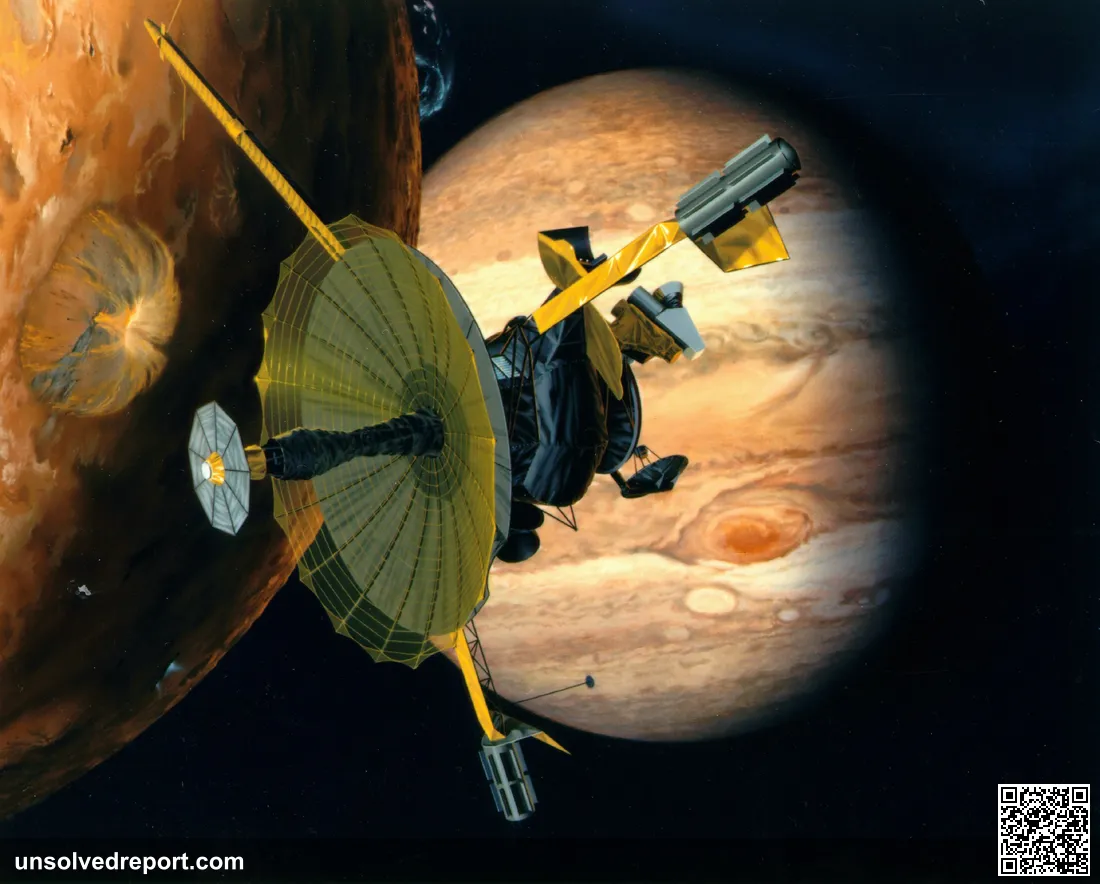
December 1990. A NASA spacecraft called Galileo dives toward Earth, steals a little speed from the planet, and slings itself out toward Jupiter. Textbook maneuver. It works exactly as planned.
Then the navigators at the Jet Propulsion Laboratory sit down with the tracking data, and something is off. Galileo left Earth roughly 3.92 millimeters per second faster than the laws of orbital mechanics allow (Anderson et al., Physical Review Letters, 2008). That is about the pace of a crawling snail. It is also, as far as anyone can tell, impossible.
That sliver of extra speed has a name now: the flyby anomaly. For more than three decades it has lived in the no-man's-land between "obvious glitch" and "hint of new physics," and nobody has ever fully nailed it down. This is the story of a mystery measured in millimeters.
What we actually measured
A "gravity assist," or slingshot, is one of the most routine tricks in spaceflight. A probe falls toward a planet, borrows a bit of the planet's motion around the Sun, and whips outward faster than it arrived. Engineers nail these encounters with almost absurd precision, because the physics underneath, Newton's gravity plus Einstein's tiny corrections, is some of the best-tested science humanity has.
So when Galileo came up short, it stood out. The predictions are supposed to be that good. After the 1990 pass, scientists went back and combed through other Earth flybys, looking for the same fingerprint. In 2008, a team led by John D. Anderson of JPL published the result in the peer-reviewed journal Physical Review Letters: a clear pattern of velocity changes that nobody had ordered (Anderson et al., 2008).
The numbers are small. But look closely, because in a couple of cases they blow right past the tracking error bars (Wikipedia summary of published flyby data):
- Galileo, December 1990: +3.92 mm/s (faster than predicted)
- Galileo, December 1992: about −4.6 mm/s (this time slower)
- NEAR, January 1998: +13.46 mm/s, the biggest clean anomaly on record
- Cassini, August 1999: roughly −2 mm/s
- Rosetta, March 2005: +1.82 mm/s
Two things make this hard to wave away. First, these are real residuals sitting in carefully calibrated radio-tracking data, not napkin math. Second, that NEAR figure of 13.46 mm/s lands so far outside its stated uncertainty (about ±0.13 mm/s) that "random fluke" just doesn't cover it. The Physical Review Letters paper called the Earth flyby anomaly "a real effect inherent to the tracking of spacecraft," and admitted its source was unknown.
Here's the tantalizing part. Anderson's team noticed the anomaly seemed to care about geometry: how big it was, and whether it sped a probe up or slowed it down, tracked with the latitudes where the spacecraft came in and went out. They boiled that pattern down into a formula, in which the fractional velocity change depends on Earth's rotation rate, Earth's radius, and the difference in the cosines of the inbound and outbound angles (Anderson et al., 2008). One catch, and it matters: the formula only describes. It's a curve traced over the old data. It never says why.
The question that won't close
This is where the mystery gets worse instead of better.
If the flyby anomaly were a genuine law of nature, it should show up every single time the geometry calls for it. It doesn't.
Run the later flybys through modern tracking and modern gravity models, and the effect basically vanishes. MESSENGER's 2005 Earth pass came in at a piddling 0.02 mm/s. Rosetta's second and third trips by Earth, in 2007 and 2009, showed nothing meaningful either, even though Anderson's own formula insisted they should (multivariate analysis, arXiv preprint, 2017). It's the kind of inconsistency that echoes Voyager's own uncorrected tracking puzzle far out at the edge of the solar system: instruments that mostly agree with theory, except when they don't.
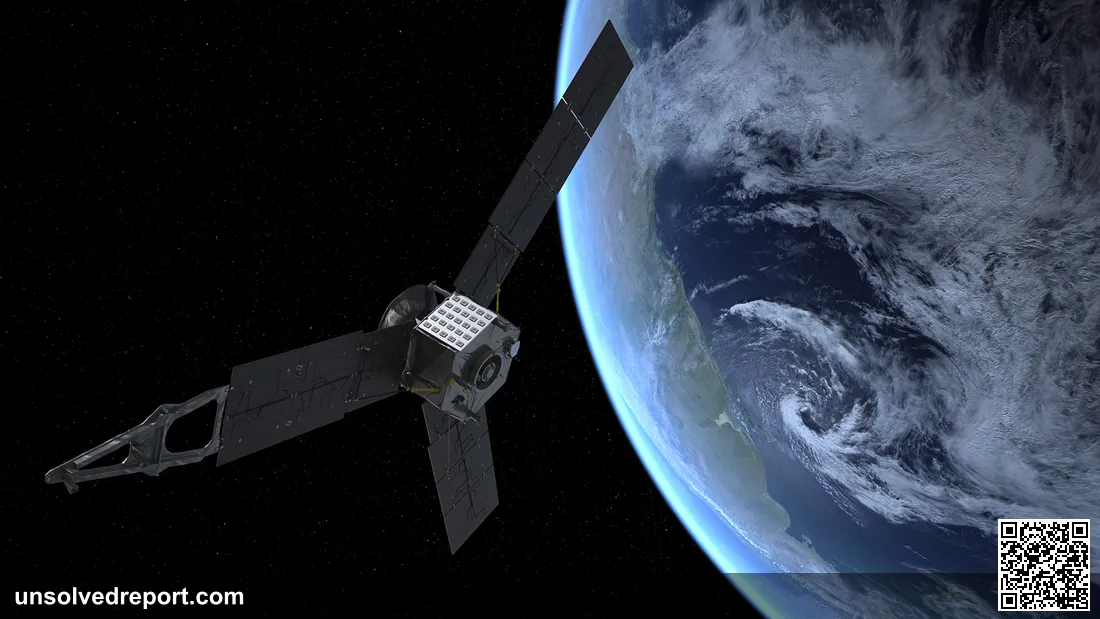
Then came the showdown. October 2013: NASA's Juno spacecraft swung past Earth on its way to Jupiter, and everyone knew to watch. Beforehand, physicist Stephen Adler had warned that if certain new-physics ideas held water, Juno should post a "large anomaly" of around 11.6 mm/s. Instead, Juno threaded the encounter almost exactly on prediction. The measured anomaly came out consistent with zero, about 0 ± 0.8 mm/s (Universe Today coverage; ESA Rocket Science blog, 2013). That quiet null result swept several exotic explanations off the table, including the eerie notion that a halo of dark matter wrapped around Earth was tugging on passing probes.
So the real puzzle splits in two. Why did the early flybys, Galileo and NEAR, throw up clean anomalies that fit a formula? And why did the later, arguably better-measured ones throw up nothing? Maybe the early signals were just ghosts of 1990s modeling that newer methods quietly exorcised. Or maybe there's a subtle effect that only wakes up under conditions the recent flybys never met. Either way, the case is still open, not unlike the Hubble Tension, where two equally careful measurement methods refuse to agree and nobody can say which one is wrong.
The suspects
Below are the leading explanations, from dull to wild. None is confirmed. Several have already taken hits from those null results.
The boring-but-likely camp (and a lot of specialists lean here). The strongest bet is that the early anomalies were never real physics at all, just modeling and measurement artifacts. Researchers have shown that feeding the math a too-coarse map of Earth's gravity field, or fumbling exactly how radio signals thread through the tracking network, can fake velocity errors of several mm/s (Juno flyby analysis, arXiv, 2013). Adler himself doesn't pretend otherwise. The old anomalies "could be simple instrumental errors," he told Vice, adding that he was "not convinced there's real physics in it" (Vice, 2020). And the way the anomaly faded as the tracking tech sharpened fits that story almost too neatly.
The subtle-known-physics camp. Other researchers wonder if the culprit is a small piece of established physics that got mishandled, say, an unmodeled relativistic effect like frame-dragging (Earth's spin literally twisting the spacetime around it), or some overlooked wrinkle in how the radio signal's Doppler shift should be calculated. Interesting leads. So far none of them snaps cleanly onto every flyby.
The new-physics camp (speculation, plainly). A few physicists have reached for genuinely strange ideas. Mario Pinheiro of the University of Lisbon floated a "topological torsion current," a force nobody had recognized before, while Luis Acedo of Spain's University of Extremadura has poked at versions of general relativity that bend spacetime through torsion (Vice, 2020). Their authors are upfront that these are exploratory shots in the dark, and Juno's flat result makes the boldest versions much harder to defend, the same way 'Oumuamua's unexplained acceleration has outlived most of the exotic explanations proposed for it.
What makes the flyby anomaly such a satisfying puzzle is its honesty. No grainy photo. No friend-of-a-friend story. Just a few numbers in some of the most meticulously kept logbooks in all of spaceflight, numbers that mostly agree with theory, except for a stubborn handful of millimeters per second that, for now, refuse to be explained. Somewhere in those logbooks, the answer may already be written. We just can't read it yet.
Sources & further reading
- Anderson, J. D., et al. (2008). "Anomalous Orbital-Energy Changes Observed during Spacecraft Flybys of Earth." Physical Review Letters 100, 091102. https://ui.adsabs.harvard.edu/abs/2008PhRvL.100i1102A
- "Fly-by anomaly." Wikipedia (data table of measured velocity changes and proposed explanations). https://en.wikipedia.org/wiki/Fly-by_anomaly
- Acedo, L., et al. (2017). "The flyby anomaly: A multivariate analysis approach" (preprint). arXiv:1701.05735. https://arxiv.org/pdf/1701.05735
- "Expected velocity anomaly for the Earth flyby of Juno spacecraft on October 9, 2013" (preprint). arXiv:1312.1139. https://arxiv.org/abs/1312.1139
- ESA Rocket Science blog (2013). "Tonight's Juno flyby may help unravel a cosmic mystery." https://blogs.esa.int/rocketscience/2013/10/09/tonights-juno-flyby-may-help-unravel-a-cosmic-mystery/
- Universe Today. "Juno Isn't Exactly Where it's Supposed To Be. The Flyby Anomaly is Back." https://www.universetoday.com/articles/juno-isnt-exactly-supposed-flyby-anomaly-back-happen
- Vice (2020). "A Bizarre Spacecraft 'Flyby Anomaly' Has Been Baffling Scientists for 30 Years." https://www.vice.com/en/article/a-bizarre-spacecraft-flyby-anomaly-has-been-baffling-scientists-for-30-years/
- IFLScience. "Flyby Anomaly: The Unexplained Phenomenon Affecting Several NASA Spacecraft." https://www.iflscience.com/flyby-anomaly-the-unexplained-phenomenon-affecting-several-nasa-spacecraft-76014
The Eltanin Antenna: A Machine on the Seafloor?
In 1964 a deep-sea camera off Cape Horn caught what looked like a TV antenna standing on the abyssal seafloor. It was alive — and it hunts.
Hoa Hakananai'a: The Easter Island Statue Hiding a Second Face
Hoa Hakananai'a's front is one religion. Its back, carved centuries later, is another. No one can say exactly when the switch happened — or why.
10 Ancient Artifacts That Shouldn't Exist
From a Greek geared computer to Roman nanoparticle glass, ten real artifacts that sit in the wrong slot in history and still leave experts stumped.