The Eltanin Antenna: A Machine on the Seafloor?
In 1964 a deep-sea camera off Cape Horn caught what looked like a TV antenna standing on the abyssal seafloor. It was alive — and it hunts.
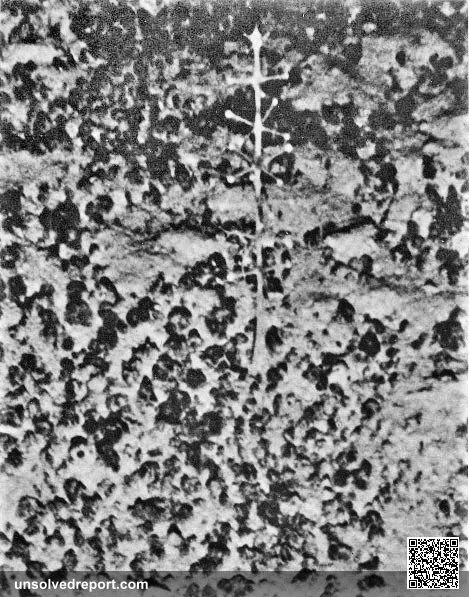
August 29, 1964. A camera sinks nearly two and a half miles into the black water off the tip of South America, hits bottom, and fires. When the film comes back, there is a thing standing in the mud that should not be there. A slim vertical stalk. Evenly spaced crossbars climbing it like rungs. It looks built — like a television antenna, or a microwave relay someone bolted to the abyssal plain a thousand miles from any coast.
The ship holding the camera was the USNS Eltanin, an American research vessel grinding through the violent seas near the Drake Passage. And the photograph it brought up would spend the next fifty years caught between two worlds — fringe whispers about a machine on the seabed, and the slow, patient work of marine biology. Here's the twist: the real answer is stranger than the alien one. And scientists are still filling it in today.
What the camera actually caught
Let's be clear about the Eltanin first, because it matters. This was no UFO hunt. The ship was a converted ice-strengthened cargo vessel, handed to the National Science Foundation's U.S. Antarctic Research Program and reclassified as an oceanographic research vessel in 1962 (Wikipedia, "USNS Eltanin")). Across 52 cruises between 1962 and 1972 it logged some 400,000 miles and helped chart roughly 80 percent of the Southern Ocean — pioneering surveys in one of the least-mapped corners of the planet, the same icy frontier that still hides sealed wonders like Lake Vostok under the Antarctic ice sheet.
The famous frame came up west of Cape Horn, at roughly 59°07′S, 105°03′W, from a depth of 3,904 meters — 12,808 feet down (Wikipedia, "Eltanin Antenna"). That's the deep southern South Pacific, right where it shoulders into the storm-lashed Drake Passage corridor between South America and Antarctica — the same gateway the Eltanin spent years probing. And the "antenna"? Upright. Symmetrical. Unsettlingly regular. The kind of thing that makes you lean closer to the picture.
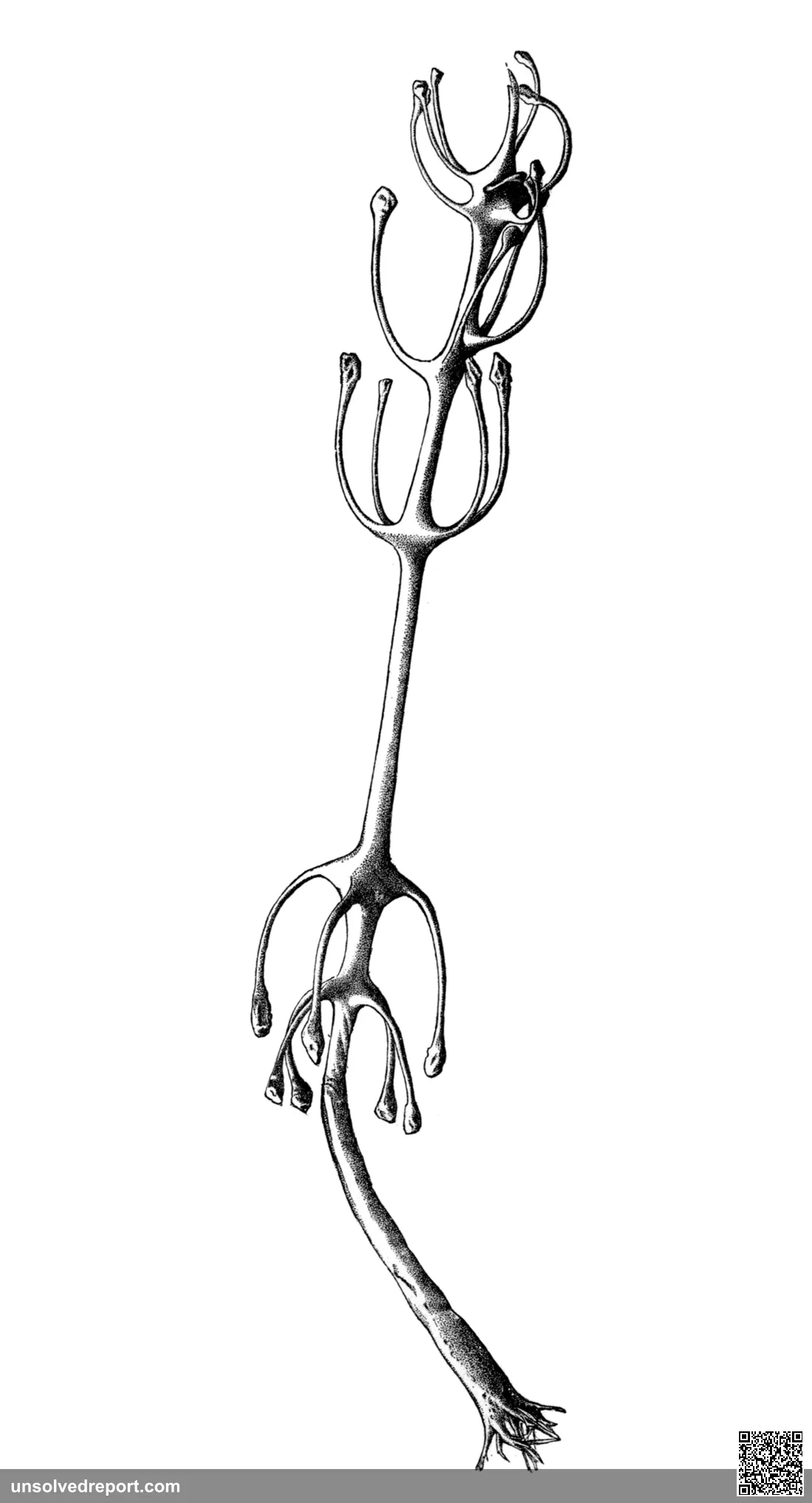
The answer arrived in 1971, and it arrived quietly. Oceanographers Bruce C. Heezen and Charles D. Hollister put out a book, The Face of the Deep, and named the object: a deep-sea sponge then called Cladorhiza concrescens (today it lives in the genus Chondrocladia). Their own description has a deadpan charm — the thing, they wrote, "somewhat resembles a space-age microwave antenna" (Wikipedia, "Eltanin Antenna"). Here's the part that makes the alien story collapse: this sponge wasn't even new. Oscar Schmidt had formally described it back in 1880, from specimens dredged up by the legendary HMS Challenger expedition (Wikipedia, "Chondrocladia concrescens"). The naturalist Alexander Agassiz had already sketched its shape: "a long stem ending in ramifying roots, sunk deeply into the mud," its nodes sprouting four to six club-like appendages.
So why did anyone think it was a machine? Because that identification sat locked inside specialist literature for decades, and almost nobody knew. It only reached the public by accident. In 2003, a chat on a UFO mailing list nudged researcher Tom DeMary to hunt down A. F. Amos — an oceanographer who had actually sailed on the Eltanin in the 1960s. Amos pointed him to Heezen and Hollister's book. DeMary scanned the old sponge drawings and posted them online (Wikipedia, "Eltanin Antenna"). Just like that, the "alien antenna" had a name, a date, and a Victorian pedigree.
The mystery that's actually still open
Now here's where the real wonder hides. It was never about whether the object was a machine — it wasn't. The genuine question is how little we still know about the gardens it grew in. A sponge shaped like an antenna is odd enough. But a sponge that hunts? That's the shock.
Picture the average sponge: a quiet filter feeder, pulling seawater through its body to strain out bacteria, harmless as a kitchen sieve. Chondrocladia and its cousins in the family Cladorhizidae threw that life away. They turned predator. And science didn't even know carnivorous sponges existed until 1995, when Asbestopluma hypogea turned up in a Mediterranean sea cave — and suddenly it was clear that meat-eating runs right across this whole family (Wikipedia, "Chondrocladia"). The trick is brutal and slow: they snag tiny crustaceans on surfaces bristling with microscopic hooked spicules, then gradually wrap them up and digest them alive.
So the open question is really one of bookkeeping. We've examined only a sliver of the Southern Ocean floor in any detail, and every new expedition rewrites the map. In October 2025, the Nippon Foundation–Nekton Ocean Census, teamed with the Schmidt Ocean Institute, confirmed 30 previously unknown deep-sea species from the region — among them a new carnivorous "death-ball" sponge (Chondrocladia sp.), studded with prey-trapping hooks, found near 12,000 feet down (Yale Environment 360). And listen to how much is left: Ocean Census head of science Michelle Taylor said the team had assessed "under 30 percent of the samples collected from this expedition." Sit with that. The Eltanin photographed one antenna-shaped resident of a neighborhood we have barely started to count — just one entry in a much longer list of deep sea mysteries science still can't explain.
Three ways to read the picture
The alien version (speculation — and no, it doesn't hold up). Starting in the 1960s, then catching fire online in the 2000s, fringe writers floated the idea that the structure was an alien artifact or relic of a lost civilization — the same reflex that fuels the natural-vs-manmade debate over Japan's underwater Yonaguni Monument. There's nothing behind it. The shape, the spicule structure, and the matching specimens sitting in the Challenger collection all point one way: a living organism. Call it legend. It survives for one reason — the photograph genuinely looks manufactured — not because a single shred of data backs it.
The "antenna" is a hunting rig (this one's solid). The most convincing scientific reading flips the whole thing: the very geometry that fooled our eyes is a weapon. Take the harp sponge Chondrocladia lyra, described by MBARI researchers in 2012 from depths around 3,300 meters off California. It fans its branches into parallel vertical "vanes," like the strings of a harp — a layout that wrings maximum surface area out of the water to snare prey drifting past on deep-sea currents (MBARI, "Scientists discover extraordinary new carnivorous sponge"). Apply that to the Eltanin sponge and its tidy crossbars become the same gambit: a living trellis tuned to catch the slow rain of food in a near-foodless world. The antenna symmetry isn't engineering. It's evolution arriving at the same blueprint from a completely different direction.
The "sponge forest" idea (newer, and partly a guess). More and more, researchers describe dense Antarctic and sub-Antarctic sponge beds as full-blown habitats — three-dimensional thickets that shelter other animals the way kelp or coral does. Did the Eltanin camera catch a lone individual, or the ragged edge of a whole community like that? One black-and-white frame can't tell us. That's an honest extrapolation from later, better-documented surveys — reasonable, but unconfirmed. Hold it loosely.
And that's the lesson buried in the photograph. A camera went somewhere no human had ever been, came back with an image that looked impossible, and made us wait decades for the truth — much like the Wow! signal, another one-shot anomaly that took years just to get taken seriously. The truth wasn't a machine. It was a hooked, patient, predatory sponge — proof that the real Drake Passage seafloor needs no invention to stop you cold. The unsettling part isn't the one antenna we identified. It's the 70 percent of those samples nobody has looked at yet.
Sources & Further Reading
- Wikipedia, "USNS Eltanin (T-AK-270)")
- Wikipedia, "Eltanin Antenna"
- Wikipedia, "Chondrocladia concrescens"
- Wikipedia, "Chondrocladia"
- MBARI, "Scientists discover extraordinary new carnivorous sponge"
- Yale Environment 360, "'Death Ball' Sponge and Glowing Worms Among Creatures Discovered in Southern Ocean"
Hoa Hakananai'a: The Easter Island Statue Hiding a Second Face
Hoa Hakananai'a's front is one religion. Its back, carved centuries later, is another. No one can say exactly when the switch happened — or why.
10 Ancient Artifacts That Shouldn't Exist
From a Greek geared computer to Roman nanoparticle glass, ten real artifacts that sit in the wrong slot in history and still leave experts stumped.

Kaspar Hauser: The Lost Prince DNA Couldn't Name
Kaspar Hauser claimed 16 years locked in the dark, then died from a wound he may have inflicted himself. In 2024, DNA answered one question about the 'lost prince' — but not the one everyone wanted.