Lead Masks Case: 2 Men Dead, Masked, and No One Knows Why
A kite snagged in the grass led a teen to two dead men wearing homemade lead masks, a cryptic note about "capsules" and a "signal" — and zero answers since 1966.
August 20, 1966. An 18-year-old is flying a kite on a hill outside Rio de Janeiro when the wind tugs his line into the tall grass. He goes to free it — and finds two men. Both well-dressed. Both lying neatly side by side. Both dead. And over each man's eyes sits a crudely cut mask made of lead.
No blood. No torn clothes. No sign anyone fought back. And, sixty years later, no agreed-upon reason any of it happened. Police argued. Pathologists argued. Armchair detectives are still arguing. The file has never closed. Here's what we actually know, where the real mystery hides, and which famous "answers" are just guesses wearing a lab coat.
Two ordinary men, one strange August day
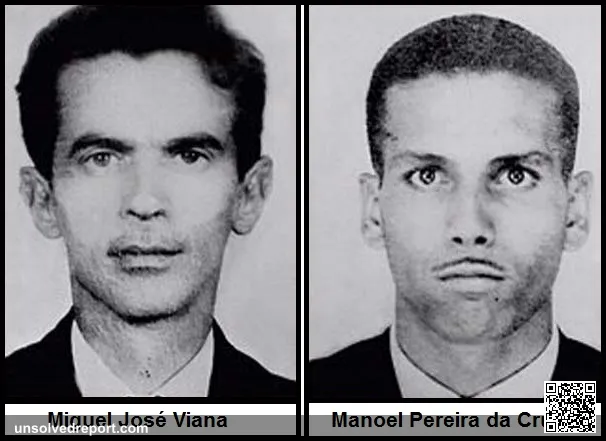
Start with the men, because they were not spooky cult figures or wild-eyed mystics. They were Miguel José Viana, 34, and Manoel Pereira da Cruz, 32 — married electronics technicians from Campos dos Goytacazes, a town about 175 miles from where they died (All That's Interesting; Mental Floss). They fixed radios and televisions for a living. Friends and family described them as serious men, good at the job (Wikipedia).
So picture the most normal errand in the world. On August 17, 1966, the two left home and told relatives they were going to buy equipment — and, by some accounts, a used car. They caught a bus to Niterói, the city across the bay from Rio, and got there in the early afternoon (Wikipedia).
We can still follow their footsteps, up to a point. Reporting says they bought waterproof coats at a local shop, then stepped into a bar and bought a single bottle of mineral water — and asked for a receipt, exactly the way men do when they plan to be paid back for work expenses (Historic Mysteries). Here's the small chill in an otherwise dull afternoon: a server at that bar later told investigators that Viana seemed nervous and kept checking his watch, like a man waiting on a deadline he couldn't miss (Wikipedia).
That was the last time anyone saw either of them alive.
On the hill
Three days passed. Then, on August 20, Jorge da Costa Alves — the 18-year-old with the kite — pushed into the tall vegetation on Morro do Vintém (Vintém Hill) and found them. The slope was so steep that police and firefighters couldn't even reach the bodies until the next day (All That's Interesting; Wikipedia).
And the scene is where this stops being a missing-persons story and becomes something else entirely.
The two men lay beside each other, dressed in formal suits and waterproof coats, each with a homemade mask cut from lead placed over the eyes. No obvious wounds. No signs of violence, no struggle. Scattered nearby: an empty water bottle, a packet holding two wet towels, and a small notebook (Wikipedia; Mental Floss).
Open the notebook and you find the line that made this case famous. Written in Portuguese, it reads roughly: "16:30 be at the agreed place. 18:30 ingest capsules, after effect protect metals, await mask signal" (Wikipedia). Read it again slowly. A meeting time. A pill. A signal. A mask. It sounds less like an errand and more like instructions for a ritual.
And the lead itself? Strange, but not impossible for the era. Homemade lead masks were a documented thing back then — workers and hobbyists sometimes used lead shielding around radiation sources or blinding light (Historic Mysteries). Which raises the obvious question: what, on a quiet Brazilian hilltop, were these two men expecting to shine?
Then the case ran into the wall that has frustrated everyone since. Because of a backlog at the coroner's office, the autopsies were badly delayed — and by the time anyone examined the internal organs, they were too decomposed for reliable toxicology (Wikipedia; Historic Mysteries). No poison was ever pinned down. No drug. No radiation to explain the masks. The official cause of death came back as one cold word — undetermined — and it has never been revised (Wikipedia), the same unsatisfying verdict that still haunts the Somerton Man case half a world away.
The question nobody can answer
Strip away the legend, the late-night podcasts, and the saucer fans, and one hard puzzle is left standing:
How do two healthy men die at the exact same time, in the exact same spot — with no wound, no clear poison, no sign of force — and why are they wearing lead masks?
Every extra detail makes it worse, not better. The note doesn't read like men who were ambushed; it reads like men who prepared. "Ingest capsules." "Await signal." That's a planned event, maybe even a ritual one. Yet the masks suggest fear of a blinding light or radiation — a wildly elaborate precaution for a couple of guys just trying a strange drug.
And the money is its own little fog. The men reportedly carried a large sum, possibly for that car. Some sources say a big amount was never recovered — while other reporting says their wallets still held cash and their belongings looked untouched (Wikipedia). So even "was anything stolen?" is genuinely contested in the record, and worth treating with caution. Meanwhile the ruined toxicology means the single most important question — what was in those capsules, if anything at all? — may be unanswerable forever.
So what killed them? The theories
Everything below is interpretation, not proven fact. Nobody has confirmed any of it. Read them as the best guesses people have argued over for decades — nothing more, the same way early theorizing about the Dyatlov Pass deaths ran wild for decades before anyone modeled a real answer.
Theory one: a séance gone wrong. This is the popular one. The idea is that the men belonged to a circle fascinated by Spiritism and "scientific" séances, and that they climbed the hill hoping to make contact with spirits or a higher plane — possibly after swallowing some substance. Investigators reportedly turned up spiritualist literature and mask-making materials tied to the men, and a relative is quoted saying the car-buying trip was a cover story for the outing's "real purpose" (Wikipedia; Historic Mysteries). In this version, the lead masks were shields against an expected blinding light, and the deaths were a tragic accidental overdose. It fits the note. It fits the masks. The problem? The wrecked toxicology means it can never actually be proven.
Theory two: somebody killed them. A darker reading says this was a crime. In 1969 a man named Hamilton Bezani, described in coverage as tied to the criminal underworld, reportedly claimed involvement, linking the men to a meeting at a spiritualist center (heartstartspounding.com). But here's the catch: that confession has never been corroborated, and it's widely viewed as unreliable — the kind of dead-end lead that turns up in almost every case this cold, from Hinterkaifeck's unsolved farmhouse killings to this one. The "missing money" angle would back a robbery — except, as we just saw, the missing money itself is in dispute.
Theory three: the UFO that ate the case. This is why the whole thing went global. On the same evening, a woman named Gracinda Barbosa Coutinho de Souza said she and her children watched an oval, orange object trailing fire rise and fall over the hill area (anomalyinfo.com). UFO enthusiasts seized on it and welded her sighting onto the masked men, the same way a single eyewitness account fueled decades of speculation around the Betty and Barney Hill abduction. But be clear-eyed here: this is a witness account, not verified physical evidence, and there is no documented link between her light and the deaths. We mention it only because it powered the case's fame — not because it explains a single thing.
What outlasts all the theories is the same quiet, unsettling picture the kite-flyer stumbled into that afternoon: two ordinary repairmen, dressed up for an occasion only they understood, who climbed a hill to wait for a signal — and never came back down. Whatever they thought was coming for them up there, the lead masks suggest they were certain it would be bright. We just don't know what it was.
Sources & Further Reading
- Wikipedia, "Lead masks case"
- Mental Floss, "The Bizarre Lead Mask Deaths of 1966"
- All That's Interesting, "Inside the Baffling Deaths of Two Men Found With Lead Masks"
- Historic Mysteries, "The Lead Masks Case"
- Anomalies: the Strange & Unexplained, "1966, August 17: The Lead Masks Mystery"
- Heart Starts Pounding, "The Unsolved Mystery of the Lead Masks Case"
Tsodilo Hills: The Cave Behind a 70,000-Year Ritual Claim
In Tsodilo Hills, a six-meter stone python hides in a cave — and one scientist called it humanity's oldest ritual. Why do her own colleagues disagree?
Baghdad Battery Debunked: The Myth Archaeologists Never Bought
The Baghdad Battery fooled the world for 80 years — but archaeologists never bought the electricity story. So what was inside that jar, really?

GRB 221009A: The BOAT, the Brightest Gamma-Ray Burst Ever
GRB 221009A hit every detector in the solar system and even reached Voyager 1. It also fired photons physics says should be impossible. Here's the BOAT.