Niya: The Silk Road Town the Desert Ate Alive
Niya ruins: a Silk Road town frozen mid-life in the Taklamakan Desert—houses standing, letters still legible after 1,700 years. So why did everyone just... walk away?
The houses are still standing. That's the first thing that gets you. More than 60 miles from the nearest drop of living water, in the middle of one of the deadliest deserts on Earth, the timber frames of homes still rise out of the sand. Dead orchard stumps poke up where gardens grew almost two thousand years ago. And inside, wooden tablets lie exactly where someone set them down — in their original archive boxes, the ink still dark enough to read. This is Niya. The Silk Road forgot it, the desert buried it, and the dry air kept it almost perfectly. People walked away. The river vanished. The dunes closed the door. Then in 1901 a British explorer tripped over the whole frozen scene. And the question it left behind is so simple it stings: why did everyone go?
What We Actually Know
Start with the map. Niya sits about 115 km — roughly 71 miles — north of modern Niya Town, on the southern lip of the Tarim Basin in Xinjiang, China, deep inside the Taklamakan Desert beside a riverbed that died long ago (Wikipedia: Niya ruins). The people who lived there had their own name for it: Caḍ́ota. The Chinese of the Han dynasty called it Jingjue (精絕) (Wikipedia: Niya ruins). It was no backwater. It was a working pit stop on the southern branch of the Silk Road, the place where caravans hugging the edge of the desert's killing interior could finally find water, food, and a roof.
And it is huge. Stretch out your arms across a map and Niya covers about 30 km north to south and 5 km east to west, threaded along the dead Niya River — a stupa, Buddhist shrines, houses, orchards, ponds, kilns, and graveyards, all of it still there (China Silk Road Travel). Here's why it survived: the Taklamakan is one of the driest places on the planet. Anything organic that would have rotted to nothing in a normal climate simply sat there, century after century, waiting to be found.
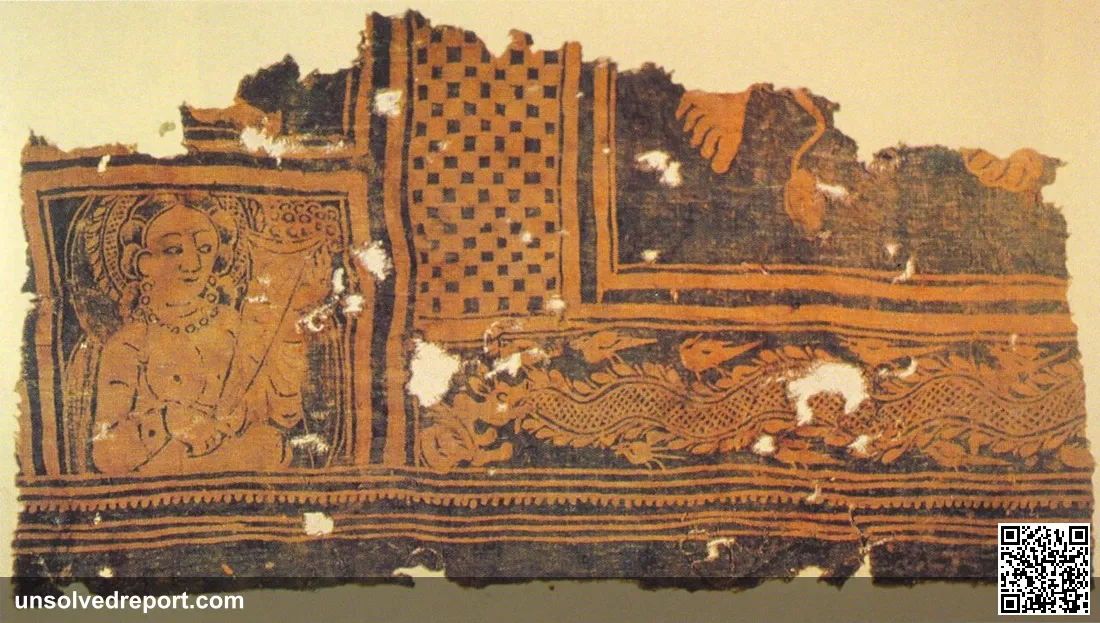
The man who found it was Sir Aurel Stein, a Hungarian-born British archaeologist who reached Niya in January 1901 on his first Central Asian expedition (1900–1901), bankrolled by the Survey of India (Encyclopaedia Iranica: Aurel Stein). What he pulled out of the sand reads like a haul from a town that left in a hurry. He mapped and dug more than 30 structures and carried off over eighty wooden tablets — plus coins, textiles, carved furniture, basketry, lacquerware, and, of all things, an ancient mousetrap (Wikipedia: Niya ruins). He came back across several later expeditions through the early 20th century. The loot was sorted at the British Museum and split between London and Delhi, and to this day Niya's treasures are scattered across the British Museum, the British Library, the National Museum in New Delhi, and the Tokyo National Museum (Silk Road Foundation).
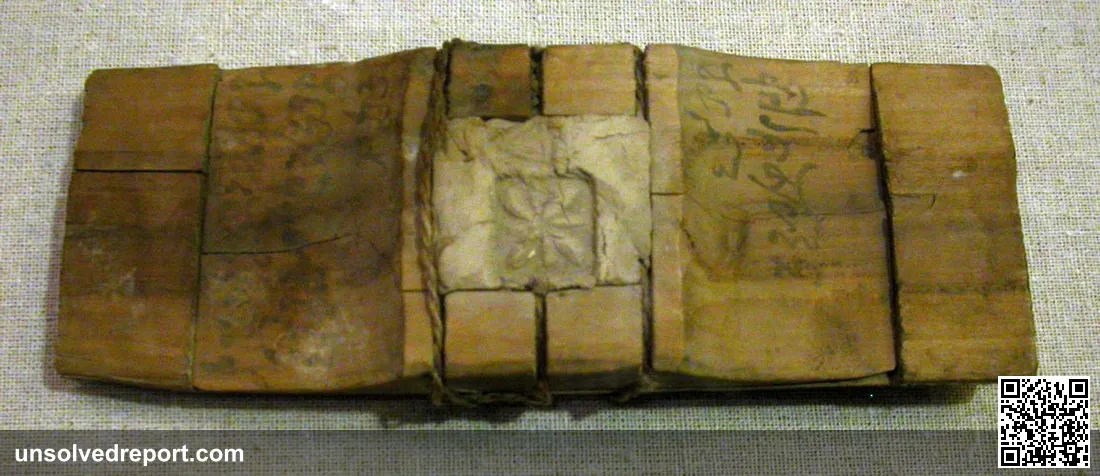
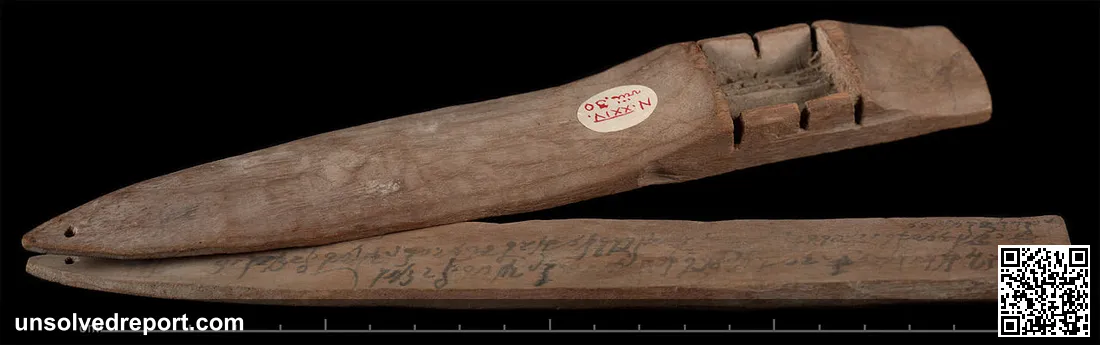
But the real heart of the story isn't gold or glass. It's paperwork. Hundreds of documents written in Kharosthi — a script born in northwestern India — have come out of Niya and the sites nearby (Wikipedia: Niya ruins). Stranger still, they were written in Gandhari Prakrit, an Indian language, even though the town lived inside the Chinese cultural orbit — a cross-cultural mash-up echoed further west at Gonur Depe, another Central Asian trade hub where foreign scripts and gods mixed freely (International Dunhuang Project, British Library). And these aren't grand chronicles of kings. They're the boring, beautiful clutter of real life: court squabbles, unpaid debts, official orders, love and marriage, letters back and forth, deals over camels and livestock and people. Some tablets even carry their own dates, pointing back to the early centuries CE (Silk Road Foundation). Put them together and a whole community wakes up — literate, organized, drowning in red tape, part of the kingdom later called Shanshan.
And then there's the object that made Niya famous. October 1995. A joint Sino-Japanese team opens a richly furnished tomb, and there, near the arm of one of the dead, lies a small piece of brocade stitched with eight Chinese characters in seal script: 五星出東方利中國 — "Five stars rise in the East, benefiting China" (Wikipedia: "Five stars rising in the East" armband; Global Times). The "five stars" are the classical planets — Mercury, Venus, Mars, Jupiter, and Saturn — and when all five line up together in the dawn sky, ancient sky-watchers read it as a thunderous good omen for the realm. The little rectangle of cloth, dated to the Han–Jin era, is woven so cleverly that experts call it a high point of ancient weaving. In 2002, China put it on the list of cultural relics forbidden to leave the country (Wikipedia: armband).
The Part Nobody Can Explain
So here's what the dunes refuse to give up. A working town — houses still standing, archives still stocked, orchards still planted — was abandoned and never, ever taken back. Best guess for the goodbye: sometime in the 4th to 5th century CE. And Niya wasn't alone. Across the southern Tarim Basin, a whole web of oasis towns went quiet inside roughly the same stretch of years (Wikipedia: Niya ruins).
Now here's the eerie part. Most places that die in history die ugly — burned, sacked, fled in a panic. Niya doesn't feel like that. It feels like a place people walked out of calmly, maybe planning to come back next season. And then no one ever did. What flipped a living oasis into a ghost town is, honestly, still up for grabs among the scholars who study it.
The Suspects
What follows are the explanations researchers have floated. None of them is the final word, and the truth is probably more than one of them holding hands.
Suspect 1 — The water just ran out. This is the front-runner. The Niya River dried up or wandered off course, and the moment the irrigation died, so did the oasis — because that's all an oasis is, water in the middle of nothing. Researchers studying the lower reaches of the Keriya and Niya rivers found that irrigated farming boomed from about 200 BCE to roughly 500 CE, then a slide toward drier conditions around 500 CE shows up as the reason the desert cities emptied out (ScienceDirect, 14C dating of the Niya site). Some popular accounts push the cutoff earlier, to around 350 CE, when the river is said to have failed and left the town high and dry (China Silk Road Travel). It happened elsewhere too: the nearby Loulan Kingdom collapsed in a way that's been studied as one of the world's earliest "Aral Sea–type" water disasters (Scientific Reports, Nature). This is the theory with the most hard physical evidence — though the exact year is still argued over.
Suspect 2 — Raiders at the gates. The tablets themselves whisper of danger. Several documents name a people called the Supis — often tied to a kingdom in northern Tibet — and the threats and incursions they brought, which has led some scholars to pin the abandonment on military pressure and unrest (Wikipedia: Niya ruins). A town living under repeated raids might empty out long before its wells ever ran dry.
Suspect 3 — The road moved on. The slowest, quietest killer. In this reading, Niya simply lost its purpose: the Silk Road shifted, caravans found other paths, and the Chinese administrative muscle that had propped up Shanshan pulled back. A remote oasis with nothing left to offer fades on its own — much like Ubar, the fabled Arabian trade hub that sand swallowed once its caravan routes dried up. This one's the hardest to nail to a single dated event, so treat it as informed guesswork rather than settled fact.
The likeliest answer braids all three together: a fragile desert economy, a dying river, and enemies on the horizon, all arriving at roughly the same cruel moment. What the desert handed us isn't the answer. It's the scene of the crime — frozen, readable, the ink still dark — and still, after seventeen centuries, quietly asking why.
Sources & Further Reading
- Wikipedia — Niya ruins
- Silk Road Foundation — The Most Important Findings of Niya in Taklamakan
- Encyclopaedia Iranica — Stein, (Marc) Aurel
- Wikipedia — "Five stars rising in the East" armband
- Global Times — Journey of Han Dynasty brocade from sand to cultural symbol
- ScienceDirect — 14C dating of the Niya site in the Tarim Basin
- Scientific Reports (Nature) — The world's earliest Aral-Sea type disaster: the decline of the Loulan Kingdom
- International Dunhuang Project, British Library
- China Silk Road Travel — The Niya Site in the Taklamakan Desert
9 Megalithic Sites Nobody Can Fully Explain
Stones too heavy, too precise, too ancient. From Gobekli Tepe to Baalbek, here are 9 megalithic sites that still leave the experts genuinely stumped.
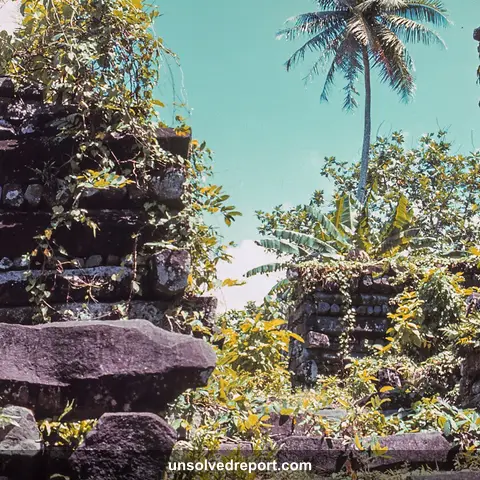
Nan Madol: The 750,000-Ton Stone City Nobody Can Explain
90+ man-made islands, no mortar, no metal tools, 750,000 tons of basalt stacked on a coral reef. Who built Nan Madol — and how did they actually move the stone?
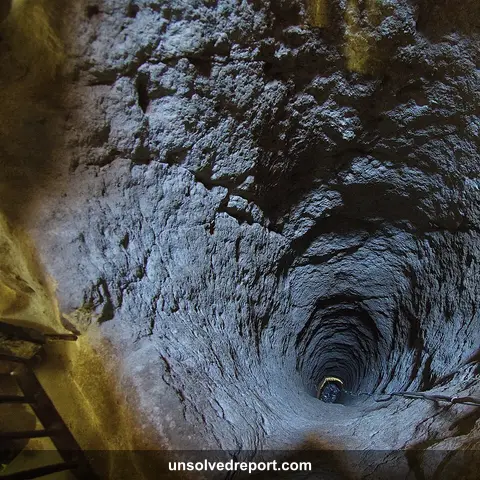
Derinkuyu: The 18-Story City Hidden Behind a Basement Wall
A Turkish man smashes a basement wall and cold air pours from the rock: a city plunging 85m down, built to hide 20,000 people. Who really carved Derinkuyu?