Gonur Depe: The Lost City a Whole Civilization Forgot
One piece of pottery in the Karakum sands exposed a vanished Bronze Age capital with plumbing, gold-packed tombs, and no name anyone remembers. What happened here?
A man stoops in the desert and picks up a piece of broken pottery. That small motion, in 1972, is about to resurrect a civilization the world had completely forgotten existed.
The man was a Soviet archaeologist named Viktor Sarianidi. The place was a low grey mound in the Karakum Desert of Turkmenistan, a hill the local Turkmen simply called "Gonur Depe" — "Grey Hill." Nobody thought much of it. Just sand, and a bump in the sand.
But under that bump lay an entire planned city, more than four thousand years old. It had palaces, temples, treasure-filled tombs, and water pipes. And then it had vanished so thoroughly that not even its name survived. This is the story of what we actually know about Gonur Depe — and the genuine puzzles nobody has solved yet.
What We Actually Know
Start with the map. Gonur Depe sits in the delta of the Murghab (Murgab) River, about 60 kilometers north of the modern city of Mary — the site of ancient Merv (Wikipedia; Silk Road Treasure Tours). From the early 1970s onward, the Margiana Archaeological Expedition dug into it under Sarianidi's direction. He kept at it for four decades, excavating almost until his death in 2013 (Vassar College).
And the deeper they dug, the bigger it got. This was not a village. It was a planned Bronze Age city sprawling across roughly 55 hectares, and radiocarbon dating pins its life span from about 2400 to 1600 BCE — built in waves conventionally grouped around 2300–1900, 1900–1700, and 1700–1500 BCE (Wikipedia). At its center sat a monumental mudbrick palace, roughly 150 by 140 meters, wrapped in double defensive walls. Around it: courtyards, temples, ritual areas, and water reservoirs fed through ceramic pipes (Wikipedia). People in the desert, four thousand years ago, were plumbing their city.
Here's the part that changes the scale of the whole thing. Gonur wasn't alone. The Murghab delta holds more than 150 documented ancient settlements, and Gonur seems to have been the capital of all of them — the principal seat of a country the ancient texts called "Margush," known to classical writers as Margiana (eurasia.travel; Eurasianet). It's the star site of a whole Bronze Age culture Sarianidi named back in the 1970s: the Bactria–Margiana Archaeological Complex, or BMAC (Grokipedia summary of Sarianidi's coinage; Wikipedia).
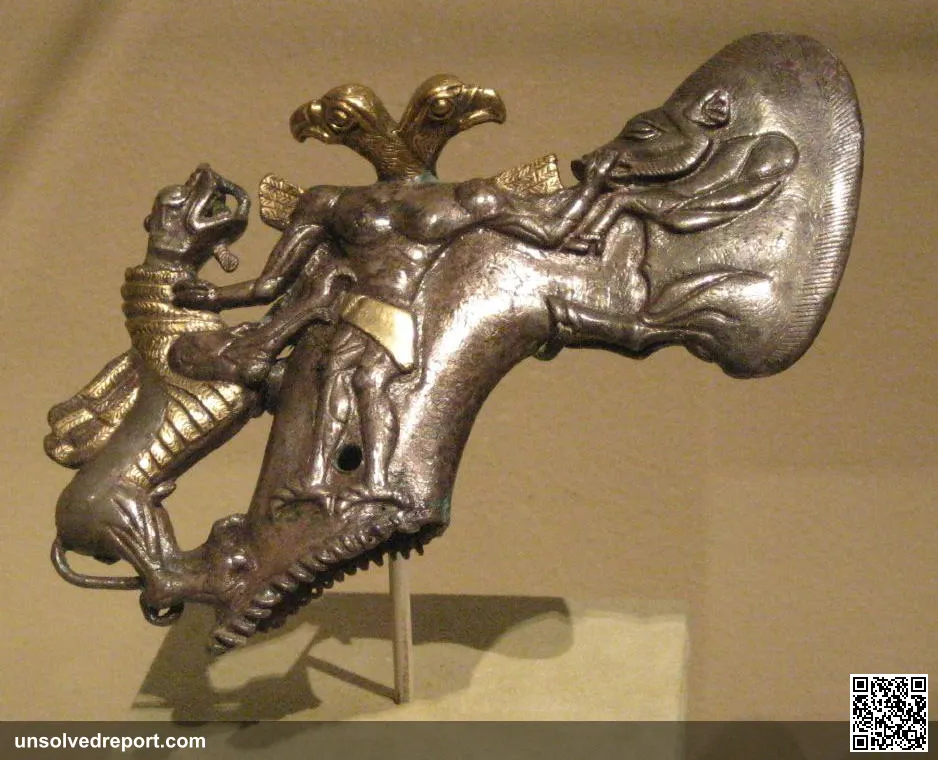
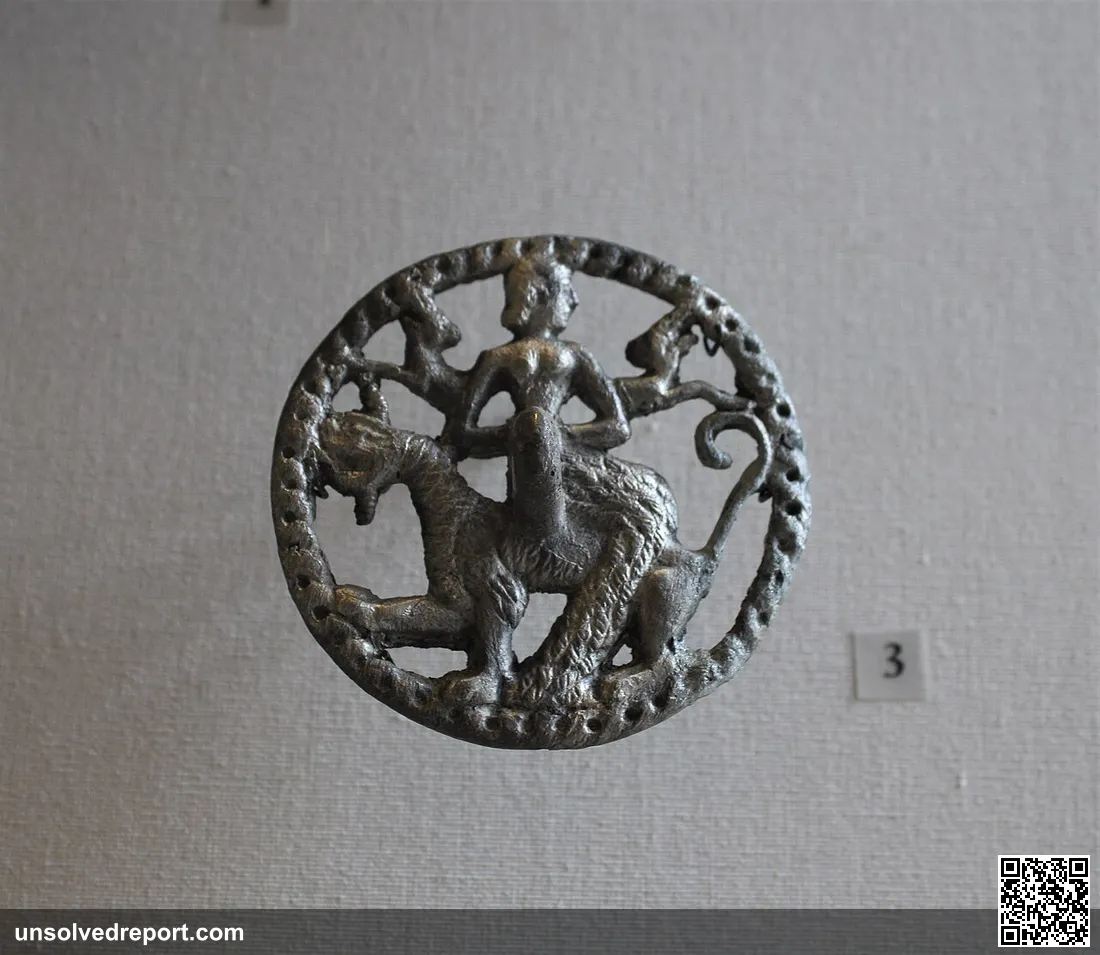
Then there are the graves, and the graves are something else. The Large Necropolis holds more than 3,000 burials spread across roughly 10 hectares, and a separate "Royal Necropolis" hid underground burial houses and pits packed with gold, silver, stone, and bronze (Wikipedia). One grave stops you cold — burial number 3200, dated to around 2250 BCE, holding a horse skeleton laid beside a four-wheeled wooden wagon with bronze-rimmed wheels (Wikipedia). The diggers also pulled out intricate mosaics that once decorated walls and wooden chests, bronze maceheads shaped like horses, objects carved from elephant ivory, carved stone statuettes, and a polychrome wall painting from a tomb — which Antiquity described as the first known polychrome painting ever found in BMAC territory (Cambridge Core / Antiquity).
Elephant ivory. In the desert. Which tells you these people were not isolated. Gonur's mosaics echo the styles of the royal cemeteries of Mari in Syria and Ur in Mesopotamia, and the goods buried here reflect contact with the Indus Valley — the same civilization that left behind puzzles like the Dancing Girl of Mohenjo-daro — as well as Iran and the inner Asian steppe (Vassar College; Wikipedia). Their own bodies tell the same story: ancient-DNA studies of BMAC individuals trace most of their ancestry to Iranian-plateau Neolithic farmers, with some people carrying South-Asian–related ancestry that fits contact with the Indus (Wikipedia). A trading crossroads, hiding under a grey hill — not unlike the fellow Bronze Age hoard at Tillya Tepe's Bactrian gold, buried in the same wider region.
So how does a thriving city like that simply disappear? Not in fire, and not in war — the best-documented answer is quieter and sadder than that. The Murghab River slowly wandered off course. As the water grew scarce, the people followed it, migrating tens of kilometers downstream over generations, drifting eventually toward the region that became Merv (visitworldheritage.com summary; turkmenportal.com). Sediment studies of the Murghab alluvium back this up: the channels shrank and wind-blown sand piled up during exactly the right period — an oasis drying out, one dry year at a time, beneath a city that was still very much alive.
The Question Nobody Can Answer Yet
Here's the strange, frustrating heart of it. For all those walls and tombs and treasures, Gonur Depe cannot tell us its own story. No deciphered writing system has been confirmed at the site — a silence that echoes the still-unbroken Indus script next door — so nearly everything we know comes from objects and architecture, not from a single sentence the people themselves wrote down (Wikipedia). We don't securely know what language they spoke. We don't know how they pictured their gods. We don't even know what they called themselves.
And that silence opens the biggest question of all: who were they, really, and how do they fit? The BMAC sits at a four-way crossroads — between the Iranian plateau, the Indus Valley, Mesopotamia, and the Eurasian steppe — and scholars are still arguing about its exact place in the great population movements of the second millennium BCE, including the spread of Indo-Iranian languages and the meeting of settled oasis farmers with incoming steppe peoples (Wikipedia). Was Margiana just soaking up influences from its powerful neighbors? Was it an active hub that shaped them? Or was it a homeland for ideas that traveled far beyond the Karakum? The evidence is rich. It is also, so far, not conclusive.
The Theories — and How Much to Trust Them
"The fifth cradle of civilization" (Sarianidi's big claim). Sarianidi thought Margiana was so advanced it earned a seat at the table beside Egypt, Mesopotamia, India, and China — a fifth, independent birthplace of civilization (Eurasianet; UNESCO Russia commission). It's a bold framing, not a settled fact. Worth noting: the wider Murghab region is recognized internationally mainly through the "State Historical and Cultural Park 'Ancient Merv,'" added to the UNESCO World Heritage List in 1999.
The Zoroastrian-birthplace idea (genuinely disputed). This is Sarianidi's most famous claim. He read Gonur's fire altars and ritual rooms as a cradle of Zoroastrianism, and argued the temples were used to brew the sacred drink haoma (the Avestan cousin of the Vedic soma), pointing to plant residues he said included ephedra, poppy, and cannabis (Vassar College; Wikipedia). Other researchers pushed back hard. Some couldn't reproduce the narcotic-residue findings at all and identified the plant traces as ordinary food grains, and critics point out that early Zoroastrians aren't known to have built urban temples like these (Wikipedia). So treat the Zoroastrian connection as an intriguing hypothesis, not a proven one.
"The city the sands swallowed" (the popular legend). You'll often read that the desert simply ate Gonur whole, dramatic and sudden — the same fate popularly claimed for the Silk Road town of Niya, further east. The grounded version is less Hollywood and more human: a community calmly following its disappearing river downstream, over generations, instead of dying in one catastrophic night.
Whatever else it was, Gonur Depe is proof that the map of early civilization is still being sketched. A nondescript grey hill in the Karakum hid an entire forgotten world — and most of it is still down there, in the sand, waiting for the next person to bend down and pick something up.
Sources and Further Reading
- Gonur Depe — Wikipedia
- "New polychrome painting from Gonur Depe, Turkmenistan" — Antiquity, Cambridge Core
- Gonur Depe — Central Asia Sites, Vassar College
- Turkmenistan: Making a Bid for Cradle-of-Civilization Status — Eurasianet
- Ancient Margiana a Center of Global Civilization — UNESCO Russia commission
- Gonur Depe — Bronze Age Capital of Ancient Margiana — Silk Road Treasure Tours
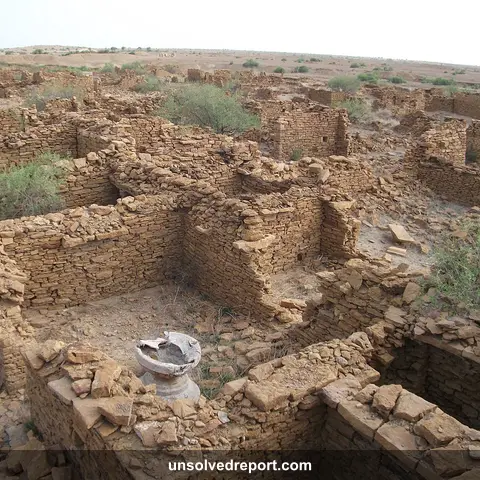
Kuldhara: The Village That Walked Out and Never Came Back
Kuldhara's legend says one cursed night emptied the whole village. The census records tell a slower, stranger story — so which one actually happened?
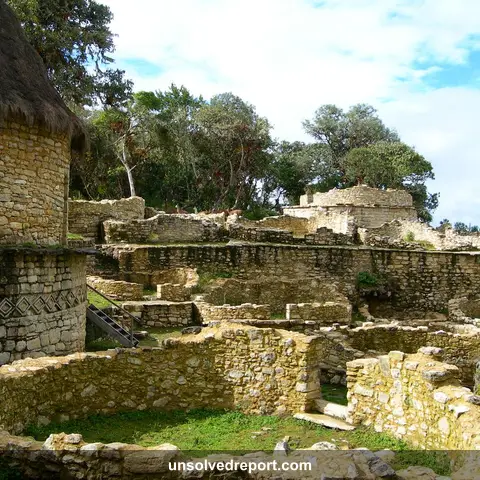
Kuelap: The Peruvian Fortress Built Into a Mass Grave
Kuelap's 60-foot wall hides 100+ human burials — and bodies left unburied where they fell. Was it a fortress, a tomb, or something no one has named yet?
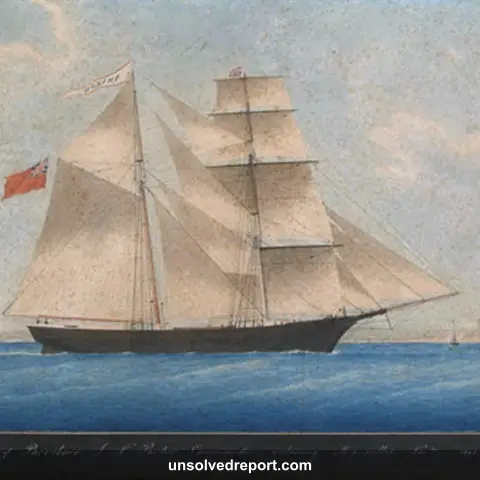
Mary Celeste: 10 People Vanished, the Ship Never Sank
1872: the Mary Celeste found adrift, fully stocked, all 10 aboard gone without a trace. Mutiny and piracy don't fit the evidence. So what does?