Kuldhara: The Village That Walked Out and Never Came Back
Kuldhara's legend says one cursed night emptied the whole village. The census records tell a slower, stranger story — so which one actually happened?
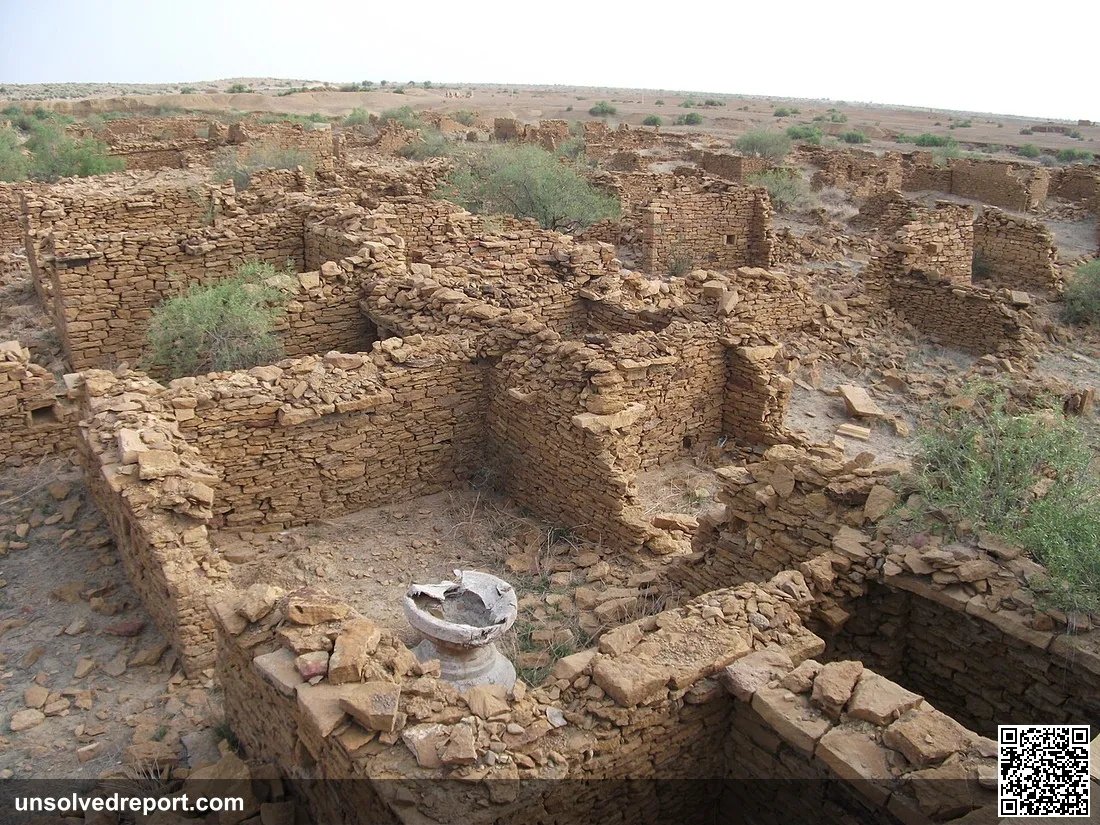
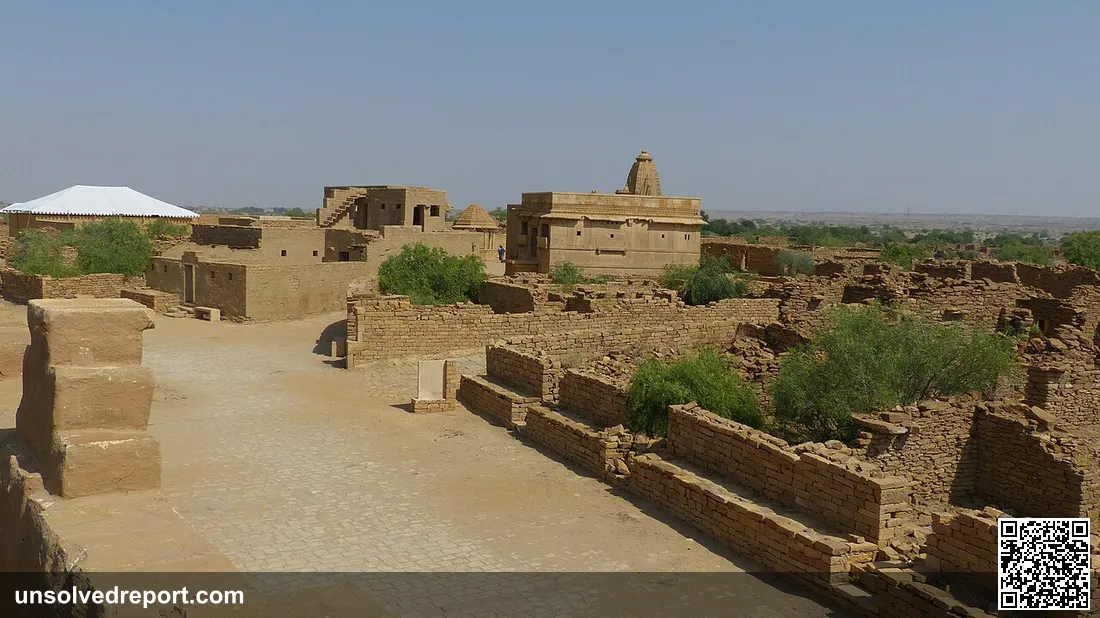
The doorways are still standing. So is the street grid — you can walk it like a map drawn in stone. There are cattle troughs. Grinding stones. The cracked bones of a temple, right where someone left them. Everything you'd need to live here is here, baked into honey-colored sandstone the desert sun has been polishing for centuries.
There's just one thing missing. People.
This is Kuldhara, about eighteen kilometers southwest of Jaisalmer in the Thar Desert of western Rajasthan. No one has called it home for well over a hundred years. And the story everyone tells about it is electric: one night, the whole village got up and walked out — every last family — and laid down a curse so that no one could ever live here again.
It's a tremendous story. Here's the strange part. The records don't quite back up the dramatic version. They tell something slower, quieter, and in its own way creepier. So let's separate what the documents actually prove from the legend that grew up over the top of them — and then get to the real question, the one historians and geologists are still chewing on today.
What We Actually Know
Start with the people who built it. Kuldhara was founded by the Paliwal Brahmins, a community named after the town of Pali in Rajasthan, and these were not ordinary villagers. They were the people who could make the desert pay — masters of farming dry land, of moving and storing water, of trade across hard country.
And the place is old. A 19th-century chronicle of the kingdom, the Tawarikh-i-Jaisalmer (1899) by Lakshmi Chand, names a Paliwal Brahmin called Kadhan as the very first settler. Two memorial stones (devali) found on-site carry dates of 1235 and 1238 CE — which drops the village's beginnings into the early 13th century (Wikipedia, citing Tawarikh-i-Jaisalmer).
This was no scattering of huts, either. Picture a real town. Archaeologists count roughly 410 ruined buildings in the main village, plus about 200 more in a lower township (Wikipedia). And the headcount over time tells a quiet, chilling story all on its own. For the 17th–18th centuries, scholars estimate around 1,588 residents — figured from roughly 400 houses at a normal household size. Then James Tod, the British political agent and antiquarian who mapped and studied Rajasthan in the early 1800s, recorded about 800 people in 200 households around 1815. Half gone. Then comes the gut-punch number: by 1890, a count found only 37 people left among 117 houses (Wikipedia, citing James Tod's Annals and Antiquities of Rajasthan).
Read those three numbers again — 1,588, then 800, then 37 — and you've found the single most important fact in the whole case. That isn't one dramatic night. That's a town bleeding out across the entire 19th century. By the time Kuldhara was truly empty, it had been emptying for decades.
The desert is part of the story too. The Paliwals survived by squeezing every drop they could from a stingy land — wells, and a stepwell tied to the mid-18th century. Today Kuldhara is a protected monument under the Archaeological Survey of India, a ticketed tourist site run with Rajasthan's tourism authorities (Rajasthan Tourism; Wikipedia). The ruins you can wander through are real, cared for, and open by day. It's after dark that the imagination takes over.
The Real Mystery
So here's the honest question, the one nobody has cleanly answered. Why did a wealthy, centuries-old community shrink to nothing and walk away from a town its own ancestors had built and tended for some 500 years?
The records confirm it happened. They just won't say why. The careful summaries put it bluntly: Kuldhara "was deserted by the early 19th century for unknown reasons" (Wikipedia). The famous "overnight" version is folklore, not a documented timeline — and Tod's figures, with the later counts, point to a fade measured in years, not hours.
And really, it's two mysteries braided into one. First: what drove the Paliwals out — politics, the land, money, or some grim mix of all three? Second — and this one nags at me more — why did nobody ever move back? Other desert villages got reoccupied over the years, and other ancient settlements — like the long-debated abandonment of Mohenjo-daro further east on the subcontinent — at least left clues behind. This big, well-built, fully planned town stayed empty. The persistence of the silence is almost stranger than the leaving. Let's lay out the leading explanations, each one labeled for exactly what it is.
The Theories
Theory 1 — The Salim Singh legend (folklore / oral tradition). This is the version on every tour itinerary, and it's why Kuldhara is famous. The way it's told: Salim Singh, the powerful and reputedly cruel Diwan (chief minister) of Jaisalmer State in the early 19th century, crushed the village with taxes — and then set his eye on the daughter of the village headman, threatening the whole community unless she was handed over. Rather than bow, the Paliwals of Kuldhara and dozens of neighboring villages — the number you'll usually hear is 83 — supposedly vanished in a single night around 1825, cursing the ground so no one could ever settle there again (All That's Interesting; Rajasthan Tourism).
Treat that as legend — because that's what it is. A Diwan named Salim Singh really did exist, a real and controversial figure in Jaisalmer's history, and heavy taxation of Paliwal communities may genuinely have pushed people to leave. But the abduction tale, the neat count of 83 villages, the exact year, the curse — those are oral tradition, and they sit awkwardly next to the slow decline the records actually show. Folklore can hold onto a real grievance while dressing up the details far past anything the evidence supports.
Theory 2 — Water and environmental stress (documented-leaning). Several accounts finger a failing water supply as the real driver (Wikipedia). Think about what that means in a place where farming lived or died on catching rain and tapping groundwater. Let the water table sink — from a shifting climate, from less rain, from too many wells pulling too hard — and a desert town gets a little less livable every single year. And notice: this fits the headcount far better than one dramatic night does. Water failure doesn't empty a town in an evening. It empties it slowly — which is exactly what that 1,588 → 800 → 37 slide looks like.
Theory 3 — Earthquake damage (academic hypothesis). Now for the wild card. A study in the peer-reviewed Indian journal Current Science (by A. B. Roy and colleagues) argued that the wrecked houses across Kuldhara and nearby Paliwal sites carry the fingerprints of seismic destruction — collapsed roofs, fallen joists, lintels, and pillars — hinting that an earthquake may have battered the settlements and wrecked the groundwater they leaned on (Wikipedia, citing Current Science). This is a scientific hypothesis, not a settled fact, and other researchers push back — the Jaisalmer region isn't known as a high-earthquake zone, so the idea stays in dispute. Still, it hands us a physical mechanism that could pile on top of the water troubles.
Here's the thing, though. These probably aren't three theories fighting each other. They might all be true at once. Heavy taxes under a hated administration, a water supply drying up, maybe the ground itself shaking the houses apart — all shoving in the same direction. And the Salim Singh story arriving later to do what stories do: hand a slow, grinding tragedy a single villain and a single unforgettable night. For the deepest look at how Kuldhara actually lived and worked, the most detailed scholarly treatment of the settlement's social and economic life is S. Ali Nadeem Rezavi's 1995 study.
What nobody argues about is the place itself: a fully planned desert town, built and watered by hand across centuries, that its people gave up — and that no one ever took back. The doorways are still open. You can stand right in the middle of it and feel the question for yourself. And if Kuldhara's silence pulls at you, wait until you meet the other towns the deserts of the world swallowed whole — like the vanished settlement at Lake Anjikuni, or the abandoned Norse colony at Hvalsey Church — each one with a last day nobody bothered to write down.
Sources & Further Reading
- Wikipedia, "Kuldhara" (summarizing Tawarikh-i-Jaisalmer, James Tod, Current Science, and Rezavi 1995): https://en.wikipedia.org/wiki/Kuldhara
- Rajasthan Tourism (official), "Kuldhara Village History": https://www.tourism.rajasthan.gov.in/kuldhara.html
- All That's Interesting, "Why Was The Indian Village Of Kuldhara Abandoned Overnight?": https://allthatsinteresting.com/kuldhara-india
- James Tod, Annals and Antiquities of Rajasthan (early-19th-century survey of the region); Royal Asiatic Society overview: https://royalasiaticsociety.org/james-tod-and-the-annals-and-antiquities-of-rajasthan/
- A. B. Roy et al., Current Science (peer-reviewed) on earthquake-related damage at Paliwal sites (as cited in the Wikipedia entry above)
Kuelap: The Peruvian Fortress Built Into a Mass Grave
Kuelap's 60-foot wall hides 100+ human burials — and bodies left unburied where they fell. Was it a fortress, a tomb, or something no one has named yet?

Mary Celeste: 10 People Vanished, the Ship Never Sank
1872: the Mary Celeste found adrift, fully stocked, all 10 aboard gone without a trace. Mutiny and piracy don't fit the evidence. So what does?

Uranus's Axial Tilt: The 98-Degree Mystery Nobody Can Explain
Uranus spins on its side at a 98-degree tilt, and scientists still cannot agree on what flipped it. Why did the collision leave its moons untouched?