Ubar & Iram of the Pillars: Oman's Lost City Nobody Can Confirm
NASA satellites found a buried fortress under Oman's sand in 1992. Explorers swore it was Ubar, the lost Iram of the Pillars — scholars still disagree.
A city of gold, swallowed whole by the desert. That was the story Bedouin storytellers carried across the Rub al-Khali — Arabia's vast, terrifying Empty Quarter — for hundreds of years. A place so rich and so proud that the sand rose up and buried it alive as punishment. Western explorers gave it a name that stuck: the "Atlantis of the Sands."
Then, in February 1992, a team of American archaeologists and adventurers stood up and said the impossible. Satellites and space-shuttle radar had found it. The lost city was real, and it was sitting beneath the dunes of Oman, much like Thonis-Heracleion, the Egyptian port city later found real beneath the sea.
The headlines went off like fireworks. But the truth underneath them turned out to be quieter, stranger, and honestly more gripping than the legend ever was.
What We Actually Know
Two names got tangled together over the centuries, so let's untangle them.
Iram of the Pillars comes from the Quran, in Surah al-Fajr (89:6-14). It speaks of "Iram, [city] of lofty pillars" — Iram dhat al-imad — home to the people of ʿĀd, said to be giants among men, unmatched anywhere on Earth (Wikipedia, "Iram of the Pillars"). Ubar (sometimes spelled Wabar) is the other name, the one Bedouin storytellers kept alive: a fabled city of frankincense merchants, fat with the riches of the incense trade — the same trade that fed Hegra, the Nabataean city further north whose people vanished without a trace.
Now, that haunting phrase — "Atlantis of the Sands." Most people credit it to T.E. Lawrence, of Lawrence of Arabia fame. Here's the strange part: it never appears anywhere in his published work. The real coiner was almost certainly the explorer Bertram Thomas, who wrote in 1933 that "on my previous journeys I had heard from other Arabs of the name of this Atlantis of the Sands" (Wikipedia, "Atlantis of the Sands"). His 1932 book, Arabia Felix: Across the Empty Quarter of Arabia, lit the legend on fire in the modern imagination.
One reader who caught that fire was a filmmaker.
His name was Nicholas Clapp — part documentary maker, part amateur archaeologist, fully obsessed, hunting a legend the way Percy Fawcett once hunted his own lost city. He read about the lost city in Thomas's work and could not let it go. Starting in 1981, he did something nobody had tried before: he talked NASA's Jet Propulsion Laboratory into pointing remote-sensing instruments at the Omani desert from space.
What they used reads like a wish list. According to JPL, the team scanned the sands with Shuttle Imaging Radar-B, flown aboard the space shuttle Challenger in 1984, plus Landsat 5 and the French SPOT satellite (NASA/JPL). JPL geologist Ronald Blom explained the trick that made it work: ancient tracks could be told apart from modern ones because "older tracks often go directly under very large sand dunes." Think about that. Roads so old they run beneath dunes that didn't exist yet.
And the radar saw lines. Faint, ghostly lines threaded across the desert — ancient caravan routes, pounded flat over centuries by hundreds of thousands of camels. They were all bending toward one spot.
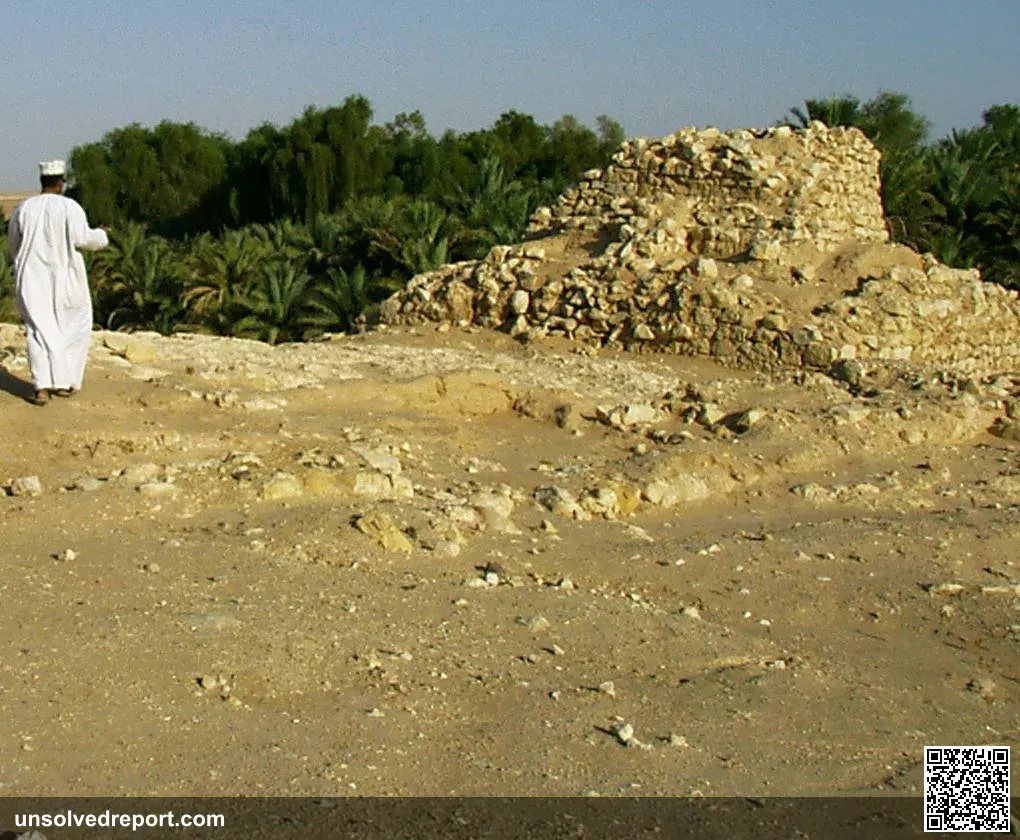
That spot was a Bedouin well at Shisr, in Oman's Dhofar region, right on the edge of the Empty Quarter. So the explorers went to dig. In the summer of 1990 and the fall of 1991, a wild crew — Clapp, lawyer George Hedges, the legendary polar explorer Sir Ranulph Fiennes, and archaeologist Dr. Juris Zarins — broke ground at Shisr.
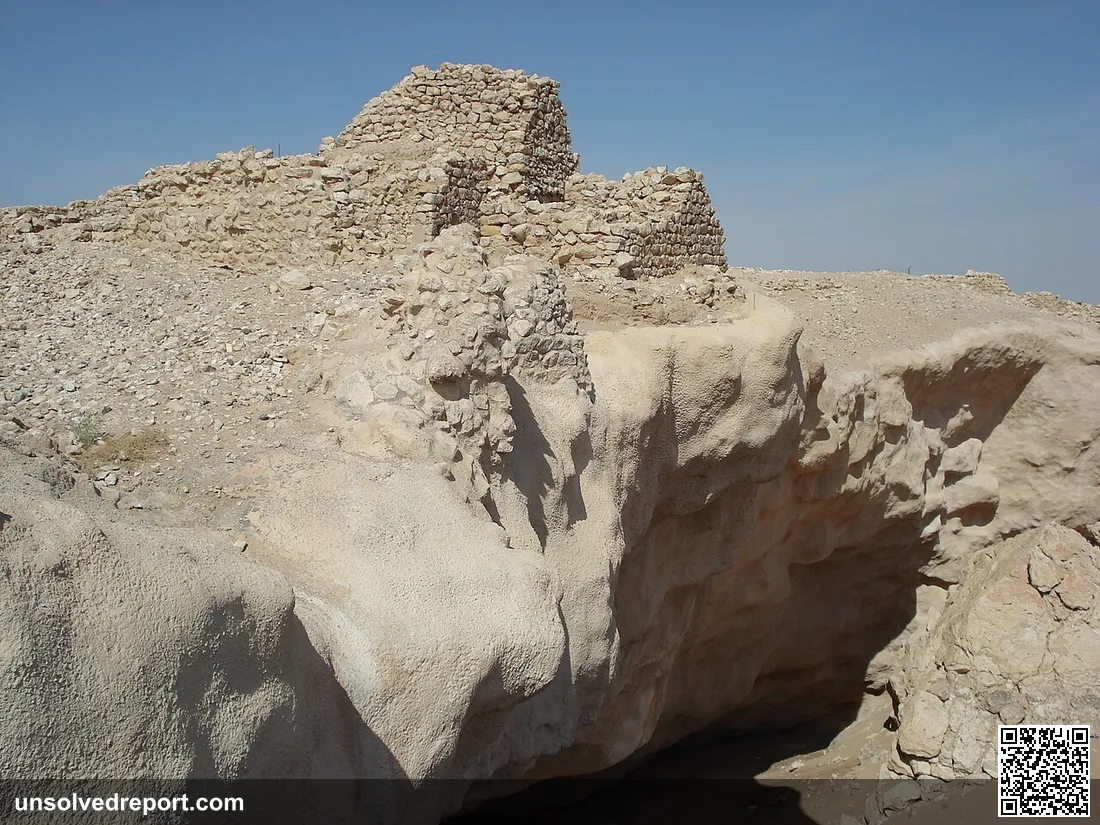
On February 5, 1992, they walked into the Huntington Library in California and announced to the world: we found Ubar (Baltimore Sun, 1992). And what they'd pulled from the sand was no campsite. An eight-sided fortress. Walls roughly two feet thick and ten to twelve feet high. Corner towers reaching some thirty feet into the air, with rooms and artifacts scattered through the ruins (NASA/JPL).
Then came the detail that raised the hair on everyone's neck. Part of the settlement had collapsed straight down into a limestone sinkhole. The earth really had opened up and swallowed a piece of the city — exactly like the legend always said.
The Part Still Buried
So here's the real mystery, and it's a good one.
The team found something genuine and ancient. No question. But was it the city — the Iram of the Quran, the Atlantis of the Sands? Or was it something smaller, something humbler, that a legend simply grew up around like ivy over a ruin?
That dramatic 1992 announcement has not aged cleanly. Wikipedia puts it plainly: Clapp's idea "is not generally accepted by scholars," the claim that Ubar equals Shisr is "problematic," and Clapp himself later quietly backed away from equating Iram with Ubar — the same legend-versus-geology fight that still surrounds Dwarka, India's own submerged "lost city" (Wikipedia, "Iram of the Pillars").
The trouble is in the timeline. The Shisr site is absolutely real and important — it's part of the UNESCO "Land of Frankincense" World Heritage Site. But its dates don't fit the story. Wikipedia places the trading post's main life from roughly the 4th century to the 15th or 16th century — way too late to be a Quranic "city of ʿĀd," which would have to be far more ancient. It notes only that "some considered it to be the legendary lost city of Ubar or Iram. This is not always accepted by scholars" (Wikipedia, "Archaeological site of Shisr").
Nobody argues about the bones of it: something stood at Shisr. It sat where the old frankincense roads came together. And a chunk of it really did fall into a sinkhole. Whether that something is the lost city of pillars, a fortified pit-stop that inspired the tale, or just an ordinary ruin handed a famous name by mistake — that's the part still waiting under the sand.
Four Ways to Read the Ruins
"We found it." (1992 — now contested.) The first claim was bold: Shisr is Ubar, and that eight-sided fort matches the Quran's many-towered city. Treat this as the explorers' opening interpretation — thrilling, splashed across every front page, but not where scholars have landed today. Even Sir Ranulph Fiennes's flourish — tying the site to the "Omanum Emporium" marked on Ptolemy's 2nd-century map — is a guess stacked on top of an 1,800-year-old map nobody can fully trust.
"It was just a rest stop." (The skeptics.) Geologist H. Stewart Edgell threw cold water on the whole thing in a 2004 paper for the Proceedings of the Seminar for Arabian Studies, bluntly titled "The myth of the 'lost city of the Arabian Sands.'" His read: Shisr's modest fort and all those tents point to a minor caravanserai — a roadside waystation on the incense route, not a glittering metropolis. It's the most deflating take on the table, and it carries real evidence behind it.
"Ubar was a place, not a building." (Zarins.) The expedition's own archaeologist, Juris Zarins, landed somewhere thoughtful in the middle: that "Ubar refers to a region and a group of people, not to a specific town," and that it was the late-medieval One Thousand and One Nights that polished a whole region down into one dazzling city (Wikipedia, "Atlantis of the Sands"). If he's right, everyone's a little correct — there was a real place and real people, just never a single buried treasure box.
The legend itself. The richest stories — King Shaddad ibn ʿĀd building an "imitation of Paradise," divine wrath burying it whole, the city caving into a cavern under its own weight — live in oral tradition and the Arabian Nights, not in the dirt. Read them as folklore that might still hold a seed of truth: a trading hub, a real sinkhole, a route that died when the frankincense trade dried up. And one last twist worth a shiver: the very similar name "Wabar" sent explorer St. John Philby chasing across the desert for a lost city — and what he found instead turned out to be a meteorite impact field. A reminder of just how easily two desert mysteries can melt into one.
So yes — the satellites found something remarkable beneath the Empty Quarter. Whether they found Iram of the Pillars, or only the place where a legend was born, is the question still lying out there in the dark, under the dunes, waiting.
Sources & further reading
- Wikipedia — Iram of the Pillars: https://en.wikipedia.org/wiki/Iram_of_the_Pillars
- Wikipedia — Atlantis of the Sands: https://en.wikipedia.org/wiki/Atlantis_of_the_Sands
- Wikipedia — Archaeological site of Shisr: https://en.wikipedia.org/wiki/Archaeological_site_of_Shisr
- NASA Jet Propulsion Laboratory — JPL Technology and Expertise Key Role in Lost City Discovery: https://www.jpl.nasa.gov/news/jpl-technology-and-expertise-key-role-in-lost-city-discovery/
- Baltimore Sun (Feb. 5, 1992) — Lost city of Ubar found in Oman, scientists say: https://www.baltimoresun.com/news/bs-xpm-1992-02-05-1992036047-story.html
- H. Stewart Edgell, 'The myth of the lost city of the Arabian Sands,' Proceedings of the Seminar for Arabian Studies (2004)
- Bertram Thomas, Arabia Felix: Across the Empty Quarter of Arabia (1932)
Newark Earthworks Mystery: They Aimed 50 Acres at the Moon
A 50-acre earthen octagon nailed a moonrise that returns once every 18.6 years — with no writing, no star charts, no instruments. So how did they pull it off?
The Dancing Plague of 1518: 400 Danced, No One Could Stop
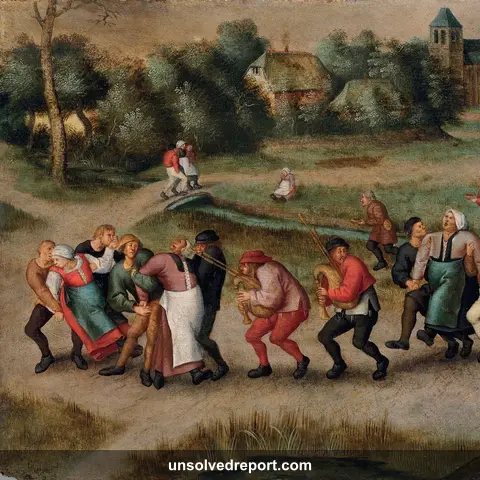
In July 1518, one woman's dancing spread to 400 people in Strasbourg who couldn't stop. The records are real — so why has no one ever explained why?
Lost Army of Cambyses: 50,000 Men, Zero Bodies, 2,500 Years
50,000 Persian soldiers marched into Egypt's desert in 525 BC and vanished without a trace. No bones. No weapons. So what really happened to them?