Hegra: The Nabataean City Whose People Vanished Without a Trace
Hegra's dead left 100+ signed, dated tombs carved in stone. Its living city? Almost nothing survived. Where did everyone go — and why so quietly?
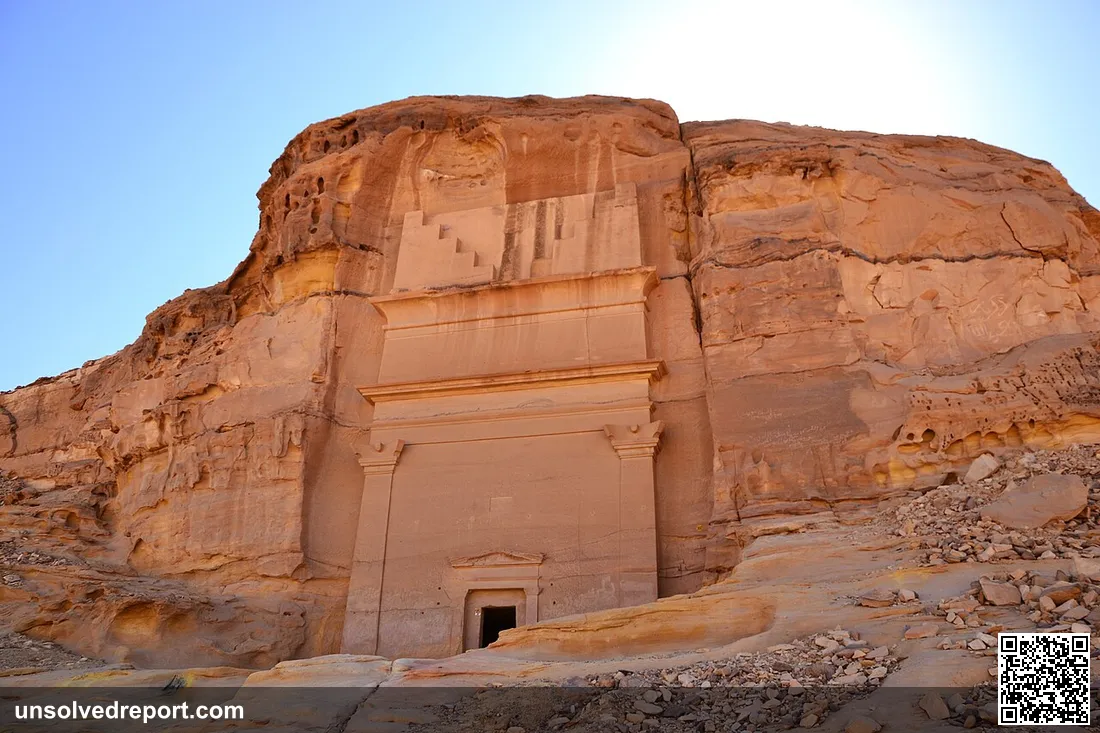
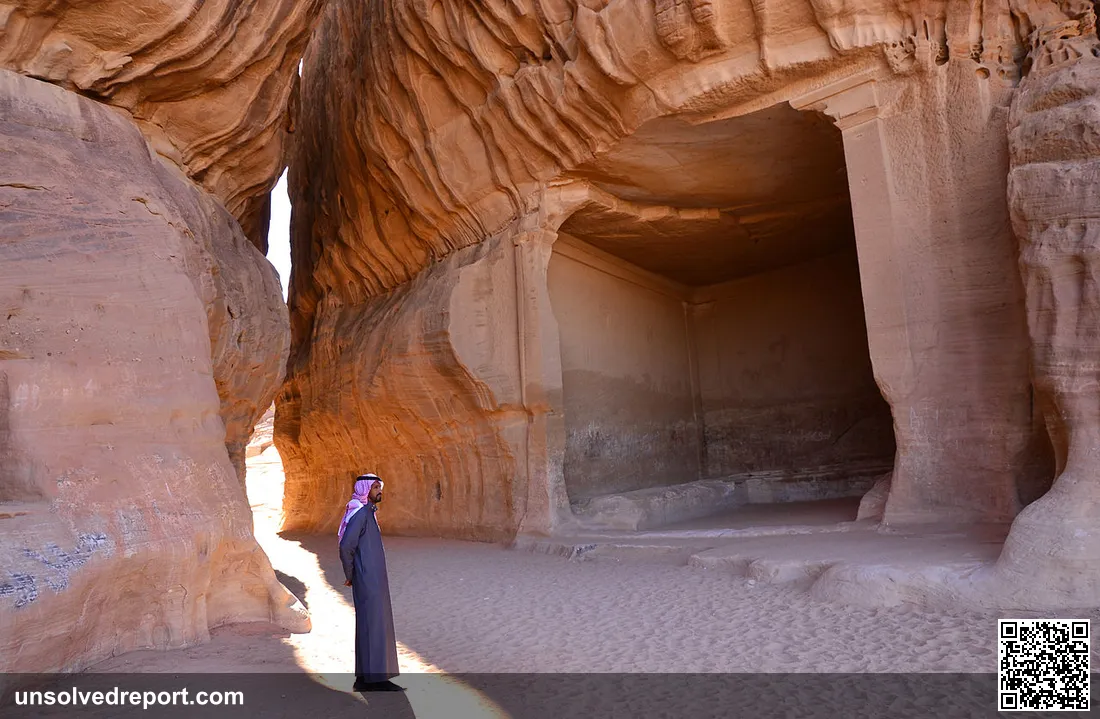
Doorways in the rock. That's the first thing you notice, driving north from AlUla into the desert of northwestern Saudi Arabia. The land turns strange — the same stretch of desert that hides the impossibly split boulder of Al Naslaa. Rounded sandstone outcrops heave up out of the flat plain like the backs of sleeping animals — and into their flanks, someone cut doors. More than a hundred of them. Walk through almost any one and you find the same thing: an empty burial chamber. Above the doorways, eagles and sphinxes and stepped stone crowns weather slowly in the dry air, watching nothing.
This is Hegra — also called al-Hijr, or Madāʾin Ṣāliḥ. And here's the part that gets under your skin. For nearly two thousand years, almost nobody came. The people who carved these dazzling tombs left them behind, then vanished, leaving startlingly little else. The houses, the markets, the lives — gone. Only the doors to the dead remain.
Who Built It, and When
Start with what we know for certain, because it's solid ground.
Hegra was the Nabataeans' southern stronghold — Arab traders whose far more famous capital was Petra, up in modern Jordan. The Royal Commission for AlUla's Hegra Conservation Project puts the first Nabataean settlers here around the mid-first century BCE, with the city hitting its golden age under King Aretas IV, who ruled from 9 BCE to 40 CE (Hegra Conservation Project). UNESCO made Hegra Saudi Arabia's first World Heritage Site in 2008, calling it "the largest conserved site of the civilization of the Nabataeans south of Petra" (UNESCO).
The numbers here are exact — because the tombs themselves are. UNESCO counts 111 monumental tombs, 94 of them decorated, all of it cut straight into living sandstone, plus water wells and roughly 50 inscriptions from before the Nabataeans even arrived — a faint echo of the older tradition of carving messages into stone seen at sites like Bir Hima elsewhere in the Arabian desert (UNESCO). The carved façades date from the first century BCE to the first century CE. Look closely and you'll see Egyptian, Greek, and Mesopotamian touches all braided together — yet the overall style belongs to no one but the Nabataeans.
The Tombs That Talk
Now the eerie bit. These tombs are not anonymous. Many are dated. Many are signed.
More than 30 façades carry Nabataean inscriptions — and they read like legal documents, because that's exactly what they are. Deeds. Written in the Aramaic-descended script that would one day grow into Arabic, they name the owners, sometimes their jobs, and they bristle with warnings: no one has the right to sell this tomb, lease it, or change it (National Geographic). Two thousand years on, the dead are still telling you to keep your hands off. World History Encyclopedia notes that one necropolis alone, Qasr al-Bint, holds 31 tombs dated between 1 and 58 CE (World History Encyclopedia).
And some of those names belong to women. One tomb says it plainly: it was made by "Hinat daughter of Wahbu... for herself and her children and descendants forever." In 2015, archaeologists working under the Royal Commission for AlUla opened that tomb. Inside, among roughly 80 people, they found Hinat. Then, in 2023, they did something no one had ever done for a Nabataean — they rebuilt her face. A forensic reconstruction. She stood about 5 feet 3 inches, and she lived to somewhere between 40 and 50 (Arab News; Live Science). A woman who has been dead for twenty centuries now has a face again.
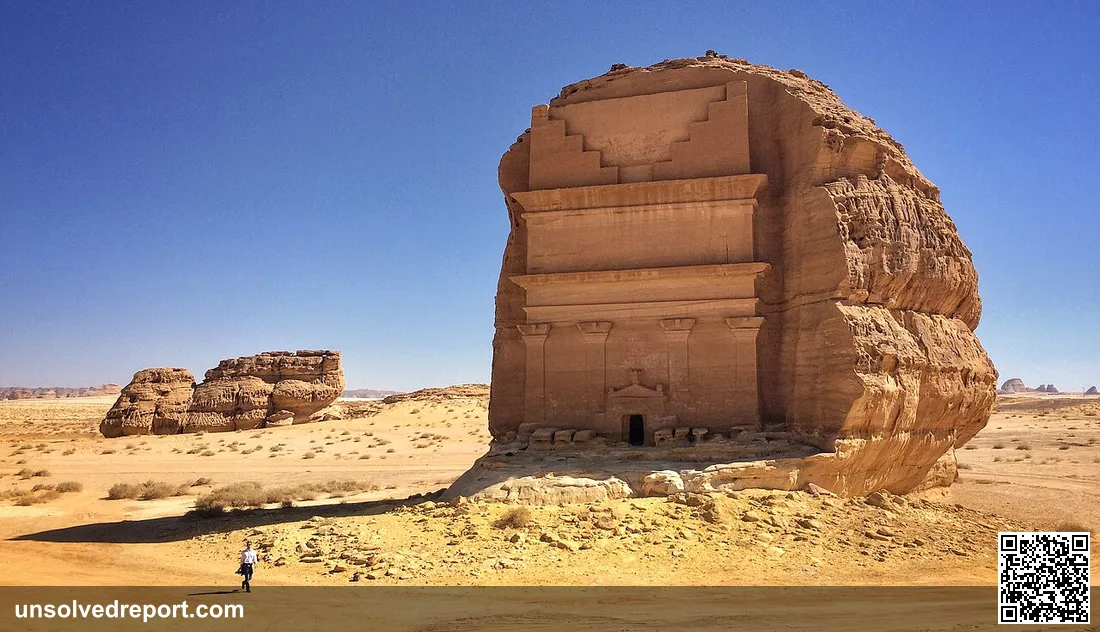
Then there's the showstopper. Qasr al-Farid — the "Lonely Castle" — a single enormous tomb carved into one isolated boulder, standing alone in the open like it was dropped there. It's the most photographed monument at Hegra for good reason. Its façade has four pilasters instead of the usual two, and its lower half is unfinished: you can still see the rough tool marks where carvers worked from the top down and then, for reasons no one recorded, just stopped. An undated inscription ties it to Lihyan (or Hayyan) son of Kuza, and it's generally placed in the first century CE (Madain Project)).
Eventually the wider world came for Hegra. In 106 CE the Roman emperor Trajan swallowed the Nabataean kingdom whole, folding it into a new province he called Arabia. The proof is carved in stone, too: a monumental Latin inscription dug up at the site in 2003, dated to 175–177 CE, records the rebuilding of the city's defenses — with help from centurions of legio III Cyrenaica. For a while, Roman soldiers patrolled this place, one of the empire's loneliest southern edges (researcher F. Villeneuve et al., summarized via Livius).
So Where Is the City of the Living?
Here's the question that stops the experts cold.
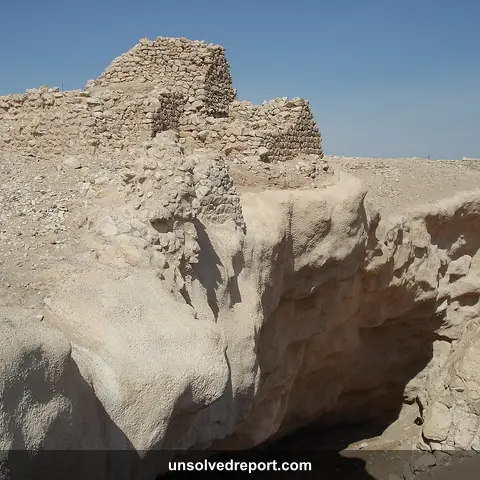
The dead of Hegra got eternal sandstone mansions. The living? They built their homes mostly out of unfired mud brick. And mud brick doesn't last. The French Ministry of Culture's archaeology portal describes a town of roughly 50 hectares, ringed by a rampart with bastions, its houses split by streets that wandered instead of meeting at neat right angles, and a central sanctuary that may have been dedicated to a "sky god" — a deity mentioned in just two Hegra inscriptions and unknown anywhere else in the entire Nabataean world (French Ministry of Culture). But where sandstone endures, mud brick simply melts away. The residential heart of Hegra has left behind far, far less than its cities of the dead, and digging there only started recently — it's still going. The Hegra Conservation Project comes right out and admits how little we actually know about everyday life here (Hegra Conservation Project).
That gap opens a second riddle: how many people lived here at all — and why did the place fade out so gently, with no bang at all? The ancient writer Diodorus of Sicily reckoned the Nabataeans numbered "not much more than 10,000," which might explain why the residential footprint is so modest (French Ministry of Culture). After 106 CE, Hegra's whole reason for being slowly slipped. The overland caravans of incense and spice — the same trade that supposedly built the legendary lost city of Ubar further south — gave way to Red Sea shipping, and long-distance trade across the region fell off sharply in the third century (Smithsonian). The last known tomb dates to 267 CE. The final Nabataean inscription, to 356 CE (Hegra Conservation Project). And then the carvers stop. Just — stop.
No burned destruction layer. No recorded massacre. No single disaster you can point to. Only a city going quiet, one generation at a time. Why the silence was so complete, and where its people finally went, is still genuinely unanswered.
Two Ways to Read the Silence
The archaeology (the well-supported read). Hegra was a prosperous but mid-sized caravan stop, and its whole life rode on one engine: the overland trade in incense and spices. When Rome absorbed the kingdom and shipping stole the camel routes, the city's purpose quietly bled out, and a small population drifted off over the decades. This fits the evidence best — though scholars still argue about exactly how the shift played out.
The legend (which is religious tradition, not archaeology). In Islamic memory, this region is tied to the Thamūd — an ancient people the Qurʾan describes carving homes into the mountains, then being destroyed for rejecting the prophet Ṣāliḥ. That's where the name Madāʾin Ṣāliḥ comes from: "Cities of Salih." Tradition holds that during the Tabūk expedition the Prophet Muhammad passed by al-Hijr and warned against lingering there (thePilgrim). The ninth-century scholar Ibn Saʿd even floated the idea that the Thamūd were the Nabataeans. That association gave Hegra a centuries-long reputation as a place you simply did not disturb — a cultural reason it stayed so untouched. But to be clear: the Qurʾanic Thamūd and the archaeological Nabataeans have never been established as the same people.
What no one disputes is the silence itself. Hegra was, in the Smithsonian's words, an ancient city "untouched for millennia." Only in the past twenty years — and only since it opened to the public in 2020 — has it started giving up its story. Face by reconstructed face. Deed by carved deed. And here's the twist worth sitting with: the tombs were never the real mystery. The mystery is everything the desert quietly erased around them.
Sources and Further Reading
- UNESCO World Heritage Centre — Hegra Archaeological Site (al-Hijr / Madāʾin Ṣāliḥ)
- Hegra Conservation Project (Royal Commission for AlUla) — The History of Hegra
- Smithsonian Magazine — Hegra Makes Its Public Debut
- National Geographic — Buried Stories: The Tombs of Hegra
- French Ministry of Culture — Hegra (Archéologie)
- World History Encyclopedia — Hegra
- Arab News — How archaeologists recreated the face of Hinat
- Live Science — Meet Hinat, a Nabataean woman
- Livius — Hegra (Roman inscription, legio III Cyrenaica)
- Madain Project — Qasr al-Farid)
Olmec Colossal Heads: 17 Giant Faces Nobody Can Name
17 stone giants, each cut from a single multi-ton boulder 3,000 years ago, stare with individual faces — and not one name survives. So who were they?
Ubar & Iram of the Pillars: Oman's Lost City Nobody Can Confirm
NASA satellites found a buried fortress under Oman's sand in 1992. Explorers swore it was Ubar, the lost Iram of the Pillars — scholars still disagree.

Newark Earthworks Mystery: They Aimed 50 Acres at the Moon
A 50-acre earthen octagon nailed a moonrise that returns once every 18.6 years — with no writing, no star charts, no instruments. So how did they pull it off?