Al Naslaa Rock: The Saudi Boulder Split Like a Laser
A Saudi boulder split by a perfectly straight gap that looks laser-cut. No tool marks, no debris — so what actually sliced Al Naslaa in two?
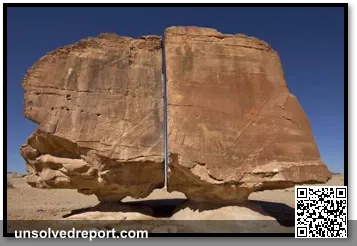
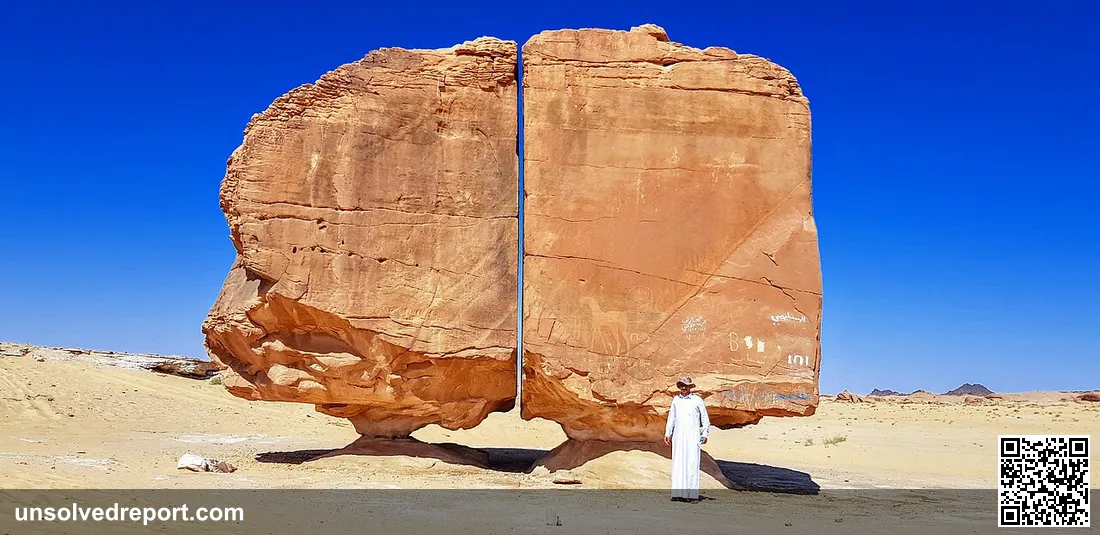
Picture a boulder that looks like it lost an argument with a laser. Out in the sandy flats south of the Tayma oasis, in northwestern Saudi Arabia, two slabs of pale sandstone stand side by side, each balanced on its own little natural pedestal. Between them runs a gap. Not a jagged crack — a gap. Narrow, vertical, and so eerily straight that almost everyone who sees it reaches for the same word: cut. This is Al Naslaa, and for more than a decade it has lived on the internet's lists of ancient mysteries archaeologists still can't explain. But here's the strange part. The most interesting thing about Al Naslaa isn't the wild claims. It's the thin, honest sliver of space between what we can prove and the one question geologists still choose their words carefully around.
What We Actually Know
Start with the things you could write on a postcard. Al Naslaa stands roughly 50 kilometers (31 miles) south of the Tayma oasis, near 27°13′N 38°34′E (Wikipedia). It began as one sandstone outcrop and has since split into two standing blocks, together about 6 meters (20 feet) tall and 9 meters (30 feet) wide (Wikipedia; Live Science). Each half perches on a slim, weather-whittled base — which is exactly why so many photos make the whole thing look one stiff breeze from toppling over.
Now the gap, the star of the show. The two faces flanking it are startlingly flat, the divide nearly dead vertical, and — pay attention to this part — the blocks haven't slid sideways past each other at all. That last detail isn't trivia. In geology, no sideways slip means you're looking at a joint, not a fault that lurched and shifted (IFLScience).
There's a human fingerprint here too. Al Naslaa's southeastern face is crowded with petroglyphs — carved horses and ibex — logged by the Arabian Rock Art Heritage project, a documentation effort tied to scholar Sandra L. Olsen (Saudi-archaeology.com; Wikipedia), the same kind of desert canvas that turned Bir Hima's cliffs into a 7,000-year-old rock-art record elsewhere in Saudi Arabia. Rock art across the wider Tayma region is described as thousands of years old, much of it credited to Bronze Age people who lived by hunting and herding (Science Times). So yes — people stood right here, long ago, and left their mark. But notice where. They decorated the surfaces. Nothing says anyone carved the gap.
And one more fact, stated plainly, because it quietly deflates the most dramatic theory before it gets off the ground: sandstone is soft, and it weathers easily (IFLScience). It is precisely the kind of rock that wind and water love to carve, given enough time.
So What's the Real Mystery?
Here's where a little honesty pays off. Geologists broadly agree on the type of process behind Al Naslaa, and the overwhelming verdict is that it's entirely natural (HowStuffWorks). No aliens required. What nobody has nailed down to a single peer-reviewed answer is the exact recipe: which mechanism cracked it open first, and how the faces ended up this smooth and this straight.
That's the whole reason careful writers refuse to slam the case shut. IFLScience said it right in a headline — "nobody's quite sure how it happened" (IFLScience). Read that carefully, though. "Not sure of the exact sequence" is a world away from "inexplicable." It almost certainly took several ordinary processes working together, and no team has ever published a definitive field study pinning down which did what, and in what order. In fact, most popular coverage cites no named geologist and no peer-reviewed paper specific to Al Naslaa at all. That's a hole in the paperwork — not in our understanding of how rocks like this come apart.
The Suspects, Lined Up
Suspect 1: A natural joint (the front-runner). A joint is a fracture where rock cracks but the two sides never slide past each other. Joints love to travel along straight, flat planes — which is exactly the geometry staring back at you here (IFLScience). And because there's no visible sideways shift, a joint fits the evidence better than anything else. Plausibility: high. Call it a well-supported reading that's still waiting on a site-specific study to make it official.
Suspect 2: Tectonic stress pried open a weak line. Over enormous spans of time, stress in the Earth's crust can fracture sandstone, and a slight shift in the ground could have snapped the block along its weakest plane (Live Science; geologyscience.com). This isn't a rival to the joint idea so much as its partner — stress is often the very thing that creates a joint in the first place. Plausibility: high.
Suspect 3: Freeze-thaw, or thermal and mineral wedging. Water trickles into a hairline crack, freezes, and expands — or minerals swell and shrink with the desert's brutal temperature swings — slowly prying the fracture wider, cycle after cycle after cycle, until the two blocks finally part ways (IFLScience; geologyscience.com). This explains the widening beautifully. It doesn't really explain the dead-straight starting line. Plausibility: moderate, as a helper.
Suspect 4: Wind sanded the faces smooth. This one's about the polish, not the crack. Once a gap existed, it could have funneled sand-laden desert wind through the channel like a wind tunnel, scouring both inner faces — a ventifact-style sandblasting that, over thousands of years, leaves stone unusually slick (IFLScience; geologyscience.com). The same wind sculpted the slender pedestals underneath. Plausibility: high for the smoothness. But notice it complements the others rather than replacing them — and here's a wrinkle: the rock's overall angular, blocky shape isn't a textbook ventifact, so wind is best understood as the finishing touch, not the whole sculptor.
Suspect 5: Human cutting, lasers, or "ancient technology" (this is speculation). The laser comparison was always just a figure of speech — and then it escaped into the wild and took on a life of its own, much like the "how did they move it" myths that grew up around Easter Island's walking moai. There's no documented evidence behind it: no tool marks, no quarrying debris, no inscription claiming the deed (HowStuffWorks). And no known ancient technology could slice a six-meter sandstone block this cleanly and then leave it perched, intact, on fragile pedestals. This one belongs in the legend column, plainly labeled.
So pull it all together, and the most satisfying answer turns out to be the most ordinary one: a straight joint, perhaps opened by tectonic stress, widened by water and temperature cycles, then sandblasted glassy-smooth by desert wind over thousands of years. Al Naslaa's lingering "mystery" isn't a hole in physics. It's a missing footnote — the detailed field study nobody has bothered to publish yet.
Stand in front of it and the honest reaction isn't "who cut this?" It's something quieter and far more durable: that wind, water, and deep time can be this precise — the same lesson lurking behind fields like the Carnac Stones, where thousands of megaliths still outpace any tidy explanation. Which leaves you with one unsettling little thought to carry on to the next stop — if a rock this clean is just weather doing its slow work, what else out there are we calling impossible simply because no one has written the paper yet?
Sources and Further Reading
- Al Naslaa — Wikipedia
- Al Naslaa rock: Saudi Arabia's enigmatic sandstone block — Live Science
- Al Naslaa: nobody's quite sure how it happened — IFLScience
- What Caused The Al Naslaa Rock Formation To Split In Two? — IFLScience
- Aliens? Lasers? Water? What Caused the Al Naslaa Rock to Split So Precisely? — HowStuffWorks
- Al Naslaa Rock: Geological Formation, Origin, and Mysterious Split — geologyscience.com
- Al Naslaa, Tayma — Arabian Rock Art Heritage
- Al Naslaa Rock Formation: How Did the Bizarre Geologic Feature Develop? — Science Times
Undeciphered Texts and Codes: 13 Nobody Can Crack
13 undeciphered texts and codes — from the Voynich Manuscript to a killer's cipher — that have beaten every expert for centuries. Which falls first?
Crystal Skulls Debunked: The Speck That Exposed the Fakes
Crystal skulls debunked: museums called them ancient Aztec relics for 100 years. One speck of grit under a microscope proved otherwise. Here's how.
Florentine Diamond: The 137-Carat Secret a Dying Empress Kept for 100 Years
The 137-carat Florentine Diamond was declared lost for a century. It was never stolen — find out what Empress Zita hid in a Canadian vault and why.