Crystal Skulls Debunked: The Speck That Exposed the Fakes
Crystal skulls debunked: museums called them ancient Aztec relics for 100 years. One speck of grit under a microscope proved otherwise. Here's how.
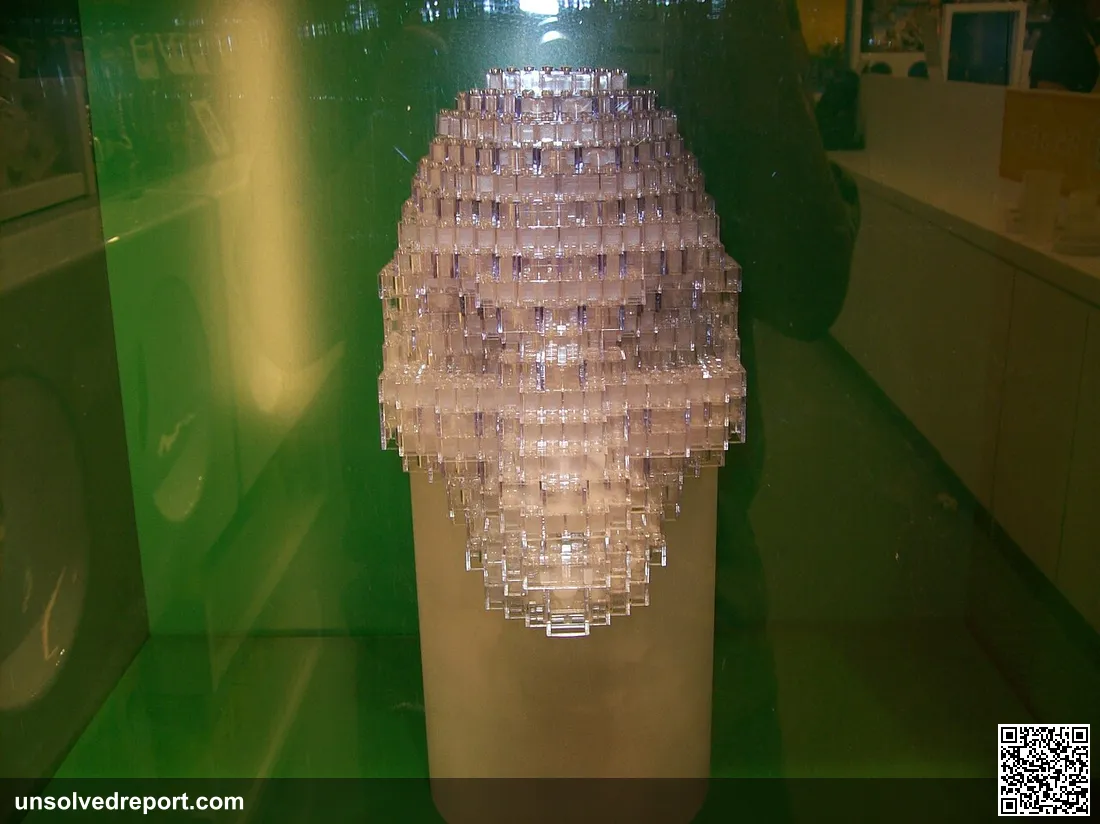
A life-sized human skull, carved from a single block of clear quartz, glaring out from a museum case. For more than a hundred years, that image traveled the world's great galleries wrapped in an irresistible legend: an Aztec or Mixtec masterpiece, somehow shaped without metal tools, glowing with a mystery that stumped even seasoned curators. Then a small team of scientists laid one under an electron microscope. The mystery didn't deepen. It evaporated — into something far more human. The skull was a clever Victorian fake, given away by tool marks no ancient hand could ever have left.
What the evidence actually shows
The most famous "ancient" skull spent decades in the British Museum — the same institution that still displays Hoa Hakananai'a, the moai statue taken from Easter Island — which bought the skull in 1897 from the New York jeweler Tiffany & Co. (British Museum / TORCH, University of Oxford). Tiffany had picked it up at a New York auction. Follow the trail back from there and it leads to a French antiquarian named Eugène Boban — a dealer who had worked in Mexico, and whose name turns up behind nearly every early "pre-Columbian" crystal skull you can name (TORCH, University of Oxford; Smithsonian, Jane MacLaren Walsh). For decades, the label under the glass said one word: Aztec.
Tearing that label off took patience, and that slow, careful work is the heart of the story. Smithsonian anthropologist Jane MacLaren Walsh teamed up with British Museum scientist Margaret Sax and materials scientist Ian Freestone (then of the British Museum, later the University of Wales, Cardiff). They wanted to read the carved surfaces under a scanning electron microscope without scratching the artifact — so they pressed flexible dental-impression resin onto it, peeled off the casts, and studied those instead (History News Network).
Here's what they saw, and what it should not have been there. The surfaces were covered in fine, parallel striations and crisp, sharply defined cuts — the unmistakable fingerprint of a rotary lapidary wheel, a spinning disc loaded with abrasive, run across the eye sockets, the teeth, the curve of the cranium. That wheel did not exist in the pre-Columbian Americas (British Museum collection record, via TORCH). And the team wasn't guessing. They had the real thing for comparison: genuine Aztec and Mixtec rock-crystal pieces — a goblet, beads, all from trustworthy collections — worked the old way, by hand, with stone and wood tools and gritty abrasive slurries. Those left a completely different mark: rough, wandering, irregular (Sax, Walsh, Freestone et al., Journal of Archaeological Science, 2008).
Then came the clue that pinned down the date. Inside a tiny cavity of the British Museum skull, a speck of residue was waiting. X-ray diffraction read it: silicon carbide — synthetic carborundum, one of the hardest abrasives ever made by humans. And carborundum didn't exist before the 1890s, when chemists first managed to synthesize it (Sax et al., 2008; Smithsonian). One flake of the stuff was enough. If carborundum touched this skull, the skull could not be older than the late nineteenth century. The British Museum piece, the team concluded, was carved in the 1800s. The Smithsonian's own skull — an anonymous donation that arrived in 1992 — wore even fresher tool marks, placing its birth in the twentieth century (Sax et al., 2008).
Even the raw stone confessed. The Department of Scientific Research at the British Museum traced the quartz most likely to Brazil or Madagascar — not Mexico, which has no known source of flawless crystal that big (History News Network; TORCH, University of Oxford). Today the museum's own label calls the skull probably European, probably nineteenth century.
The question science still can't close
Science settled when the skulls were made, and how. What it can't fully nail down is who — and where. The strongest documented guess points to Idar-Oberstein, a German town on the Nahe River that, in the 1800s, became the world capital of carving imported Brazilian quartz into trinkets, ornaments, and curiosities (TORCH, University of Oxford; Discover Magazine). The town had everything you'd need: the stone, the lapidary wheels, the skilled hands. But there's no signed workshop ledger, no order book, no carver's confession to close the case for certain. The link is an inference drawn from materials and trade routes — not a contract with a name on it. That's a real gap, and an honest mystery brand should say so out loud rather than smooth it over.
And then there's the celebrity of the bunch: the so-called Mitchell-Hedges skull. The adventurer F.A. Mitchell-Hedges claimed his daughter Anna dug it up in the 1920s at a Maya site in Belize. That one stayed in private hands and never made it into the British Museum–Smithsonian study, so it sits outside the peer-reviewed analysis entirely. Researchers did, however, find paper trails suggesting Mitchell-Hedges actually bought it at a 1943 Sotheby's auction in London — which knocks a serious dent in the jungle-discovery legend (Smithsonian / Jane Walsh research; Archaeology, Archaeological Institute of America). The true origin of that particular skull is still the field's liveliest loose end.
The legends that grew on top
Beyond the documented science, the crystal skulls collected a thick crust of legend. What follows is folklore and speculation, not established fact — laid out here only so you'll recognize it when you bump into it.
The "thirteen skulls" legend (folklore). A popular New Age belief insists that thirteen ancient crystal skulls are out there, and that reuniting them would unlock cosmic knowledge — or stave off catastrophe. There's no archaeological evidence for any set of thirteen, and the verified skulls trace back to nineteenth-century dealers, not ancient ceremony — a fabricated backstory not unlike the one behind the Cottingley Fairies photographs, which fooled believers for decades before the hoax unraveled.
The "lost technology" theory (speculation). Enthusiasts once argued the skulls were simply too perfect for human hands, hinting at some lost or extraordinary technique — the same "too perfect to be real" instinct that once dogged the Igbo-Ukwu bronzes. The microscope flipped that on its head. The perfection comes from modern rotary tools — not ancient genius (Sax et al., 2008).
The pop-culture megaphone (context). In 2008, Indiana Jones and the Kingdom of the Crystal Skull blasted the legend into mainstream imagination — in the very same year the peer-reviewed debunking hit print. Myth and evidence, marching in opposite directions, passing each other on the way (Archaeology, AIA).
The real lesson is gentler than any curse. These skulls are genuine artifacts — they're just not ancient ones, much like the Baghdad Battery, a real object stripped of its exaggerated legend by careful science. They're beautiful records of nineteenth-century craft, nineteenth-century salesmanship, and the deep, very human hunger for wonder. And cracking the case took nothing more mystical than a microscope, a fleck of synthetic grit, and the patience to compare. Funny how often the truth waits inside the smallest cavity — if someone bothers to look.
Sources & further reading
- Margaret Sax, Jane M. Walsh, Ian C. Freestone, et al., "The origins of two purportedly pre-Columbian Mexican crystal skulls," Journal of Archaeological Science 35 (2008): 2751–2760. ScienceDirect
- "April Fakes: The British Museum Crystal Skull," TORCH, University of Oxford. torch.ox.ac.uk
- "British Museum's 'Crystal Skull' A Fake," History News Network. historynewsnetwork.org
- Jane MacLaren Walsh, staff profile and crystal-skull research, Smithsonian National Museum of Natural History. naturalhistory.si.edu
- "The Anatomy of a Crystal Skull," Archaeology (Archaeological Institute of America). archaeology.org
- "The Real Story Behind Aztec Crystal Skulls," Discover Magazine. discovermagazine.com
Florentine Diamond: The 137-Carat Secret a Dying Empress Kept for 100 Years
The 137-carat Florentine Diamond was declared lost for a century. It was never stolen — find out what Empress Zita hid in a Canadian vault and why.

Lost Library of Ivan the Terrible: 400 Years, Zero Books Found
Lost library of Ivan the Terrible: 400 years of tsars, monks, and diggers hunting a sealed Kremlin vault. Still no book found. Did it ever exist?

SS Waratah Disappearance 1909: 211 Vanished, No Wreck Found
SS Waratah disappearance, 1909: a 9,339-ton luxury liner vanishes off South Africa with 211 aboard — no wreck, no bodies. What sank her?