Oc Eo Lost City: The Funan Port That Traded With Rome
A farmer's plough hit gold in a Vietnamese rice paddy—then archaeologists found Roman coins buried beside it. What was Oc Eo, and why did it vanish?
A farmer's plough catches on something hard in the mud. He digs it out, wipes it clean, and finds gold—a tiny bead, then another. He has no idea he's standing on top of a city. A city that once shook hands with the Roman Empire, stamped out its own silver coins, and then, quietly, slipped off the map of the world. Its name is Oc Eo. For centuries it lived only as whispers: gold turned up in the rice paddies, and one strange place-name scratched onto an ancient Greek map—not unlike Thonis-Heracleion, Egypt's own lost port city, swallowed for a thousand years before anyone found it again. Then a camera in the sky and a Frenchman with a spade pulled it back into the light. Oc Eo is real. We have proof. And it is still, in the ways that matter most, a riddle.
What We Know for Sure
Start with the dirt. Oc Eo lies in Thoai Son district of An Giang province, out in the flat, water-laced lowlands of southern Vietnam's Mekong Delta (Wikipedia, "Óc Eo"). The culture tied to it boomed from roughly the 1st to the 7th century CE, during the age of a kingdom the Chinese called Funan (Wikipedia, "Funan"). Vietnamese heritage officials put it plainly: Oc Eo–Ba The was the beating urban and economic heart of that kingdom (Nhan Dan).
So how did a buried city give itself away? From the air—much like Ubar, the legendary Arabian trade city that satellites eventually pulled out of the sand. French archaeologist Louis Malleret was looking at aerial photographs when the outlines of an ancient settlement bled through the landscape—straight lines and shapes that nature does not make. He started digging in the early 1940s. Vietnamese sources say he identified the site in 1944; other accounts push the first spadework back to 1942 (VietnamPlus; Wikipedia, "Óc Eo"). Either way, here's the jaw-dropper: those photos didn't show a messy heap of ruins. They showed a plan. A city sliced down its length by one canal, crossed by more canals running the other way, dotted with the foundations of houses raised on stilts, temples, and reservoirs (Wikipedia, "Óc Eo").
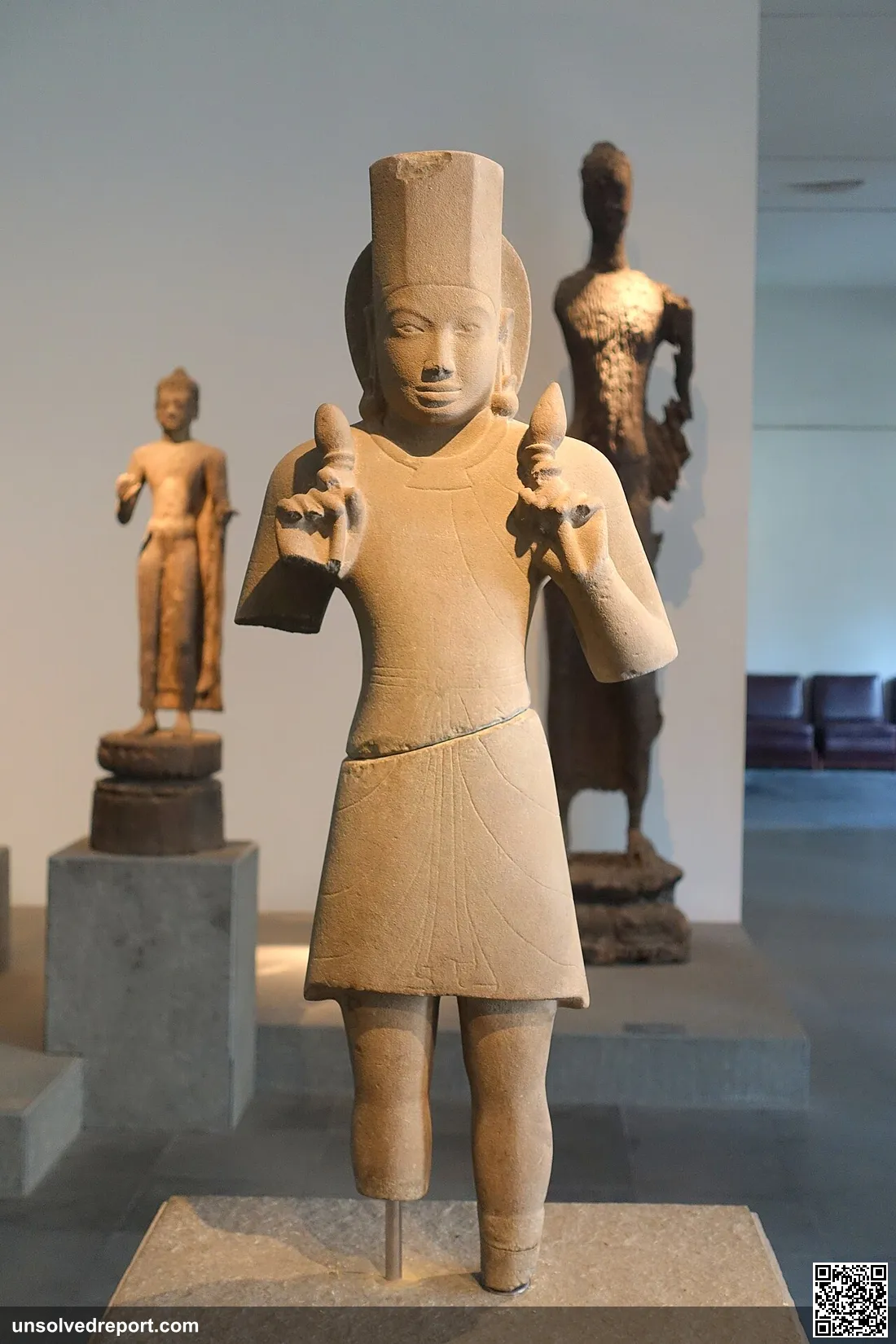
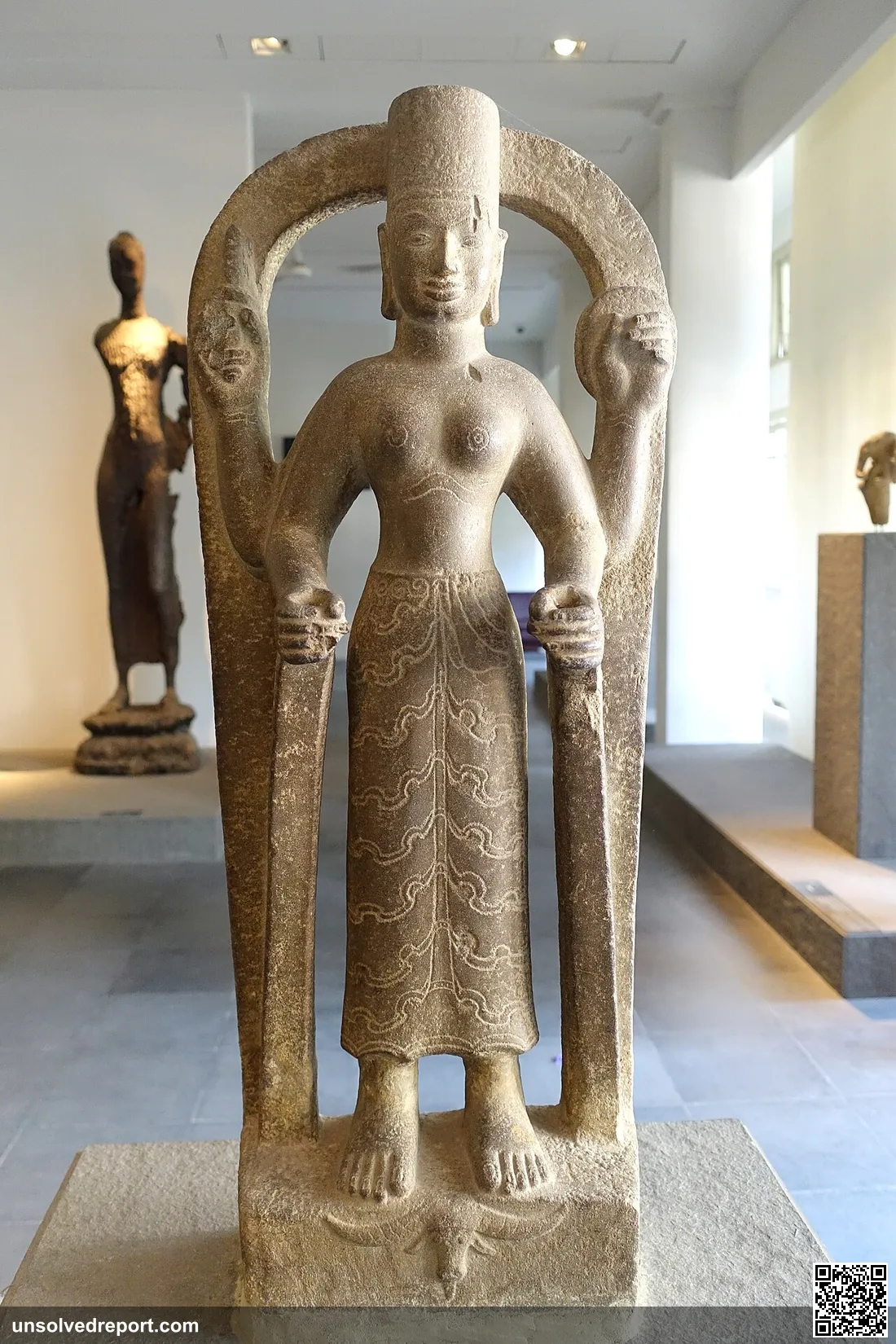
Those canals are the loudest clue of all. One ran out to a seaport. Another stretched some 68 kilometers northeast to Angkor Borei, in what is now Cambodia (Wikipedia, "Óc Eo"). This wasn't decoration—it was a highway built to move cargo. And the cargo gives the game away. Diggers pulled up Roman golden medallions stamped with the faces of emperors Antoninus Pius and possibly Marcus Aurelius, from the 2nd century CE—right beside Indian jewelry, Persian glass, and Chinese ceramics (Wikipedia, "Óc Eo"). Let that sink in: Roman gold, in the Mekong mud. And Oc Eo wasn't just buying—it was making. Archaeologists found casting molds, workshops turning out jewelry in gold, glass, and precious stones, and silver coins that appear to have been minted in Funan itself (Nhan Dan; Wikipedia, "Óc Eo"). Faith left its fingerprints too, carved in stone—including a Vishnu statue dated to the 6th–7th century, proof that Hindu worship lived and breathed here in the delta, much as it did further north at Dong Duong, the Cham kingdom's own Indian-influenced capital (Wikipedia, "Óc Eo").
But here's the eerie part. Funan barely speaks for itself. Almost everything we know comes from outsiders peering in. In the mid-3rd century, envoys from the Eastern Wu state—Kang Tai and Zhu Ying—sailed to the kingdom and wrote it down. Their original reports are lost, yet fragments survived inside later Chinese dynastic histories, including the Liang shu (Book of Liang), finished in 636 (Wikipedia, "Funan"; Wikipedia, "Kang Tai"). Those same texts carry a founding legend that reads like a fairy tale: a foreigner—written down as Huntian, and often matched by scholars to a Brahmin named Kaundinya—who married a local queen (Liuye, linked to a naga princess named Soma). Scholars still argue over who he really was, but for ages the story has been read as a marriage of two worlds: Indian and indigenous, fused into one (Wikipedia, "Funan").
The world has finally noticed. On January 4, 2022, UNESCO placed the Oc Eo–Ba The Archaeological Site on its World Heritage Tentative List, flagging roughly 433 hectares of conservation area (VietnamPlus). And by early 2026, Vietnam had finished its full nomination dossier, pushing for the site to be carved into the official list of World Heritage treasures (VietnamPlus).
The Question Nobody Can Answer
Now the ground gets soft under our feet. The big mystery isn't whether Oc Eo existed—it obviously did. It's something stranger: what was this place, really? And what killed it?
Even the experts can't agree on the first part. Was the "Oc Eo culture" one unified civilization, or just a web of separate local towns sharing the same trade routes—the same puzzle historians face at Bujang Valley, Southeast Asia's other ancient trading hub, where most of the city still lies buried? The Vietnamese historian Ha Van Tan came down on the second side—he argued that individual sites grew their own distinct cultures, not one tidy, copy-paste Funan (Wikipedia, "Óc Eo"). And it gets murkier: we don't even know for certain who these people were. Rival theories cast the Funanese as Khmer or Mon-Khmer, as Austronesian, or as a mixed-up blend of many peoples—and no theory has won (Wikipedia, "Funan"). Funan left almost no writing of its own behind. So much of what we "know" is really a story told about them, by foreigners, for foreigners.
The death of the city is hazier still. The broad outline is solid: by the late 6th and 7th centuries, a rising Khmer power called Chenla swallowed Funan, and Chinese sources flatly record that its capital was suddenly conquered (Wikipedia, "Funan"). But how did the lights actually go out? Here's one chilling possibility. As ships started skipping the Isthmus of Kra and sailing straight for China, the trade winds of commerce simply moved on—and the port that had made Oc Eo fabulously rich may have been left behind, marooned, forgotten by the very routes that built it (searchinginhistory.blogspot.com). Conquest? Bankruptcy? A delta that quietly shifted its water and drowned its harbors? Or all three at once? Nobody knows. The case is still open.
Theories and Loose Threads
Theory 1: Oc Eo is the lost "Cattigara" on Ptolemy's map. (Plausible, but argued over.) Roll back to the 2nd century CE. The Alexandrian geographer Claudius Ptolemy drew a port named Cattigara (or Kattigara) at the very edge of the known world—the last dot before the unknown. Many scholars, including the towering Southeast Asia expert George Coedès, say that dot is Oc Eo, and they point straight at the genuine Roman finds buried there as their proof (Wikipedia, "Cattigara"). The name might even come from Sanskrit—Kirti-nagara ("Renowned City") or Kotti-nagara ("Strong City") (Wikipedia, "Cattigara"). It's a beautiful fit. But "beautiful fit" isn't "proven"—other locations have been suggested, and that pile of Roman objects, real as it is, is small.
Theory 2: Did Romans actually show up—or just their gold? (Educated guesswork.) The medallions are 100% real. What they mean is anyone's call. Did Mediterranean merchants genuinely sail all the way to the delta? Or did that Roman gold creep eastward, passed hand to hand through Indian and Southeast Asian middlemen until it landed in the mud? Researchers like Emilia Smagur and Kasper Hanus have chewed on exactly this, and the careful answer is sobering: a few Roman trinkets prove contact with the Roman world—not necessarily a single Roman standing on Oc Eo's docks (Academia.edu).
Theory 3: The founding legend is memory, not minutes. (Folklore, not a record.) The tale of Kaundinya and the naga princess shows up again and again across Southeast Asia—it's a pattern, not an eyewitness account. Read it as a legend that carries a real truth inside it (the Indianization of the delta), rather than something you could circle on a calendar (Wikipedia, "Funan").
One thing, though, is beyond all doubt: the sheer wonder of the place. A city of delta mud that somehow reached all the way to the marble of Rome. The canals are still out there, lying quiet beneath the rice. The answers are not. For now, the mud keeps its secrets—and somewhere under the next paddy, another bead of gold is waiting.
Sources & Further Reading
- Wikipedia, "Óc Eo" — https://en.wikipedia.org/wiki/%C3%93c_Eo
- Wikipedia, "Funan" — https://en.wikipedia.org/wiki/Funan
- Wikipedia, "Kang Tai" — https://en.wikipedia.org/wiki/Kang_Tai
- Wikipedia, "Cattigara" — https://en.wikipedia.org/wiki/Cattigara
- Nhan Dan Online, "Admiring national treasures of Oc Eo–Ba The" — https://en.nhandan.vn/admiring-national-treasures-of-oc-eoba-the-post150613.html
- VietnamPlus, "Dossier finalised to seek UNESCO recognition of Oc Eo–Ba The archaeological site" — https://en.vietnamplus.vn/dossier-finalised-to-seek-unesco-recognition-of-oc-eo-ba-the-archaeological-site-post336750.vnp
- Smagur, E. & Hanus, K., "Kattigara of Claudius Ptolemy and Óc Eo" (academic paper) — https://www.academia.edu/43774046/
The Voynich Manuscript: The Book No One Can Read
The Voynich Manuscript sits in a Yale vault, fully photographed and free to read online — yet in 600 years, not one word has ever been decoded. Why not?
Sinaia Lead Plates Forgery Mystery: The Clue Nobody Can Explain
Lab tests call the Sinaia lead plates 19th-century forgeries. So why hasn't anyone explained the one clue that doesn't fit the hoax story?
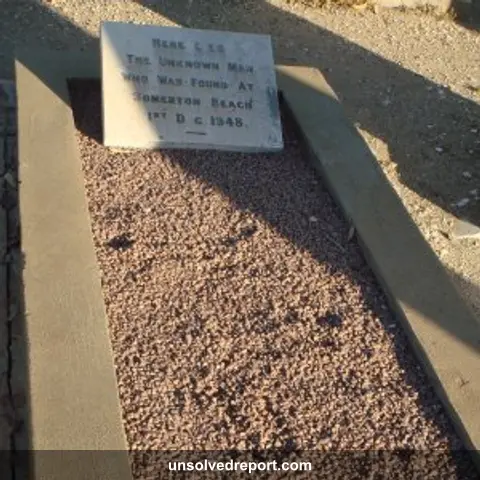
Somerton Man: The Body Nobody Could Name for 74 Years
Who was the Somerton Man? A coded note, a torn Persian poem, and a phone number kept him nameless for 74 years - until DNA cracked the case in 2022.