Sinaia Lead Plates Forgery Mystery: The Clue Nobody Can Explain
Lab tests call the Sinaia lead plates 19th-century forgeries. So why hasn't anyone explained the one clue that doesn't fit the hoax story?
A small stack of gray metal sits in a museum warehouse in Bucharest, quietly daring everyone to figure it out. The tablets are lead. They're corroded. And they're covered in a script that no living person can fully read — a puzzle in the same league as the Voynich manuscript. What we can read says they tell the story of the Dacians — the fierce ancient people who once ruled what is now Romania and handed Rome one of the toughest fights it ever had. So which is it? If these plates are real, they're a priceless lost chronicle. If they're fake, they're one of the boldest historical hoaxes anyone has ever pulled off — up there with the Lady of Elche forgery debate. More than a hundred years later, the smartest scholars in the room still can't slam the case shut.
What We Actually Know
Start with the strange arrival. After 1875, roughly 200 lead plates simply turned up in a warehouse of the Museum of Antiquities in Bucharest. No grand excavation. No dig. They were just there. Today only 35 still survive, though photographs of some of the lost ones remain (Wikipedia; The Art Newspaper). Most are rectangles, the smallest about 9.3 by 9.8 cm, the largest a hefty 35.4 by 25.5 cm — and there's one odd round one in the mix (Wikipedia).
Now look closer at the writing. The words run together with no spaces between them — a style called scriptio continua — written in the Greek alphabet but with a few extra signs thrown in, including a Latin "V" and some Cyrillic-style marks (Wikipedia). The language has Indo-European bones. Many nouns end in "-o" (Dacibalo, Sarmigetuzo, Boerobiseto), some words are clearly borrowed from Greek and Latin — and then there are words like mato (king) and kotopolo (priest) that match nothing anyone knows (Wikipedia). And the pictures? Armies. Kings. Cities. Temples. What look like royal family trees, apparently naming Dacian rulers, gods, and places (The Art Newspaper).
One man stands at the center of the whole story. Bogdan Petriceicu-Hasdeu (1836–1907) was a celebrated Romanian polymath — a genius said to have known dozens of languages. He was put in charge of the State Archives in 1876 and made a professor of philology at the University of Bucharest in 1878 (The Art Newspaper). And here's the catch: many skeptics think Hasdeu made the plates himself. They point out he is known to have produced other forgeries (Wikipedia) — a 19th-century habit shared by the forgers behind the crystal skulls now known to be fakes.
So what do most experts actually believe? That the plates are modern fakes. Alexandru Vulpe, a director of the Institute of Archaeology, said it without flinching: they were made in the 19th century (Wikipedia; Ancient Origins). And the clues pile up fast. When the plates first surfaced, they looked new — none of the corrosion you'd expect on ancient metal pulled from the ground (Ancient Origins). Then there's the cannon. At least one battle scene appears to show one — and cannons didn't show up in Europe until roughly the 13th century, more than a thousand years after the Dacian kingdom fell to Rome in AD 106 (Ancient Origins). Here's the sneakiest tell of all. The plates spell a Dacian town "Comidava" — the form taken from the ancient geographer Ptolemy — instead of the correct "Cumidava," a spelling only confirmed in 1942 from an inscription. In other words, whoever wrote these was working from what people knew before 1900 (Wikipedia).
But the hardest blow comes from the metal itself. Scientists at the Institute of Nuclear Physics in Bucharest tested samples from all 35 surviving plates (the results came out around 2004). The verdict: the lead matches printing lead manufactured in the second half of the 19th century (Wikipedia; Ancient Origins). Case closed, right? Not so fast.
The Part Nobody Can Explain Away
Here's what keeps this from being a tidy story with a tidy ending: even the skeptics admit that if these are forgeries, they are jaw-droppingly clever ones. The Art Newspaper puts it plainly — pulling this off would have demanded "a vast knowledge of archaeology, linguistics, history and ancient art" (The Art Newspaper).
And two loose threads refuse to be tucked away. The first is a map. One plate seems to lay out the plan of Sarmizegetusa, the Dacian capital — and its defenders argue it does so with a precision that archaeologists only confirmed by digging, decades after 1875. That includes a two-story temple that wasn't uncovered until 1956 (Antiquity; The Art Newspaper). So how could a 19th-century forger have drawn things that excavators hadn't even found yet? That's the question that just won't die.
The second thread is a rival lead test. Dr. Peter Northover at Oxford studied one plate (item 023) and reportedly found its lead nearly identical to a metal cramp pulled straight from the wall of Sarmizegetusa itself (Ancient Origins). That single result sits very awkwardly next to the Bucharest finding of modern printing lead — and nobody has fully squared the two analyses in the public record.
Now, a dose of honesty. The Sarmizegetusa "accuracy" claim comes from the plates' own defenders, and it hasn't been independently checked against what was truly unknowable in 1875 — some features of the city may have been visible or guessable earlier than people assume. The point isn't that the plates are real. The point is that no published study has cleanly killed off every oddity. As researcher Aurora Pețan noted in the journal Antiquity, specialists have shown remarkably little curiosity about all this over more than 130 years, and there's never been an official program to study the archive at all (Antiquity).
So What Are They? Three Possibilities
Possibility one: a 19th-century forgery — the mainstream call. Most archaeologists think the plates were cooked up in the 1800s — maybe by Hasdeu, maybe by others in his circle — to puff up Romanian national pride at a moment when the country was wild about its Dacian past. The modern printing lead, the impossible cannon, the missing corrosion, the spelling that betrays pre-1900 knowledge: all of it points the same way (Wikipedia; Ancient Origins). The likeliest motive, by this reading, was patriotic myth-making rather than money — though that part is speculation.
Possibility two: copies of lost gold originals. A stubborn oral tradition — and the sources flat-out call it "dubious" — says the lead plates are 1875 copies of gold originals, supposedly cast at a nail factory in Sinaia. The gold, the story goes, was then melted down to help pay for Peleș Castle, or swallowed into the Romanian treasure later held in Russia (Wikipedia; Antiquity). It's a tidy idea, because it would explain both the modern lead and the ancient-looking content in one stroke. There's just one problem, and it's a big one: those gold originals have never been produced.
Possibility three: a real ancient archive — the minority view. A handful of researchers, including engineer Dan Romalo (whose 2003 study reignited the whole debate) and Aurora Pețan, argue the plates carry genuine Dacian information and deserve serious, open-minded study instead of a shrug and a dismissal (Ancient Origins; Antiquity) — a fringe-vs-mainstream fight echoed today in the Gunung Padang dating controversy. It's a minority position, and mainstream archaeology hasn't accepted it.
So here's the honest landing. The physical evidence leans hard toward forgery — that much is real. But a stubborn few anomalies, the Sarmizegetusa plan and that conflicting Oxford lead result, have never been fully explained. The Sinaia lead plates might be a brilliant hoax. They might be a garbled echo of something genuinely lost. Either way, that little stack of gray metal in a Bucharest warehouse is still holding its secret — waiting for someone curious enough to crack it.
Sources & further reading
- Sinaia lead plates — Wikipedia: https://en.wikipedia.org/wiki/Sinaia_lead_plates
- Lost art: the possibly forged but tantalising Sinaia lead plates — The Art Newspaper: https://www.theartnewspaper.com/feature/lost-art-the-possibly-forged-but-tantalising-sinaia-lead-plates
- The Sinaia Lead Plates: Dacian Treasure Trove or Impressive Fakes? — Ancient Origins: https://www.ancient-origins.net/unexplained-phenomena/sinaia-lead-plate-0016596
- Aurora Pețan, 'A possible Dacian royal archive on lead plates' — Antiquity, Vol 79 No 303 (2005): https://antiquity.ac.uk/projgall/petan303

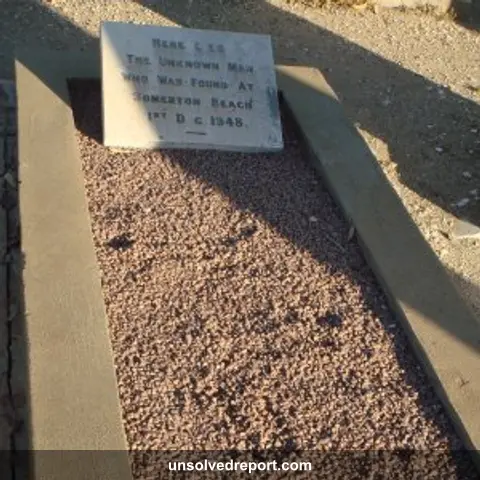
Somerton Man: The Body Nobody Could Name for 74 Years
Who was the Somerton Man? A coded note, a torn Persian poem, and a phone number kept him nameless for 74 years - until DNA cracked the case in 2022.
Mahendraparvata: The Lost Khmer City a Laser Uncovered
Mahendraparvata: a Khmer capital hidden under Cambodia's jungle for 1,200 years, found only when a laser exposed it from the air. Why did it empty out so fast?
Dwarka Submerged City: The Sunken Ruins Nobody Can Explain
Divers found cut stone walls and 120+ anchors submerged off Dwarka, India. Is it Krishna's legendary drowned city? The age nobody can pin down.