Axis of Evil Cosmology: The Line in the Sky Nobody Can Erase
Axis of evil cosmology: two separate satellites found the same impossible line in the oldest light in the universe. Is it a glitch, or something worse?
There is one photograph of the entire sky, taken when the universe was just 380,000 years old. It exists. It really exists — a faint, even glow we can still see today, called the cosmic microwave background, or CMB. It is the oldest light in existence, and for sixty years it has been one of the most stared-at images in all of science.
The textbooks make a promise about that photograph. The patterns in it should be random and direction-less, scattered across the sky with no favorite way to point. No up. No down. No grain. Just noise, sprinkled evenly in every direction.
Now look closer at the biggest, smoothest swirls in that ancient glow. Several teams did, and they kept seeing the same thing — something that has no business being there. A line. In 2005, cosmologists Kate Land and João Magueijo gave it a name that was half a joke and half a warning: the "axis of evil."
This is not fringe stuff. It is a real, documented puzzle in mainstream astrophysics, argued over in peer-reviewed journals and in the official analyses from NASA's WMAP and the European Space Agency's Planck missions. No aliens. No secret designer. No hidden message. Just a genuine open question about whether one of cosmology's deepest assumptions is exactly true — and so far, nobody can make the line go away. Let's pull apart what we actually know from what we don't.
What we actually know
Start with how cosmologists read the CMB. The temperature of that ancient light wobbles by tiny amounts from one patch of sky to the next, and scientists sort those wobbles by size into patterns they call "multipoles." The two biggest patterns are the quadrupole (a four-lobed shape, labeled ℓ=2) and the octupole (an eight-lobed shape, ℓ=3). In a universe that looks the same in every direction — the bedrock idea called "statistical isotropy" — these two patterns should point every which way, with orientations that are essentially random and have nothing to do with each other (Schwarz et al., CMB Anomalies after Planck, 2016).
They are not random. In 2005, Land and Magueijo reported in Physical Review Letters that the quadrupole and octupole axes line up far more tightly than chance should ever allow — and that the alignment seemed to march on through still-higher multipoles, "rejecting statistical isotropy with a probability in excess of 99.9%" in their analysis (Land & Magueijo, Phys. Rev. Lett. 95, 071301, 2005). And here's the part that makes the hair stand up. Earlier work by Dominik Schwarz, Glenn Starkman, and colleagues had spotted something even weirder: those two patterns don't just line up with each other — they point, roughly, along things inside our own Solar System. The ecliptic plane, which is the plane of Earth's orbit. The direction of the equinoxes. The cosmological dipole — the same all-sky tilt in the CMB that also encodes our galaxy's headlong rush toward the Great Attractor. The oldest light in the universe appears to know which way our little planet goes around the Sun. They put the odds of various pieces of that coincidence at roughly 0.1% to 0.9% (Schwarz et al., summarized in the Planck anomaly literature).
The first hint came from NASA's Wilkinson Microwave Anisotropy Probe, WMAP, with data starting in 2003. You might expect a single instrument to be fooling itself — and that would be the easy way out. But the line refused to take it. When a completely different machine looked, it didn't vanish. ESA's Planck satellite, built with different detectors and a different way of scanning the sky, saw the same large-scale features all over again. As cosmologist Dominik Schwarz later put it, "For a long time, part of the community was hoping that this would go away, but it hasn't" (overview via Wikipedia, Axis of evil (cosmology))).
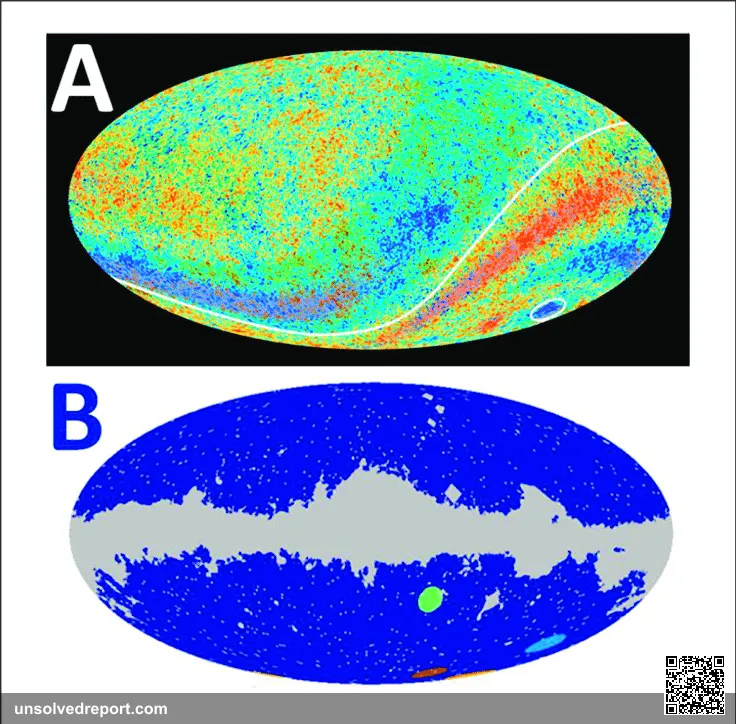
And the axis doesn't travel alone. Planck's official analysis lists a whole little gang of large-scale oddities. There's a strange lack of correlation on the very biggest angular scales. There's a "hemispherical asymmetry," where one half of the sky carries a bit more power than the other — a difference of around 7%. There's an unusually large "Cold Spot" sitting in the southern sky. And then there are the multipole alignments themselves. Taken one at a time, each of these lands at a quoted significance "in the per mille to per cent level" against the standard inflationary ΛCDM model — meaning each is roughly a 0.1%-to-1% departure from what the theory expects (Schwarz et al., 2016). Strange company for a line that shouldn't exist.
So is it real?
Here's the honest heart of it — and the place where careful scientists slow way down. Either the axis of evil is a real feature of the universe, a hint that space is not quite the same in every direction and a cornerstone of modern cosmology is cracked. Or it's a mirage: bad luck, instrument quirks, and the very human habit of seeing faces in the clouds, all stacked on top of each other.
The single biggest reason to stay cool is something physicists call the "look-elsewhere effect" — the a posteriori problem. We have exactly one sky. One. And we noticed these alignments after the fact, by combing through the data and asking how weird the weirdest-looking bits were. Search any rich dataset hard enough for something surprising, and you are practically guaranteed to find it. ESA's own Planck 2018 isotropy paper says this out loud, again and again: yes, it confirms "the presence of several so-called 'anomalies' on large angular scales," but it also finds the CMB broadly "consistent with the Gaussian predictions of the ΛCDM cosmological model," and notes that once you properly account for having gone looking, the significance of any single feature drops sharply (Planck 2018 results VII, Isotropy and Statistics of the CMB).
So the field is stuck in a genuine standoff. On one side: the anomalies show up across two independent satellites, which is hard to wave away as a simple measurement glitch. On the other: their significance is modest once you correct for fishing — never reaching the "5-sigma" gold standard physicists demand before they'll call something a discovery. And there's a tell-tale silence. Planck found no clear echo of these temperature anomalies in the CMB's polarization — a separate, independent dataset that, if the signal were a true feature of the cosmos, should have lit up too. It didn't (Planck 2018 results VII). The mystery isn't solved in either direction. It just sits there.
Three ways to read the line
Because the question is wide open, several explanations are still standing. What follows is a menu of live possibilities under active debate — not settled answers. Treat each as a theory, not a verdict.
It's a fluke. The most cautious reading: we just rolled rotten dice. The biggest CMB patterns suffer from "cosmic variance" — with only one universe to observe, the handful of largest features are inherently fuzzy and uncertain, and a 1-in-1000 coincidence has to land somewhere in the cosmos, the same way a single stubborn hole in the galaxy map, like the Boötes Void, can look impossibly empty by chance alone. WMAP's principal investigator, Charles Bennett, has chalked much of the excitement up to "coincidence and human psychology" (Wikipedia summary)).
It's something close to home. Remember how the line points partly toward Solar System structures? That makes some researchers suspicious that the culprit is local — foreground glow that wasn't fully scrubbed out, whether from our own galaxy or even from dust drifting inside the Solar System, or subtle side-effects of how the sky gets "masked" during data processing. One 2016 study found that different masking choices could shrink the axis until it became statistically insignificant (discussion in Planck anomaly literature). If some nearby contaminant is bleeding into the maps, then the "axis" might be partly a story about us, not about the cosmos.
It's new physics. This is the most thrilling possibility — and the one to hold at arm's length. Maybe the alignment is telling the truth about the early universe: a faint large-scale lopsidedness, an exotic wrinkle in cosmic inflation, or a strange topology of space itself — the kind of crack in the standard model that also fuels puzzles like the Hubble tension, where the universe seems to disagree with itself about its own expansion rate. Schwarz and colleagues argue that the bundle of anomalies, which they show are not correlated with one another, hints at "a violation of statistical isotropy and scale invariance" — something the standard model simply does not predict (Schwarz et al., 2016). If that's right, it would be a profound clue about how everything began. But extraordinary claims need the kind of independent backup that the polarization data, so far, just haven't handed over.
For now, the axis of evil stays exactly what a good mystery should be: a documented, repeatable pattern that nobody can fully explain — or fully explain away. The next generation of sky maps, especially the polarization measurements coming from new experiments, may finally settle it. They'll tell us whether that line in the oldest light is a whisper from the dawn of time, or just a trick played by the one sky we happen to live under. Until then, keep one eye on the data — the universe is still deciding what to confess.
Sources & further reading
- Land, K. & Magueijo, J., "The Axis of Evil," Physical Review Letters 95, 071301 (2005) — arXiv:astro-ph/0502237
- Schwarz, D. J., Copi, C. J., Huterer, D. & Starkman, G. D., "CMB Anomalies after Planck," Classical and Quantum Gravity 33, 184001 (2016) — arXiv:1510.07929
- Planck Collaboration, "Planck 2018 results. VII. Isotropy and Statistics of the CMB" — arXiv:1906.02552
- "Axis of evil (cosmology)," Wikipedia overview — en.wikipedia.org)

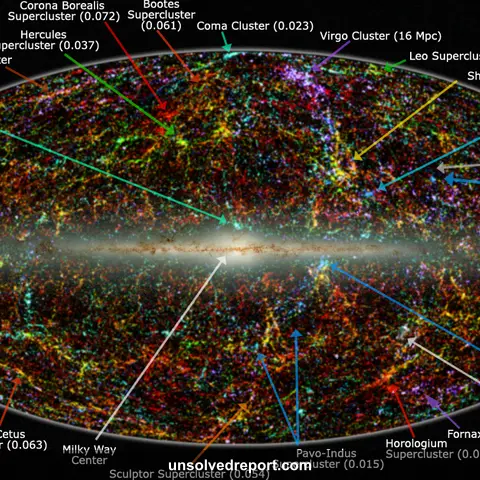
The Great Attractor: The Pull You Can't See or Stop
Something is dragging the Milky Way at 600 km/s toward a spot hidden behind our own galaxy. Astronomers call it the Great Attractor. What is it, really?
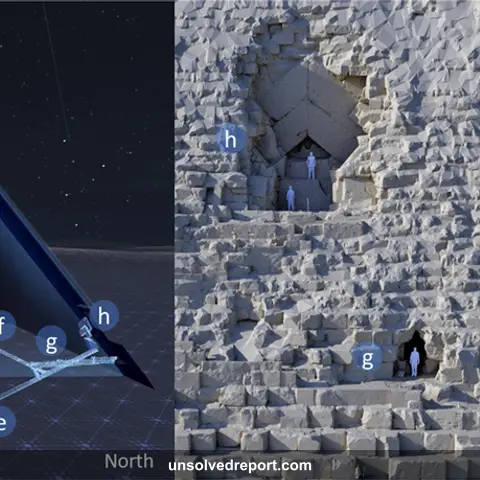
Great Pyramid's Big Void: A 100-Foot Room No One Has Entered
ScanPyramids detected a 100-foot void hidden inside the Great Pyramid in 2017 — and no human has ever seen inside it. So what's really in there?
Plane of Satellite Galaxies Problem: A Puzzle No One Can Crack
Plane of satellite galaxies problem: tiny galaxies orbit the Milky Way and Andromeda in flat, spinning discs cosmology says shouldn't exist. Why?