Cosmological Lithium Problem: Big Bang Made 3x Too Much
Big Bang physics predicts triple the lithium the oldest stars actually have. Nuclear reactions, dark matter, new physics — which one is hiding the missing two-thirds?
Two-thirds of the universe's oldest lithium is missing, and nobody can find it.
That's not a typo. The same theory that nails how much hydrogen, helium, and deuterium the newborn universe cooked up also tells us how much lithium it should have made. So astronomers went looking, in the most ancient stars they could find. They came up short. Way short. Three parts predicted, one part actually there.
More than two decades later, the gap is still wide open. This is the cosmological lithium problem, and it might be the most quietly unsettling unsolved puzzle in all of astrophysics.
What we know for sure
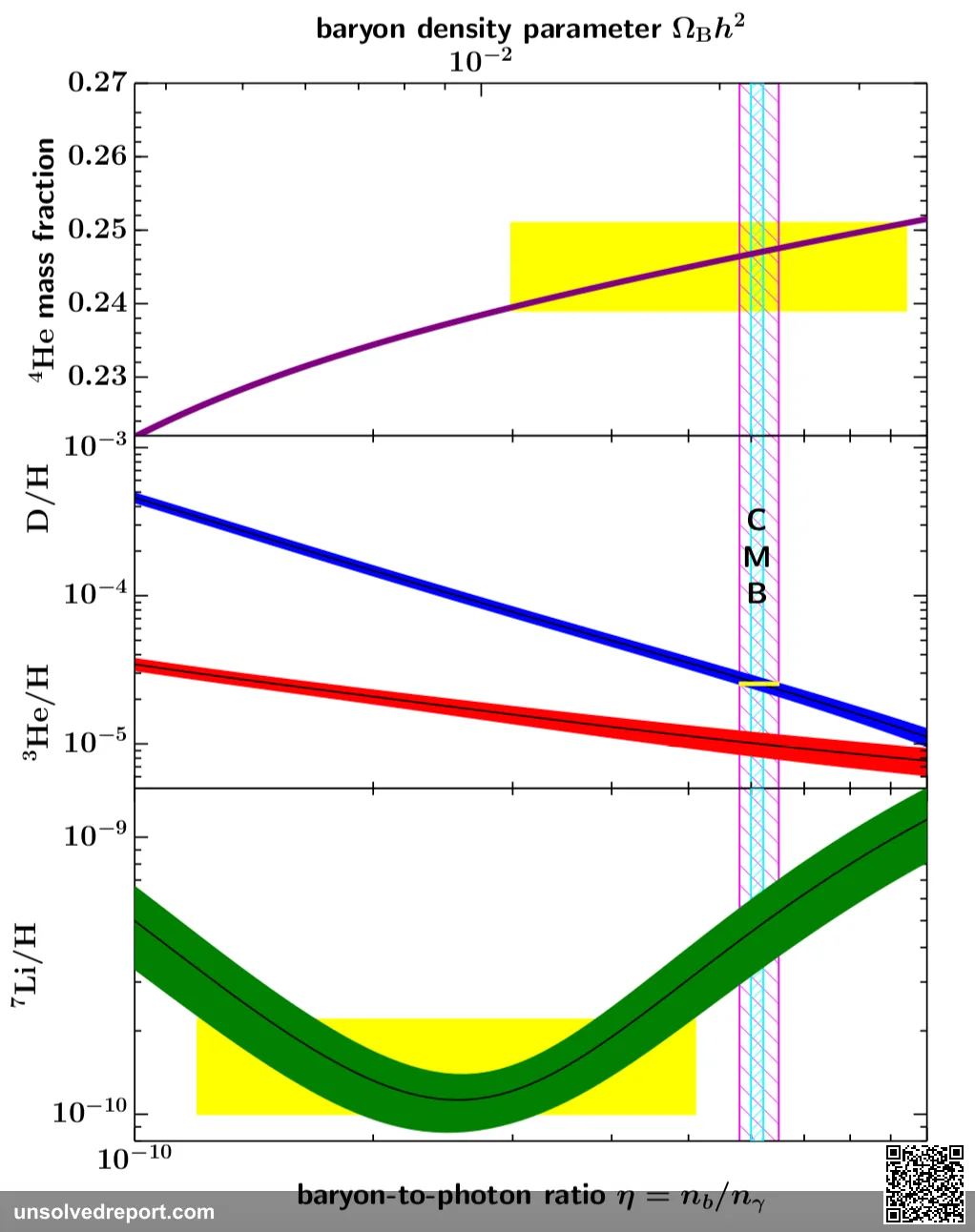
Rewind to the first few minutes after the Big Bang. The whole universe is a furnace, hot and dense enough to weld light atomic nuclei together, a process called Big Bang nucleosynthesis, or BBN for short. Here's what makes BBN so powerful: there's almost nothing left to fudge. Once the Planck satellite nailed down exactly how much ordinary (baryonic) matter exists by reading the cosmic microwave background, BBN turned into a "zero-parameter theory." Feed it that one number, and it spits out how much of each light element the early universe should have forged (Astronomy & Astrophysics, 2025).
For most of those elements, it's a stunning win. Measure the deuterium and helium-4 floating around the cosmos, and the numbers line up with theory almost perfectly (A&A, 2021). Deuterium matches to within a few percent. This is one of the load-bearing pillars of Big Bang cosmology, the kind of agreement that makes physicists trust the whole framework.
Then there's lithium-7. The black sheep.
Plug in the same CMB-measured baryon density, and standard BBN predicts a primordial lithium-7 abundance of about (7Li/H) = (4.9 ± 0.7) × 10⁻¹⁰ (A&A, 2025, citing Yeh et al. 2021 and Fields & Olive 2022). Clean. Confident. Now we just have to go check it.
How do you check the lithium left over from the Big Bang? You hunt for the oldest, most chemically pristine stars in the Milky Way's halo, ancient relics like the star that seemed older than the universe that have barely been touched by later cosmic chemistry. In the 1980s, François and Monique Spite found something striking: warm, metal-poor halo stars nearly all carry the same lithium level, no matter what else differs about them. A flat line across the sky. The field named it the "Spite plateau." Because these stars congealed from gas that had hardly been enriched by younger stellar generations, their lithium should be close to the original Big Bang stock. And where does that plateau sit? At a logarithmic abundance of roughly A(Li) ≈ 2.2, which works out to (7Li/H) ≈ (1.6 ± 0.3) × 10⁻¹⁰ (A&A, 2025).
Now line the two numbers up. Theory says 4.9. The ancient stars say 1.6. Theory predicts roughly three to four times more lithium-7 than is actually there (Wikipedia summary of the literature; A&A, 2025). The field just calls it "the factor of three." And before you reach for the easy out, the measurement errors are nowhere near big enough to paper over the gap. The discrepancy dwarfs the uncertainties many times over. This isn't sloppy data. It's a real hole.
Why nobody has solved it
So why hasn't someone just fixed this? Because every obvious suspect has been hauled in for questioning, and not one of them closes the gap alone.
Think of it as a three-way standoff. The culprit could be (1) the nuclear physics fed into BBN, (2) the way stars cling to or quietly burn off their lithium across billions of years, or (3) some unknown physics lurking in the early universe itself (A&A, 2025). And here's the cruel part: the other light elements give cosmologists nowhere to hide. Try to tweak the recipe to suppress lithium, and you almost always wreck the gorgeous deuterium and helium predictions in the process. Those are non-negotiable. They work too well to break.
So the missing lithium isn't some loose thread you can yank without unraveling a sweater that already fits. That tension, that you can't fix one number without breaking three others, is the whole reason this thing is still alive and still generating papers in 2025.
The leading suspects
Three main explanations are on the table. None is confirmed. Read each as a contender, not a verdict.
Suspect 1: The stars ate it. This is the cautious, currently-favored bet. The pitch goes like this: the Spite plateau stars really did form with the full Big Bang ration of lithium, then slowly destroyed or buried it over some 13 billion years. Lithium is fragile stuff, it burns at relatively low temperatures, so processes like atomic diffusion (heavier elements sinking gently beneath a star's surface under gravity) and turbulent mixing could gradually scrub away the surface lithium we measure (IOPscience, ApJ 2012). There's a tantalizing clue in the globular cluster NGC 6397, where slightly more evolved stars show different lithium and iron levels than their less-evolved neighbors, exactly the fingerprint diffusion would leave (A&A, 2009). Some models can even start from the BBN value of A(Li) ≈ 2.7 and grind it down to the observed plateau, but only by hand-tuning a suspiciously specific dose of turbulence to get there (MNRAS, 2015). And there's the nagging catch: the plateau is eerily flat and tight. Real depletion is usually messy, varying star to star, which is hard to reconcile with such perfect uniformity.
Suspect 2: The nuclear rates are wrong. BBN's lithium yield rides on a chain of nuclear reactions, much of it funneled through beryllium-7, which later decays into lithium-7. If even one of those reaction rates were measured wrong, the prediction would shift. So physicists went and checked. In 2021, a team led by Seiya Hayakawa and Hidetoshi Yamaguchi at the University of Tokyo's Center for Nuclear Study pulled off a "Trojan horse" trick, smuggling a neutron into a beryllium-7 beam hidden inside a deuteron, to measure the reaction where beryllium-7 plus a neutron flips into lithium-7 plus a proton (Phys.org, 2021). The payoff? It trimmed the predicted lithium by all of 10 percent (ScienceDaily, 2021). A genuine refinement, sure, but a factor of three this is not. Experiment after experiment like this keeps squeezing the room for a tidy nuclear-physics fix.
Suspect 3: Something brand new in the early universe. Here's where it gets fun. If neither the stars nor the nuclear rates can swallow the whole gap, maybe the answer is physics beyond the Standard Model, operating during BBN itself — the same kind of crack that the galaxies showing up too early in the universe might also be exposing. The proposals read like a wishlist of the exotic: decaying or annihilating dark-matter particles, hypothetical long-lived supersymmetric particles, sterile neutrinos, even fundamental constants that drifted in the universe's first minutes (A&A, 2021). What makes these so seductive is that a lithium-only anomaly is precisely the kind of crack where genuinely new physics might be peeking through. But they're also the least pinned-down of the bunch: any such model has to thread an impossibly fine needle, fixing lithium while leaving deuterium and helium perfectly intact. For now, this remains speculation, an open hand of maybes rather than an answer.
So where does that leave us in 2025? The honest read is that some combination of effects, most likely modest stellar depletion doing most of the heavy lifting, is the front-runner. But nobody has won the field outright. The universe made the lithium. The old stars refuse to show it. And the gap between those two sentences is still, genuinely, an open question, the kind that quietly waits for whoever decides to crack it next.
Sources & Further Reading
- Astronomy & Astrophysics (2025), "The cosmological lithium problem" — aanda.org
- Astronomy & Astrophysics (2021), "Primordial nucleosynthesis with varying fundamental constants" — aanda.org
- Monthly Notices of the Royal Astronomical Society (2015), "Lithium evolution in metal-poor stars" — academic.oup.com
- The Astrophysical Journal (2012), "Atomic Diffusion and Mixing in Old Stars III: NGC 6397" — iopscience.iop.org
- Astronomy & Astrophysics (2009), "Lithium in the globular cluster NGC 6397" — aanda.org
- Phys.org (2021), "Researchers account for some of the lithium missing from our universe" — phys.org
- ScienceDaily (2021), "Closing the gap on the missing lithium" — sciencedaily.com
- "Cosmological lithium problem" overview — Wikipedia
Neutron Star Maximum Mass: The Line Nobody Can Find
A neutron star dies and becomes a black hole somewhere between 2.2 and 2.9 solar masses. Astronomers already found one that shouldn't exist. Where's the real line?

6478 Gault: The 'Dead' Asteroid That Grew Two Comet Tails
6478 Gault is a dry rock, not a comet — yet in 2019 it sprouted two glowing tails and nobody agrees on why it happens when it does. Here's the evidence.
Eta Carinae: The Star That Faked Its Own Death
In 1843, Eta Carinae's Great Eruption nearly outshone a supernova — then the star refused to die. Astronomers still can't fully explain how it survived.