Eta Carinae: The Star That Faked Its Own Death
In 1843, Eta Carinae's Great Eruption nearly outshone a supernova — then the star refused to die. Astronomers still can't fully explain how it survived.
A single star in the southern constellation Carina swelled, year after year, until it became one of the brightest points in the entire sky. This was 1843. Sailors saw it. Astronomers tracked it. For a few astonishing years it nearly matched Sirius itself. And then it did something no dying star is supposed to do: it faded — not into a smoking crater of wreckage, the way a star ends, but quietly back into the dark. Eta Carinae had rehearsed its own death and then walked away from the grave. Almost two centuries on, nobody can fully explain how it pulled off the trick.
What we know for certain
Start with the address. Eta Carinae sits about 7,500 light-years away in the southern constellation Carina, and there is nothing ordinary about it (Encyclopaedia Britannica). It isn't even one star. It's two: a primary heavyweight carrying something like 90 to 100 times the mass of the Sun and blazing millions of times brighter, locked in orbit with a companion of perhaps 30 solar masses (NASA/Chandra X-ray Observatory). The pair waltz around each other once every 5.54 years (arXiv preprint, Richardson et al.).
And here's the remarkable thing — we watched the eruption happen, in real time. Sir John Herschel, peering up from the Cape of Good Hope in South Africa, clocked the star climbing steeply through the 1830s; by December 1837 it had hit first magnitude. It kept rising for years. Observers at the Cape and in Calcutta caught the peak in March 1843, when Eta Carinae reached roughly magnitude −1 — the second-brightest star in the whole night sky, beaten only by Sirius (Encyclopaedia Britannica). The full episode, sometimes dated 1837 to 1858, got a fitting name: the "Great Eruption."
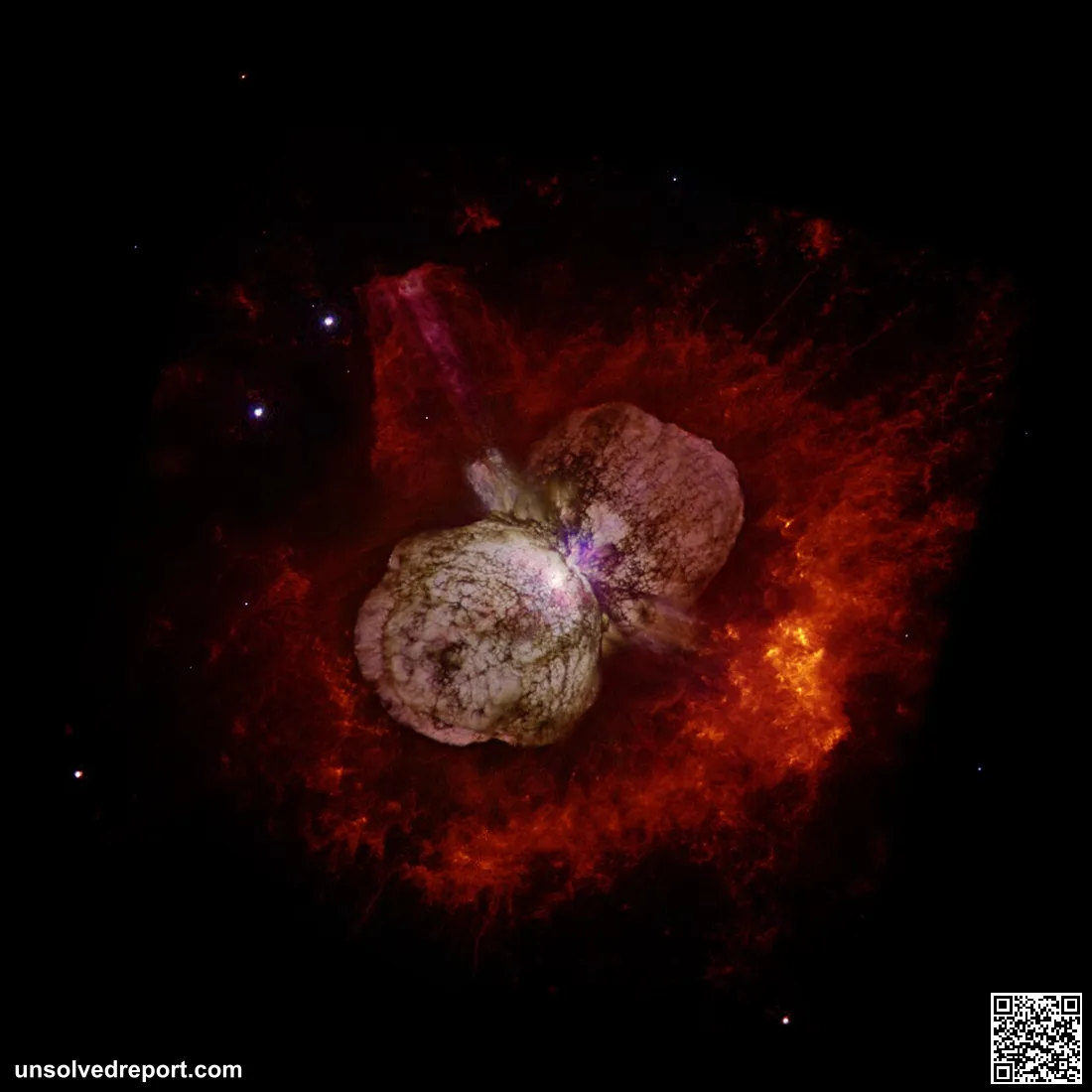
Now the part that still stops astronomers cold. During that eruption Eta Carinae poured out almost as much visible light as a full supernova explosion — and yet it did not blow itself apart. Instead it flung off a staggering amount of material, somewhere between about 10 and 45 times the mass of the Sun, which billowed outward, cooled, and froze into a glowing, dumbbell-shaped cloud we now call the Homunculus Nebula (NASA Chandra release). That shell is still tearing outward today, fast — up to about 4.5 million miles per hour (NASA/Chandra), a velocity in the same league as the runaway stars flung clean out of the galaxy.
A star that survives its own apparent death needs a name, and astronomers gave it a good one: a "supernova impostor." More formally, Eta Carinae belongs to a rare, short-lived club of wildly unstable giants called luminous blue variables, or LBVs (Astronomy & Astrophysics) — an instability in brightness that echoes, on a far grander scale, the unexplained flickering behind Tabby's Star.
The detail keeps sharpening. In 2023, NASA's Chandra X-ray Observatory and ESA's XMM-Newton spotted a faint shell of X-rays wrapped around the familiar nebula — read as the blast wave from the 1840s eruption. They also found a clue that Eta Carinae had violently thrown off material at least once before the Great Eruption, sometime between roughly 1200 and 1800 (NASA/Chandra). So 1843 was spectacular. But it may not have been this star's first tantrum.
The question nobody can answer yet
Peel away the fireworks and one stubborn question sits underneath: what actually triggered the Great Eruption? A normal star does not hurl off dozens of suns' worth of gas and then calmly carry on living. Astronomers say so plainly — the trigger is one of the most important unsolved problems in stellar astrophysics. They can measure the wreckage in exquisite detail. The thing that lit the fuse, and the brake that somehow stopped the blast short of total destruction, remain genuinely unsettled.
Two things make this puzzle so hard. First, no single proposed mechanism cleanly explains both what kicks off an eruption like this and what makes it stop before the star is gone. Second, that close binary companion smudges any tidy "one unstable star" story — the two stars' gravitational dance almost certainly matters, but exactly how is still argued over.
The leading theories
Everything below is a scientific hypothesis, not a verdict. Each one has some evidence behind it and some awkward gaps in front of it.
Theory 1 — Radiation pressure runs away (the old favorite, still speculative). The most traditional idea is brutally simple. Eta Carinae shines so ferociously that its own outpouring light pushes outward harder than gravity can hold the star together — and for a moment, light wins. The outer layers, losing their grip, get blasted off into space (AAVSO Variable Star of the Season, summarizing the radiation-pressure hypothesis). It's an appealing picture because LBVs live right up against the theoretical "Eddington limit," the line where radiation can physically shove matter off a star. The catch: on its own, this struggles to account for just how much mass got thrown off — and why the eruption stopped so abruptly.
Theory 2 — A two-stage, shock-powered blast (peer-reviewed, and recent). A 2018 study in the Monthly Notices of the Royal Astronomical Society did something clever. It used "light echoes" — flashes of the original 1840s light bouncing off distant dust and only reaching us now — as a kind of time machine to dissect the eruption. What the team found was a two-stage event: a slower outflow building over decades, then a genuinely explosive burst, with some material flung past 10,000 kilometers per second and slamming into the slower gas ahead of it. That collision itself helped pump up the brightness (Smith et al., MNRAS). Suddenly the Great Eruption looks less like a gentle puff and more like part wind, part shock — a scaled-down cousin of a real supernova.
Theory 3 — A stellar merger inside a triple system (an active idea). Follow those light-echo clues further and you arrive at a wilder possibility: that today's two stars were once three. In this scenario, two of them spiraled inward and merged in a violent collision, dumping a flood of orbital energy into the eruption and leaving behind the lopsided two-star system we see now (Smith et al., MNRAS; see also the arXiv merger-simulation preprint by Hirai et al., which is a preprint and not the final word). A merger would tidily explain two things at once — the enormous energy release, and why the survivor is a tight, off-balance binary. For now it stays a model waiting for firmer proof.
A human footnote. Here's a twist you might not expect. Researchers Duane Hamacher and David Frew argued in the peer-reviewed Journal of Astronomical History and Heritage that the Boorong people of northwestern Victoria, Australia, may have recorded Eta Carinae's brightening in their oral tradition, tied to observations relayed in the 1850s (arXiv version of Hamacher & Frew, 2010). It's a carefully argued possibility, not a closed case. But if it holds up, it means the Great Eruption was watched — and remembered — on two continents at the same time.
What can we say for sure? Only the ending, and only for now. Since about 1940, Eta Carinae has been brightening again, in fits and starts, and astronomers widely expect it to finish its life as a true supernova one day — perhaps within the next million years (AAVSO). The star that faked its death in 1843 is still alive up there, still puzzling, still holding onto the one secret that matters most: exactly how it survived — proof that even well-monitored stars can defy prediction, the way HD 139139 blinks with no pattern astronomers can pin down. The next time you read about a star "about to explode," remember Eta Carinae — and how confidently the sky can lie.
Sources & further reading
- NASA / Chandra X-ray Observatory press release, "Chandra Rewinds Story of the Great Eruption of the 1840s" (2023) — chandra.harvard.edu and nasa.gov
- Encyclopaedia Britannica, "Eta Carinae"
- N. Smith et al., "Light echoes from the plateau in Eta Carinae's Great Eruption reveal a two-stage shock-powered event," Monthly Notices of the Royal Astronomical Society (2018)
- AAVSO, "Eta Carinae" (Variable Star of the Season)
- Astronomy & Astrophysics, "Eta Carinae's 2014.6 spectroscopic event" (2015)
- Hirai et al., merger-in-triple simulation (arXiv preprint, 2020 — preprint, not peer-reviewed)
- Hamacher & Frew, "An Aboriginal Australian Record of the Great Eruption of Eta Carinae," Journal of Astronomical History and Heritage (2010)
10 Cosmic Mysteries Even the Best Telescopes Can't Crack
Dark matter, the Hubble tension, signals from billions of light-years away. Ten real cosmic mysteries the world's best telescopes still cannot solve.
Planet Nine: The Massive World Nobody Can Find
Dozens of icy worlds past Neptune all lean the same eerie way, as if something massive and unseen is pulling the strings. Is Planet Nine actually real?
Methuselah Star: The Star Older Than the Universe It Lives In
The Methuselah star, HD 140283, was clocked at 14.5 billion years old — older than the 13.8-billion-year-old universe holding it. How can that be true?