HD 139139: The Star That Blinks With No Pattern
HD 139139 blinked 28 times in 87 days — no orbit fits, no glitch explains it, and astronomers even checked for aliens. So what's really out there?
Planet hunting is supposed to be the easy part of astronomy. The deal is simple: a planet slides across the face of its star, drops a tiny shadow on us, and then — because orbits are loyal things — it comes back. Same dip, same size, on a schedule you can set your watch by. Watch long enough and the pattern shows itself. The pattern is the whole point.
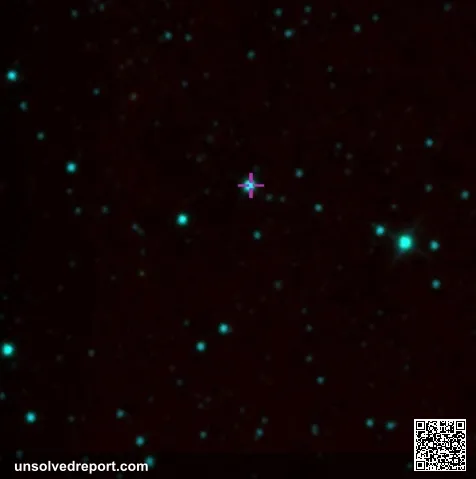
So picture the confusion when a single star in the constellation Boötes blinked 28 separate times in three months — dimming, recovering, dimming again — and absolutely refused to keep time. The dips came whenever they felt like it. Astronomers gave the star a name that sounds less like a label and more like a shrug of defeat: the Random Transiter. On the charts it's HD 139139, also filed as EPIC 249706694. Years after it was found, it's still one of the strangest streaks of light in the entire Kepler archive — and a quietly fascinating look at what scientists actually do when the data does something they can't explain.
What we know for sure
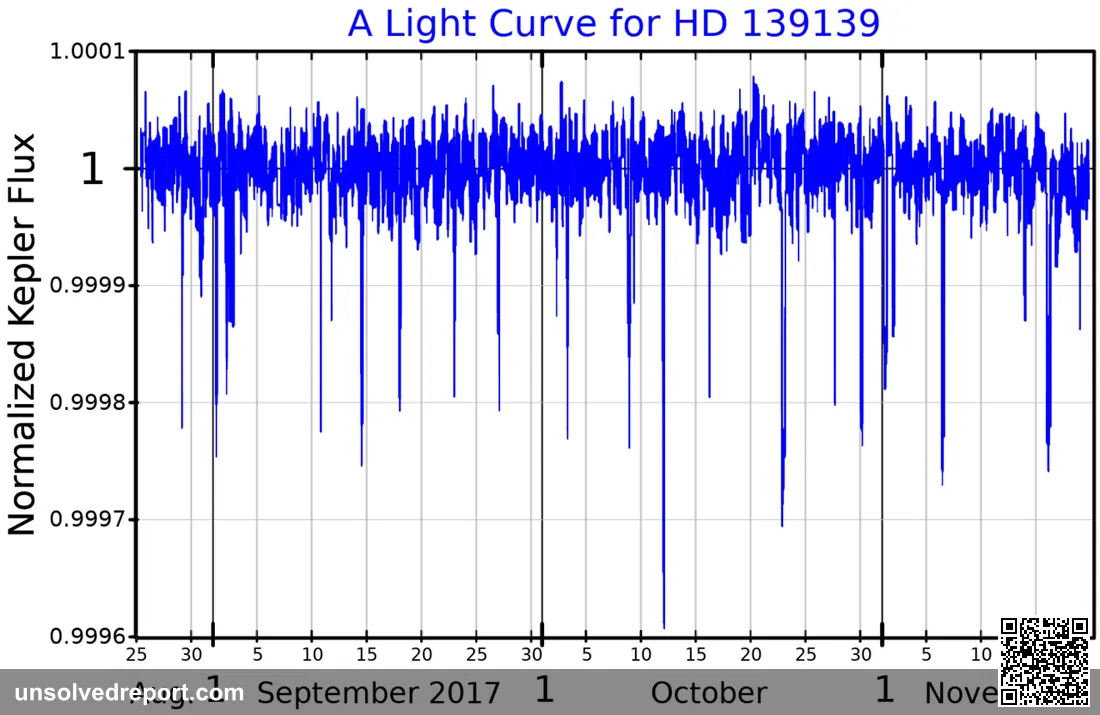
The star turned up during Campaign 15 of NASA's K2 mission — the scrappy second act of the Kepler spacecraft, kept alive after two of its steering wheels broke. For 87 days, Kepler stared. And over that stretch the brightness flickered 28 separate times, each one a little transit-shaped dip, all of it written up in a 2019 paper led by MIT's Saul Rappaport and Andrew Vanderburg (then at the University of Texas) in Monthly Notices of the Royal Astronomical Society (Rappaport et al. 2019).
Now, the dips themselves are nothing to write home about. They're tiny. Shallow. Most dimmed the star by about 200 ± 80 parts per million — roughly two-hundredths of one percent of its light. You could never catch that with your eye; it shows up only because Kepler's camera is almost absurdly precise. Each dip lasted somewhere between 0.74 and 8.19 hours (Rappaport et al. 2019). Take any single one out of the lineup and it looks like a perfectly ordinary planet sailing past. Boring, even.
Here's the strange part: it's all in the timing. The team fed the 28 arrival times into every standard period-hunting tool they had — Box Least Squares, Lomb–Scargle transforms, even a custom "Interval Match" search that bent over backwards to allow for small wobbles in the schedule. They found nothing. No rhythm. No hidden beat. The paper says it flat out: the arrival times "could just as well have been produced by a random number generator," and no more than four of the 28 events could possibly belong to any single repeating orbit (Rappaport et al. 2019). Sit with that. The dips look exactly like bodies going around a star — yet things that go around come back. These don't. That's not just odd. That breaks the rule.
So the authors did the unglamorous, essential work first: they tried to kill the mystery. Maybe it's just the telescope hiccupping — a machine ghost dressed up as a discovery. They hunted down and ruled out rolling-band detector artifacts, pixel cross-talk, bad pixels, and stray light leaking in from the background, and they used difference imaging to pin the dips to the target star itself, not some impostor nearby (Rappaport et al. 2019). One wrinkle, though: HD 139139 is probably a true binary, with a fainter sibling star about 3.3 arcseconds away. The dips could be coming from either one — and which star it is changes everything about the thing casting the shadow. Earth-sized if it's the bright primary, bigger if it's the dim companion (Rappaport et al. 2019). The whole system sits about 350 light-years out, and the main star is a near-twin of our own Sun (EarthSky).
The question nobody can answer
Let's lay it out plainly. A Sun-like star produced 28 planet-shaped dips that flatly refuse to line up into an orbit. The dips look real — astrophysical, not a machine glitch. And not one proposed explanation fits without a fight.
Then it got worse — or at least weirder. The most important follow-up came when a team led by Roi Alonso swung the European Space Agency's CHEOPS satellite toward HD 139139 across 2021 and 2022. They racked up 12.75 days of watching over 15 visits, with eyes sharp enough to catch dips as faint as 150 ppm — well below what K2 had seen. And CHEOPS caught... nothing. Not one dip (Alonso et al. 2023). The team offered three ways to read that silence: rotten luck (they figured only a 4.8% chance of missing events that come that often), a phenomenon that genuinely switched off or faded between 2018 and 2022, or the most deflating option of all — that the original K2 signal was rare, unidentified instrument noise the whole time (Alonso et al. 2023). Without a second, independent sighting, the case isn't closed. It's just... hanging there.
So what's doing it?
Everything from here on is a guess — a candidate, not a verdict. And here's the telling thing: the discovery team rounded up the natural, sensible explanations one by one and found something wrong with every single one (Rappaport et al. 2019).
A swarm of small planets — or planets with wildly shifting clocks. Pile up enough planets and maybe you scatter dips across the sky. But getting 28 of them with zero recoverable rhythm? The idea buckles under its own weight. And nudging the timings around enough to scramble the schedule this badly would mean wobbles bigger than anything seen anywhere else. This one is speculation, and the authors didn't like it.
Crumbling planets, or bodies trailing dust. Dying worlds and dust-shedding asteroids really can throw off ragged, irregular dips. The catch: they usually leave fingerprints — lopsided dip shapes, depths that change with color of light — and the authors couldn't find a clean match for any of them here. Speculation, and disfavored.
Something to do with the binary. Since HD 139139 likely has a stellar partner, the team ran through the geometries where bodies orbit one star, or loop around both. None of them coughed up a random-looking parade of dips either. Speculation, and disfavored.
Some brand-new kind of stellar behavior. With every transit story falling apart, the authors floated the boldest idea of all — that the star itself is doing something we've simply never seen or named before. They flagged it themselves as "novel and untested" (Rappaport et al. 2019). Pure speculation, by their own honest admission.
It's worth standing this star next to its famous cousin, Boyajian's Star — Tabby's Star — the one that dimmed deep and dramatically, which astronomers generally chalk up to passing clouds of dust. HD 139139 is the mirror image of that weirdness. Its dips are shallow, ordinary, forgettable one at a time. It's the timing that screams. Vanderburg put it about as plainly as a scientist can: "We've never seen anything like this in Kepler, and Kepler's looked at 500,000 stars" (EarthSky).
And yes — because the question always comes the moment you say "we can't explain it" — someone checked for aliens. A Breakthrough Listen team led by Bryan Brzycki aimed the Green Bank Telescope at HD 139139 and listened for narrowband radio technosignatures — the same kind of clean, one-off signal that made the Wow! signal famous — the kind a transmitter might leak. They heard none, and set an upper limit on any hidden broadcaster (Brzycki et al. 2019). That doesn't rule anything in — it just shuts one box. The smart money is still on some natural process, most likely something the star itself is doing, that we simply haven't learned to read yet. For now HD 139139 stays a documented blank in the catalog: a star caught doing something real, recorded with care, and still waiting for its answer. Somewhere out there, in a star nobody's looked at twice, the next one is probably already blinking.
Sources & further reading
- Rappaport, S., et al. (2019). "The Random Transiter — EPIC 249706694/HD 139139." Monthly Notices of the Royal Astronomical Society, 488(2), 2455–2465. Oxford Academic · arXiv preprint
- Alonso, R., et al. (2023). "No random transits in CHEOPS observations of HD 139139." Astronomy & Astrophysics, 680. A&A full text
- Brzycki, B., et al. (2019). "Breakthrough Listen Follow-up of the Random Transiter (EPIC 249706694/HD 139139) with the Green Bank Telescope." arXiv preprint
- "Is the Random Transiter weirder than Tabby's Star?" EarthSky. Article
Venus Retrograde Rotation: The Mystery Nobody Can Explain
Venus spins backward so slowly its day outlasts its year. The retrograde rotation mystery has two rival theories, and neither has won yet.
The Faint Young Sun Paradox: Earth Should Be Frozen
The Sun was 25% dimmer 4 billion years ago—Earth should've been frozen solid. The rocks say oceans existed anyway. Over 50 years later, no one has a clean answer.

Lake Anjikuni: The Vanished Village That Never Existed
2,000 people vanished from Lake Anjikuni with empty graves and no footprints — or so the story goes. The real trail leads somewhere stranger.