Hypervelocity Stars: Flung From the Galaxy at 4 Million MPH
Hypervelocity stars are escaping the Milky Way forever at 4 million mph. Astronomers traced one straight back to a black hole — but most don't point there. So what's firing the rest?
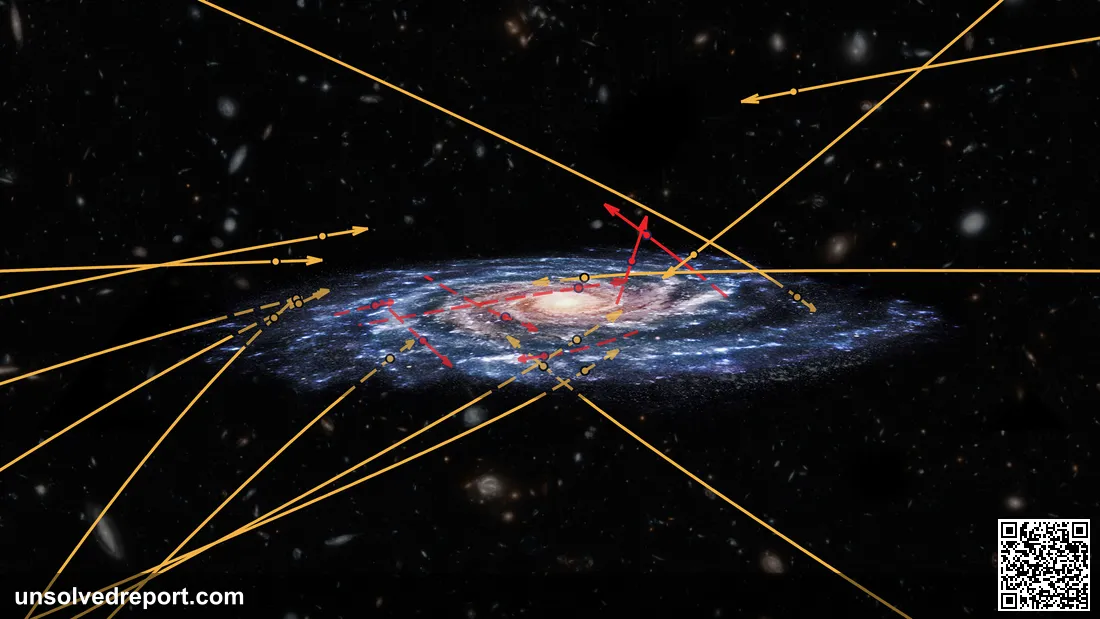
Right now, somewhere past the bright spiral arms of the Milky Way, a few stars are running for the exit. They are not orbiting. They are not drifting on some lazy, looping path. They are leaving — tearing straight out, fast enough to beat the galaxy's gravity and disappear into the black emptiness between galaxies, gone forever. The fastest one we have confirmed is doing about four million miles per hour. Let that sink in: a whole sun, bigger than ours, flung like a stone from a sling. Astronomers call these runaways hypervelocity stars. And the question of what could possibly hurl an entire star into the void has turned into one of the best detective stories in modern science — with a twist at the end that nobody saw coming.
What We Actually Know
This story starts with a guess. A very good guess.
In 1988, astronomer Jack Hills did the math on a frightening idea. Suppose a supermassive black hole really does sit at the center of our galaxy. What happens to a pair of stars — a binary, two suns locked in a dance — that wanders too close? Hills worked it out. The black hole's tides would tear the couple apart in an instant. One star gets trapped, snared into a tight orbit near the swarm of strange G objects around Sagittarius A. The other gets whipped around and flung away at a speed that almost sounds made up — thousands of kilometers per second (Hills 1988, Nature*). We now call this the Hills mechanism. Back then it was pure prediction. Nobody had seen such a star. Nobody had even confirmed the black hole.
Then, in 2005, one walked into the picture.
Warren Brown and his colleagues at the Harvard-Smithsonian Center for Astrophysics were quietly surveying blue stars when one of them refused to behave. Cataloged with the unlovely name SDSS J090745.0+024507, it was sprinting away from the galaxy at about 700 kilometers per second — way too fast to be an ordinary halo star (Brown et al. 2005). It was the first hypervelocity star ever caught, and it fit Hills's 17-year-old prediction almost too perfectly. More surveys followed, this time with the MMT telescope, and the count climbed to roughly two dozen candidates streaking through the galactic halo.
But the knockout punch came in 2019. Here's the one that closed the case — or seemed to.
Using the Southern Stellar Stream Spectroscopic Survey alongside data from Europe's Gaia satellite, a team found a star called S5-HVS1. It sits about 29,000 light-years out, blazing along at roughly 1,017 km/s relative to the Sun — around 1,755 km/s when you measure it against the galaxy itself (Koposov et al. 2020, MNRAS). Then the astronomers did something simple and chilling. They ran the star's motion backward, like rewinding a security tape. The path led to exactly one spot: Sagittarius A*, the supermassive black hole at the heart of the Milky Way — the same neighborhood blamed for the galaxy's unexplained antimatter glow. The star had been launched about 4.8 million years ago at roughly 1,800 km/s. "We have long suspected that black holes can eject stars with very high velocities," said lead author Sergey Koposov. "However, we never had an unambiguous association of such a fast star with the Galactic center" (Sci-News, 2019). S5-HVS1 is still the cleanest proof we have that the Hills mechanism is real, and that it happens right here.
So there's the paper trail: a 1988 prediction, a 2005 discovery, and a 2019 star whose trajectory points like an arrow straight back to our galaxy's monster. For a while, it really did look like the mystery was solved.
It wasn't.
The Part Nobody Can Explain Yet
The trouble started when Gaia got greedy with data.
When the Gaia mission handed astronomers precise positions and motions for over a billion stars, scientists could finally rewind the known hypervelocity candidates with real precision — the same dataset sharp enough to catch an invisible object punching a gap in the GD-1 stellar stream — and a lot of them broke the story. After Gaia's second data release, reanalyses found that a surprising number of these supposed runaways weren't actually escaping at all. And of the ones that genuinely were leaving, many traced back to nowhere near the galactic center (Boubert et al. 2018, MNRAS).
This is the real mystery, and it's a good one. If the central black hole is the cannon, then every true hypervelocity star should aim back at it. Many don't. So what's firing the others?
The honest answer, today, is that we don't fully know. The population is a mix, and the accounting isn't finished. The Hills mechanism clearly throws some of these stars — S5-HVS1 is the poster child — but it can't be the whole story. Somewhere out there, something else is doing the throwing, and astronomers are still untangling which star came from which gun.
The Suspects
Several explanations are on the table. It's worth being clear about which ones are nailed down and which are still guesses.
Suspect one: a second black hole, hiding in another galaxy. This is the strange, thrilling one — and it's still speculation, so hold it loosely. A 2025 study by Han and colleagues took Gaia data plus updated models of how the Milky Way and the Large Magellanic Cloud (our biggest satellite galaxy) tug on each other. They sorted 16 confidently classified hypervelocity stars and found something odd: about nine of them don't trace back to our galaxy's center at all. They trace to the LMC. Only seven point back to Sagittarius A (Han et al. 2025, ApJ*). The authors' read on this is bold — they argue there's a hidden supermassive black hole inside the LMC, weighing roughly 600,000 suns, running its own Hills mechanism and slinging stars at us across intergalactic space, the kind of hidden giant that would one day face the same merger problem stumping physicists elsewhere if the LMC ever collides with the Milky Way. And here's the part that gives it weight: their model also explains a real, previously baffling clump of hypervelocity stars near the constellation Leo. The team stays careful, though. They admit that how heavy the LMC actually is changes the numbers, and five of the stars are still ambiguous. Nobody has seen this LMC black hole. It's inferred entirely from where the stars are running from — a compelling lead, not a confirmed culprit.
Suspect two: exploding partners. This one's old and solid, just slower. Long before anyone blamed black holes, astronomers knew binaries could kick a star loose. When one star in a close pair detonates as a supernova, the survivor can go flying off at whatever speed it was orbiting. The problem is energy. This "binary supernova" route — along with stars getting jostled out of crowded clusters — usually tops out around 500 km/s (Hansen 2007 and related work summarized in A&A). Fast enough to make a "runaway." Usually too slow to truly escape the galaxy. That's why these explain the gentler runaways better than the genuine speed demons.
Suspect three: something weirder. A handful of stars just won't fit any neat box. Take HD 271791. It seems to have been kicked by an unusually violent dynamical encounter — possibly tangling with very massive binaries — rather than by the central black hole (Heber et al. and follow-ups). Cases like this are a reminder that the universe has more than one way to throw a star, and we probably haven't found them all.
Here's why these runaways matter so much. Each one is a messenger. A star screaming out of the dark carries — locked inside its speed and direction — a record of the violent thing that launched it, sometimes from the literal edge of a black hole. We've already caught one in the act of fleeing Sagittarius A*. The open question is how many of its fellow escapees were hurled by a completely different, unseen hand — maybe one crouching in a neighboring galaxy. The next decade of Gaia and survey data may finally name it. Until then, every one of those fleeing lights is still pointing back at something we can't quite see.
Sources & further reading
- Hills, J. G. (1988). "Hyper-velocity and tidal stars from binaries disrupted by a massive Galactic black hole." Nature. https://www.nature.com/articles/331687a0
- Brown, W. R., et al. (2005). "Discovery of an Unbound Hypervelocity Star in the Milky Way Halo." The Astrophysical Journal. https://iopscience.iop.org/article/10.1086/491744
- Koposov, S. E., et al. (2020). "Discovery of a nearby 1700 km/s star ejected from the Milky Way by Sgr A." MNRAS*. https://academic.oup.com/mnras/article/491/2/2465/5612212
- Boubert, D., et al. (2018). "Revisiting hypervelocity stars after Gaia DR2." MNRAS. https://academic.oup.com/mnras/article/479/2/2789/5038395
- Han, J. J., et al. (2025). "Hypervelocity Stars Trace a Supermassive Black Hole in the Large Magellanic Cloud." The Astrophysical Journal. https://iopscience.iop.org/article/10.3847/1538-4357/adb967
- "Hypervelocity stars in the Gaia era." Astronomy & Astrophysics (2018). https://www.aanda.org/articles/aa/full_html/2018/12/aa33874-18/aa33874-18.html
- Sci-News coverage of S5-HVS1 (2019). https://www.sci.news/astronomy/s5-hvs1-hypervelocity-star-07799.html
- Heber et al., follow-up study on HD 271791. https://arxiv.org/pdf/0909.4928
Cygnus X-3: The Hidden X-Ray Monster Nobody Can Name
Cygnus X-3 hid behind its own light for 50 years — now confirmed as one of the galaxy's most extreme X-ray sources. So why can't anyone say what's inside it?
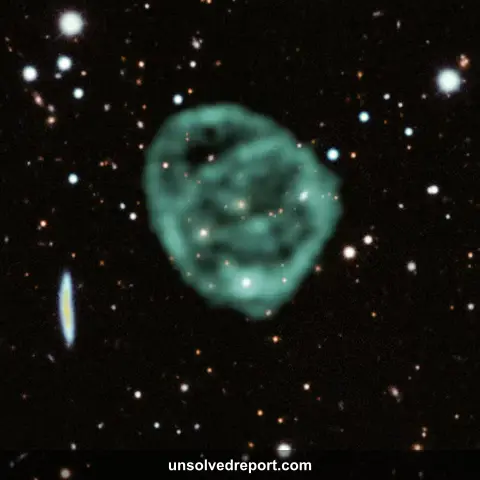
Odd Radio Circles: Giant Rings in Space Nobody Can Explain
A ring of radio light wider than the Milky Way, glowing in nothing else, no visible light, no X-rays. Scientists found it. They still can't explain it.
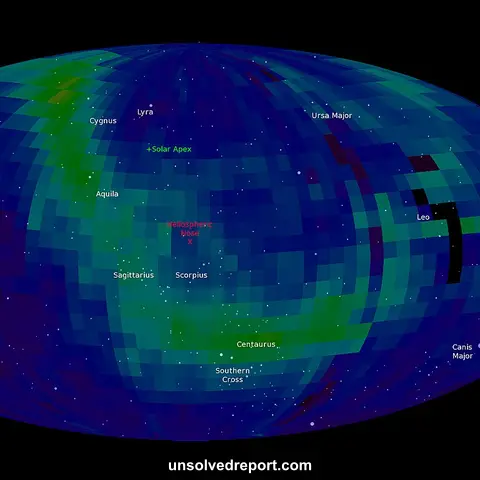
Voyager Interstellar Magnetic Field Anomaly: 40 Degrees Wrong
Voyager's interstellar magnetic field anomaly: two probes, two crossings, six years apart — same impossible reading. Why won't the compass swing back?