Cygnus X-3: The Hidden X-Ray Monster Nobody Can Name
Cygnus X-3 hid behind its own light for 50 years — now confirmed as one of the galaxy's most extreme X-ray sources. So why can't anyone say what's inside it?
One of the most violent X-ray engines in the entire Milky Way spent half a century pretending to be ordinary—and we let it. Cygnus X-3 was found in 1967, picked over by generations of astronomers, and filed away as a bright-but-typical X-ray binary. Case closed. Then, in 2023 and 2024, a small NASA telescope did something clever: instead of measuring how bright the light was, it measured the twist in the light. And the twist gave the whole thing away. We had been staring at this object from the side the entire time, peering past a funnel it had built around itself. Look at it straight on, and Cygnus X-3 stands toe to toe with the most luminous X-ray sources astronomers have ever spotted in other galaxies. The catch? At its very center sits something we still can't name.
What We Actually Know
Start at the beginning. Cygnus X-3 lit up a detector carried aloft on a rocket flight, reported by Riccardo Giacconi and colleagues in 1967—one of the very first cosmic X-ray sources humans ever caught (Phys.org). It sits in the constellation Cygnus, somewhere between roughly 24,000 and 32,000 light-years away (about 7.4 to 9.7 kiloparsecs—the sources don't fully agree), buried deep in the disk of our galaxy and smeared red by all the gas and dust standing between us and it (A&A, Veledina et al. 2024).
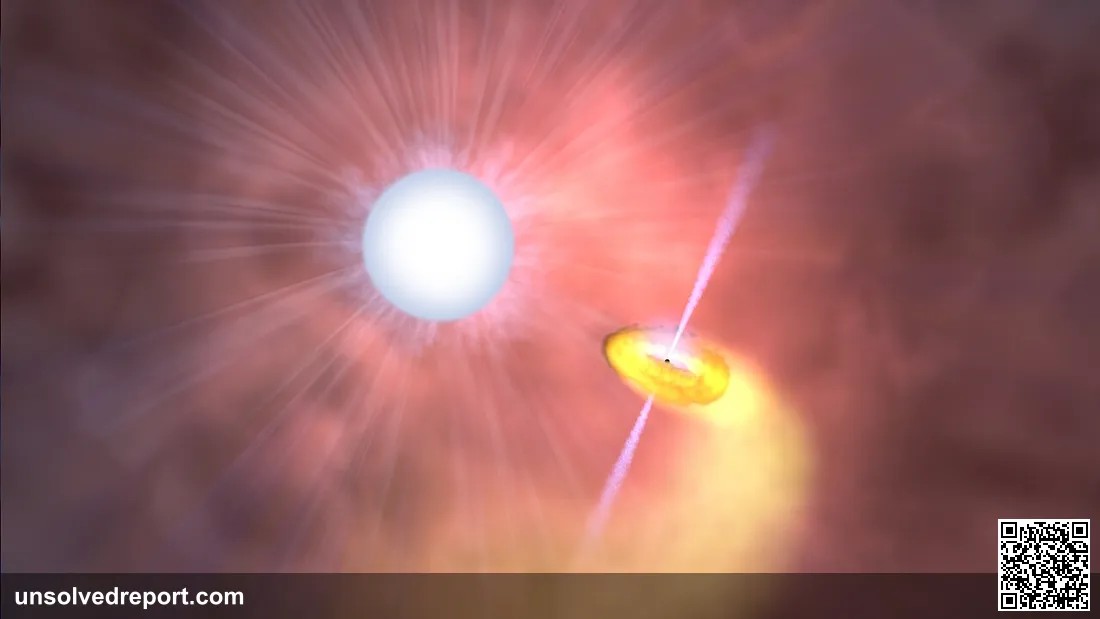
It's a pair. A compact object whipping around a massive companion, locked in a punishingly tight embrace. How tight? One full orbit takes just 4.8 hours—among the shortest of any X-ray binary known (A&A, Veledina et al. 2024). The companion is a Wolf-Rayet star: a rare, scorching, hydrogen-stripped giant in its dying days, the same violent late-life stage that made Eta Carinae famous for faking its own death. And here's a detail worth stopping on—Cygnus X-3 is the only confirmed X-ray binary in our whole galaxy fed by a Wolf-Rayet donor (MNRAS Letters, Zdziarski et al. 2013). Its compact partner doesn't sip from a neat accretion disk. It drinks straight from the donor's savage stellar wind.
Cygnus X-3 is also a microquasar—a stellar-scale system that fires off relativistic jets, running the same physics as the supermassive black holes at the hearts of galaxies, just shrunk down. Its first recorded giant radio flare, back in 1972, brightened the source by roughly a thousand times (Phys.org). Since then, very-long-baseline interferometry has pinned down fast-moving jet structures, and in 2009 the Fermi and AGILE satellites caught high-energy gamma rays pouring out of it—proof that this thing accelerates particles to ferocious energies, the same family of gamma-ray physics behind cosmic blasts like the BOAT (arXiv, Veledina et al. 2023).
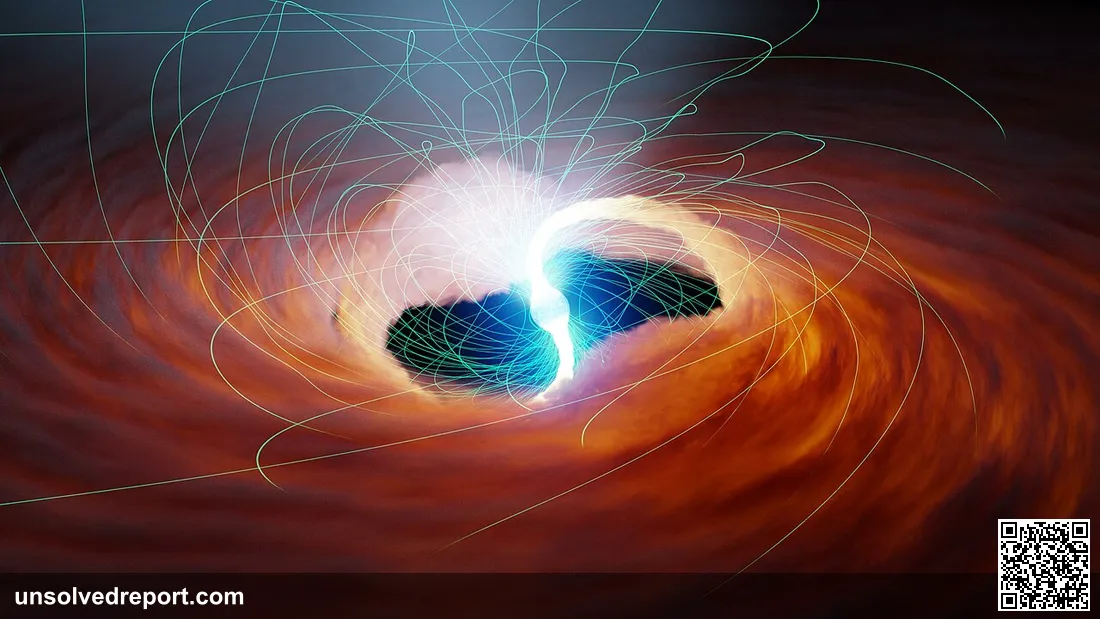
Then came the discovery that rewrote everything. NASA's Imaging X-ray Polarimetry Explorer—IXPE—measures something older telescopes simply couldn't: the polarization, the orientation, of X-ray light. When IXPE looked at Cygnus X-3, the X-rays came back highly polarized, around 25%, and almost the same across every energy. Stranger still, that polarization pointed nearly perpendicular to the radio jets (MNRAS Letters, Veledina et al. 2023). That's not the fingerprint of light streaming straight at you. That's the fingerprint of light ricocheting out through a narrow funnel. The team's read: the central engine hides behind a thick, opaque outflow with an opening angle of about 32 degrees or less, and we happen to be looking in at an inclination near 27.5 degrees (A&A, Veledina et al. 2024).
Now do the math, and the result is jaw-dropping. From where we sit, Cygnus X-3's apparent X-ray output is around 10³⁸ erg per second—bright, sure, but nothing to write home about. Strip away the funnel that's been hiding the core, though, and its true output blows past 5.5 × 10³⁹ erg per second (A&A, Veledina et al. 2024). That number drops it squarely into the league of ultraluminous X-ray sources—ULXs—a class astronomers had only ever found in other galaxies and long suspected of hiding some exotic physics. In IXPE's words, Cygnus X-3 is a "hidden" galactic ULX: a galaxy-class engine that its own outflow had been masking, right here at home, for decades (Caltech Library).
The Question Nobody Can Answer
So we've measured its distance, its dizzying orbit, its jets, the twist in its light, and now its real, terrifying brightness. And after all that, the most basic question of all is still wide open: what is the thing at the center?
Nearly six decades of watching, and astronomers still cannot tell you whether the heart of Cygnus X-3 is a neutron star or a black hole. The trouble runs deep. That dense Wolf-Rayet wind smothers the whole system, and the short, wind-fed orbit wrecks the standard trick—weighing the unseen object by tracking how its companion wobbles. There's simply no reliable mass function (MNRAS Letters, Zdziarski et al. 2013).
One careful study pegged the compact object at about 2.4 solar masses—but with an error range of (+2.1, −1.1), wide enough to allow either a hefty neutron star or a featherweight black hole (MNRAS Letters, Zdziarski et al. 2013). And that mass lands right inside the so-called "mass gap" between the two—the same shadowy territory explored by the neutron star that breaks physics' bathroom scale—a stretch where nature, for reasons we don't fully grasp, seems to make almost nothing. Which makes the puzzle that much more maddening. We know nearly everything about this system. The one thing we can't read is the identity of the engine running it all.
The Leading Theories
A featherweight black hole. Several researchers quietly lean this way, though it remains speculation. Across the board, Cygnus X-3's behavior—its spectral states, its radio and infrared signatures, its jets—looks more like the known black-hole binaries than like a typical neutron-star system. Some analyses argue for a low-mass black hole somewhere around 2 to 4.5 solar masses (MNRAS Letters, Zdziarski et al. 2013). If that's right, it would be one of the lightest stellar black holes anyone has found.
A heavyweight neutron star. Also speculation, but the numbers don't rule it out: a neutron star sitting near the very top of what physics permits. Nailing it down would mean catching the telltale signs of a neutron star—X-ray pulsations, say, or thermonuclear bursts. So far, none have been firmly seen.
A super-Eddington funnel. This one the IXPE data actually backs. The leading explanation for the "hidden ULX" trick is that matter dumps onto the compact object faster than radiation pressure should normally allow, blasting out a thick, cone-shaped outflow. We just happen to be peering down that cone at an angle, catching scattered light instead of the blinding core (A&A, Veledina et al. 2024). That would turn Cygnus X-3 into a rare nearby laboratory for the same extreme feeding frenzy thought to power those distant ULXs.
A gravitational-wave source in waiting. This is speculation about the far future. With the orbit so tight and the Wolf-Rayet donor so massive, some have floated the idea that this system could be the seed of a merging compact binary down the line—the very endgame that leaves supermassive pairs stuck in the final parsec problem on a much grander scale. The orbital period is slowly stretching out, on a timescale of roughly 850,000 years, as the donor sheds mass (arXiv, Bhargava et al. 2017).
The lesson here is a humbling one. You can study an object for fifty years and it can still keep its deepest secret. We now know Cygnus X-3 is a galactic powerhouse wearing a disguise. What we still don't know is whose hand is on the throttle—and somewhere out there, in the glare of another galaxy, its louder cousins are keeping that same secret too.
Sources & further reading
- Veledina et al. (2024), "Ultrasoft state of microquasar Cygnus X-3," Astronomy & Astrophysics — https://www.aanda.org/articles/aa/full_html/2024/08/aa51356-24/aa51356-24.html
- Veledina et al. (2023), "The innermost jet in the hidden ultra-luminous X-ray source Cygnus X-3," MNRAS Letters — https://academic.oup.com/mnrasl/article/526/1/L1/7236871
- arXiv preprint of Veledina et al. (2023) — https://arxiv.org/pdf/2308.01002
- Caltech Library: "Cygnus X-3 revealed as a Galactic ultraluminous X-ray source by IXPE" — https://authors.library.caltech.edu/records/xyd1j-66r19
- Zdziarski et al. (2013), "Cyg X-3: a low-mass black hole or a neutron star," MNRAS Letters — https://academic.oup.com/mnrasl/article/429/1/L104/1107642
- Phys.org (2016), "Giant radio flare of Cygnus X-3 detected by astronomers" — https://phys.org/news/2016-12-giant-radio-flare-cygnus-x-.html
- Bhargava et al. (2017), "A precise measurement of the orbital period parameters of Cygnus X-3," arXiv — https://arxiv.org/abs/1709.07441

Odd Radio Circles: Giant Rings in Space Nobody Can Explain
A ring of radio light wider than the Milky Way, glowing in nothing else, no visible light, no X-rays. Scientists found it. They still can't explain it.
Voyager Interstellar Magnetic Field Anomaly: 40 Degrees Wrong
Voyager's interstellar magnetic field anomaly: two probes, two crossings, six years apart — same impossible reading. Why won't the compass swing back?
Przybylski's Star: The Sky's Most Impossible Light
Przybylski's Star glows with plutonium and promethium, elements that decay in years, not eons. Sixty years on, nobody can explain why they're still there.