The Vela Incident: The Double Flash Nobody Can Explain
The Vela Incident, 1979: the mystery flash a dying satellite caught over an empty ocean. Secret bomb test, or glitch? Scientists still can't agree.
Two pulses of light. One millisecond apart. Over an ocean so empty that the nearest land was a clump of frozen rocks between Africa and Antarctica.
It was just before 1:00 a.m. GMT on September 22, 1979. An old American satellite — one almost nobody outside the U.S. government had ever heard of — was staring down at the dark South Atlantic when it caught that flicker. And here's the chilling part: the pattern it saw was the exact thing its sensors had been built, from the ground up, to recognize. The signature of a nuclear bomb going off.
Then something strange happened. Instead of an answer, the world got an argument that has now lasted more than forty years.
This is the Vela Incident. It lives at a weird crossroads — hard astrophysics, satellite engineering, and Cold War secrecy, all tangled together. And the most unsettling thing about it isn't that we're missing data. It's that brilliant, serious scientists looked at the same data and walked away with opposite answers. So let's lay it out: what's actually on the record, what's still a genuine black hole of unknown, and the theories that have grown like mold in the gap between.
What We Know for Sure
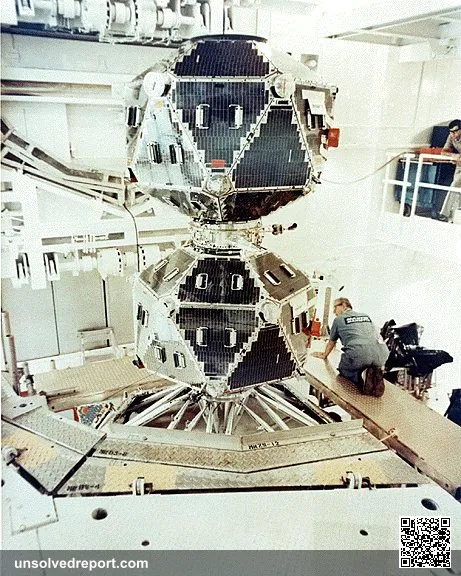
Meet the witness: Vela 6911. It was one of a fleet of satellites the United States flung into orbit after the 1963 Partial Test Ban Treaty outlawed nuclear tests in the air, underwater, and in space. Somebody had to make sure nobody cheated — and that somebody was a Vela. Each one carried strange little instruments called bhangmeters: photodiode sensors tuned to one job and one job only, to catch the unmistakable light of a nuclear fireball (Nuclear Weapon Archive; Wikipedia: Bhangmeter).
So what does a bomb actually look like to a satellite? Not one flash — two. A nuclear blast throws out a savage burst of light lasting about a millisecond, then dims to a low point, then blooms again into a second, slower, longer glow. Why the dip in the middle? Because the expanding shock wave slams shut like an opaque curtain, hiding the white-hot baby fireball — until the cooling fireball burns back through it (Nuclear Weapon Archive). That two-humped light curve is the fingerprint of an atmospheric nuclear blast. And the Vela network knew it cold: it had already logged 41 confirmed detonations before 1979, twelve of them caught by Vela 6911 itself (Damn Interesting; Nuclear Weapon Archive).
This satellite was not a rookie. It had seen the real thing a dozen times.
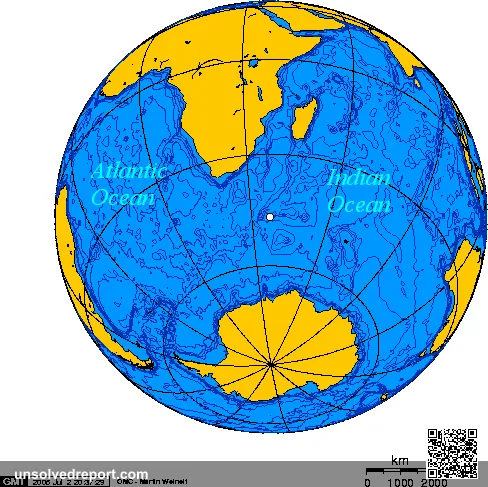
The 1979 signal whispered something specific: a small explosion, around 3 kilotons, somewhere out near the Prince Edward and Marion Islands — a bleak, wind-scoured South African territory in the Indian Ocean, way down south of the continent (Nuclear Weapon Archive; Science & Global Security).
Then the U.S. government tore itself in two over what to do with it.
In October 1979, the CIA pulled together three heavyweight scientists — Los Alamos director Harold Agnew, H-bomb physicist Richard Garwin, and Stephen Lukasik. Their verdict? The signals "were consistent with detection of a nuclear explosion" (National Security Archive). Case looking closed.
Except it wasn't. A bigger White House science panel, led by MIT's Jack Ruina and wrapped up in 1980 — playing a role not unlike the Air Force's own Project Blue Book investigations decades earlier — came back with the exact opposite call: the event "was probably not from a nuclear event." Their best guess instead? Sunlight glinting off a tiny meteoroid or piece of space debris — the same category of small-body impact blamed for flattening a Siberian forest in the 1908 Tunguska event — that had smacked into the geriatric satellite (National Security Archive).
Their main objection was concrete, and it stings. The satellite had two bhangmeters — and for that second flash, the two of them didn't record matching brightness (National Security Archive). Worse, Vela 6911 was years past its expiration date. Its electromagnetic-pulse detector — the one piece of gear that could have shouted "yes, that was a bomb" — had already died. So that confirming reading? It never came.
The Question That Won't Die
Strip everything away and you're left with one question, easy to ask and so far impossible to answer in public:
Did Vela 6911 see a real nuclear bomb go off — or did a clapped-out satellite cry wolf with terrifying conviction?
The most honest answer we have comes from 2019, when the Wilson Center gathered scientists and historians for a critical oral history conference. Their summary, four decades after the flash: "40 years after the VELA event, there is still no reliable public, non-circumstantial, information that settles the controversy" (Wilson Center). The room itself split right down the middle — some called it a nuclear test, others held a hard "not proven," and physicists like Richard Muller and John Deutch flatly rejected the bomb reading.
And here's why it stays stuck: some of the key evidence is locked in a vault. A Naval Research Laboratory study, reportedly running to some 300 pages, is said to have concluded that hydroacoustic data "strongly suggests that a nuclear test took place." Sounds decisive. But that document is still classified — the same kind of Cold War paper trail that stayed sealed for decades in cases like the Gulf of Tonkin Incident (Wilson Center). For years, rumors have swirled about a smoking-gun intelligence intercept — somebody, somewhere, supposedly heard the truth. Yet Deutch and former NSA director Bobby Inman both firmly denied any such intercept exists (Wilson Center). Until the files are opened, nobody gets to slam this case shut.
The Theories, Lined Up
It was a real bomb (popular with independent researchers — but not officially confirmed). Plenty of physicists and historians lean toward a genuine low-yield blast. In 2017, a peer-reviewed analysis in Science & Global Security by Christopher Wright and Lars-Erik De Geer went after the meteoroid story directly. Their point: do the geometry. If something had smashed into the satellite, the debris would mostly fly away from the sensors, not into their line of sight — which leaves the nuclear reading "consistent" with the data (Science & Global Security). Backing that up are those hydroacoustic signals the NRL judged consistent with a small surface or near-surface ocean blast right by Prince Edward Island (Nuclear Weapon Archive).
So who pulled the trigger? (speculation — unverified). If it really was a test, one name comes up more than any other: a small detonation by Israel, possibly with South African help. The journalist Dan Raviv floated it in 1980, and historians have circled back to it ever since (Wilson Center; National Security Archive). But be clear-eyed here: this is speculation, not fact. No government has confirmed it. The Wilson Center report flatly warns that such accounts "do not meet standards of historical knowledge." Neither country has ever admitted to a test.
It was just a broken satellite (the official 1980 ruling). The Ruina panel's meteoroid-reflection explanation is still, to this day, the U.S. government's standing answer. And physicists like Muller keep defending it as exactly the kind of phantom you'd expect a dying satellite to conjure (National Security Archive; Wilson Center).
The clues that almost — but not quite — fit (disputed). Two famous side-details deserve a skeptical eye. That same day, the Arecibo Observatory picked up an odd ripple in the ionosphere — but the scientist who first tied it to the flash later admitted he was "not fully convinced" it pointed to a bomb. And months afterward, raised iodine-131 turned up in the thyroids of Australian sheep, and the wind patterns could, maybe, line up — except wider fallout sampling came back empty, and the whole finding has been challenged (Nuclear Weapon Archive). Tantalizing. Not proof.
So we're left where we started. A machine built for one purpose saw precisely the thing it was made to see — and the smartest people on Earth still can't agree on what really lit up that lonely patch of southern ocean, a stalemate as stubborn as the one surrounding the Wow! signal. The flash lasted a millisecond. The mystery is going on half a century. And somewhere, the answer may still be sitting in a sealed file, waiting for a hand to open the drawer.
Sources & further reading
- National Security Archive (George Washington University), "The Vela Incident: South Atlantic Mystery Flash in September 1979": https://nsarchive.gwu.edu/briefing-book/nuclear-vault/2016-12-06/vela-incident-south-atlantic-mystery-flash-september-1979-raised-questions-about-nuclear-test
- Wright, C. & De Geer, L.-E., "The 22 September 1979 Vela Incident: The Detected Double-Flash," Science & Global Security 25(3), 2017: https://scienceandglobalsecurity.org/archive/2017/11/the_22_september_1979_vela_inc.html
- Wilson Center, "Revisiting the 1979 VELA Mystery: A Report on a Critical Oral History Conference": https://www.wilsoncenter.org/blog-post/revisiting-1979-vela-mystery-report-critical-oral-history-conference
- Nuclear Weapon Archive, "Report on the 1979 Vela Incident": https://nuclearweaponarchive.org/Safrica/Vela.html
- Wikipedia, "Bhangmeter" (background on detector physics): https://en.wikipedia.org/wiki/Bhangmeter
- Damn Interesting, "The Vela Incident" (detection-history figures): https://www.damninteresting.com/the-vela-incident/

Gardner Museum Heist: The $500M Theft Nobody Can Solve
Gardner Museum heist: two fake cops, 13 masterpieces, $500M gone in 81 minutes. The FBI says it knows who did it — so why is the art still missing?
G Objects Sagittarius A: 6 Things That Should Be Dead, But Aren't
Six objects orbit our galaxy's black hole wearing gas clouds like disguises. One was due to be shredded in 2014. It walked away. Why?

Hegra: The Nabataean City Whose People Vanished Without a Trace
Hegra's dead left 100+ signed, dated tombs carved in stone. Its living city? Almost nothing survived. Where did everyone go — and why so quietly?