Amber Room Lost Treasure: The $500M Wonder Nobody Can Find
Six tons of amber looted in 36 hours, $500M gone. Experts say it burned in 1945 — then a piece surfaced in 1997. So where is the Amber Room?
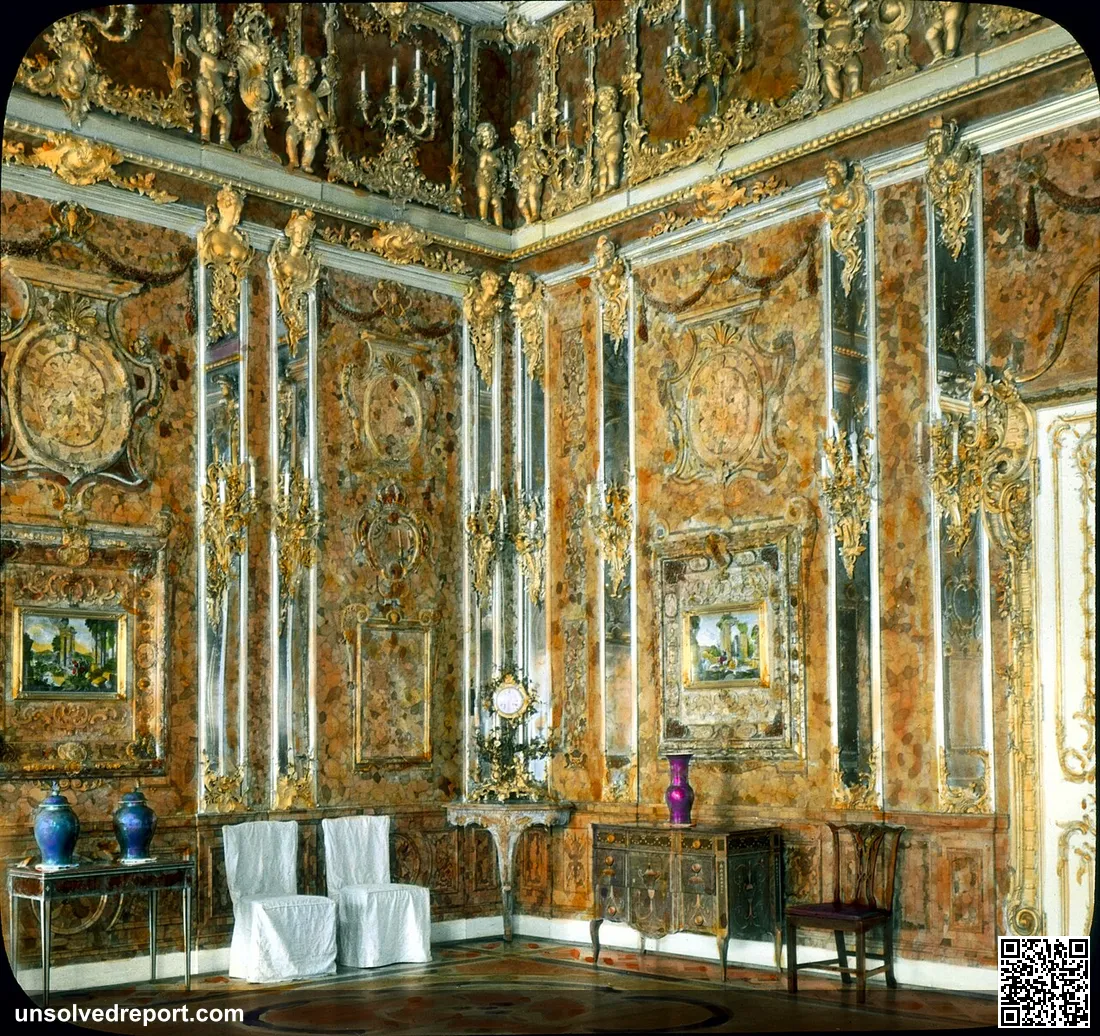
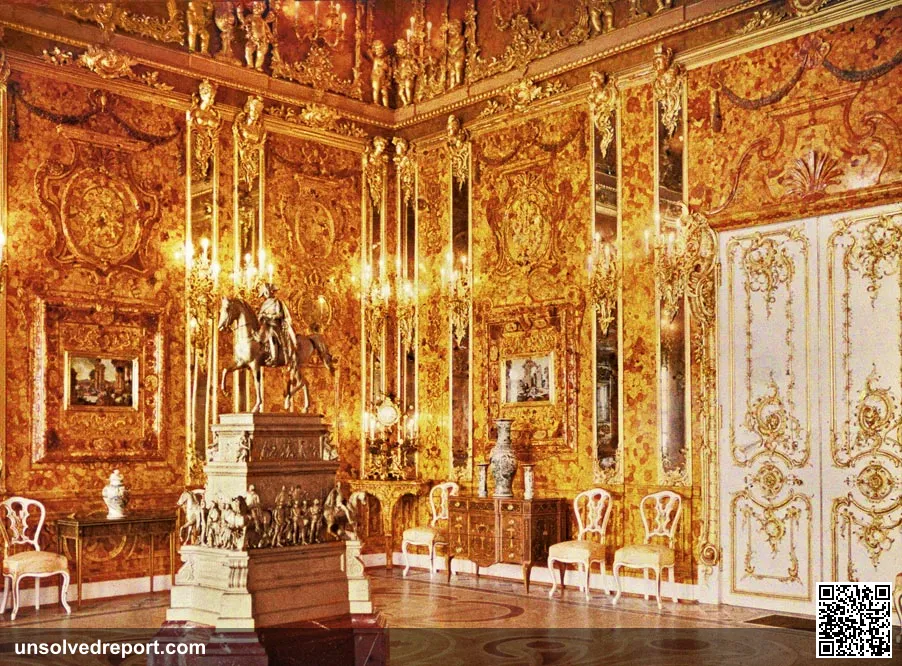
Picture a room with walls made entirely of amber. Not a few amber accents. Not inlaid panels here and there. Walls — roughly six tons of fossilized tree resin, carved into rococo curls, backed with gold leaf and mirrors, studded with Florentine stone mosaics. Light a few candles, and the whole chamber glows from the inside, like standing within a jewel.
People called it the Eighth Wonder of the World. Tsars dined in it.
And then it vanished. In the last desperate year of World War II, somebody packed it into crates, shipped it across a crumbling empire, and lost it. No one has found it since.
Here's what makes the Amber Room so maddening. This isn't a vague legend stitched together from rumor. Almost everything about it is documented — who built it, when it moved, how it was stolen. It's the ending that's missing. So let's walk the trail as far as the records take us, watch exactly where it goes dark, and sort the real clues from the campfire stories.
A gift fit for two kings
First surprise: it began in Prussia, not Russia.
Work started around 1701, led by the German baroque sculptor Andreas Schlüter and the Danish amber master Gottfried Wolfram, with later contributions from the craftsmen Gottfried Turau and Ernst Schacht of Danzig (today's Gdańsk). And building it was genuinely hard. Amber is brittle and stubborn to work at scale — coaxing whole wall panels out of the stuff was an extraordinary feat.
So how did a Prussian masterpiece end up near St. Petersburg? Diplomacy. In 1716, the Prussian king Frederick William I handed the amber panels to Tsar Peter the Great of Russia as a gift, helping seal a Russo-Prussian alliance. One detail gets repeated in nearly every telling: the exchange supposedly also involved a contingent of tall Russian soldiers for the Prussian king's army. It's a colorful flourish, and a popular one. The panels themselves made the journey east and were eventually installed near St. Petersburg.
The room didn't stop there. Decades later, Empress Elizabeth had it moved to the Catherine Palace at Tsarskoye Selo, and brought in the Italian architect Bartolomeo Francesco Rastrelli to redesign and enlarge it for the grander space, with more amber shipped in from Berlin. In its final form it sprawled across more than 55 square meters and held over six tonnes of amber and other semi-precious stones. What's that worth? Modern guesses run from around $142 million to well past $500 million in today's money — and they're only guesses, because nothing quite like it has ever come up for sale.
Operation Barbarossa and the 36-hour heist
On 22 June 1941, Nazi Germany launched Operation Barbarossa, its invasion of the Soviet Union. German forces drove toward Leningrad — and the Catherine Palace sat squarely in their path.
The Soviet curators tried to save the room. But the amber had grown fragile with age, and one well-known account says staff chose to hide the panels behind wallpaper rather than risk moving them and watching them crumble.
It didn't work. When German troops reached the palace, they found the room, stripped it within roughly 36 hours, packed it into 27 crates, and shipped it west. A wonder that had stood for two centuries, gone from the wall in a day and a half.
By 14 October 1941, the crates reached Königsberg in East Prussia — today's Kaliningrad, Russia. There the room was reassembled and put on display in the city's castle museum, watched over by curator and amber expert Dr. Alfred Rohde, a man who genuinely loved the piece and studied it up close. For a couple of years, the Eighth Wonder sat in German hands as a trophy of conquest.
Then the lights start to go out.
Where the trail goes cold
This is the moment documented history thins into mystery.
As Allied bombs fell harder and the Red Army closed in, the room was crated up again to keep it safe. The last reasonably solid sighting we can point to is January 1945 — right around the time Rohde was overseeing the panels amid evacuation plans that the advancing front simply overran. Then, in April 1945, Soviet forces besieged and captured Königsberg. In the bombardment and the fires that came after, much of the castle burned.
After the war, the official Soviet conclusion was blunt: the Amber Room had most likely been destroyed in the destruction of Königsberg, with the records pointing to its loss around 9–11 April 1945. And plenty of experts find that entirely believable on physical grounds. Amber has a low melting point. A sustained fire could have simply eaten it, leaving almost nothing you'd recognize behind.
But two real clues survive — and they pull in opposite directions.
Soviet investigators reportedly pulled some of the room's original Florentine stone mosaic panels out of the castle cellars after the war: damaged, but real. And in 1997, German police recovered one of the room's original mosaics in a sting operation. It had drifted into the hands of the family of a soldier said to have been involved in the wartime evacuations. So here's the rub. The fact that a piece survived in private hands proves not everything burned — yet it still doesn't tell us where the amber itself went.
So where did it go? The theories
Beyond the official "it burned" account, the Amber Room has drawn a full century of treasure hunters. Fair warning before we go further: none of what follows has ever been confirmed. Treat these as folklore and unproven hunches, not history — the kind of thing that keeps treasure hunters busy for generations, much like the Beale Ciphers.
It sank with a ship
One popular idea says the panels were loaded onto a vessel fleeing the Baltic — sometimes named as the Wilhelm Gustloff, torpedoed in January 1945 with catastrophic loss of life, or other ships like the Karlsruhe. Divers have gone down to Baltic wrecks looking. So far, no Amber Room.
It's hidden in a mine, bunker, or tunnel
For decades, hunters have crawled through abandoned mines, sealed bunkers, and underground complexes across Germany, Poland, and the former East Prussia, certain the crates were spirited away before the fire ever reached them — the same instinct that has sent searchers to Lake Toplitz and chasing rumors like the Nazi gold train in Poland. Every so often someone announces "the location," and the headlines follow. None has ever produced the room.
The Soviets had it all along — or destroyed it themselves
Other versions claim the room was quietly recovered, or accidentally smashed by the very forces besieging Königsberg, and the truth buried. There's no compelling evidence for these either.
So what's the honest answer? It's the unsatisfying one. The best-supported explanation is that the Amber Room burned in 1945 — but nobody has ever laid the remains on a table, so the question stays wide open.
The room you can walk into today
There is, at least, a happy coda.
Beginning in 1979, Soviet — and later Russian — craftsmen took on a painstaking reconstruction, working from old photographs and a single surviving color image of the lost original. The project ran some 25 years and cost roughly $11 million, helped along by a German corporate donation. The recreated room was dedicated in 2003, at the 300th anniversary of St. Petersburg, by Russian President Vladimir Putin and German Chancellor Gerhard Schröder.
You can stand inside that golden glow right now, at the Catherine Palace. It is breathtaking — and it is a replica. The original is still out there somewhere, maybe: in ash, in seawater, or in a forgotten cellar waiting to be opened. Or maybe it's already gone for good, and we just refuse to stop looking.
That refusal might be the real treasure here. A room so beautiful that, eight decades on, the world still can't quite accept that it's lost — and somewhere out there, the next crate, the next cellar, the next wreck is always one search away.
The Amber Room at a glance
Because so much of this case is documented, it helps to lay the hard facts side by side before weighing the theories.
| Detail | What the record says |
|---|---|
| Construction began | c. 1701, in Prussia |
| Original makers | Andreas Schlüter (sculptor); Gottfried Wolfram (amber master); later Gottfried Turau and Ernst Schacht of Danzig |
| Given to Russia | 1716 — Frederick William I of Prussia to Tsar Peter the Great, to seal a Russo-Prussian alliance |
| Moved to Catherine Palace | Under Empress Elizabeth; redesigned and enlarged by Bartolomeo Francesco Rastrelli |
| Final size | More than 55 square metres; over six tonnes of amber and semi-precious stones |
| Estimated value | c. $142 million to well past $500 million in today's money (all guesses) |
| Looted | After 22 June 1941 (Operation Barbarossa); stripped in ~36 hours, packed in 27 crates |
| Reassembled | Königsberg castle museum, on display under Dr. Alfred Rohde |
| Last solid sighting | January 1945 |
| Official fate | Most likely destroyed in the fall of Königsberg, c. 9–11 April 1945 |
| Surviving pieces | Florentine stone mosaic(s) recovered from castle cellars; one original mosaic recovered by German police in 1997 |
| Reconstruction | Begun 1979, ~25 years, ~$11 million; dedicated 2003 by Putin and Schröder |
A timeline from gift to vanishing
The trail is unusually well-dated right up to the point where it isn't — which is exactly what makes the ending so frustrating.
- c. 1701 — Work begins in Prussia under Schlüter and Wolfram.
- 1716 — Frederick William I gives the amber panels to Peter the Great, cementing a Prussian-Russian alliance.
- 18th century — Empress Elizabeth has the room moved to the Catherine Palace at Tsarskoye Selo; Rastrelli enlarges it, with more amber shipped from Berlin.
- 22 June 1941 — Nazi Germany launches Operation Barbarossa; German forces drive toward Leningrad.
- 1941 (during the occupation) — Troops strip the room in roughly 36 hours and pack it into 27 crates.
- 14 October 1941 — The crates reach Königsberg, where the room is reassembled and displayed under Dr. Alfred Rohde.
- January 1945 — The last reasonably solid sighting, amid evacuation plans overrun by the advancing front.
- April 1945 — Soviet forces besiege and capture Königsberg; much of the castle burns. Records place the room's loss around 9–11 April 1945.
- 1979 — Soviet, later Russian, craftsmen begin the reconstruction.
- 1997 — German police recover one of the room's original mosaics in a sting operation.
- 2003 — The recreated room is dedicated at St. Petersburg's 300th anniversary by Putin and Schröder.
What the evidence actually shows
Strip away the folklore and only three explanations really contend. Here is how each one stands up.
It burned in 1945 (the official conclusion). This is the best-supported reading. It fits the physical facts — amber melts at a low temperature, and a sustained fire in the burning castle could have consumed the panels almost entirely — and it matches the Soviet records pointing to a loss around 9–11 April 1945. The weakness is negative: no one has ever produced identifiable remains from that fire. What would settle it is exactly what's missing — recognisable charred amber or mosaic fragments traced to the castle ruins.
It was evacuated and hidden (ship, mine, or bunker). The strongest point in its favour is real, not rumour: pieces of the room did survive outside the fire — mosaics pulled from the cellars, and the mosaic recovered in 1997 from the family of a soldier tied to the evacuations. That proves not everything burned. But survival of a fragment is not survival of the room, and a century of dives on Baltic wrecks and crawls through mines has never produced the panels. Resolution would require one verified crate, wreck, or cellar actually containing amber panels — the one thing every announced "location" has so far failed to deliver.
The Soviets recovered or destroyed it and buried the truth. This has the least behind it. It rests on suspicion rather than any document or artefact, and no compelling evidence supports either version. Only released archival records or a physical find could move it from speculation to fact.
Sources & further reading
- Smithsonian Magazine, "A Brief History of the Amber Room" — https://www.smithsonianmag.com/history/a-brief-history-of-the-amber-room-160940121/
- Encyclopaedia Britannica, "Amber Room" — https://www.britannica.com/art/Amber-Room-Catherine-Palace
- Wikipedia, "Amber Room" — https://en.wikipedia.org/wiki/Amber_Room
- HISTORY, "WWII Mystery: What Happened to Russia's Amber Room?" — https://www.history.com/articles/amber-room-mystery
- GIA, Gems & Gemology, "The History and Reconstruction of the Amber Room" — https://www.gia.edu/gems-gemology/winter-2018-history-and-reconstruction-of-amber-room
- Atlas Obscura, "The Enduring Mystery of the Amber Room" — https://www.atlasobscura.com/articles/amber-room-mystery-russia-nazis
Golden Sun Bird Mystery: The Vanished City China Can't Explain
A 20-gram gold disc dug up by accident in 2001 may be the only clue to where an entire Bronze Age civilization went. So where did Sanxingdui's people actually go?
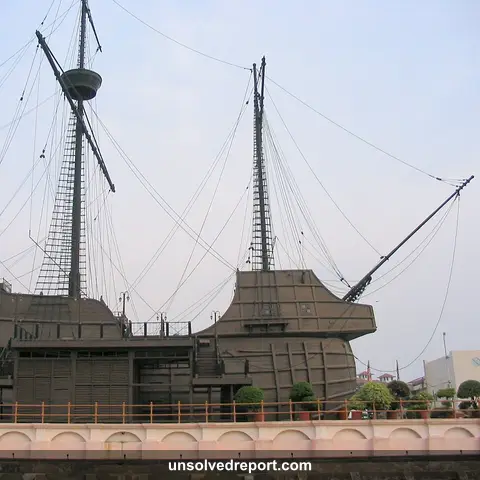
Flor de la Mar: The Richest Wreck Never Found
A Portuguese carrack sank off Sumatra in 1511 loaded with a sultan's fortune. Centuries later, still no proof the Flor de la Mar was ever found. Here's why.
Cuerdale Hoard: 88 Lbs of Viking Silver Nobody Ever Reclaimed
88 pounds of Viking silver, buried by a river in 905 AD and never dug up again. The largest hoard ever found — so who owned it, and what stopped them coming back?