NGC 1052-DF2: The Galaxy With No Dark Matter Nobody Can Explain
NGC 1052-DF2 shouldn't exist—a galaxy with almost no dark matter, then a second one turned up nearby. So what's really missing? Here's what the data says.
Every galaxy ever weighed had the same secret ingredient. Hidden inside each one—holding its stars together, keeping the whole spinning structure from flying apart—was a vast amount of something nobody can see. Astronomers call it dark matter, and for nearly a century it has been the invisible scaffolding of the cosmos. There was always far more of it than ordinary matter. Always.
Then, in 2018, a team announced a galaxy that seemed to have almost none.
Its name was NGC 1052-DF2. The result read like a contradiction in terms—a galaxy missing the very stuff that supposedly makes galaxies possible. And then a cousin turned up nearby. What came next is one of the most spirited debates in modern astrophysics, and large parts of it are still wide open.
What We Actually Know
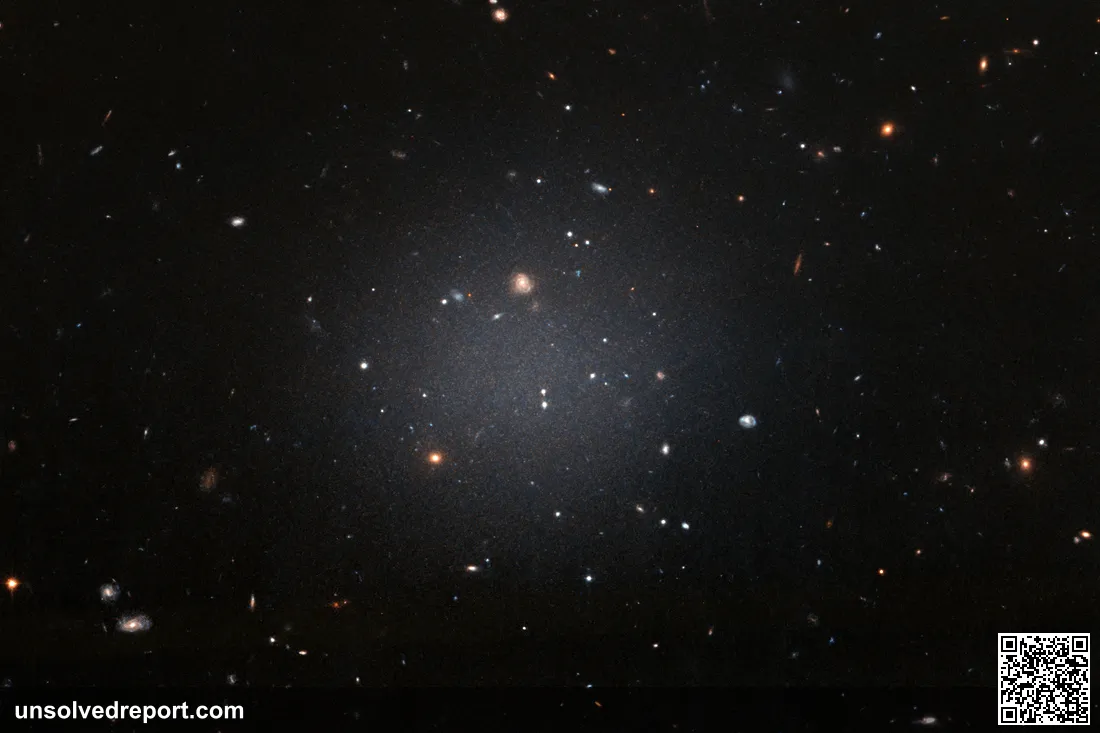
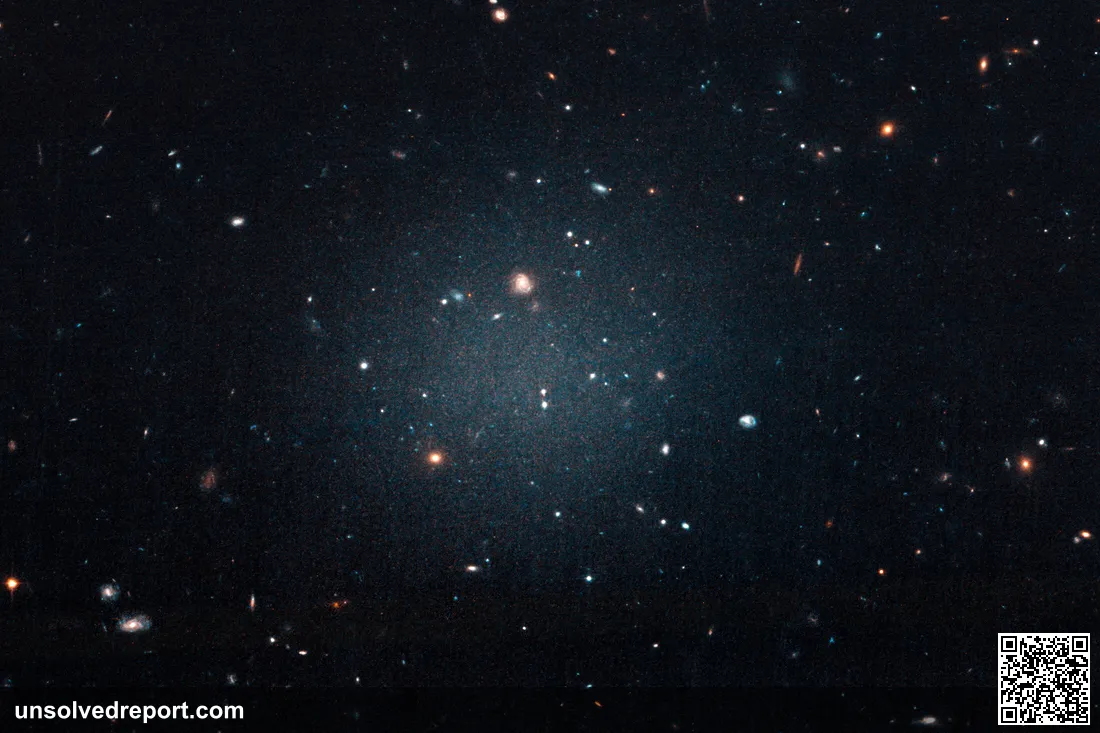
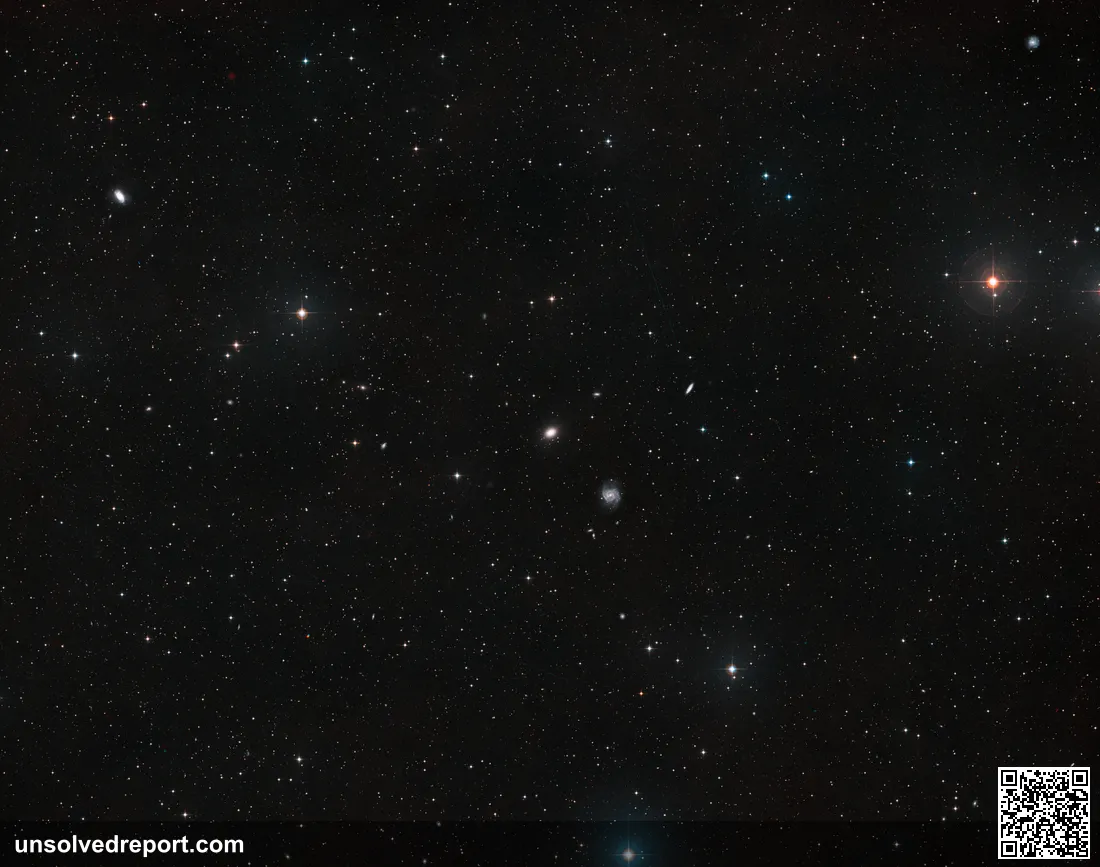
Start with the galaxy itself, because it is strange before you even measure it—the kind of oddball that puts it in the same company as Hoag's Object, another galaxy whose structure still defies a clean explanation. NGC 1052-DF2 is "ultra-diffuse": roughly as wide as the Milky Way, yet so thinly sprinkled with stars that you can look straight through it and see distant galaxies on the other side. It sits in the direction of the constellation Cetus, hanging near the elliptical galaxy NGC 1052.
The bombshell came from Pieter van Dokkum and colleagues, in a 2018 Nature paper with a title that doesn't bother being coy: "A galaxy lacking dark matter" (van Dokkum et al. 2018, Nature). Here's what they did. They clocked the speeds of about ten bright globular clusters—dense knots of stars—orbiting inside DF2. In a normal galaxy that size, dark matter's extra gravity should fling those clusters around at tens of kilometers per second. Instead, they barely budged relative to one another. The line-of-sight velocity dispersion came out extraordinarily low, later pinned down to roughly σ ≈ 7.8 km/s (Haghi et al. 2019, MNRAS).
Do the math and the conclusion is blunt. The mass needed to explain that lazy, gentle motion matched the mass of the galaxy's visible stars—and nothing more. The dark matter content came out consistent with little or none. We're talking a shortfall of a few hundredfold against what galaxy-formation models demand for an object that size.
That was so far out of bounds that it practically begged for skepticism. And the skepticism produced a second discovery. In 2019, the same group reported NGC 1052-DF4, another ultra-diffuse galaxy in the same group, in The Astrophysical Journal Letters (Danieli et al. 2019, ApJL). Using the Low Resolution Imaging Spectrometer at the W. M. Keck Observatory, they tracked seven globular clusters this time—and again the velocities lined up with the galaxy's ordinary matter alone (Keck Observatory). One oddball galaxy could be a fluke. Two near-identical oddballs in the same neighborhood looked like a pattern.
Now here's the twist that turns the whole thing wholesome. A galaxy that can exist without dark matter is, oddly, evidence that dark matter is real. Think about it: if "dark matter" were really just our misunderstanding of how gravity works, you could not have two perfectly normal-looking galaxies where it's simply gone while their neighbors are stuffed with it. You can't subtract a thing that was never there. As the discovery teams have pointed out, separating dark matter from ordinary matter is exactly the trick a modified-gravity law struggles to pull off—but a genuine particle can, the same way it can leave its fingerprints on a torn-apart star stream like GD-1 or the unexplained glow at the galactic center (AAS Nova summary).
The Question Nobody Has Settled
This is where the honest mystery lives, and it comes in two layers.
The first is a stubborn, almost stubbornly small fight: how far away is DF2? That single number changes everything, because distance sets the galaxy's true size, its real brightness, and the mass you infer from it. Van Dokkum's team put it around 20 megaparsecs—about 65 million light-years out. But Ignacio Trujillo and collaborators pushed back in 2019, arguing it might sit much closer, near 13 Mpc. Move it that much nearer and the drama drains away: it becomes a fairly ordinary low-surface-brightness dwarf with an unremarkable mass budget. The whole argument hangs on a yardstick called the "tip of the red giant branch"—and even that got contested, with one analysis warning that crowded, blended stars can fake a "phantom" tip and trick you into reading a shorter distance (Wikipedia overview, citing the primary literature). Then deeper Hubble imaging by Shen and colleagues in 2021 measured a distance of about 22 Mpc (Shen et al. 2021, ApJL), backing the far—and far stranger—reading. The numbers have since tightened toward the larger distance. But the saga is a perfect lesson in how one measurement can make or break a "galaxy with no dark matter"—cosmology has been burned by exactly this kind of distance-and-calibration fight before, most famously in the Hubble Tension.
The second question runs deeper. Even if you grant the result, how does nature build a galaxy without dark matter at all? Standard cosmology is adamant that dark matter comes first—it digs the gravitational well that gas falls into before stars can light up. A galaxy that skipped that step needs an origin story. And astronomers don't yet agree on which one is true.
The Competing Explanations
What follows are rival scientific hypotheses, not settled answers. Each one is still under test.
The bullet-dwarf collision. In 2022, van Dokkum's group floated an origin in Nature: a head-on, high-speed smashup between two gas-rich dwarf galaxies, roughly eight billion years ago (van Dokkum et al. 2022, Nature). Picture the physics for a second. Dark matter barely interacts with anything, so it would sail straight through the crash, untouched. The gas clouds, on the other hand, slam together, compress, and shatter into a string of brand-new galaxies—each one born dark-matter-free. And here's the suggestive part: DF2 and DF4 seem to lie along a roughly straight chain of 7–11 faint objects, which the authors read as the debris trail of exactly that kind of collision (Phys.org coverage). It's an elegant idea. If confirmed, it would turn the whole anomaly into a natural by-product of physics we already know. For now, it's a model waiting on more evidence.
Tidal stripping. Other researchers have asked whether the gravity of massive NGC 1052 could have peeled the dark matter halo clean off over many orbits—plausible, since loosely bound dark matter is easier to tear away than tightly packed stars. The snag: some studies report that DF2 shows a clean disk with no obvious signs of tidal mangling, which makes this harder to swallow (Emsellem et al. 2019, A&A).
Modified gravity, the "external field effect." Then there's the boldest take of all: maybe DF2 doesn't lack dark matter because there's no dark matter anywhere to lack. Supporters of Modified Newtonian Dynamics (MOND) argue that a small galaxy parked near a massive host can have its own internal gravity quietly suppressed—an "external field effect"—producing precisely the sluggish star motions we see. Haghi and colleagues ran the numbers and found the predicted velocity dispersion matches DF2 if it sits within about 150 kpc of NGC 1052 and both lie near 20 Mpc (Haghi et al. 2019, MNRAS). It's a real, quantitative alternative—though most astronomers still favor the particle-dark-matter picture over it.
What makes NGC 1052-DF2 such a satisfying mystery is that nobody here is waving their hands. Every claim ties back to something you can measure—a velocity, a distance, a star count—and every fresh telescope pointing nudges the argument one way or the other. The galaxy that looked like it might break our theory of the universe may, in the end, be the thing that confirms it. We're still out here listening to its faint, slow-drifting clusters, waiting for them to tell us which.
Sources & further reading
- van Dokkum et al. (2018), "A galaxy lacking dark matter," Nature — https://www.nature.com/articles/nature25767
- Danieli et al. (2019), "A Second Galaxy Missing Dark Matter in the NGC 1052 Group," ApJL — https://iopscience.iop.org/article/10.3847/2041-8213/ab0d92
- Shen et al. (2021), "A Tip of the Red Giant Branch Distance of 22.1 ± 1.2 Mpc to NGC 1052-DF2," ApJL — https://iopscience.iop.org/article/10.3847/2041-8213/ac0335
- van Dokkum et al. (2022), "A trail of dark-matter-free galaxies from a bullet-dwarf collision," Nature — https://www.nature.com/articles/s41586-022-04665-6
- Haghi et al. (2019), MOND external field effect, MNRAS — https://academic.oup.com/mnras/article/487/2/2441/5505850
- Emsellem et al. (2019), "The ultra-diffuse galaxy NGC 1052-DF2 with MUSE," A&A — https://www.aanda.org/articles/aa/full_html/2019/05/aa34909-18/aa34909-18.html
- W. M. Keck Observatory, "Unusual Galaxies Defy Dark Matter Theory" — https://keckobservatory.org/df2-df4/
- AAS Nova, "Where Did All the Dark Matter Go?" — https://aasnova.org/2019/02/26/where-did-all-the-dark-matter-go/
- Phys.org, "New theory suggests collision of dwarf galaxies could explain dark matter-free galaxies" — https://phys.org/news/2022-05-theory-collision-dwarf-galaxies-dark.html
- Wikipedia, "NGC 1052-DF2" (overview citing primary literature on distance debate) — https://en.wikipedia.org/wiki/NGC_1052-DF2
Dark Energy: The Invisible Force Ripping Space Apart
Dark energy makes up 70% of the universe and is tearing it apart faster every second — but nobody actually knows what it is. So what's really behind it?
Cosmic Ray Knee: The Galaxy's Speed Limit Nobody Can Explain
At 3.7 quadrillion electron-volts, something in our galaxy hits a wall — precisely, every time. The cosmic ray knee is measured to the percent. So why can't anyone name the machine that draws it?
Hoag's Object: The Perfect Ring Galaxy No One Can Explain
Hoag's Object: a flawless ring galaxy 600 million light-years away with no collision, no wreckage, no source. 70 years on, how did it form?