Hoag's Object: The Perfect Ring Galaxy No One Can Explain
Hoag's Object: a flawless ring galaxy 600 million light-years away with no collision, no wreckage, no source. 70 years on, how did it form?
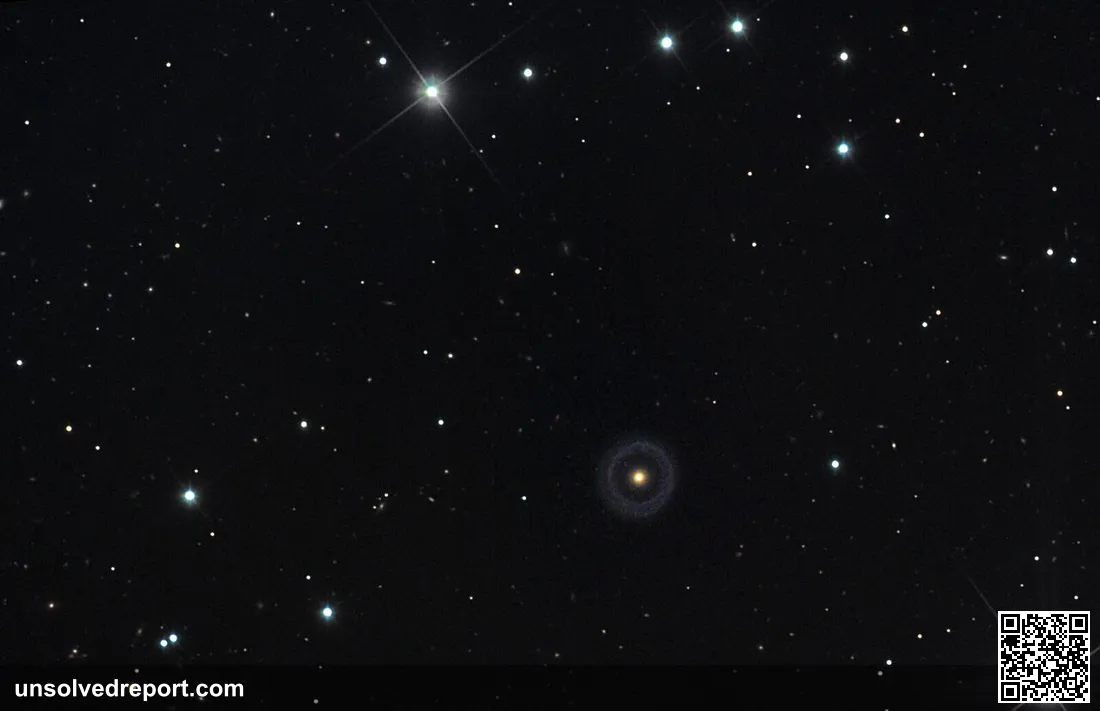
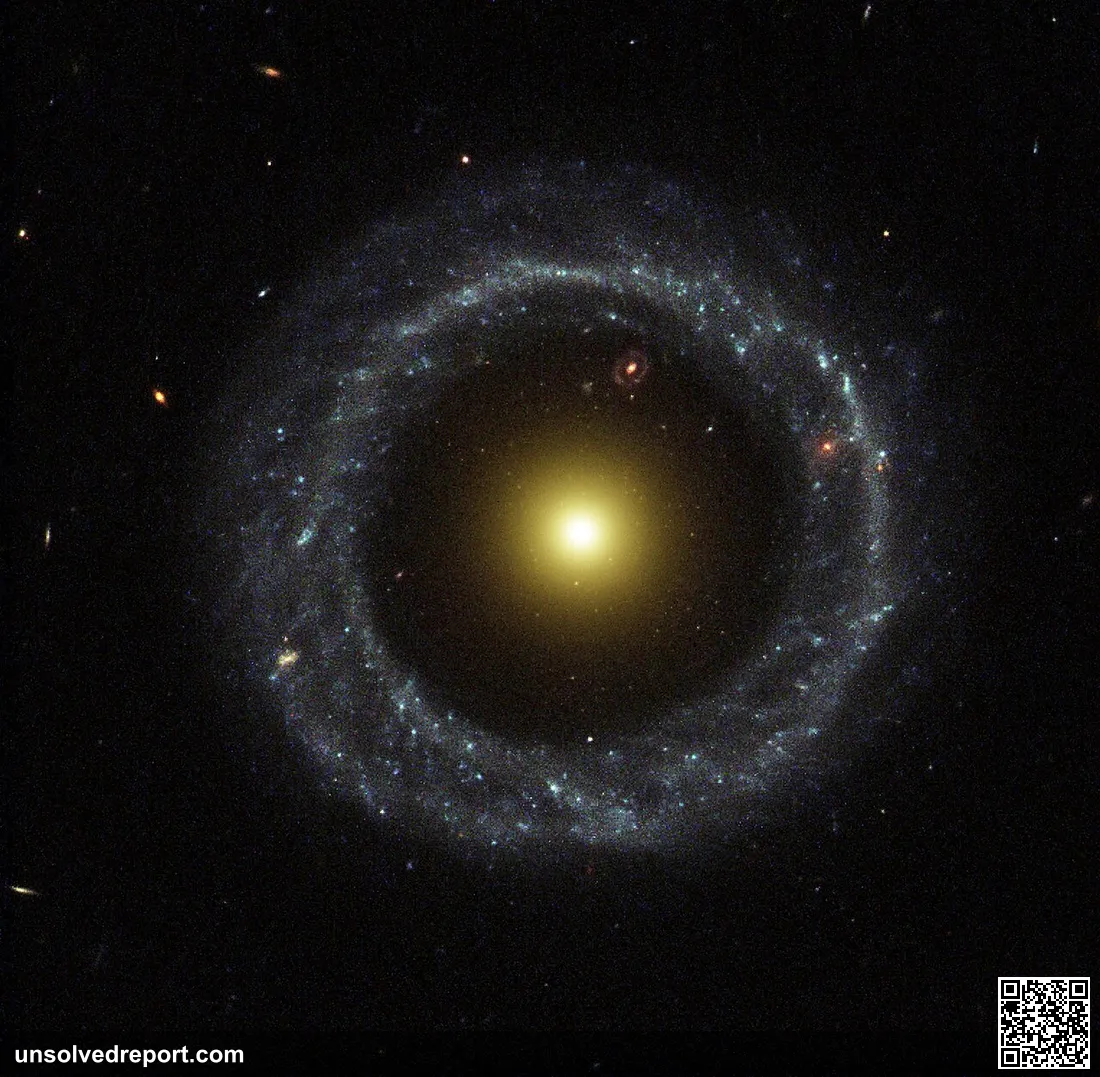
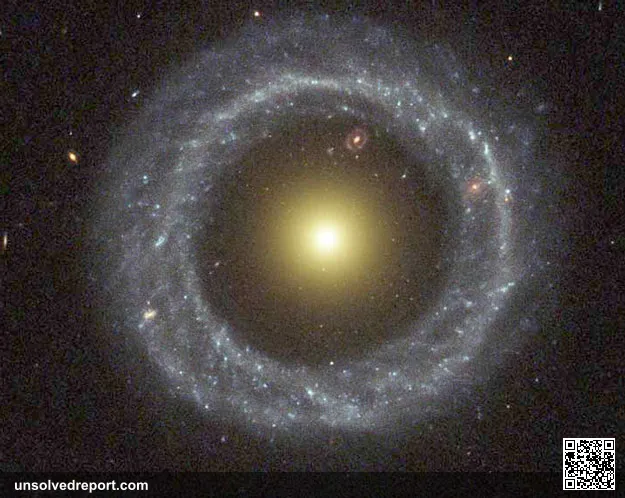
A glowing ball of golden stars. A flawless blue ring wrapped around it. And between them, a band of perfect, empty darkness. The photograph looks faked. It looks like a piece of cosmic jewelry someone hung in the void, or a bullseye target floating where no target should be.
It's real. It's called Hoag's Object. And here's the strange part: more than seventy years after we first spotted it, the most honest thing the world's astronomers can say about how it got that ring is — we don't know.
Sit with that for a second. Astronomy is good at explaining weird-looking things. Give it a smudge, a streak, a glow, and it will tell you exactly what's going on. Hoag's Object is one of the rare cases — like the galaxy that somehow lost its dark matter — where the photo is razor-sharp, the numbers are rock-solid, and the answer still slips through our fingers.
A Mystery Hiding in Plain Sight
Back in 1950, an American astronomer named Arthur Hoag squinted at this thing and couldn't make up his mind. Was it "either a planetary nebula or a peculiar galaxy"? He genuinely didn't know which (Wikipedia, "Hoag's Object"). His name stuck to it. So did the confusion — much like the Wow! signal, a single strange reading that decades of follow-up still haven't explained away.
Everything we've measured since is dizzyingly precise. This thing floats about 600 million light-years from Earth, off in the direction of the constellation Serpens — the Serpent — and it stretches roughly 100,000 light-years across. That makes it about the size of our entire Milky Way (NASA Astronomy Picture of the Day, Nov. 27, 2019; Live Science). Zoom in and the geometry gets almost suspicious: the bright outer ring is about 121,000 light-years wide, the inner core is a compact 17,000 light-years, and the gap between them looks nearly pitch-black (Wikipedia).
Now here's what really turns the screw. The ring and the core aren't just shaped differently — they're built from completely different kinds of stars. The ring blazes with hot, young, blue stars. The central ball glows with much older, redder ones (NASA APOD). Translation? The ring is busy giving birth to brand-new stars right now. The core stopped doing that ages ago.
So could the whole thing be a trick of the light? Hoag wondered the same. Maybe the ring was an "Einstein ring" — the warped glow of a far-off galaxy, bent into a halo by the gravity of a closer one. A mirage. Spectroscopy shut that door hard. The core and the ring share the exact same redshift, which means they sit at the same distance and belong to the same real, physical object — no cosmic coincidence, no illusion (Live Science; Wikipedia).
And then — as if the universe were showing off — there's the detail that makes the picture almost too good to be true. In the dark gap between the core and the ring sits a second ring galaxy (catalogued as SDSS J151713.93+213516.8), far, far more distant, just happening to line up in our view. A ring galaxy, framed inside a ring galaxy, by pure dumb luck of the line of sight (NASA APOD; Wikipedia).
So How Do You Build a Perfect Ring?
That's the whole question. Where did the ring come from?
We actually have a recipe for ring galaxies — and they're already strange, making up well under one percent of all the galaxies we know (Live Science). The recipe goes like this: a smaller "bullet" galaxy slams straight through the heart of a bigger disk galaxy. The impact sends a shockwave rippling outward, like a stone dropped into a pond, and that ripple squeezes gas into a expanding ring of fresh stars.
Beautiful theory. It falls apart here.
Because where's the bullet? Astronomers have looked hard, and there's no nearby second galaxy and no scattered wreckage — none of the debris a recent crash should have left behind (Wikipedia). Radio telescopes hunting for neutral hydrogen say Hoag's Object hasn't eaten a smaller galaxy in roughly a billion years (NASA APOD). And the core and the ring are drifting at low speed relative to each other — exactly what you would not expect from a violent, off-center smash.
So the go-to explanation for ring galaxies seems to flunk on the most famous ring galaxy of them all. That's the puzzle that's kept scientists up at night for decades: a near-perfect structure with no obvious cause, and barely a handful of cousins — the rare "Hoag-type" galaxies — to even compare it to.
The Suspects
Here are the leading explanations. Fair warning: every one of them is still up for debate, and not a single one is settled.
Suspect 1 — A crash so old it erased itself. This one is speculation, and weakly backed at that. Maybe there was a collision — but so long ago, billions of years back, that every fingerprint of the intruder has scattered into nothing we can detect (Live Science). It saves the standard recipe. But it does so by pointing to evidence that has conveniently vanished, which makes it nearly impossible to prove wrong — or right.
Suspect 2 — A bar that disappeared. Also speculation. Astronomer Noah Brosch suggested the ring might be the leftover of a wild "bar instability" inside a barred spiral galaxy a few billion years ago — a gravitational tantrum from a central bar that later dissolved away (Wikipedia; NASA APOD). The problem? Critics, including the team led by François Schweizer, point out that the central body looks like a round, spheroidal blob — not the flattened disk shape a barred-spiral origin would demand (Wikipedia).
Suspect 3 — A slow, patient feeding. This one is speculation too, but it's been through peer review. In a 2011 paper in the Monthly Notices of the Royal Astronomical Society, Finkelman and colleagues argued that the core is a true elliptical galaxy packed with very old stars — older than about 10 billion years — and that the ring came later. Their story: the elliptical core formed first, way back in the early universe. Then, over enormous stretches of time, a disk of hydrogen quietly assembled around it through "cold" accretion — pristine primordial gas pulled in from the surrounding intergalactic emptiness, with new stars lighting up along the gravitational grooves of the core (Finkelman et al., MNRAS, 2011). No collision needed. Just a galaxy slowly grazing across billions of years.
Notice the catch in each one. The collision idea needs a villain who left no body. The bar idea needs a bar that left no trace. The accretion idea sidesteps both — elegant, almost too elegant — but it's far easier to propose than to prove.
And that's exactly why Hoag's Object refuses to let go of us. It isn't some fuzzy blob begging for a sharper telescope. It's a crisp, gorgeous, fully-photographed thing, sitting right there in the open — a quiet reminder that the universe still hides simple-sounding questions, like how do you make a perfect ring, whose answers we honestly haven't finished writing. It belongs on any honest list of cosmic mysteries even the best telescopes can't crack. Somewhere out there in Serpens, the ring keeps turning, keeping its secret. The next one might be waiting in the dark gap of a galaxy you've never heard of.
Sources & Further Reading
- Wikipedia: "Hoag's Object"
- NASA Astronomy Picture of the Day — "Hoag's Object: A Nearly Perfect Ring Galaxy" (Nov. 27, 2019)
- Live Science — "Hoag's Object Is a Galaxy Within a Galaxy Within a Galaxy (and Nobody Knows Why)"
- Finkelman et al., "Hoag's Object: evidence for cold accretion on to an elliptical galaxy," Monthly Notices of the Royal Astronomical Society (2011)
- Astronomy.com — "Hoag's Object"
Hypervelocity Stars: Flung From the Galaxy at 4 Million MPH
Hypervelocity stars are escaping the Milky Way forever at 4 million mph. Astronomers traced one straight back to a black hole — but most don't point there. So what's firing the rest?
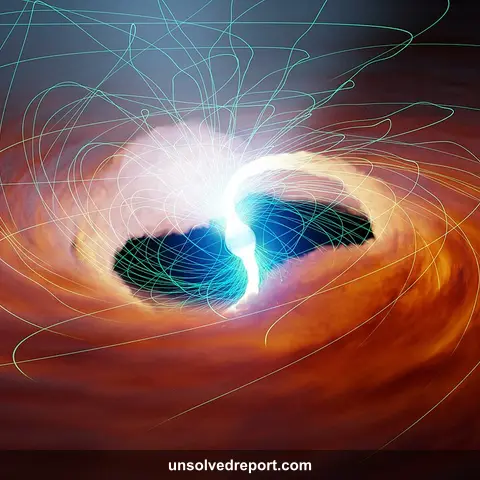
Cygnus X-3: The Hidden X-Ray Monster Nobody Can Name
Cygnus X-3 hid behind its own light for 50 years — now confirmed as one of the galaxy's most extreme X-ray sources. So why can't anyone say what's inside it?
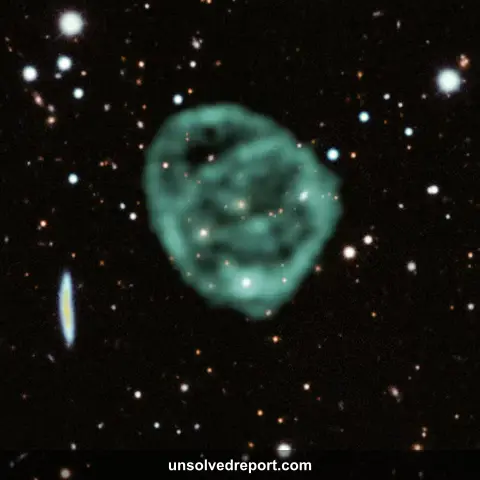
Odd Radio Circles: Giant Rings in Space Nobody Can Explain
A ring of radio light wider than the Milky Way, glowing in nothing else, no visible light, no X-rays. Scientists found it. They still can't explain it.