Cosmic Ray Knee: The Galaxy's Speed Limit Nobody Can Explain
At 3.7 quadrillion electron-volts, something in our galaxy hits a wall — precisely, every time. The cosmic ray knee is measured to the percent. So why can't anyone name the machine that draws it?
There is one graph in physics so dependable it almost feels like cheating. Count the cosmic rays hitting Earth, sort them by energy, and the dots fall onto a near-perfect straight line — a line that holds steady across ten orders of magnitude. Ten. Then, at an energy of roughly three to four quadrillion electron-volts, the line does something quiet and unsettling. It bends. Not a break, not a cliff — it just tilts a touch steeper and keeps falling, as if the sky had a barely visible kink in it.
Astronomers call that kink "the knee." For more than sixty years it has sat there like a milepost nobody planted. Something out in the galaxy hits its limit at that exact energy. We are still arguing about what.
What We Actually Know
First, drop the word "ray." Cosmic rays aren't beams of light at all. They're particles — mostly naked protons and atomic nuclei — screaming in from space at nearly the speed of light. When one slams into the top of our atmosphere, it shatters into a downpour of secondary particles called an extensive air shower. Ground arrays catch the splash.
That splash is how the knee was found. Back in 1958, Georgy Kulikov and German Khristiansen at Moscow State University, working with an array of hodoscope counters, spotted a "kink" in the air-shower spectrum at primary energies of several PeV — and a PeV is 10^15 electron-volts, a quadrillion of them. The steepening they stumbled onto is the feature everyone now simply calls the knee (CERN Courier; University of Siena, Early History of Cosmic Rays).
Six decades later, we've pinned it down with surgical precision. The Large High Altitude Air Shower Observatory (LHAASO), perched high in Sichuan, China, published the sharpest measurement yet in Physical Review Letters in 2024. Its KM2A array put the knee at 3.67 ± 0.05 ± 0.15 PeV. The spectral index — basically how steeply that line falls — clocked in at −2.7413 just below the knee and −3.128 just above it (LHAASO Collaboration, Phys. Rev. Lett. 132, 131002). The earlier KASCADE experiment in Germany had already spotted a similar knee-like bend near 4 PeV (arXiv:1308.2098).
Want a sense of scale? 3.7 PeV is about a million times the energy the Large Hadron Collider — humanity's biggest, most expensive machine — manages to hand a single proton. And nature is doing it somewhere in our own galaxy, for free, no funding committee required. The knee is the moment that free machine starts to run out of breath.
Here's where the physics gets clean. Charged particles get whipped up and held in place by the galaxy's magnetic field, and the quantity that really matters isn't raw energy — it's rigidity, roughly energy divided by charge. So the top energy any source can reach scales with a particle's charge number Z. If protons (Z=1) cap out around a few PeV, then helium, carbon, and iron (Z=26) should each hit their own knees at proportionally higher energies. This is the rigidity-dependent picture — the "Peters cycle" — and it stakes out a bold, falsifiable claim: the cosmic-ray mix should turn heavier as you climb past the knee (IOPscience, Cosmic-Ray Physics).
And that's exactly what showed up. LHAASO's 2024 data show the mean logarithmic mass of cosmic rays drifting toward heavier elements above the knee — precisely what you'd see if the light protons bail out first and the heavy nuclei crowd in behind them (Phys. Rev. Lett. 132, 131002).
There's a second ceiling too, this one purely geometric. The Hillas criterion says a source can only keep accelerating a particle for as long as that particle's looping orbit still fits inside the accelerating region — put formally, the maximum energy scales with magnetic field strength times source size (E_max ≈ eBR). For most objects in the galaxy, that arithmetic slams the brakes somewhere in the PeV range, unless the magnetic field gets cranked up dramatically (Frontiers in Astronomy and Space Sciences).
So is anything out there actually reaching these energies? Yes — we've caught it red-handed. In 2021, LHAASO reported in Nature a dozen "PeVatrons": sources blasting out gamma rays above 100 TeV. One of them flung a photon of about 1.4 PeV — the highest-energy photon ever recorded, though it still trails the record-shattering blast of the BOAT gamma-ray burst — out of the Cygnus star-forming region. The Crab Nebula, that famous tangle of supernova wreckage, was caught spitting photons above 1 PeV with no clear cutoff in sight (Cao et al., Nature 594, 33, 2021).
The Part Nobody Can Pin Down
Now the catch — and it's a strange one. We can see the galaxy hurling particles up to PeV energies. We have a clean theory for why a knee should appear. And yet we still cannot point at any one kind of object and say, with confidence, "that's the thing that draws the line."
For decades the lead suspects have been supernova remnants — the expanding blast waves of stars that have already exploded, sometimes leaving behind the kind of ultra-magnetized corpse seen in the roaming magnetar SGR 0501+4516, where a process called diffusive shock acceleration is thought to ramp particles up to ferocious energies (Astronomy & Astrophysics, arXiv:astro-ph/0303159). It's a beautiful idea. The problem is the bookkeeping. When you model real, observed remnants in detail, many of them seem to soften or cut off their particle spectra around 100 TeV — about ten times below the knee (LHAASO and Galactic Cosmic Rays, PMC). A typical middle-aged remnant, its shock wave already slowing down, may strain to reach even 10 TeV.
So a gap yawns open between what supernova remnants appear to deliver and where the knee actually sits. And the PeVatrons LHAASO found don't quite close it, because they're spotted by their gamma rays — and gamma rays can be made by protons (the cosmic rays we're chasing) or by electrons (which contribute nothing to the knee). Telling those two apart, and proving genuinely hadronic PeV acceleration, is brutally hard. As of the most recent reviews, not one galactic source has been nailed down as a confirmed proton PeVatron beyond reasonable doubt (arXiv:2306.01484).
Put it plainly: the knee almost certainly marks the top speed of the galaxy's accelerators. We just can't yet walk up to the machine — or machines — and say this one, running exactly like this, sets the limit at 3.7 PeV.
So What's Drawing the Line?
The acceleration-limit view (the mainstream bet). The knee is simply where the galaxy's accelerators max out for protons, with heavier nuclei stretching the spectrum onward through the rigidity sequence. This is the consensus reading, and it's the one the composition data backs most strongly (IOPscience review).
The confinement / leakage view (a real contender). A closely related idea says the knee partly marks the moment the galaxy can no longer hold on to its cosmic rays. Above a certain rigidity, particles stop staying trapped in the galactic magnetic field and start leaking out into intergalactic space. Recent work suggests that anisotropy measurements — the faint directional unevenness in where particles arrive from — might help reveal whether the bend is really about escape rather than acceleration (Astrophysical Journal study). It's a credible rival, not a fringe one.
The single-source and exotic proposals (more speculative). A handful of models reach for one nearby dominant source, or for novel particle-physics effects, to sculpt the knee. They're fun to think about, but they lean on far thinner observational support — treat them as informed guesses, not established science.
What makes the cosmic-ray knee such a deliciously tidy mystery is that it isn't fuzzy. It's a precise number, measured to within a few percent, written right into the sky. We even know, more or less, why it should be there. We just haven't found the galactic engines that put it there — and every single PeV photon LHAASO snares tightens the net a little more. The next one might be the one that finally names the machine.
Sources & further reading
- LHAASO Collaboration, "Measurements of All-Particle Energy Spectrum and Mean Logarithmic Mass of Cosmic Rays from 0.3 to 30 PeV with LHAASO-KM2A," Physical Review Letters 132, 131002 (2024). ADS
- Cao et al., LHAASO Collaboration, "Ultrahigh-energy photons up to 1.4 petaelectronvolts from 12 γ-ray Galactic sources," Nature 594 (2021). IHEP/LHAASO release
- "The origin of cosmic rays," CERN Courier. cerncourier.com
- "Early History of Cosmic Ray Research," University of Siena. PDF
- "LHAASO and Galactic cosmic rays," PMC review. ncbi.nlm.nih.gov
- "Chapter 4: Cosmic-Ray Physics," IOPscience. iopscience.iop.org
- "Open Questions in Cosmic-Ray Research at Ultrahigh Energies," Frontiers in Astronomy and Space Sciences. frontiersin.org
- "The knee in galactic cosmic ray spectrum and variety in supernovae," arXiv:astro-ph/0303159. arxiv.org
- "Search for the Galactic accelerators of cosmic rays up to the knee with the Pevatron Test Statistic," arXiv:2306.01484 (preprint). arxiv.org
- KASCADE-Grande elemental spectra, arXiv:1308.2098. arxiv.org
- Joint constraint on propagation origin of the knee, Astrophysical Journal. iopscience.iop.org
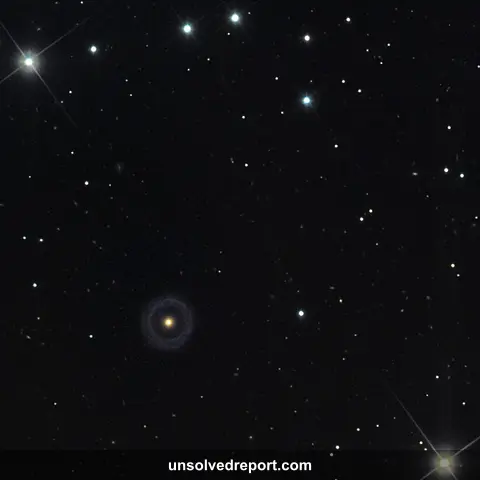
Hoag's Object: The Perfect Ring Galaxy No One Can Explain
Hoag's Object: a flawless ring galaxy 600 million light-years away with no collision, no wreckage, no source. 70 years on, how did it form?
Hypervelocity Stars: Flung From the Galaxy at 4 Million MPH
Hypervelocity stars are escaping the Milky Way forever at 4 million mph. Astronomers traced one straight back to a black hole — but most don't point there. So what's firing the rest?
Cygnus X-3: The Hidden X-Ray Monster Nobody Can Name
Cygnus X-3 hid behind its own light for 50 years — now confirmed as one of the galaxy's most extreme X-ray sources. So why can't anyone say what's inside it?