Hoxne Hoard: A Lost Hammer, Britain's Richest Roman Fortune
A Suffolk hammer hunt uncovered Britain's richest Roman hoard: 15,000 coins, a lost fortune, and an owner who vanished without a trace. Who were they?
A farmer dropped a hammer in a field. That is how this story starts. Not with grave robbers, not with a treasure map — with a lost tool and a favor between neighbors.
November 1992. A damp afternoon in Suffolk. A retired gardener walks out to help find that hammer, sweeping the dirt with a metal detector he'd been handed as a retirement gift. The hammer can wait. Because his detector starts screaming over something else — and what he pulls out of the cold English ground is the single richest stash of late Roman gold and silver ever found on British soil, ahead even of the Anglo-Saxon war gold of the Staffordshire Hoard. Nearly 15,000 coins. More than 200 objects of precious metal. All of it sealed underground for roughly 1,600 years, waiting.
The treasure made headlines. The hammer made headlines too. But here's the strange part — the most haunting thing about the Hoxne (say it "Hoxon") Hoard isn't what came out of the ground. It's a question nobody has ever been able to answer about why it went in.
What we know really happened
The date is fixed: November 16, 1992, near the village of Hoxne in Suffolk, England. Eric Lawes, an amateur metal detectorist, was hunting for a hammer his friend, tenant farmer Peter Whatling, had lost — when his detector caught the signal of something big and metal buried in the soil (Smithsonian Magazine; British Museum, via Wikipedia).
Now here's the move that archaeologists still talk about with something close to reverence. Lawes scraped up a few silver spoons and gold coins — and then he stopped. He did not keep digging. He and Whatling told the landowners (Suffolk County Council) and the police, and left the rest exactly where it sat (Smithsonian Magazine). Think about that level of self-control with a fortune at your fingertips. The very next day, a team from the Suffolk Archaeological Unit ran an emergency dig, lifting the treasure out in one solid block of earth so it could be picked apart in a lab — packed exactly the way someone had packed it sixteen centuries earlier (World History Encyclopedia). That single decision to stop digging is the reason we know so much about how the hoard was buried in the first place.
And the numbers? They almost don't sound real. The hoard held 14,865 coins: 569 gold solidi, 14,272 silver coins (60 miliarensia and 14,212 siliquae), and 24 bronze nummi (British Museum, via Wikipedia). On top of the coins sat roughly 200 other objects — gold jewelry, silver tableware, the small private things of a wealthy life.
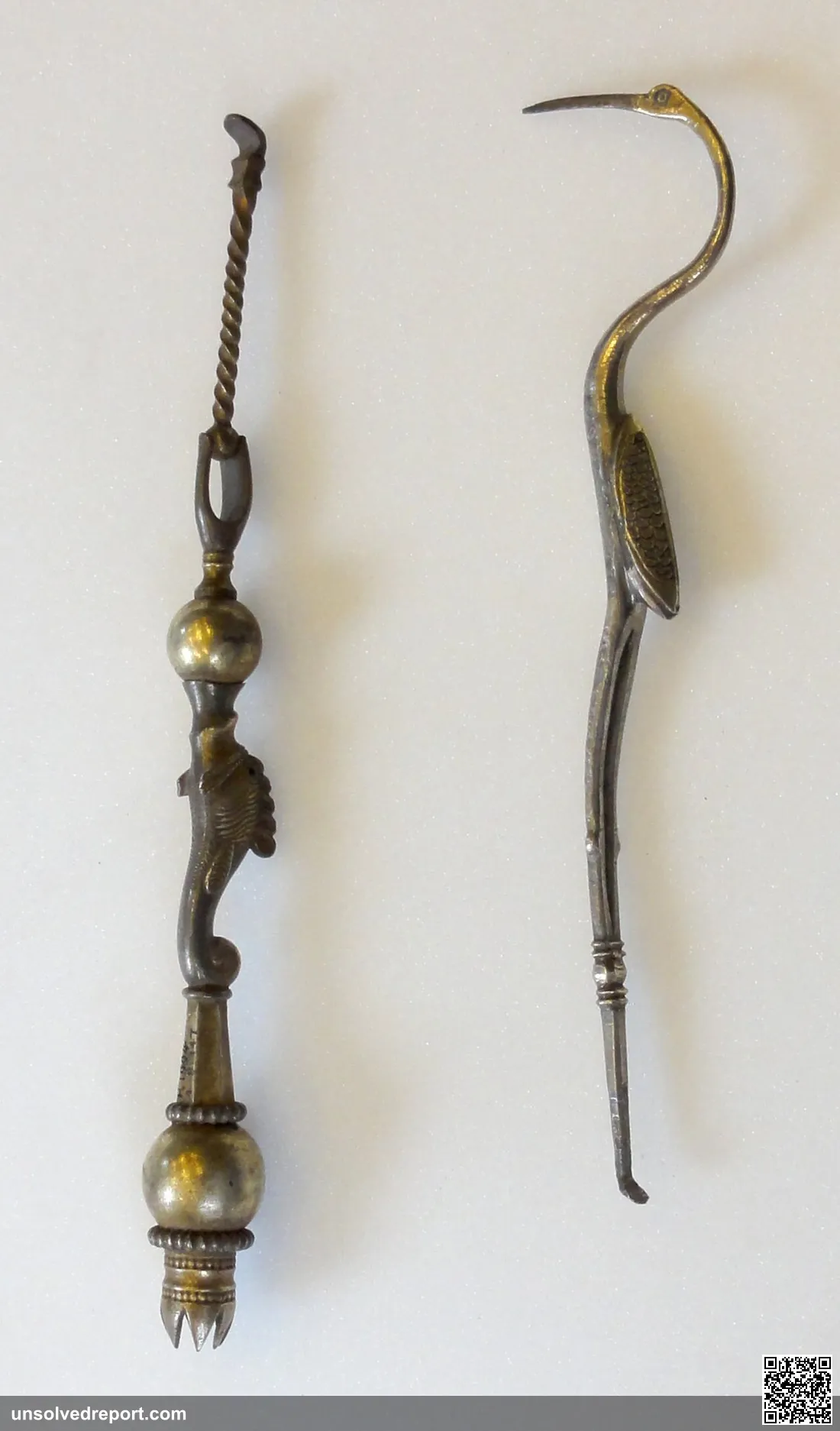
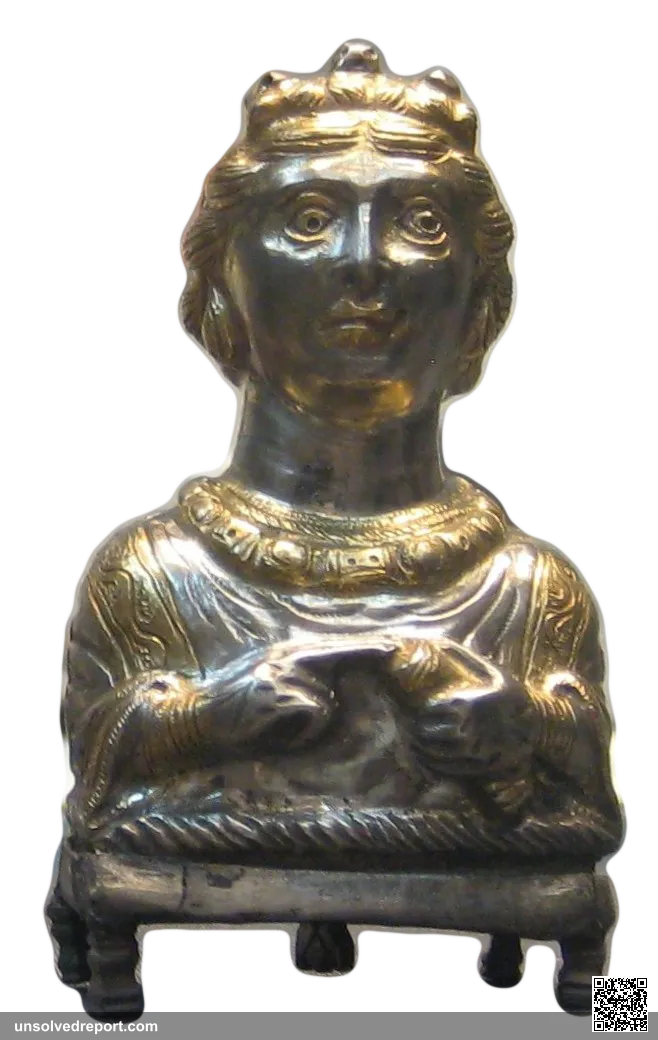
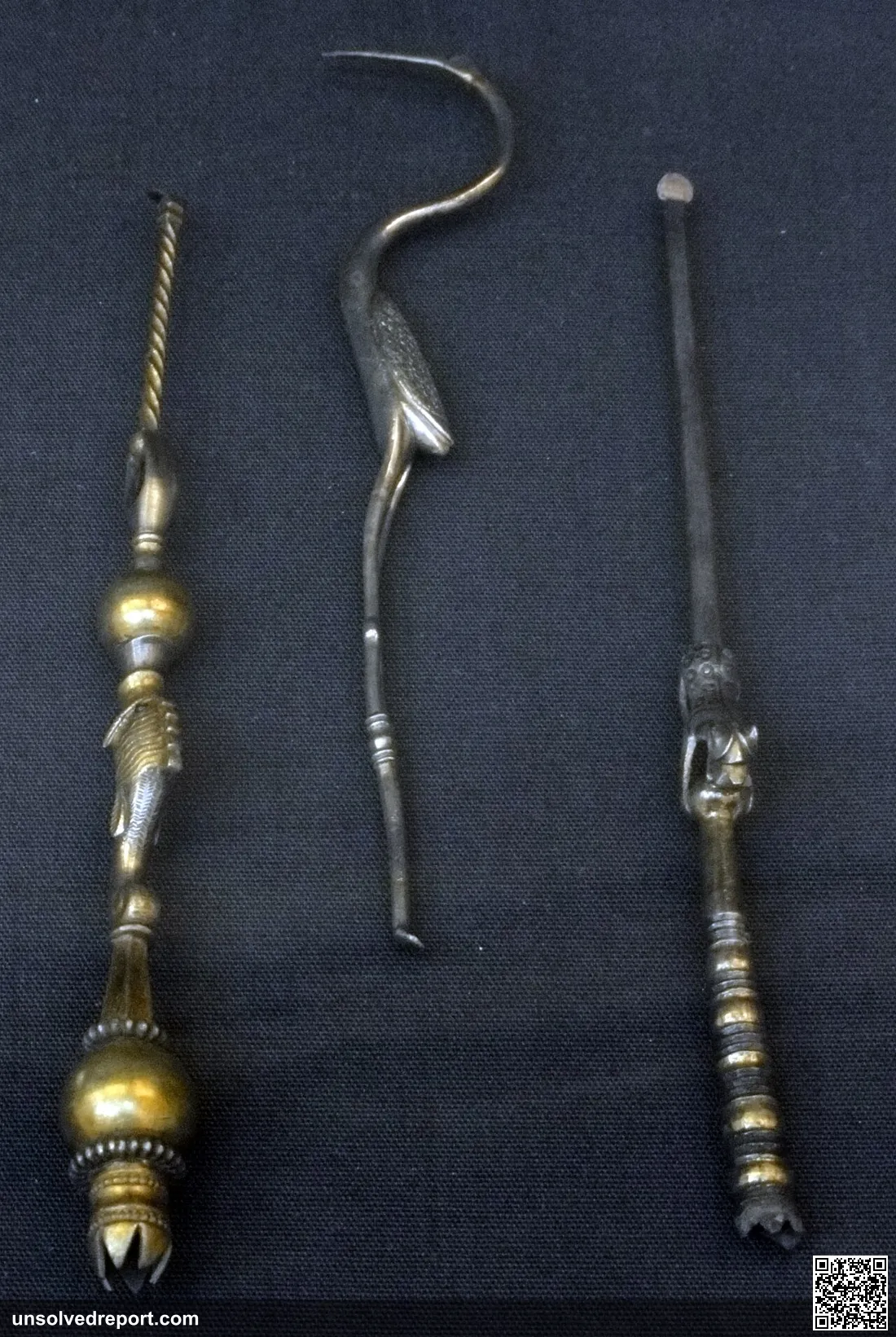
Some pieces will stop you cold. A delicate gold body chain, set with amethysts and garnets, made to be worn draped across a torso. Four silver-gilt pepper pots (piperatoria) — the most famous being the "Empress" pepper pot, a hollow little statuette of a woman's upper body with a mechanism hidden in its base for grinding and shaking out pepper, made around 400 AD (Empress pepper pot, Wikipedia). A gorgeous silver handle shaped like a prancing tigress, striped with inlaid black niello — and here's the eerie detail: it looks like someone deliberately snapped it off a bigger vessel before burying it, not unlike the puzzling craftsmanship behind the Roman dodecahedra that keep turning up with no agreed purpose (World History Encyclopedia). Plus dozens of silver spoons and ladles.
All of it had been packed into a wooden chest — an oak box about 60 by 45 by 30 centimeters, with smaller inner caskets of yew and cherry wood nested inside. The wood rotted away centuries ago. But the iron fittings, hinges, locks, and rings survived to show exactly how it was built (British Museum, via Wikipedia).
So what happens when a retired gardener digs up several million pounds? In 1993 the Treasure Valuation Committee put the hoard's worth at £1.75 million (worth several million pounds today). Under the treasure-trove rules of the time, the museum that wanted to keep the find paid that sum as a reward — and Eric Lawes split it with Peter Whatling (roman-empire.net). The hoard went to the British Museum, where the great pieces have been on display since 1997 — not far from the Sutton Hoo ship-burial treasures, another British find whose owner remains disputed. And because Hoxne was handled so cleanly and so publicly, it became part of the conversation that shaped the Treasure Act 1996, which swept away the old treasure-trove system in England, Wales, and Northern Ireland and replaced it with clearer rules for reporting finds and rewarding the finders (Treasure Act 1996, Wikipedia). Oh — and the hammer? They found it. It now sits in the British Museum, parked near the gold it accidentally led the way to (Smithsonian Magazine).
The question the treasure won't answer
Here's where the gold goes quiet. For everything it tells us, the hoard refuses to answer the only two questions that really matter: who buried it — and why did they never come back for it?
The newest coins in the chest were struck under the emperors Honorius and the usurper Constantine III. That gives us a terminus post quem — an "earliest possible" burial date — of around 408 AD (British Museum, via Wikipedia). And that date drops us straight into one of the most violent, uncertain hinges in British history: the years when Roman power was crumbling across the province, right before Britain was cut loose from the Empire around 410 AD.
But "earliest possible" is a trap. It is not the same as "actual." Numismatist Peter Guest has argued that hoards like this should be dated to the period after Britain split from Rome — possibly years past 410 (Smithsonian Magazine). As Smithsonian put it, bluntly: "You can't prove or disprove either of these two positions." Translation — the year this fortune went into the ground is genuinely, permanently unknown.
The owner slips through our fingers just as easily. The name that turns up most often in the hoard — scratched onto a set of silver spoons and ladles — is "Aurelius Ursicinus." A gold bracelet reads VTERE FELIX DOMINA IVLIANE: "Use this happily, Lady Juliane." A single spoon may bear the name "Faustinus" (British Museum, via Wikipedia). Real names. Real people. And yet not one of them can be proven to be the hand that buried the chest. As one account asks: "Were Aurelius and Juliane the owners of the treasure, or perhaps their ancestors? We do not know."
Theories — and what's only a guess
Everything below is interpretation, not proven fact. Read it as educated guessing.
Theory 1: Buried in a moment of fear. The most-repeated idea — and an honestly believable one — is that a wealthy Roman-British family stashed their portable fortune to keep it safe through the chaos of Rome's collapse, planning to dig it back up once the danger passed. They never got the chance. The careful packing of the chest fits that picture neatly. But it's a guess drawn from context, not something anyone wrote down.
Theory 2: A whole family's life savings. The coins span decades, and the objects mix heirloom-grade jewelry with everyday tableware — so some read the hoard as one household's piled-up wealth, not a merchant's stock or an army payroll. That snapped-off tigress handle whispers that some pieces may have been broken down just for their silver value. Reasonable. Still speculation.
The honest answer. We don't know if the owner died, ran, forgot, or was simply stopped from ever coming back — the same unanswerable silence that hangs over America's Saddle Ridge Hoard, buried gold whose owner has never been identified either. The Hoxne Hoard is a near-perfect freeze-frame of late Roman British wealth, caught at the exact instant an empire let an island go. The treasure made it out. The person who hid it did not. That gap — between a fortune recorded down to the last coin and an owner who vanished without a trace — is the real mystery here. And it's the one no hammer, however lucky, will ever turn up.
Sources & Further Reading
- Hoxne Hoard — Wikipedia (citing British Museum collection records)
- "A Search for a Lost Hammer Led to the Largest Cache of Roman Treasure Ever Found in Britain" — Smithsonian Magazine
- The Roman Hoxne Hoard — World History Encyclopedia
- Empress pepper pot — Wikipedia
- Treasure Act 1996 — Wikipedia
- Treasure of Hoxne — roman-empire.net
Le Griffon Shipwreck: The 1679 Ghost Ship Nobody Can Find
In 1679 the Le Griffon vanished on Lake Michigan with 7 men aboard. 345 years and multiple "found it" claims later, why is it still missing?
The Lost Dutchman Mine: Arizona's Deadliest Gold Hunt
A dying prospector hid 48 pounds of gold and named no map. For 130 years, Arizona's Superstition Mountains have swallowed the people chasing the rest.
Knights Templar Treasure: The Gold That Vanished Overnight
In 1307 France raided the richest order in Europe and the vault came up empty. Was the Knights Templar treasure hidden, or did it never exist at all?