Staffordshire Hoard: 4,000 Pieces of War Gold Nobody Can Explain
Staffordshire Hoard: 4,000 pieces of torn-up Anglo-Saxon war gold — and one question experts still can't answer: who buried it, and why?
July 5, 2009. A man with a metal detector is walking a freshly ploughed field outside the little village of Hammerwich, near Lichfield in Staffordshire, England. His name is Terry Herbert. The machine starts screaming, and it doesn't stop. Within days he has pulled so much gold out of that dirt that he reportedly can't sleep at night. He has just walked into the largest pile of Anglo-Saxon gold and silver ever found on Earth, rivaling even the Cuerdale Hoard, Britain's biggest hoard of Viking silver.
Fifteen years on, the experts have counted it, cleaned it, and rebuilt a king's helmet out of its shattered scraps. They've written a whole scholarly book about it. And they still cannot tell you the one thing a ten-year-old would ask first: why on earth was it buried?
What We Actually Know
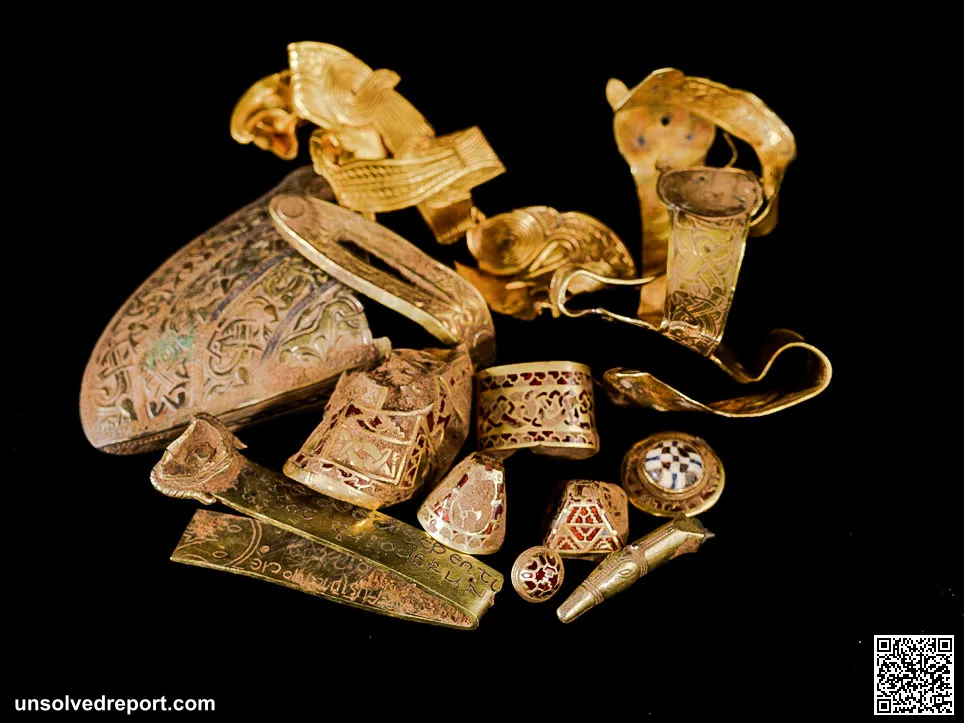
Start with the sheer size of the thing, because it is hard to believe. Add the original 2009 find to a second dig of the same field in 2012, and you get roughly 4,000 fragments — broken pieces that conservators have painstakingly fitted back into around 700 separate objects (Historic England). Weigh just the metal and you're holding about 5.1 kilograms of gold and 1.4 kilograms of silver, studded with thousands of tiny red garnets locked into dazzling cloisonné patterns (Wikipedia).
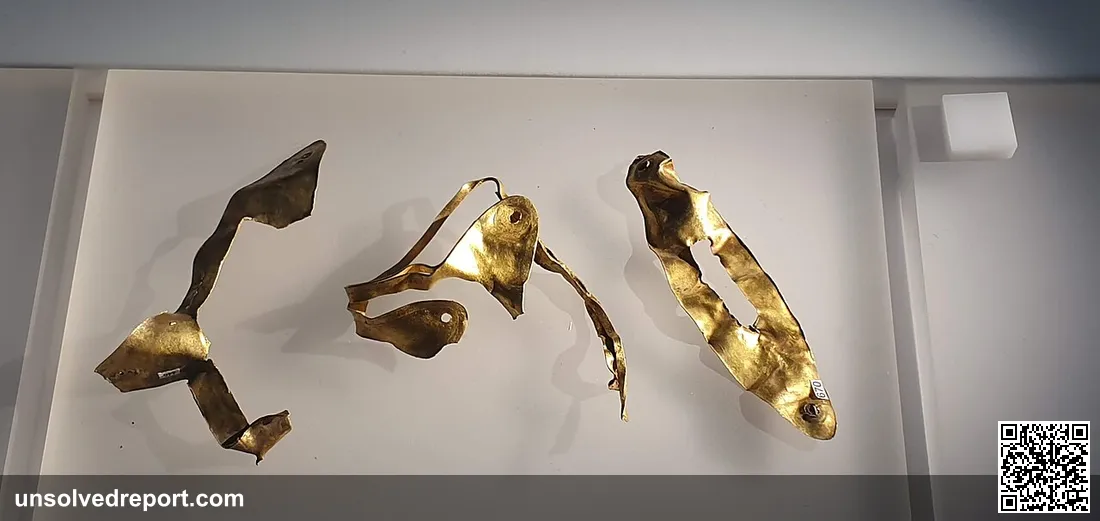
Here's the strange part. It isn't the size that unsettles archaeologists — it's what the gold is. Almost all of it came off weapons. Every glittering scrap was once the trim on elite war gear: by the standard count, 86 sword pommel caps and 66 hilt collars, part of more than a hundred sword fittings, plus the crumpled wreckage of at least one truly extraordinary helmet (Wikipedia). No coins. No cups or bowls. No brooches. Not a single piece of women's jewelry. This was treasure of one very specific kind — the golden skin peeled clean off the swords of fighting men.
That helmet is a mystery hiding inside the mystery. Anglo-Saxon helmets are almost mythically rare; the Staffordshire one is only the sixth ever known from the whole period, keeping company with the legendary helmets from Sutton Hoo and Benty Grange (Wikipedia, Staffordshire helmet). Roughly a third of the hoard's fragments are thought to belong to one single, very grand helmet. In 2018, after years of work, two full reconstructions of it were unveiled — one for the museum in Birmingham, one for Stoke-on-Trent.
So when did all this go into the ground? The seventh century, almost certainly. The objects themselves were crafted across the sixth and seventh centuries — some were already old, even passed-down heirlooms, by the time they were buried — and scholars date the burial to somewhere around AD 650 to 675 (Historic England). That puts us right in the beating heart of the kingdom of Mercia, in one of the bloodiest, most unstable chapters of early English history. The mighty Mercian king Penda — often called the last great pagan Anglo-Saxon ruler — fell in battle around AD 655, and the decades that followed were a churn of war and upheaval as Christianity swept through the kingdoms, the same turbulent century that saw a Bulgar khan's fortune buried half a world away in the Pereshchepina Treasure.
And one object speaks. A thin strip of gold, folded over, carries the hoard's only words: a line of Latin that translates as "Rise up, Lord, and may your enemies be scattered, and those who hate you flee from your face." The wording lines up with Numbers 10:35, not the similar verse in the Psalms (English-language coverage of the inscription). Read that again and feel the chill of it. It's a battle prayer — a cry for God to smash your foes — scratched into gold and then buried among the trophies of war.
The law had a say too. The find was handled under the Treasure Act 1996, and the Treasure Valuation Committee put a price on it: £3.285 million, a reward split between Herbert and the landowner, Fred Johnson (Wikipedia). The hoard was bought for the public and is now jointly owned by Birmingham and Stoke-on-Trent, looked after by Birmingham Museums Trust and the Potteries Museum & Art Gallery.
The Question Nobody Can Answer
For all of that — the weight, the counts, the dating, the prayer — no document on Earth tells us who put it there, or why. Historic England doesn't dress it up. They say it straight: "the mystery of why it was buried has still not been solved" (Historic England).
And the harder you look, the worse it gets. This was not gold tidily packed away in a treasury. Many of the pieces were ripped or wrenched off the weapons they once decorated — the precious metal torn free with brutal speed, no care at all for the beauty of the things. No scabbards. No blades. No wood, no leather, nothing organic at all — just the gold and the garnet trim. Whoever gathered this wanted the metal and nothing else. And whoever buried it had their hands on a staggering fortune in elite war gear, the kind you could only collect from many, many high-status warriors. Then they left no marker. No record. And, as far as anyone can tell, they never came back for it.
The Best Guesses We Have
Everything below is scholarly proposal and educated guesswork — not proven fact. The honest answer is still: nobody knows.
War loot, stripped from the enemy dead. This is the favorite, and the one the evidence fits most snugly: it's plunder. In early medieval war, the winners stripped the gold off the weapons of the fallen. The all-weapons content, the violent tearing-off of the fittings, the savage politics of mid-seventh-century Mercia — it all leans this way. The gold may have been a war trophy, hidden for safekeeping while the kingdom tore itself apart.
A payment, or an offering — to a king, or to the gods. Some researchers float the idea that this was formalized wealth — maybe a heriot, a death duty of war gear owed to a lord — or a ritual deposit, gold placed in the ground on purpose rather than stashed for later (as summarized on Wikipedia). The fact that nobody ever dug it back up could fit that idea perfectly: maybe it was never meant to come back out.
Buried in a panic. The simplest read of all: the gold was shoved into the ground in a hurry to keep it out of enemy hands during some specific crisis, and then the owner was killed or chased off before they could return. It explains the never-recovered part without any need for ritual.
A wrinkle in the timeline. Scholars have argued over whether that inscribed gold strip was made in the seventh century or the early eighth — a tiny detail that quietly stirs up a bigger question about exactly when the whole collection was put together. Like so much here, it's contested, not closed.
One thing, though, is beyond argument: this hoard rewrote the history books. It blew apart what scholars thought they knew about Mercian craft, Mercian wealth, and the jaw-dropping concentration of gold in early Anglo-Saxon warfare. The objects have given up their secrets of metal and artistry, one by one. But the reason they were torn apart and buried in a quiet Staffordshire field? That secret is still down there with them.
Sources & Further Reading
- Staffordshire Hoard — Wikipedia
- What Does the Staffordshire Hoard Tell Us? — Historic England (Heritage Calling)
- Staffordshire helmet — Wikipedia
- Discovering the Staffordshire Hoard — Birmingham Museums
- The Staffordshire Hoard — The Potteries Museum & Art Gallery, Stoke-on-Trent
- The Staffordshire Hoard inscription — BabelStone Blog (epigraphy discussion)
Lost Faberge Imperial Eggs: 6 Are Still Missing Right Now
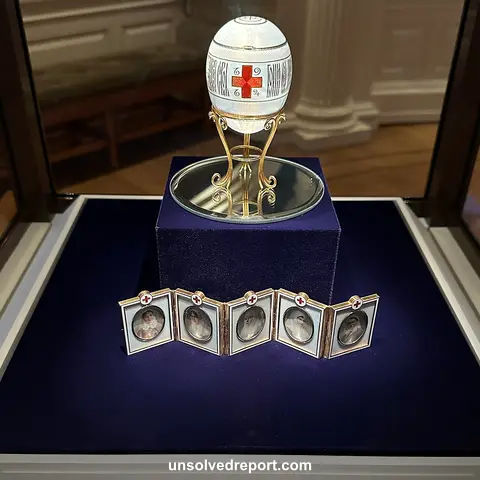
6 of the 50 lost Faberge Imperial eggs are still unaccounted for - and one nearly got melted for scrap gold before anyone realized what it was. Where are the rest?
Knights of Malta Gold: Did It Sink With L'Orient?
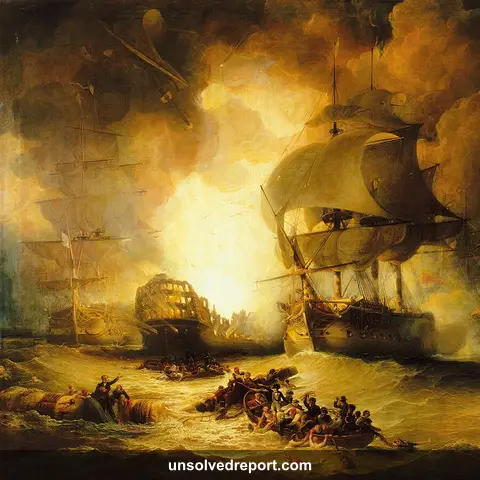
Napoleon stripped the Knights of Malta of a fortune in 1798. Weeks later L'Orient exploded off Egypt — and divers found coins. So how much gold is still missing?
Seuso Treasure: $100M Silver That Won't Say Where It's From
Roman silver worth $100M, a forged Lebanese permit, and a dead conscript. The Seuso Treasure tells you everything — except where it was actually dug up.