Knights of Malta Gold: Did It Sink With L'Orient?
Napoleon stripped the Knights of Malta of a fortune in 1798. Weeks later L'Orient exploded off Egypt — and divers found coins. So how much gold is still missing?
The richest crusading order in Europe handed over the keys to the toughest harbor in the Mediterranean — almost without a fight. That was a June morning in 1798. Within days, French soldiers were prying silver from altars and emptying centuries-old vaults in Valletta. Six weeks after that, the ship many believe carried the loot blew apart in one sky-splitting blast off the coast of Egypt.
So here's the question that has haunted treasure hunters ever since, and it sounds almost too simple: when the French flagship L'Orient went down, how much of the Knights of Malta's stolen fortune went with her — and how much never did?
It's one of those rare legends where the documented facts are nearly as wild as the myth. Let's pull them apart carefully.
What We Actually Know Happened
Start with the prize. The Order of St. John — the Knights Hospitaller, later the Knights of Malta — had ruled Malta since 1530. For 268 years, wealth flowed in from across Catholic Europe and piled up behind those walls, in the same crusading tradition that left behind the Templar treasure centuries earlier.
That run ended in a week. Napoleon Bonaparte, sailing for Egypt, showed up off Malta on June 13. His fleet was refused entry, a brief bombardment followed, and the Order's nerve broke. Grand Master Ferdinand von Hompesch asked for a ceasefire on June 11–12, and surrendered the next day. The strangest detail? The surrender was signed aboard L'Orient herself. Hompesch handed over everything — sovereignty, all fortifications, military supplies, the navy (Museum of the Order of St John; Yellow.com.mt).
Then the stripping began, and it too is on the record. "Much of the Order's treasure was stolen," the Museum of the Order of St John records, flatly. French troops emptied the vaults and gutted St. John's Co-Cathedral in Valletta. One often-cited estimate puts the single-week haul at roughly seven million francs in gold, silver, and gems — lifted from churches, monasteries, the treasury, and people's homes. And here's the part that matters most for the mystery: on June 14, Napoleon ordered the seized gold "to be melted into ingots and deposited in the army's military chest" (Yellow.com.mt). Hold that thought.
Not everything was carried off, though. One survivor stayed in plain sight thanks to a clever trick: the silver altar rails of St. John's were painted black before the French inspectors walked in. The inspectors took them for plain iron and left them alone. They're still in Valletta today.
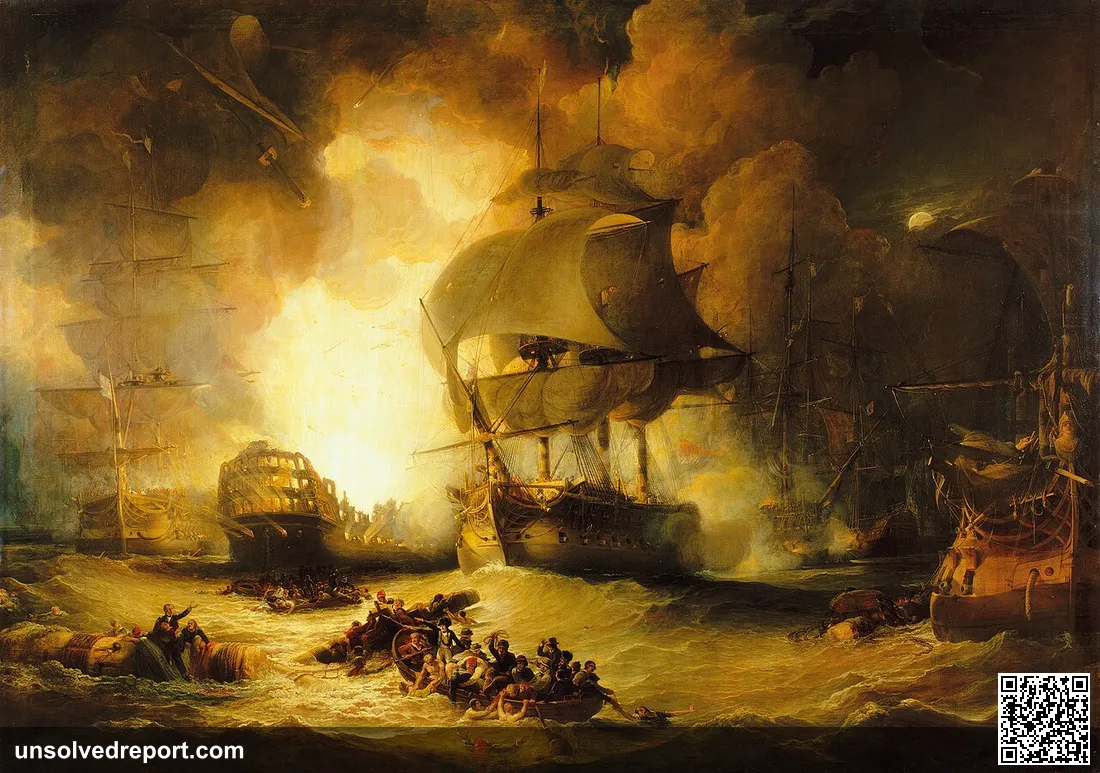
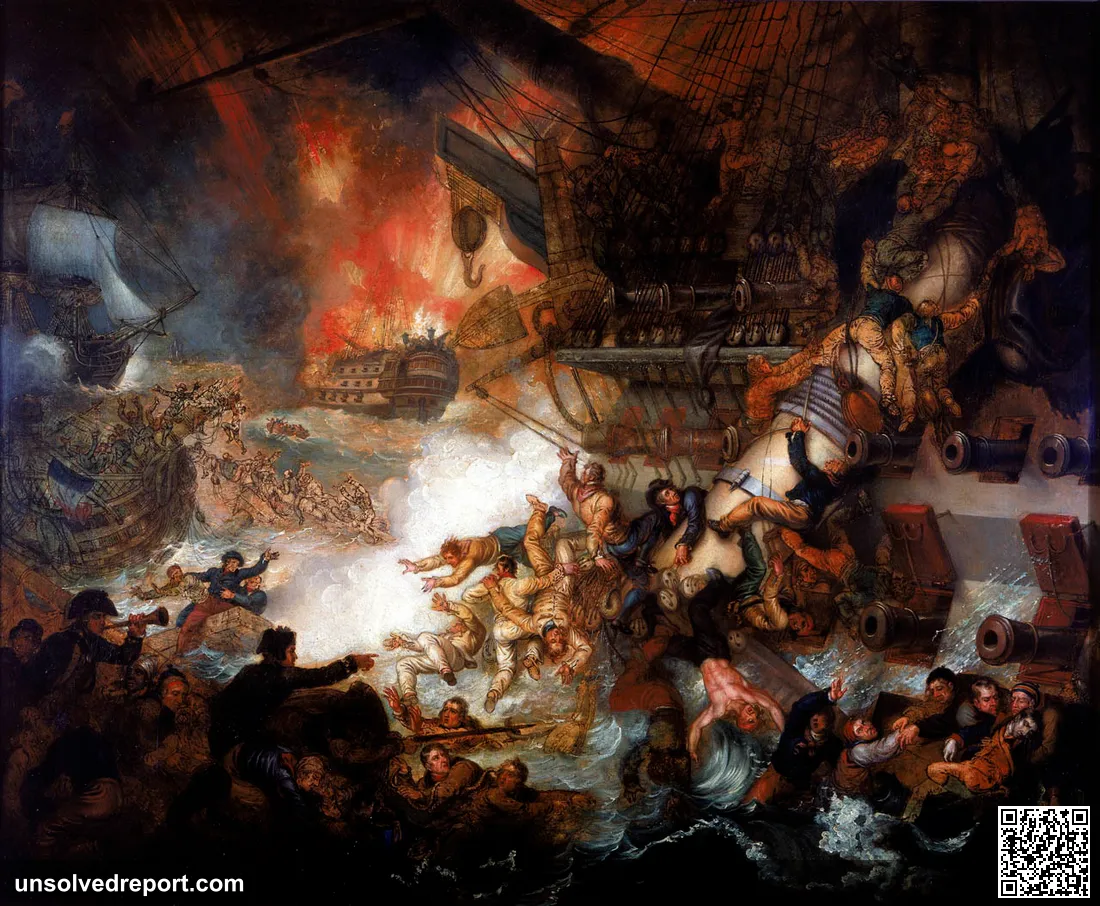
Now the reckoning. August 1, 1798. Rear-Admiral Horatio Nelson found the French fleet anchored at Aboukir Bay, near Alexandria — and attacked. The 120-gun L'Orient was the biggest ship in the bay and the flagship of Vice-Admiral François-Paul Brueys. Around 9 p.m., she caught fire. For an hour the flames crawled toward her heart. At roughly 10 p.m. the fire reached the magazines, and the ship simply ceased to exist in a colossal explosion. Of a crew topping 1,000, fewer than 100 lived. Brueys was already dead — nearly cut in two by a cannonball. Captain Casabianca and his young son died in the blast, the scene later burned into a famous poem, "Casabianca" ("The boy stood on the burning deck"). When the smoke cleared, nine of 13 French ships of the line had been captured, one destroyed, one scuttled. Two escaped (Britannica; Wikipedia: Battle of the Nile).
And then — almost two centuries later — comes the fact that drags this whole legend out of the realm of campfire stories. Jacques Dumas started searching in 1983. Underwater archaeologist Franck Goddio picked it up in 1998, working with Egypt's Supreme Council of Antiquities. Divers found the wreck of L'Orient. And among thousands of artifacts, they pulled up coins — a remarkable spread of them. Alongside French gold running from Louis XIV to Louis XVI, the team recovered coins "from Malta, the Ottoman Empire, Venice, Spain and Portugal," which Goddio's project says outright is likely "the Maltese Treasure that Bonaparte captured" (Franck Goddio Foundation).
So that part is settled, no myth required: some of the Order's plunder really was aboard L'Orient — and some of it really did sink, joining the long list of famous shipwrecks that swallowed fortunes still missing.
The Question Nobody Can Answer
Here's the strange part. The mystery isn't whether treasure went down. Coins on the seabed close that case. The mystery is how much — and where the rest of it went.
The romantic version says the whole fortune of the Knights of Malta vanished into Aboukir Bay in a single fireball. Tidy. Tragic. Probably wrong. Because Napoleon's own June 14 order had the seized gold melted into ingots for the army's military chest — and an army's pay chest doesn't usually ride through a war zone in one flagship's hold. Some historians point out that, despite the legend, "no such treasures were recovered" anywhere near the staggering sums in the story. The likeliest reason? Much of that melted Maltese gold probably reached France, or was simply spent on the Egyptian campaign, rather than going down with the ship (M.M. Bennetts).
But then Maltese sources push right back, insisting "most of it is still in Aboukir Bay" (Yellow.com.mt).
Both of those can't be fully true. That clash is the mystery: of all the wealth the Order lost, what fraction was aboard L'Orient when she blew, and what fraction was melted, spread out, or already spent before she ever lifted anchor? No surviving manifest gives a clean count. The gold escaped the ledgers.
Three Ways to Read It
Theory 1 — Most of it sank. This is the popular legend, and it's speculation. The Museum of the Order of St John and many Maltese accounts tell it the classic way: the stolen treasure "was to be lost soon after when Napoleon's flagship L'Orient was sunk." The recovered Maltese coins give it real teeth. The catch is that "much was lost" is not "all of it" — and those coin finds, though genuine, look modest next to a seven-million-franc legend.
Theory 2 — The bulk never went to sea. Also speculation, but the documents lean its way. If the gold was melted into army ingots on June 14, the smartest place for it was funding boots on the ground in Egypt — not stacked in one ship's belly. Under this reading, L'Orient carried only a slice: ceremonial pieces, loose coin, maybe the stuff not yet melted, while the big melted mass moved with the army or back toward France. This fits Napoleon's own order, and it fits how little has actually been recovered.
Theory 3 — It's still down there, waiting. Speculation again. Goddio's surveys covered scattered debris across roughly half a square kilometer of seabed, and the digging is ongoing and picky. Believers argue a serious cache could still be buried in the sediment. Plausible — but only more archaeology will prove it, and so far the finds have been historically rich, not jaw-droppingly vast.
What we can say for certain is plenty on its own: a real fortune was taken, a real flagship exploded, and real Maltese coins now sit in museum cases, lifted from the bay where Nelson turned the course of a war. The rest — the exact weight of gold still lying under the silt — is genuinely unsolved, a puzzle that belongs on any list of famous lost treasures still missing. Somewhere out in Aboukir Bay, the ledger is still open.
Sources & Further Reading
- Museum of the Order of St John — "The French Revolution and the Loss of Malta": https://museumstjohn.org.uk/the-french-revolution-and-the-loss-of-malta/
- Franck Goddio Foundation — "Napoleon Bonaparte's fleet" (Aboukir Bay excavation): https://www.franckgoddio.org/projects/others/napoleon-bonapartes-fleet/
- Encyclopaedia Britannica — "Battle of the Nile": https://www.britannica.com/event/Battle-of-the-Nile
- Wikipedia — "Battle of the Nile": https://en.wikipedia.org/wiki/Battle_of_the_Nile
- Yellow.com.mt — "Napoleon Came to Malta and Stayed Six Days": https://www.yellow.com.mt/news/culture/napoleon-came-to-malta-and-stayed-six-days-what-he-did-what-he-took-and-why-the-maltese-rose-against-him/
- Warfare History Network — "Napoleon's Lost Fleet Rediscovered": https://warfarehistorynetwork.com/article/napoleons_lost_fleet_rediscovered/
Seuso Treasure: $100M Silver That Won't Say Where It's From
Roman silver worth $100M, a forged Lebanese permit, and a dead conscript. The Seuso Treasure tells you everything — except where it was actually dug up.
Beale Ciphers: $60 Million in Gold, One Code Nobody Can Crack
$60M buried in Virginia. One Beale cipher decoded — the map to the gold has stumped every cryptographer for 135 years. Real fortune or genius hoax?
Nazi Gold Train: The Dig That Found Absolutely Nothing
Two treasure hunters swore radar showed a buried Nazi gold train in Poland. A government official said he was 99% sure. So why did the dig come up empty?