Treasure of Guarrazar: The Visigothic Crown That Vanished in 1921
The Treasure of Guarrazar: a Visigothic gold crown survived 1,300 buried years, then vanished from a locked royal palace in 1921. Where did it go?
The rain came down hard that autumn of 1858, and when it stopped, the soil of an orchard near Toledo, Spain, had been peeled back like a lid. Something underneath was glinting. Two villagers crouched in the mud and started to dig — and pulled out pure gold. Not coins. Not a buried purse. Crowns. Heavy gold crowns hung with sapphires and pearls, made by jewelers who had served the Visigothic kings of Hispania more than 1,300 years before anyone alive had drawn a breath.
This is not a legend. The Treasure of Guarrazar is real, documented, and you can go look at part of it right now. But woven into its glittering story is a genuine puzzle that has never been solved: one royal crown that slept safely underground for over a thousand years vanished in modern times — and it has never come home.
How a Rainstorm Gave Up a King's Gold
The treasure is named for a garden called Guarrazar, near the village of Guadamur, just outside Toledo. The Spanish records tell it plainly. On August 25, 1858, two people named Francisco Morales and María Pérez spotted a shiny object under flagstones that the heavy rains had stripped bare (Wikipedia; The History Blog). That was only the first handful. The following year, in 1859, a proper excavation — run under the Royal Academy of History and the Ministry of Public Works, led by the archaeologist José Amador de los Ríos — pulled still more out of the ground, including several more votive crowns (Wikipedia).
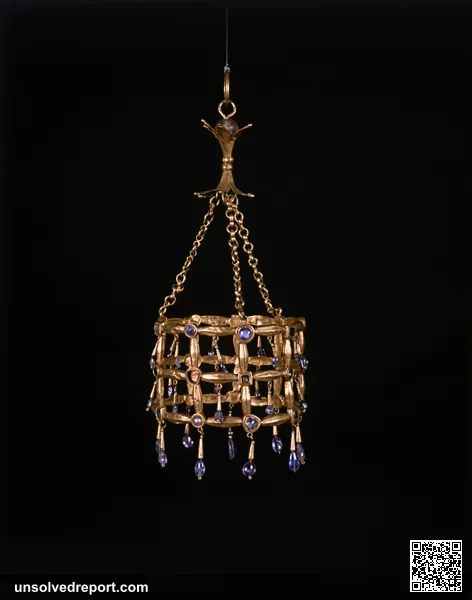
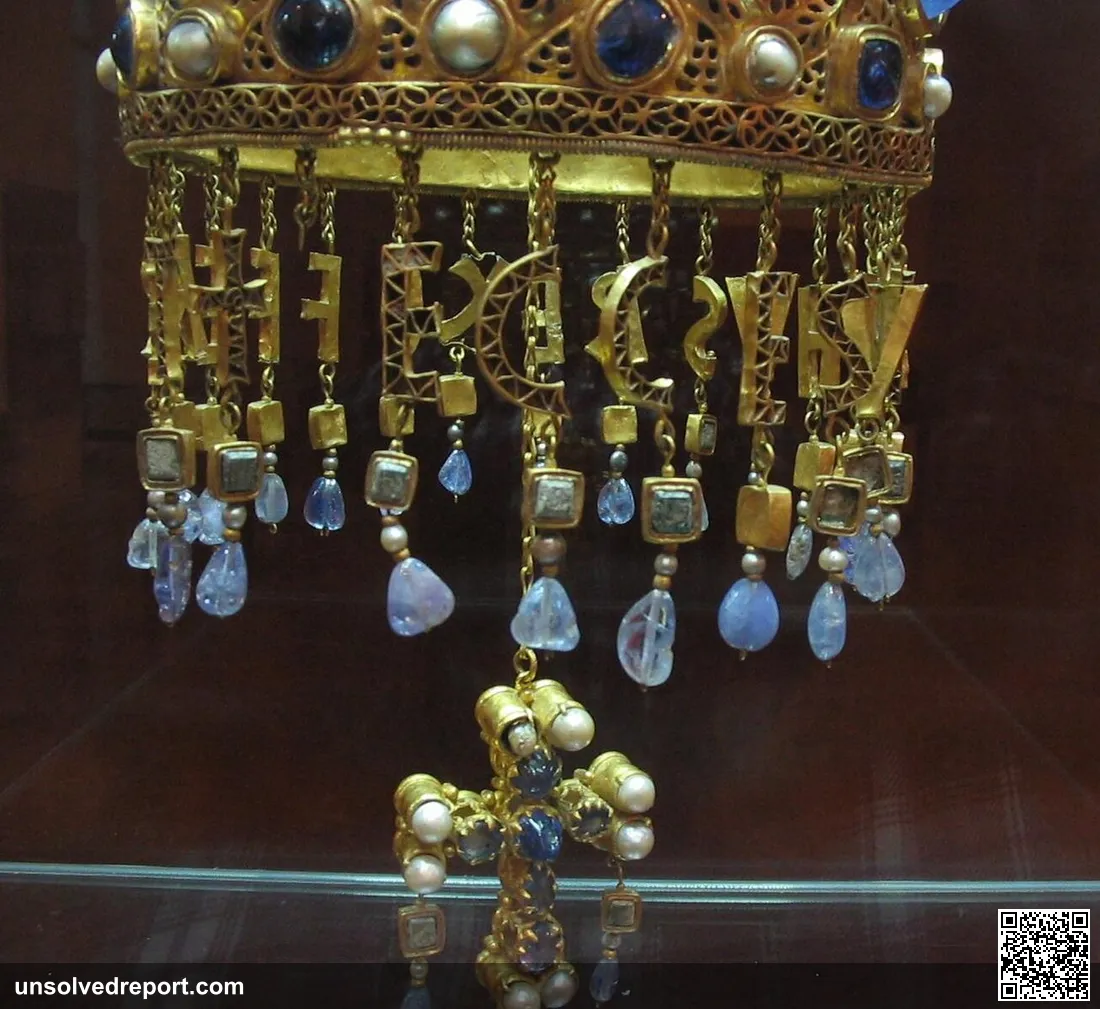
So what exactly had been hiding down there? A cluster of votive crowns and gold crosses — gifts offered by Visigothic kings to the Church in the seventh century, a public, glittering way of announcing their orthodox Christian faith for everyone to see (The Vintage News). Here's the strange part: these crowns were never meant to be worn. No king ever set one on his head. Instead they were hung by chains above church altars, swaying gently in the candlelight, with golden letters dangling from the rim that spelled out the donor's name (The Vintage News).
Two of those crowns are the showstoppers — the royal ones.
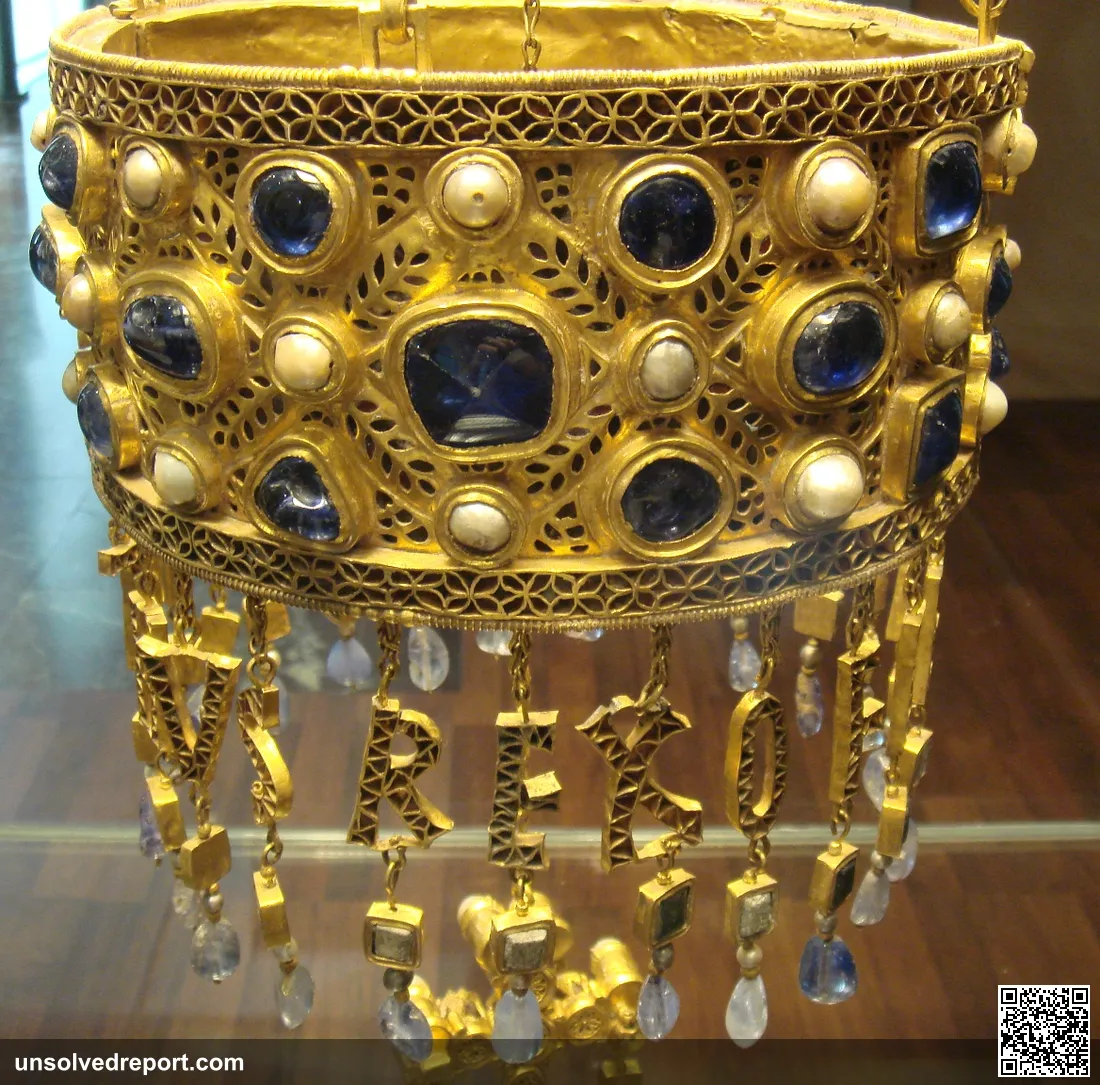
The most famous belonged to King Recceswinth, who ruled roughly 649–672 CE. From its golden ring hang pendant letters that, read in order, declare "+ [R]ECCESVINTHVS REX OFFERET" — "King Recceswinth offers [this]" (Musée de Cluny; Wikipedia). The ring blazes with large blue sapphires, each one ringed by pearls (The Vintage News). The second royal crown belonged to King Suintila, who reigned earlier in the same century. Like Recceswinth's, it was gold, set with sapphires, pearls, and other gems (Wikipedia). Remember that name — Suintila. It matters later.
Look closely at the workmanship and you're seeing three lost worlds at once. The goldsmiths blended late-Roman, Byzantine, and Germanic techniques: lacy cut-through goldwork (often called by the Latin term opus interrasile), repoussé, and gems set thick into the metal — a style that craftsmen used right across the post-Roman West, from Visigothic Spain to the war-gold of Anglo-Saxon England's Staffordshire Hoard (Wikipedia). And where did the gold itself come from? A peer-reviewed study by María Filomena Guerra and colleagues, published in the journal Archaeometry in 2007, fired ion beams (PIXE and PIGE) at dozens of tiny samples from the Spanish-held pieces. Matching the results against Visigothic coins and against gold sources the Roman writer Pliny the Elder once described, the team concluded the metal fit with mining in southern Iberia (Guerra et al., Archaeometry, Wiley). The crowns, in other words, were grown from Spanish earth and then given back to it, the same southern-Iberian ground that once yielded the Tartessian gold of the El Carambolo Treasure.
But the treasure didn't stay whole, and it didn't stay home. In 1859 a large batch — reportedly pieced back together from fragments by a dealer — was sold to Edmond Du Sommerard, director of the Cluny museum in Paris. Spain asked for the pieces back. Napoleon III's government said no (The History Blog). Spain did claw back a separate portion in 1861, when a second finder struck a deal with Queen Isabella II (Wikipedia; The History Blog). To this day the survivors are scattered, split mainly between the National Archaeological Museum in Madrid, the Royal Palace of Madrid, and the Musée de Cluny in Paris (Wikipedia).
The Crown That Outlived a Thousand Years — Then Disappeared
Now the part nobody can explain.
The royal crown of King Suintila sat in the Royal Armory at the Royal Palace in Madrid. In 1921 it was stolen — and it has never been found (Wikipedia; The History Blog). Sit with that for a second. This was solid Visigothic gold that had survived more than a thousand years buried in the dark. It survived being torn out of the ground, broken apart, sold off, and hauled across borders. And then, inside a guarded royal collection, in the twentieth century, with witnesses and locks and electric light — it simply vanished.
What makes it gnaw at you is how little anyone actually knows about where it went. The record proves two things and only two things: the crown was stolen, and it was never recovered — the same unsolved shape as the Irish Crown Jewels theft of 1907, still open more than a century on. After that, the trail goes cold. Everything past "stolen and never found" is guesswork — so let's keep the hard facts and the guesses on separate shelves.
So Where Did It Go? Three Theories
Theory 1 — Melted into untraceable gold (the one most people repeat). The leading idea is grim and simple. Toledo had a deep tradition of goldsmiths, and after the original 1858 discovery, odd jeweled gold pieces reportedly started turning up in local shops — where some were broken up and melted down, erasing them forever (The History Blog) — the same grim end that befell Childeric's golden bees after their own theft in Paris. Follow that logic to a stolen royal crown and the answer is ugly: it's worth far more as faceless bullion and a handful of loose gems than as a one-of-a-kind treasure no thief could ever sell. This is a plausible reconstruction, not a proven fact — call it speculation. And if it's true, the Suintila crown doesn't exist anymore in any shape you'd recognize.
Theory 2 — Locked away in a private collection. Others hope for something better. An object this important, the thinking goes, might have been stolen to order — quietly swallowed into someone's private hoard, where it could still sit intact, out of sight, to this day. Stolen art does claw its way back into the light generations later. We flag this as a hopeful maybe, nothing more. There's no public evidence putting the crown in any particular collection, and pointing fingers at people would be reckless.
Theory 3 — Swallowed by a chaotic era. Some accounts blur the disappearance across the unsettled stretch between roughly 1921 and Spain's upheavals of the 1930s, hinting that more than one Guarrazar object slipped away in the turmoil rather than in one clean snatch-and-grab (The Vintage News). In this version the loss isn't a single crime at all — it's a slow bleed over years of instability.
Here's what no one disputes: the wonder of what's left. You can still stand in front of Recceswinth's crown in Madrid and read a dead king's name spelled out, letter by golden letter, swinging just below the rim. And the ground at Guarrazar isn't finished talking, either — excavations there have been running since 2013 under a project studying the Visigothic monastic-palatial complex around the site, slowly filling in where these offerings were made, and hidden (Yacimiento Arqueológico de Guarrazar). The crowns that survived are dazzling on their own. The one that vanished is a quiet warning — that even the most stubborn, enduring treasures can slip through our fingers in a single night. And some questions, once a rainstorm cracks them open, just stay open.
Sources & Further Reading
- Treasure of Guarrazar — Wikipedia: https://en.wikipedia.org/wiki/Treasure_of_Guarrazar
- Votive crowns from the treasure of Guarrazar — Musée de Cluny (Musée national du Moyen Âge): https://www.musee-moyenage.fr/en/collection/votive-crowns-from-the-treasure-of-guarrazar.html
- M. F. Guerra et al., "The treasure of Guarrazar: tracing the gold supplies in the Visigothic Iberian Peninsula," Archaeometry (2007), Wiley Online Library: https://onlinelibrary.wiley.com/doi/10.1111/j.1475-4754.2007.00287.x
- "A tale of Visigothic treasure lost and found" — The History Blog: https://www.thehistoryblog.com/archives/53993
- "The Treasure of Guarrazar" — The Vintage News: https://www.thevintagenews.com/2017/04/08/the-treasure-of-guarrazar-one-of-the-most-important-visigothic-treasures-in-the-iberian-peninsula/
- Excavations — Yacimiento Arqueológico de Guarrazar (official site): https://guarrazar.com/el-yacimiento/las-excavaciones/?lang=en
Copper Scroll: The 64-Site Gold Map Nobody Has Ever Found
A scroll of pure copper lists 64 sites of buried gold from the Dead Sea caves. Tons of treasure, never found in 70+ years. Was it ever real?
Hoxne Hoard: A Lost Hammer, Britain's Richest Roman Fortune
A Suffolk hammer hunt uncovered Britain's richest Roman hoard: 15,000 coins, a lost fortune, and an owner who vanished without a trace. Who were they?

Le Griffon Shipwreck: The 1679 Ghost Ship Nobody Can Find
In 1679 the Le Griffon vanished on Lake Michigan with 7 men aboard. 345 years and multiple "found it" claims later, why is it still missing?