Mercury Large Iron Core Mystery: The Planet That Shouldn't Exist
Mercury's iron core swallows 85% of the planet, more than double any rocky world's share. Something added metal or stole the rock, but the evidence contradicts itself. See why.
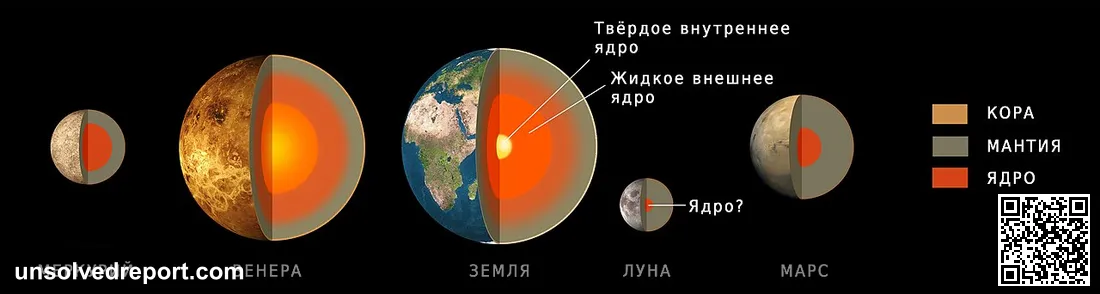
Cut open a normal rocky planet and you get something like a peach: a small metal pit buried in a thick stony body. Earth works that way. So do Venus and Mars. Mercury threw the recipe out. The tiniest planet in the solar system is hiding a metal heart so huge that, for its size, nothing else in the family comes close. Scientists have weighed it, mapped it, and run it through computer after computer for decades. And they still can't agree on how it got that way. Here's what we actually know, the exact spot where the real mystery kicks in, and which ideas are still just smart guessing.
What we know for sure
Mercury is small. Its radius is about 2,440 kilometers, roughly the width of the lower United States, according to NASA. That part isn't strange. The strange part is how heavy it is for something that small. Among the rocky planets, Mercury is the second densest, beaten only by Earth (NASA).
But that ranking is a trick. Earth is dense partly because it's so big that its own gravity crushes its insides tighter. Take that squeeze away and the picture flips. Mercury's "uncompressed density" of about 5.3 grams per cubic centimeter blows past every other rocky planet, crushing Earth's corrected value of around 4.45 (MESSENGER mission, Johns Hopkins APL). Put simply: gram for gram, Mercury is the most metal-stuffed planet we've ever found.
All that weight points to one thing. A giant core. NASA pegs Mercury's iron core at a radius of about 2,074 kilometers. That's roughly 85 percent of the whole planet, leaving a skin of mantle and crust just 400 kilometers thick (NASA). Measure by mass instead, and the core still hogs about 60 to 70 percent of everything (Space.com). Now compare. The cores of Earth, Venus, and Mars make up only about 30 percent of their mass. Mercury's "core mass fraction" of around 0.7 is more than double what its rocky siblings carry, a gap that recent modeling keeps circling back to (see the 2025 preprint arXiv:2511.01842, not yet peer-reviewed).
These aren't back-of-the-envelope numbers. NASA's MESSENGER spacecraft launched on August 3, 2004, eased into orbit around Mercury on March 18, 2011, and finally slammed into the surface on April 30, 2015, after more than four years circling in close (NASA). By tracking the planet's gravity field down to a whisper, and watching how the core reacts to magnetic fields, MESSENGER confirmed two things: the core is enormous, and at least part of it is still liquid (NASA). Then it found something nobody ordered. A surprise that turned the whole debate upside down. And that's where the mystery really begins.
The question nobody can answer
Here's the puzzle in one breath: how does a planet end up with two or three times the normal amount of metal? Only two roads lead there. Either something dumped extra iron onto Mercury, or something tore most of its rock away.
For years the prime suspect was a monster crash. A colossal collision that blasted Mercury's original rocky shell clean off, leaving the dense core sitting exposed. Neat story. Easy to picture. Before MESSENGER showed up, plenty of scientists figured that was simply the answer (astronomy.com).
Then MESSENGER read the planet's surface chemistry, and the neat story cracked right down the middle. A brutal, white-hot event, a giant impact or a savage roasting by the Sun, should have cooked away the lighter, more delicate elements. The fragile stuff should be gone. Instead, the spacecraft's gamma-ray spectrometer found Mercury's ratio of potassium (a fragile, easily-cooked element) to thorium (a tough one that stays put) sitting around 6,000, roughly in line with Venus, Earth, and Mars (The Planetary Society). For contrast, look at our Moon, which we know was born in a giant impact. Its ratio is far lower, the fingerprint of heavy roasting. Mercury doesn't show that scar. The spacecraft even picked up surprisingly high levels of sulfur and other delicate elements (Chemistry World).
That's the unsolved heart of it. Mercury looks like it was built from raw, barely-cooked material, the kind that keeps its fragile elements. Yet it carries the metal budget of a planet that should have been violently fried. Two clues pointing in opposite directions, and no single accepted model that makes them shake hands. The huge metal core says "cooked." The intact fragile elements say "never cooked." Cracking that contradiction is the big open question, and it's exactly what the next visitor to Mercury, the European-Japanese BepiColombo spacecraft, was built to chase down.
The leading ideas (none confirmed)
These are the front-runners scientists are actually arguing about. Every one is still debated. Not one is settled.
Idea 1: a giant crash stripped the rock away (now being patched up). The classic pitch is that a massive collision early in the solar system's life sheared off most of baby Mercury's rock. Two problems sank it. First, when scientists ran the numbers, a single crash big enough to peel away that much mantle turns out to be wildly unlikely, pegged at the one-percent level or worse (arXiv:2207.14774, peer-reviewed in MNRAS). Second, those surviving fragile elements flatly refuse to fit the furnace-like heat such a crash would unleash. The idea isn't dead. But it's had to bend hard to survive.
Idea 2: a sideways hit-and-run between two near-equals. A 2025 study in Nature Astronomy by Patrick Franco and colleagues swaps the single knockout blow for something gentler and glancing. Picture a near-miss that wasn't quite a miss: a proto-Mercury about 2.36 times today's mass clipped by another protoplanet of similar heft, striking at roughly a 32-degree angle, the same kind of violent close call scientists blame for the strange grooves scarring Phobos, Mars' battered little moon. Their simulations show that grazing strike could fling off about 60 percent of the mantle and leave behind a leftover only about 5 percent bigger than today's Mercury, with the metal-to-rock balance dialed in just right (ZME Science summary). And here's the kicker: these sideways encounters turn up in as many as 20 percent of formation simulations, making them far more believable than the old one-big-bang scenario.
Idea 3: it was just born this way. Some researchers say skip the crash entirely. In the scorching, swirling disk of gas and dust hugging the young Sun, the theory goes, physics may have sorted heavy iron grains away from lighter rocky ones before Mercury was even a planet, so it simply built itself from iron-rich bricks (arXiv:2511.01842, preprint). A cousin idea, "magnetic erosion," suggests the young Sun's magnetism acted like a sorting magnet, sweeping iron-heavy material straight into Mercury's feeding zone (arXiv:1407.0274, preprint).
For now, Mercury keeps its mouth shut. The facts are locked: it's the most metal-rich planet we know, with a core that swallows nearly the whole world. The why is wide open. And whichever answer wins, it may quietly rewrite a chapter of how we think rocky planets get made at all.
Sources & further reading
- NASA — Mercury Facts: https://science.nasa.gov/mercury/facts/
- Johns Hopkins APL — MESSENGER, Why Mercury?: https://messenger.jhuapl.edu/About/Why-Mercury.html
- NASA — 15 Years Ago: MESSENGER Launched to Orbit Mercury: https://www.nasa.gov/history/15-years-ago-messenger-launched-to-orbit-mercury/
- The Planetary Society — Mercury's strange potassium-thorium ratio: https://www.planetary.org/space-images/mercurys-strange-potassium-thorium-ratio
- Chemistry World — MESSENGER sheds light on Mercury's formation: https://www.chemistryworld.com/news/messenger-sheds-light-on-mercurys-formation/3002463.article
- Space.com — Did a Huge Impact Shape Planet Mercury?: https://www.space.com/26447-mercury-composition-giant-impact.html
- Astronomy.com — Did a hit-and-run shape Mercury's strange core?: https://www.astronomy.com/science/did-a-hitandrun-shape-mercurys-strange-core/
- Hyde et al., MNRAS 2022 (peer-reviewed) — Explaining Mercury via a single giant impact is highly unlikely: https://academic.oup.com/mnras/article/515/4/5576/6654888
- Franco et al., Nature Astronomy 2025 — grazing collision theory (summary via ZME Science): https://www.zmescience.com/science/astronomy/mercury-planet-collision-theory/
- arXiv:2511.01842 (preprint, not peer-reviewed) — Origins of Mercury's Big Heart of Iron: https://arxiv.org/abs/2511.01842
- arXiv:1407.0274 (preprint) — Explaining Mercury's Density through Magnetic Erosion: https://arxiv.org/abs/1407.0274
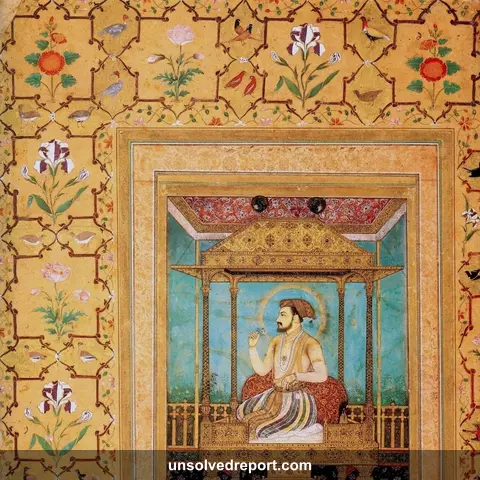
Lost Peacock Throne: Gone Since 1747, Not One Piece Survives
Nader Shah looted the most jeweled throne on Earth in 1739 — then it vanished. Not one verified piece survives. Where did Shah Jahan's Peacock Throne go?
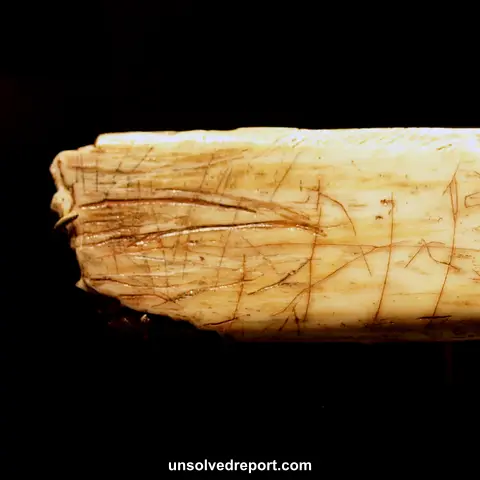
The Sherborne Bone: A 700-Year-Old Lie
The Sherborne Bone fooled Britain's top scientists for 80 years as genuine Ice Age art. Then radiocarbon exposed a 700-year-old fake — so who really carved it?

Dyatlov Pass Incident: The Tent Nobody Could Explain, Until 2021
Nine hikers fled barefoot into a fatal night on Dead Mountain. A 2021 model finally explains the Dyatlov Pass incident — but not everything. Here is why.