Phobos Grooves: The Claw Marks No One Can Explain
Phobos grooves: ruler-straight scars raking across Mars' dying moon. Four rival theories, zero proof — so what really carved these claw marks?
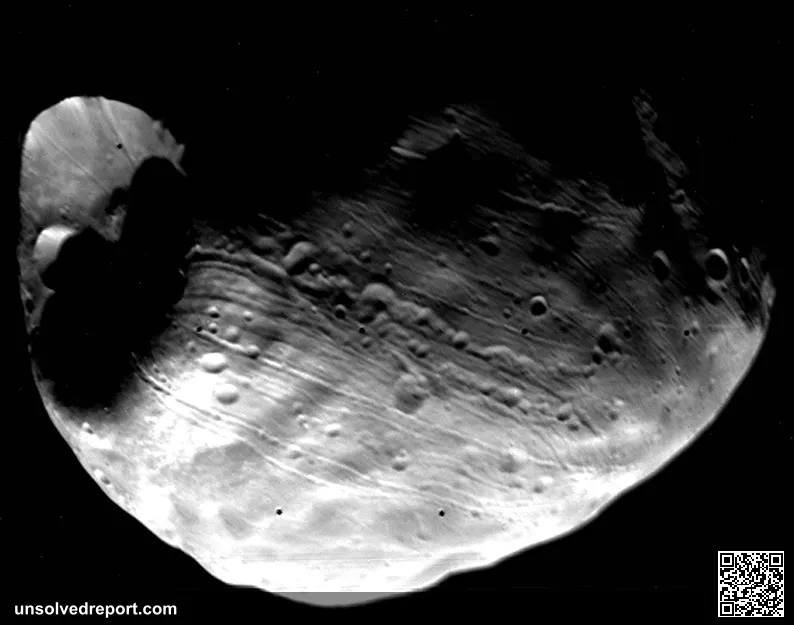
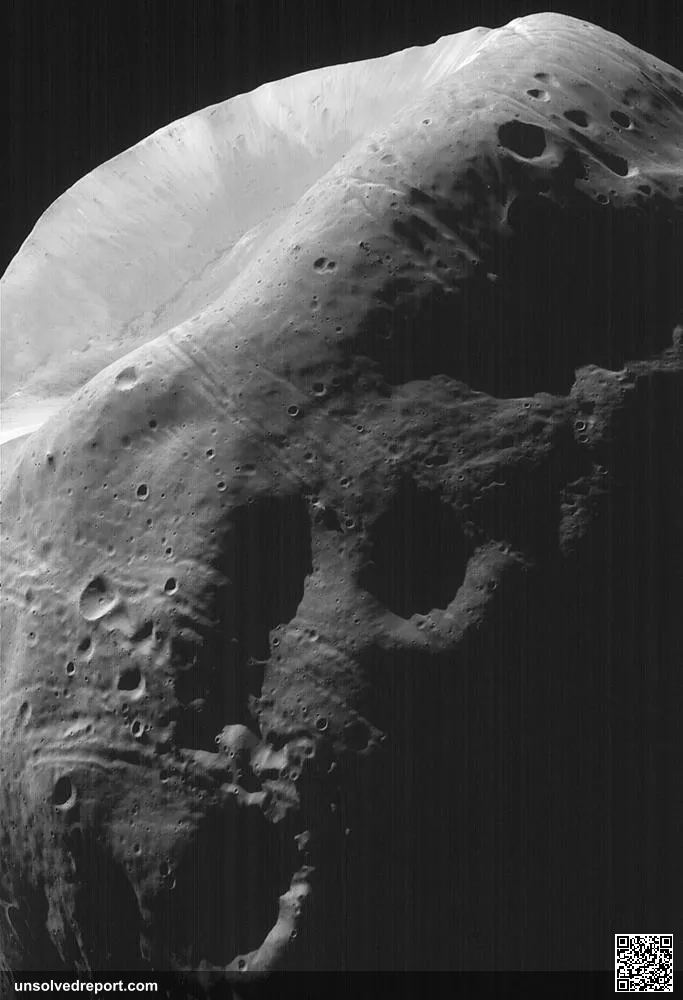
Spin a globe of Mars' inner moon, and the first thing you notice is the scratches. Long, eerily straight grooves rake across Phobos like something with claws dragged itself the whole way around. Many run in neat, parallel sets, ruler-straight, side by side. They are real. They are everywhere. And for about forty years, ever since the first sharp spacecraft photos came back, nobody has been able to say for sure what made them.
Here's the strange part: almost everything else about these marks is up for argument. So let's lay it out — what we actually know, what is honestly still a mystery, and the leading ideas scientists keep wrestling with.
A Tiny, Broken Little World
First, picture the thing being scratched. Phobos is small and lumpy — not a smooth ball at all. The European Space Agency clocks it at roughly 27 kilometers across at its widest, a squashed potato measuring about 13.0 x 11.39 x 9.07 km. It's simply too small for its own gravity to pull it into a sphere (ESA, Mars Express). An American astronomer named Asaph Hall spotted it in August 1877 from the U.S. Naval Observatory, along with its smaller sibling, Deimos (ESA; EarthSky).
Now here's where it gets unsettling. No moon in the entire solar system hugs its planet tighter than Phobos. It skims just under 6,000 km above the Martian surface and whips around in only about 7 hours and 39 minutes (ESA). And that orbit is falling. NASA says Mars is dragging the little moon inward by roughly 2 meters — about 6.6 feet — every hundred years, and the ending is already written: within 30 to 50 million years, Phobos will either be ripped to shreds — the same Roche-limit fate blamed for seeding Saturn's rings — or smash into the planet below (NASA).
Look at one end of the moon and you'll see the biggest scar of all: Stickney crater, a gaping basin about 9.5 km across (ESA). Think about that. On a rock just 27 km wide, that's a wound that nearly took the whole thing out. As Brown University researcher Ken Ramsley flatly put it, "Stickney is a huge crater" for the moon it sits on (Brown University).
And then there are the grooves. Most run 100 to 200 meters wide and 10 to 20 meters deep, stretching for 10 to 20 kilometers across the surface — though the giants near Stickney swell to around 700 meters wide and plunge nearly 90 meters down. Many fan out from Stickney like spokes. But a strange handful cut clean across the moon's middle in nearly perfect parallel ranks (ESA). Peter Thomas and his colleagues first cataloged them in detail back in 1979 — and the fight over how they got there has raged ever since.
So What Carved Them?
The question sounds almost childishly simple: what made the grooves? But it has refused to be answered for decades. The marks are clearly tied to whatever violence Phobos has lived through — yet no single cause has ever been proven. Worse, the different families of grooves might not even share the same origin story.
That's the maddening twist. On paper, several wildly different processes can all scratch roughly parallel furrows into a small, low-gravity rock. Each idea nails some of the grooves beautifully — then trips over others. And nobody has the one thing that would settle it: ground truth. Every theory is built from photos taken from orbit and crunched in a computer. No samples. No seismometers buried in the surface. Nobody has ever dug a trench in Phobos. That's exactly why a recent review threw up its hands and concluded the grooves probably come from a mix of processes, not one tidy answer — and why their origin remains, in the literature's own words, genuinely uncertain (MDPI, Applied Sciences review).
So what are the suspects? There are four good ones.
The Four Suspects
Suspect 1 — The moon is tearing itself apart (well-supported, contested). Because Phobos clings so close to Mars and keeps spiraling inward, the planet's gravity is stretching it like taffy — the same tidal squeeze slowly shredding a doomed exoplanet orbiting a white dwarf light-years away. In 2015, Terry Hurford of NASA's Goddard Space Flight Center ran the numbers and suggested the grooves are stretch marks — the first cracks of a moon beginning to fail. "We think that Phobos has already started to fail, and the first sign of this failure is the production of these grooves," Hurford said (NASA). The idea works best if Phobos isn't solid rock at all but a loose pile of rubble wrapped in a dusty blanket of regolith maybe 100 meters thick. Researcher Erik Asphaug calls that outer layer "a kind of mildly cohesive outer fabric" that warps and splits as Mars pulls on it (NASA). It's one of the most popular explanations going — but it struggles to explain grooves that cross over each other, and the exact shapes don't always line up.
Suspect 2 — Boulders that wouldn't stop rolling (recent, hotly argued). Here's a wilder one — the kind of low-gravity mayhem also blamed for reshaping asteroid 6478 Gault. In 2018, Ramsley and Jim Head — publishing in Planetary and Space Science — breathed new life into an old ejecta idea Head first floated back in the late 1970s. Their simulations told a vivid story: when something slammed into Phobos and blasted out Stickney, it hurled house-sized boulders skidding across the surface. And in Phobos' feeble gravity, those boulders just kept going — rolling, bouncing, refusing to settle — carving tracks that "tended to align themselves in sets of parallel paths," exactly matching the parallel grooves we see (Brown University). The model even nails the weird stuff: a low "dead spot" with no grooves at all, where boulders hit a raised lip and take a "suborbital flight" right over the gap, plus grooves that loop the entire moon and slice back through Stickney itself. Ramsley says the rolling-boulder model "accounts for most if not all the grooves on Phobos" (Brown University) — a bold claim, and not everyone is sold.
Suspect 3 — Shrapnel from Mars itself (the Murray hypothesis, largely challenged). John Murray pitched a different culprit entirely: the grooves are chains of secondary craters, dug by parallel jets of debris that got blasted off Mars during giant impacts on the planet. It's a tidy way to explain evenly spaced, parallel marks. But when a 2013 study put the idea to the test, six of its big predictions clashed with realistic models of how Mars debris would actually fly and land (ADS / Planetary and Space Science, 2013). Not dead — but limping badly.
Suspect 4 — Phobos throwing rocks at itself (sesquinary chains). And then there's the eeriest option of all. A 2016 Nature Communications paper suggests that when impacts kick debris off Phobos, some of it escapes the moon but can't escape Mars' grip — so it drifts in orbit for weeks before raining back down onto Phobos as slow-motion "sesquinary" crater chains. The moon, in other words, scarred by its own returning shrapnel. The authors found these fall-back patterns match certain linear features the tidal model can't quite explain (Nature Communications, 2016). This one probably accounts for a particular subset of grooves rather than all of them.
A Test Is Coming
So where does that leave us? With an honest, unsolved mystery — and, finally, a way to crack it open. Japan's Martian Moons eXploration mission, MMX, is set to launch in the 2026 window with a wild goal: land on Phobos, scoop up more than 10 grams of the surface, and bring it home to Earth (JAXA). Once we know what Phobos is truly made of — and how tightly its insides are held together — we may finally learn whether these scars are the fingerprints of tides, of tumbling boulders, of falling debris, or, most likely, of more than one at once.
Until then, the claw marks on Mars' dying moon stay a riddle written across a world that, in cosmic terms, is already running out of time.
Sources & Further Reading
- NASA: Mars' Moon Phobos Is Slowly Falling Apart
- ESA Mars Express: Phobos
- Brown University: Mars moon got its grooves from rolling stones, study suggests
- Ramsley & Head (2013), origin of Phobos grooves from Mars ejecta (ADS)
- Nahm et al. (2016), Sesquinary catenae on Phobos, Nature Communications
- Composition and Physical Properties of Phobos: A Comprehensive Review, Applied Sciences (MDPI, 2024)
- JAXA: Martian Moons eXploration (MMX)
- EarthSky: Asaph Hall discovers a moon for Mars
Gonur Depe: The Lost City a Whole Civilization Forgot
One piece of pottery in the Karakum sands exposed a vanished Bronze Age capital with plumbing, gold-packed tombs, and no name anyone remembers. What happened here?

Kuldhara: The Village That Walked Out and Never Came Back
Kuldhara's legend says one cursed night emptied the whole village. The census records tell a slower, stranger story — so which one actually happened?

Kuelap: The Peruvian Fortress Built Into a Mass Grave
Kuelap's 60-foot wall hides 100+ human burials — and bodies left unburied where they fell. Was it a fortress, a tomb, or something no one has named yet?