Saturn Rings Age Mystery: Younger Than the Dinosaurs?
Saturn rings age mystery: Cassini's data say they might be younger than T. rex — but no one can explain how, or agree they're really young. Why not?
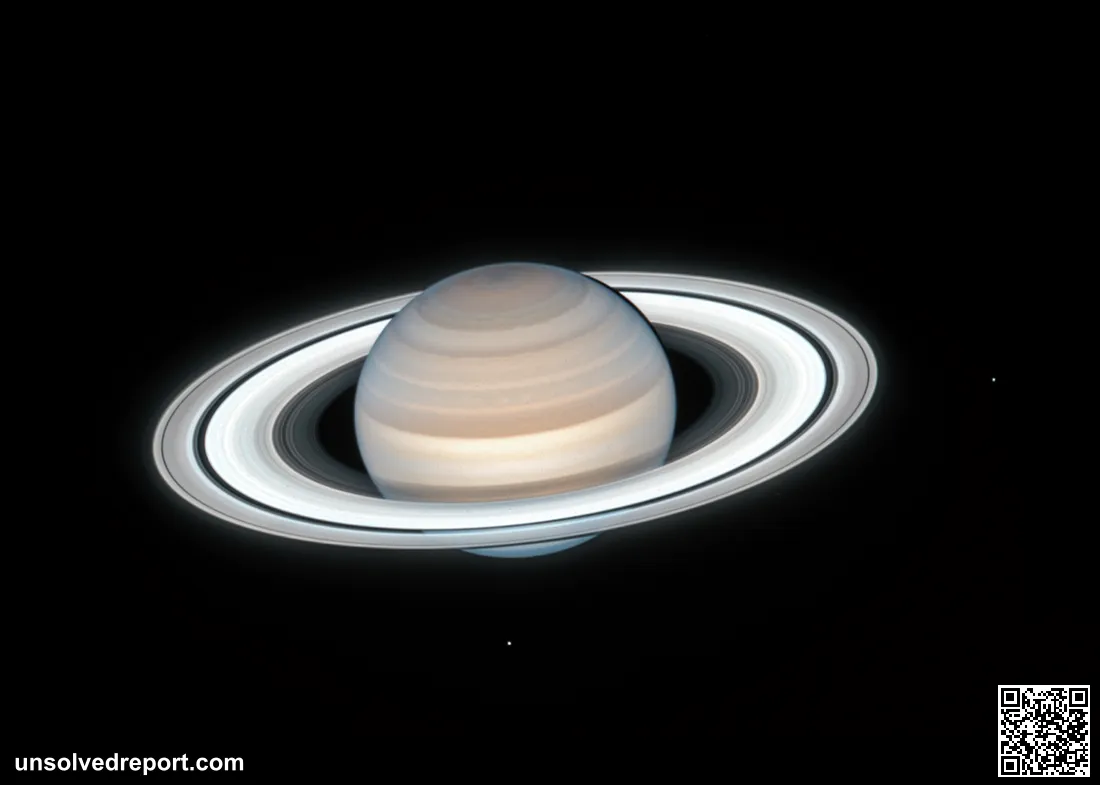
Look up through a backyard telescope and there they are: the rings of Saturn, the most famous sight in the night sky. Humans have stared at them for four hundred years. Everyone assumes they are ancient. Here's the strange part. The best measurements we have whisper something almost impossible. Those glittering rings might be shockingly young, possibly younger than Tyrannosaurus rex. If the leading numbers hold, the rings appeared long after Saturn was born, in an age when dinosaurs already thundered across Earth. And the worst part for the scientists? Nobody can explain how. Some aren't even sure it's true.
What the spacecraft actually measured
Start with what we know for certain. Saturn itself is ancient, roughly 4.5 billion years old, born with the rest of the solar system (NASA Science). For most of the last century, scientists figured the rings were just as old, rubble left over from the planet's birth. Then a spacecraft named Cassini showed up, orbited Saturn from 2004 to 2017, and quietly blew that idea apart in two different ways.
The first clue was weight. In 2017, NASA sent Cassini on a suicide run it called the "Grand Finale," threading the spacecraft through the narrow gap between Saturn and its innermost ring 22 times. Each pass, the rings tugged on the probe with their gravity. By listening to the radio signal coming back to Earth and catching tiny shifts in Cassini's speed — the same kind of subtle speed anomaly at the heart of the flyby anomaly — changes as small as fractions of a millimeter per second, scientists weighed the rings (NASA Science). The answer surprised everyone. The rings are featherlight, barely 40 percent the mass of Mimas, one of Saturn's small moons, according to the analysis led by Luciano Iess of Sapienza University of Rome, published in Science in January 2019 (Sci-News). Why does light mean young? NASA put it simply: "Lower mass points to a younger age, because the rings, which are bright and mostly made of ice, would have been contaminated and darkened by interplanetary debris over a longer period."
That brings us to the second clue, and it's a beautiful one. Saturn's rings are over 95 percent pure water ice, and they gleam. But space is filthy. For billions of years, a steady drizzle of dark, sooty micrometeoroid dust should have grimed up that ice and dimmed its shine. So a physicist named Sascha Kempf, at the University of Colorado Boulder, decided to measure the dust. In May 2023 he published the result in Science Advances. Using Cassini's onboard dust catcher, his team spent 13 patient years snagging a grand total of 163 specks of interplanetary dust, just enough to figure out how fast the grime falls in (CU Boulder Today). Think of your living room floor. "Dust will settle on your carpet," Kempf said. The rings, it turns out, have barely any dust on them. They've been gathering grime for no more than a few hundred million years, and probably a lot less (Science Advances).
Two completely separate clues, weight and cleanliness, point to the same jaw-dropping number. The Cassini gravity data suggest the rings could be as young as 10 to 100 million years old (NASA/JPL). For comparison: Tyrannosaurus rex stomped around roughly 66 to 68 million years ago. So yes, parts of Saturn's crown jewel may be younger than the dinosaurs.
And here's a twist that adds a clock ticking in the background. The rings aren't just young. They're vanishing. In a process called "ring rain," charged ice particles slide down Saturn's magnetic field and pour into the planet's atmosphere, bleeding the rings away so fast that NASA figures they could be gone in about 100 to 300 million years (NASA Science). Young and dying. If that's right, we showed up at exactly the right moment to see them at all.
The question that won't go away
Now for the part that keeps scientists up at night. A young ring system isn't a fun little footnote. It's a crack in our whole story of the solar system — the same solar system that may still be hiding an unseen Planet Nine far past Neptune. Long ago, the early solar system was a chaotic shooting gallery, planets and moons smashing into each other constantly. But 100 million years ago? Things had calmed down. The neighborhood was quiet and settled. So what on Earth, or rather what out there, could have built a brand-new ring of nearly pure ice that recently?
Even Kempf, whose own work says the rings are young, throws up his hands at the next question. "We know approximately how old the rings are, but it doesn't solve any of our other problems," he said. "We still don't know how these rings formed in the first place" (CU Boulder Today).
And then there's the deeper doubt, the one that could pull the whole thing apart: maybe the rings aren't young after all. The entire "dust clock" rests on assumptions. Chief among them, how much of that incoming dust actually sticks to the ice instead of bouncing off or vaporizing on impact. Planetary scientist Aurélien Crida of the Côte d'Azur Observatory put the catch perfectly to Quanta Magazine: "The rings look young, but that doesn't mean the rings are really young" (Quanta Magazine). So the real mystery has two halves. Are the rings young? And if they are, what made them?
Three suspects, no confession
What follows are rival scientific guesses, not settled facts. Treat them as theories on the table, each fighting for the truth.
Suspect 1: A murdered moon (the "Chrysalis" hypothesis). Picture a moon that no longer exists. In a 2022 Science paper, MIT planetary scientist Jack Wisdom and his colleagues argued that Saturn once had an extra moon, which they nicknamed Chrysalis. Over time, the giant moon Titan drifted outward and started yanking on Chrysalis, knocking it into a wobbly, doomed orbit. Then, about 100 million years ago, the doomed moon swung too close to Saturn and the planet's tides ripped it to shreds — not unlike a dead star tearing apart a planet elsewhere in the galaxy — with a sliver of its icy guts spreading out into a ring (MIT EAPS). The clever bonus: this same wreck could explain why Saturn leans the way it does today. It's a leading idea, but still unproven, and follow-up studies are still poking at whether you can really tear apart a pre-existing moon this way (IOPscience).
Suspect 2: The rings are faking it. Maybe they only look young. A December 2024 study in Nature Geoscience, led by a Japanese team, made the case that the rings might be "pollution resistant." Their simulations suggest that when micrometeoroids slam into ring particles at brutal speeds, most of the dark debris doesn't stick at all. Instead it vaporizes into charged nanoparticles and gets flung clean out of the system (Nature Geoscience). If that holds, the rings could stay sparkling and bright for billions of years, which means they might be every bit as old as Saturn itself (Phys.org). Kempf isn't buying it, pointing out that his own method accounts for more than just how well the grime clings.
Suspect 3: As old as the planet. The oldest theory of all, that the rings are simply leftover rubble from Saturn's birth 4.5 billion years ago, refuses to die. The "pollution resistant" argument keeps it breathing. But it still has to answer one nagging question: if the rings are that ancient, why are they so absurdly lightweight?
So where does that leave us? With a stunning measurement, a powerful argument, and a fight that is very much still raging (Scientific American). Saturn's rings might be a fleeting marvel we got lucky enough to catch before they fade. Or they might be ancient relics that have simply hidden their wrinkles well. Until a future mission goes back and settles it, the most familiar sight in the solar system stays one of its most stubbornly unsolved — right up there with these deep-space signals science still can't explain — and somewhere out there, a shattered moon may still be holding its breath.
Sources & further reading
- NASA Science / Cassini, "Cassini Data Show Saturn's Rings Relatively New": https://science.nasa.gov/missions/cassini/nasas-cassini-data-show-saturns-rings-relatively-new/
- NASA JPL, "NASA's Cassini Data Show Saturn's Rings Relatively New": https://www.jpl.nasa.gov/news/nasas-cassini-data-show-saturns-rings-relatively-new/
- University of Colorado Boulder, "How old are Saturn's rings? Far younger than once thought": https://www.colorado.edu/today/2023/05/12/how-old-are-saturns-rings-far-younger-once-thought-according-new-study
- Kempf et al., Science Advances (2023), "Micrometeoroid infall onto Saturn's rings constrains their age to no more than a few hundred million years": https://www.science.org/doi/10.1126/sciadv.adf8537
- Sci-News, "Saturn's Rings are 10 to 100 Million Years Old": https://www.sci.news/space/saturns-rings-age-06825.html
- MIT EAPS, "Saturn's rings and tilt could be the product of an ancient, missing moon": https://eaps.mit.edu/news-impact/saturns-rings-and-tilt-could-be-the-product-of-an-ancient-missing-moon/
- Nature Geoscience (2024), "Pollution resistance of Saturn's ring particles during micrometeoroid impact": https://www.nature.com/articles/s41561-024-01598-9
- Phys.org, "How old are Saturn's rings? Study suggests they could be 4.5 billion years old": https://phys.org/news/2024-12-saturn-billion-years-planet.html
- Quanta Magazine, "Are Saturn's Rings Really as Young as the Dinosaurs?": https://www.quantamagazine.org/are-saturns-rings-really-as-young-as-the-dinosaurs-20191121/
- Scientific American, "How Old Are Saturn's Rings? The Debate Rages On": https://www.scientificamerican.com/article/how-old-are-saturns-rings-the-debate-rages-on/
- NASA Science, "NASA Research Reveals Saturn Is Losing Its Rings at Worst-Case-Scenario Rate": https://science.nasa.gov/solar-system/planets/saturn/rings-of-saturn/nasa-research-reveals-saturn-is-losing-its-rings-at-worst-case-scenario-rate/
- IOPscience / ApJ Letters, "Investigating Tidal Stripping of a Preexisting Moon as the Origin of Saturn's Young Icy Rings": https://iopscience.iop.org/article/10.3847/2041-8213/ae5ca5
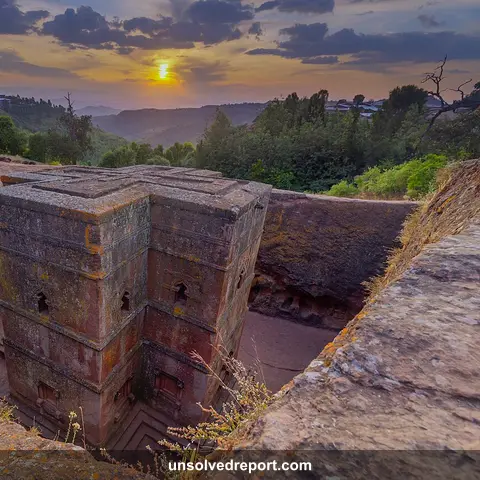
Lalibela's Rock-Hewn Churches: Carved Downward, No One Knows How
Ethiopia's Lalibela churches were carved downward into solid rock with zero room for error. So how did they do it, and when? Experts still can't agree.

Lead Masks Case: 2 Men Dead, Masked, and No One Knows Why
A kite snagged in the grass led a teen to two dead men wearing homemade lead masks, a cryptic note about "capsules" and a "signal" — and zero answers since 1966.
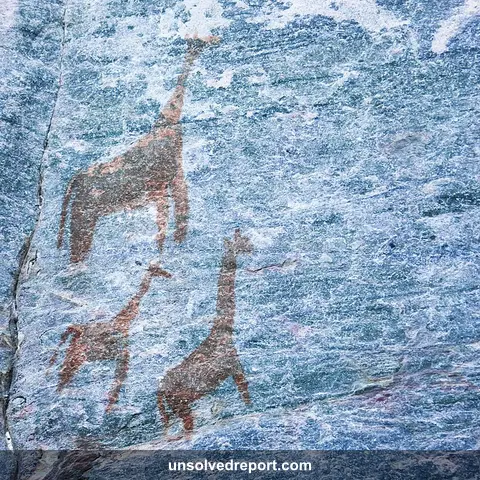
Tsodilo Hills: The Cave Behind a 70,000-Year Ritual Claim
In Tsodilo Hills, a six-meter stone python hides in a cave — and one scientist called it humanity's oldest ritual. Why do her own colleagues disagree?