Sigiriya: The Sky Palace a Murderer Built on a Rock
Sigiriya rock fortress: a king who killed his father built a sky palace on a 180m cliff, painted 500 women on its face, then cut his own throat. Why?
A wall of rust-red stone shoots straight up out of the green plains of central Sri Lanka — 180 meters of sheer cliff with no slope, no foothold, no good reason to be there. On top of it, a king built a palace. He wrapped it in walls polished bright as mirrors, in gardens whose fountains still spit water when it rains, and he painted a parade of bare-shouldered women across the face of the cliff. Then he died at the bottom of the thing he made. Fifteen hundred years later, we can measure those fountains. We can count those women. And we still can't tell you who they are — or what this place was ever supposed to be.
The story we can actually prove
Most of what we know starts with a single book and a century of digging. The book is a Sri Lankan chronicle called the Culavamsa — the sequel to an even older chronicle, the Mahavamsa — and it tells a story you'd expect from a soap opera, not a history text. King Kashyapa I ruled from 477 to 495 CE. He got the throne the ugly way: he murdered his own father, King Dhatusena. His half-brother Moggallana — the son who should have been king — ran for South India, swearing he'd come back for revenge (National Geographic; Wikipedia). Kashyapa knew that promise was coming for him. So he moved his capital away from Anuradhapura, out to the great rock, and over roughly eighteen years he turned it into one of the most jaw-dropping royal complexes the ancient world ever built, a mountaintop ambition matched only by places like Kuelap, the Chachapoya's own cloud fortress in Peru (Central Cultural Fund).
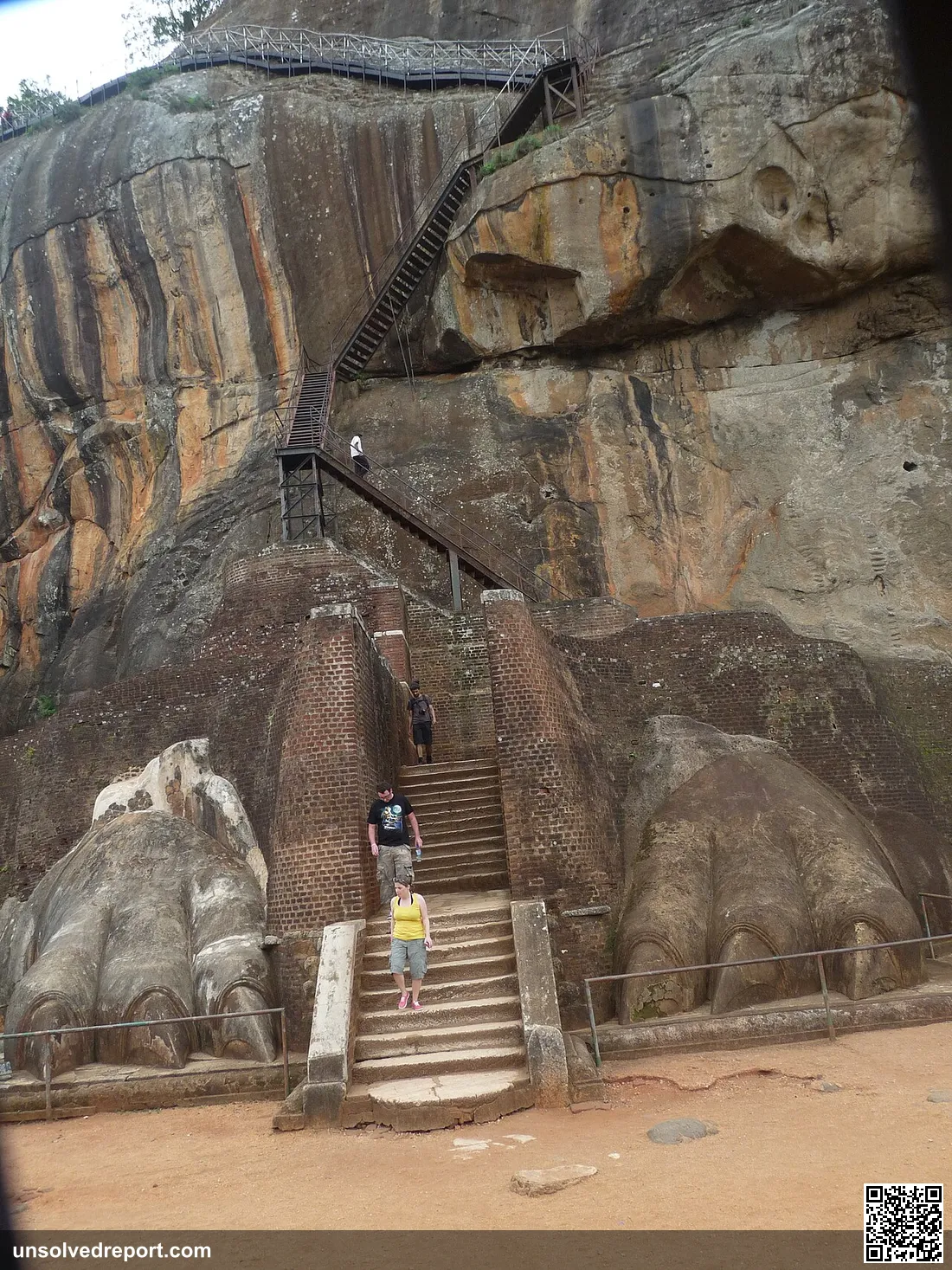
Here's the wild part about the rock itself: it's a dead volcano. What you're climbing is the hardened plug of magma left behind after the volcano around it eroded away, standing about 180 meters above the plain (Wikipedia). The name comes from the Sinhala word Sihagiri — "Lion Rock" — and it's not a metaphor. A giant stone lion once crouched at the top, and to reach the summit you had to climb a staircase that ran straight through its body. The lion is mostly gone now. What's left are its two paws, each about three meters long, still guarding the last stretch of the climb (Central Cultural Fund). A British archaeologist named H.C.P. Bell started serious excavations here in the 1890s, and in 1898 he uncovered those paws (Sri Lanka Archaeology / Wikipedia).
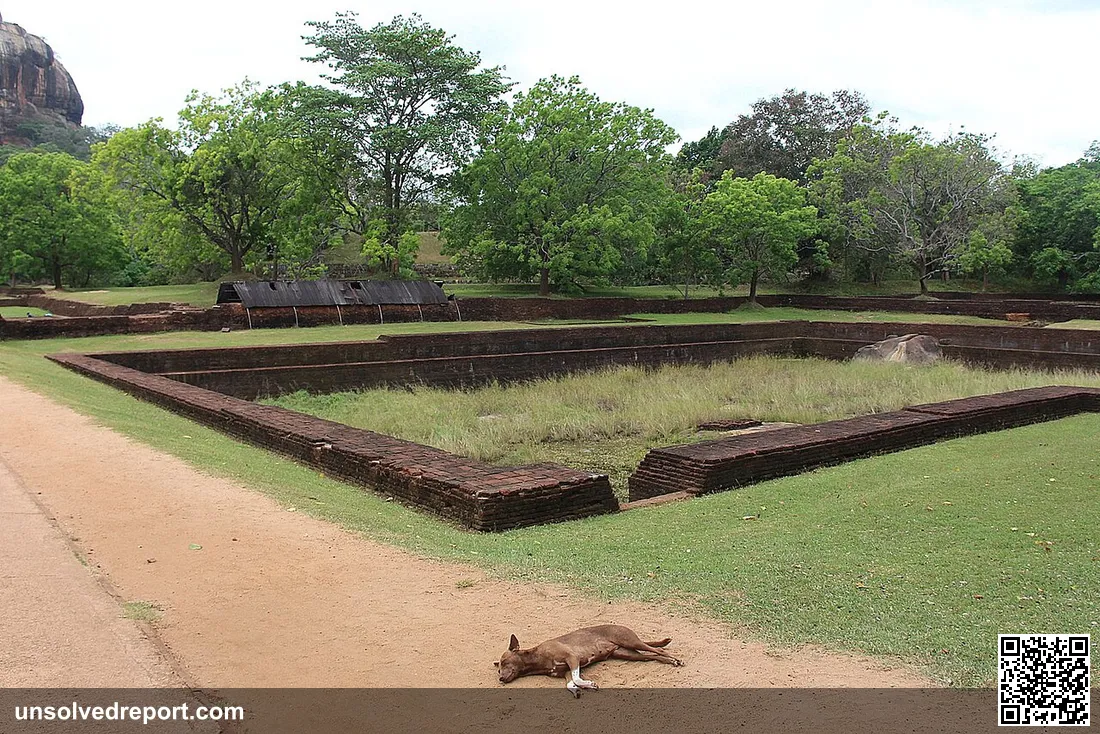
But the thing that makes modern engineers go quiet is the water. The grounds hold three different kinds of garden — neat symmetrical water gardens, wild boulder gardens, and stepped terrace gardens — all stitched together with pools, channels, and fountains fed by an underground plumbing system. And those fountains still work. During the rainy season, more than 1,500 years after someone laid the last pipe, water rises and flows exactly as it was meant to — precision that puts it in the same league as the baffling stonework at Puma Punku (Central Cultural Fund; Wikipedia). These are among the oldest landscaped gardens on Earth, and their flawless symmetry tells you something: beauty and engineering weren't separate jobs here. They were drawn up together.
Now climb to a sheltered fold in the western cliff, and you meet the women. The frescoes — painted ladies dripping with jewelry and flowers, their lower halves dissolving into stylized clouds. They once stretched across an enormous band of the rock. Graffiti scratched by later visitors talks about "500 ladies." Today only about twenty-two figures survive (Central Cultural Fund; Wikipedia). People often compare their style to the Gupta-era paintings in India's Ajanta Caves, though experts insist the Sigiriya look is its own thing.
Below the women runs the Mirror Wall. It was once coated in lime plaster, buffed until it shone — you could see your own face in it. And over the centuries, people couldn't resist it. They wrote on it. Verses, hundreds and hundreds of them, making this one of the oldest piles of graffiti anywhere in the world. The epigraphist Senarath Paranavitana — the man who learned to read it — deciphered 685 of these inscriptions, most of them from the 8th to 10th centuries, scribbled by poets, governors, monks, and ordinary people just passing through (Wikipedia). One of them is gloriously honest: since everybody else had already written a poem, he wrote, he wouldn't bother.
And the ending? It came in 495 CE, when Moggallana finally made good on his vow and invaded. The Culavamsa says Kashyapa's war elephant suddenly turned aside in the middle of the battle. His own troops read it as a retreat and bolted. Surrounded, refusing to be taken alive, the king drew a blade across his own throat. After he died, the rock went back to the Buddhist monks — a role it had probably played long before Kashyapa ever showed up, since monks were living in caves there as early as the 1st or 2nd century BCE — and it stayed a monastery until somewhere around the 13th or 14th century (Wikipedia; Central Cultural Fund). In 1982 UNESCO named the Ancient City of Sigiriya a World Heritage Site — the very same year Sri Lanka's Cultural Triangle Project, led by Professor Seneka Bandaranayake, first excavated the whole city (UNESCO).
The questions nobody can close
That's a lot of solid history. And yet two questions are still wide open — and they're tangled up in each other.
Start with the painted women. There is no inscription on the rock that names them. The chronicles don't mention them. Nobody knows who they are — the same silence that hangs over the Dancing Girl of Mohenjo-daro two thousand years earlier — and the reason the mystery survives is brutally simple: there's no caption. No label, no answer (Sri Lanka Authentic Holidays).
The second question is bigger. What was Sigiriya for? You'll hear it called an "impregnable fortress," and the moats and gateways back that up. But then you look at the lavish gardens, the galleries, the pleasure pavilions — and it reads less like a war machine and more like a paradise resort. Add in all those centuries of monks living there, before Kashyapa and after, and every neat label starts to fall apart — the same fortress-or-palace argument that still surrounds Great Zimbabwe on the other side of the Indian Ocean (Coleman Concierge). Was it a fortress? A royal playground? A holy place? Some on-purpose blend of all three? Scholars are still arguing.
So who are the women? Take your pick
Nobody has nailed down the painted ladies, but plenty of smart people have tried. Here's where things get fun — these are the leading theories, and not one of them is proven.
Maybe they're goddesses. The heavyweight art historian Ananda Coomaraswamy said the figures are apsaras — heavenly nymphs. His clue: their bodies vanish into clouds at the waist, and in this kind of art, that's a visual code that says "divine" (Sri Lanka Authentic Holidays). The fact that they look so much like Ajanta's celestial beings only helps the case.
Maybe they're real women from the court. Other scholars, H.C.P. Bell among them, see flesh-and-blood ladies of Kashyapa's court — perhaps the queens (the fair-skinned figures) with maidservants (the darker ones) — all of them carrying flowers toward a temple, since every figure is walking the same direction (National Geographic; Sri Lanka Authentic Holidays).
Maybe they're the weather. Paranavitana had a poetic idea: the women are vijju kumari (lightning princesses) and megha lata (cloud damsels) — spirits of storm and sky, painted, fittingly, on a cliff that scrapes the clouds (Sri Lanka Authentic Holidays).
Maybe they're Buddhist holy figures. A newer reading links them to Tara, a beloved bodhisattva in Tantric Buddhism — which would tie the murals straight back to the rock's long life as a monastery (Sri Lanka Authentic Holidays).
Here's what keeps Sigiriya so maddening, and so wonderful: none of these answers knocks out the others. A man who built fountains that still run, walls that once held the whole sky in their reflection, and a lion whose open mouth swallowed the stairway to his throne was not a man who dealt in straight answers. The facts of Sigiriya are astonishing. Its meaning is still unsolved — a riddle the rock has kept for fifteen centuries, and looks ready to keep for many more. Some rocks, it turns out, are better at keeping secrets than any of us.
Sources & Further Reading
- UNESCO World Heritage Centre — Ancient City of Sigiriya: https://whc.unesco.org/en/list/202/
- Central Cultural Fund, Sri Lanka — Sigiriya Rock Fortress: https://ccf.gov.lk/heritage-sites/sigiriya-rock-fortress/
- National Geographic — "Sigiriya, the 'Lion Fortress' of Sri Lanka": https://www.nationalgeographic.com/history/history-magazine/article/sri-lanka-sigiriya-fortress
- Encyclopaedia Britannica — Sigiriya: https://www.britannica.com/place/Sigiriya
- Wikipedia — Sigiriya: https://en.wikipedia.org/wiki/Sigiriya
- Sri Lanka Authentic Holidays — "Sigiriya Uncovered": https://www.srilankaauthenticholidays.com/travel-blog/sigiriya-uncovered-delving-into-the-history-art-and-legends-of-an-iconic-wonder/
Flannan Isles Mystery: Three Vanished, One Coat Left Behind
December 1900: three keepers vanish from Flannan Isles lighthouse. Two coats are missing. The third is still on its hook. What happened to him?

The Sun Won't Tell Us What It's Made Of
We made a better model of the Sun's surface — and it broke our model of its core. Why scientists still can't agree what our own star is made of.
The Vela Incident: The Double Flash Nobody Can Explain
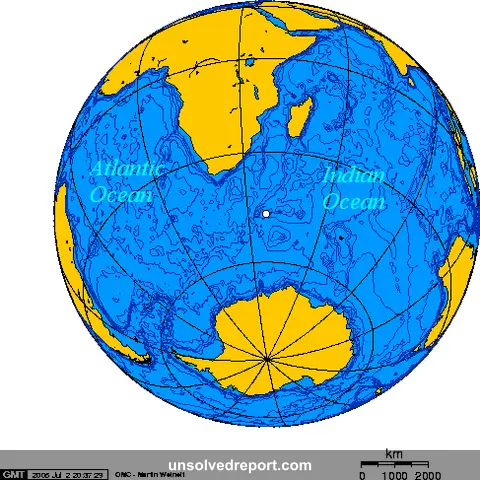
The Vela Incident, 1979: the mystery flash a dying satellite caught over an empty ocean. Secret bomb test, or glitch? Scientists still can't agree.