Sroda Treasure: The $100M Crown Nobody Can Name
The Sroda Treasure's $100M crown may not belong to who everyone thinks — and most of the hoard vanished before authorities arrived. What's still missing?
Spring, 1985. A wrecking crew in a sleepy Polish town swings into an old building — and breaks open the dark. Coins pour out of the broken wall. They have been waiting there, in silence, for roughly 600 years. A few years later more rubble gives up jewelry, and sitting at the heart of it all is a golden crown so fine that scholars now call it the only one of its kind to survive the entire Middle Ages.
Here's the thing. This story has everything. An emperor scrambling for cash. A banker who vanished as the plague rolled in. And a hoard that started slipping into private pockets the very second it touched daylight. The hard part isn't finding the drama. The hard part is sorting what we actually know from the legend we can't stop telling — and that's where it gets really good.
What we know for sure
The town is Sroda Slaska (Środa Śląska), near Wrocław in southwestern Poland. The first find came on June 8, 1985, during demolition and foundation work for a local telephone exchange building. Workers cracked the ground open and out came a vessel holding roughly 3,000 silver Prague groschen, according to the English-language Wikipedia summary of the discovery. Then, on May 24, 1988, during more work nearby, came a second find — far richer than the first. And this is the moment the story breaks your heart.
Because, in the words of that same account, "most of this new find disappeared before the site was secured by the authorities." Word got out. Fast. Residents reportedly started picking through the municipal landfill where the rubble from demolished buildings had been dumped — and that's when the first whispers of jewelry began. The authorities scrambled. They announced a plan to buy the looted pieces back. They opened criminal investigations. Many pieces did come home. But the record is honest about the rest: "there are still missing items."
What did survive is breathtaking. The collection now lives at the National Museum in Wrocław and is shown at the regional museum in Sroda Slaska itself. Picture a woman's gold crown. A ceremonial clasp set with a chalcedony cameo of an imperial eagle. Gold pendants dated to the 12th–13th centuries. Rings, ornamental fittings, gold and silver coins. The museum calls the crown a wedding piece, its whole design built around a rings motif — a quiet symbol of marriage and commitment. Look closely and you'll find seven eagles perched on top, fleurons, a circular fibula bearing that cameo, the entire thing studded with gemstones and pearls.
So whose gold was this? The history is solid. The treasure most likely came from Prague — from the crown treasury of the House of Luxembourg — and made its way to Silesia under Charles IV, who borrowed heavily from wealthy Sroda Slaska merchants to fund his push for the imperial title, per the National Museum in Wrocław. Around 1348, short on money, Charles pawned items to a banker recorded as Muscho (Moshe). The treasure was first shown to the public in 1996. As for what it's worth: press valuations have run from roughly $50 million in a 2001 estimate to about $100 million by 2005 — figures both the museum and Wikipedia pass along carefully, eyebrows raised.
The two questions nobody can answer
Two real mysteries sit at the center of this hoard. Museums and historians handle both with gloves on.
The first: who actually wore the crown? The popular shorthand — splashed across headline after headline — is that it belonged to Blanche of Valois, the first wife of Charles IV. But the people who actually hold the object are far more careful. The National Museum in Wrocław will say only that "the crown belonged to the Czech queens, and its last owner could have been" Blanche of Valois. Read that again. "Could have been." Those three words are doing a lot of honest work. The crown is firmly dated to the early 14th century and clearly made for a royal wedding — but it doesn't come with a name tag. Blanche is a strong, beautiful guess. She is not a proven fact.
The second mystery is colder, and it may never thaw: how much is still gone? The 1988 find scattered before anyone could write it down. And because no complete inventory existed before the looting, no one can say what the full hoard truly held — which coins, which jewels, perhaps which other pieces of regalia walked off in someone's coat pocket and got melted, sold in the shadows, or shoved into a drawer somewhere and forgotten. What we recovered dazzles. What we never got to see stays a genuine, open hole in the story.
Theories worth weighing — and ones to hold loosely
The strong one: it was loan collateral, lost by accident. The leading interpretation, backed by the museum, is straightforward and a little sad. These objects were pawned by Charles IV to a Sroda banker in the mid-14th century — and simply never reclaimed. Why not? Here the solid record runs thin and informed guessing begins. The widely repeated version goes like this: the banker Muscho vanished during the Black Death, which swept the region around 1348–1351. Fleeing. Dying. Lost in the chaos. And the pledged valuables stayed walled up, waiting, forgotten. It fits the dating and it makes sense. But be clear-eyed — the banker's exact end is legend more than verified biography. The public museum account doesn't include contemporary documents pinning down what really happened to him.
The hopeful one (speculation): the missing pieces could still surface. Since part of the 1988 find slipped into private hands, treasure hunters have long whispered that more Sroda objects survive somewhere, uncatalogued. That's a reasonable hunch, not evidence. No major confirmed recovery has been publicly announced in recent years, and any tale of a "still-hidden" cache deserves to be filed under folklore — right up until an artifact with a real paper trail actually walks through the door.
The romance (and we should name it as romance). The National Museum itself admits the dramatic discovery spun up "new theories, legends and a particular mythology" around the find. That's the honest frame. The eagles and gemstones are real. But the picture of a queen's crown bricked into a wall as plague stalks the streets outside? That's partly reconstruction, and partly the kind of story human beings simply cannot resist telling each other.
And that tension is exactly why the Sroda treasure won't let go of us. A verifiably magnificent crown — and a human story that's only half-recovered, just like the hoard itself. We have the crown. We have the coins. What we don't fully have — the banker's fate, the true owner of the crown, the count of what vanished into private pockets — is precisely what keeps people leaning closer to the glass. Somewhere out there, a missing piece may still be waiting in the dark. Just like the coins once were.
Sources & Further Reading
- National Museum in Wrocław — The Treasure of Środa Śląska
- National Museum in Wrocław — The Środa Treasure: Crown, Symbol of Reign
- National Museum in Wrocław — The Środa Treasure: Legends and Myths
- Wikipedia — Środa Treasure
- Polish History — The Środa Treasure
Staffordshire Hoard: 4,000 Pieces of War Gold Nobody Can Explain
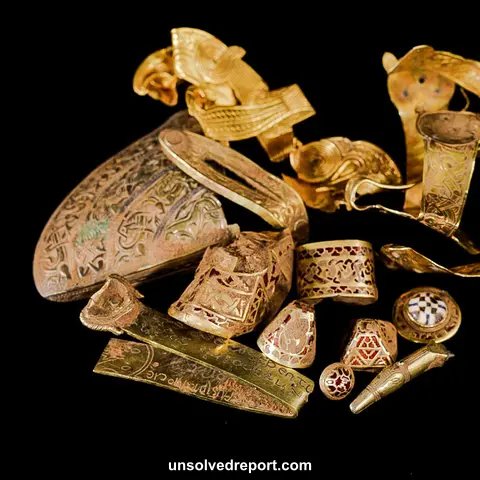
Staffordshire Hoard: 4,000 pieces of torn-up Anglo-Saxon war gold — and one question experts still can't answer: who buried it, and why?
Lost Faberge Imperial Eggs: 6 Are Still Missing Right Now
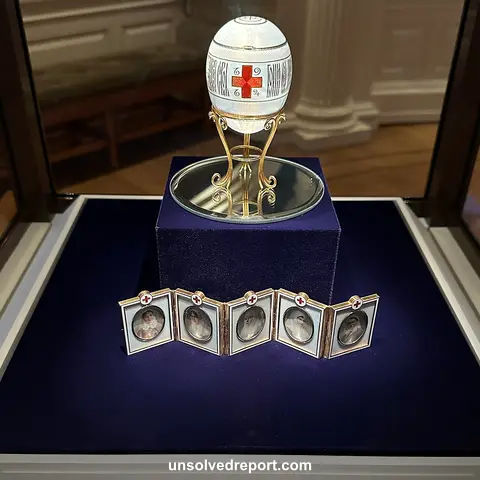
6 of the 50 lost Faberge Imperial eggs are still unaccounted for - and one nearly got melted for scrap gold before anyone realized what it was. Where are the rest?

Knights of Malta Gold: Did It Sink With L'Orient?
Napoleon stripped the Knights of Malta of a fortune in 1798. Weeks later L'Orient exploded off Egypt — and divers found coins. So how much gold is still missing?