Sea Peoples: The Invaders Nobody Can Explain
Around 1200 BCE, a whole civilization went dark overnight. Egypt blamed the Sea Peoples—150 years later, no one can say who they really were.
The cities burned first. Then the writing stopped.
Around 1200 BCE, the eastern Mediterranean was a connected world—rich, literate, trading freely from Greece to Egypt. Kings wrote letters to kings. Ships carried tin and copper and gossip across the sea. And then, in the span of a few generations, it came apart. The Hittite Empire simply vanished. Great cities went up in flames. Entire kingdoms forgot how to write, their clay tablets going silent mid-sentence. Egyptian scribes pinned the chaos on a coalition of attackers who came off the water—enemies they described in fear but never truly named. We call them the Sea Peoples. And here's the part that should keep you up at night: more than 150 years after scholars first gave them that name, we still cannot say who they were or where they came from.
What the Stone Actually Says
These raiders are not a campfire story someone made up. They are carved into a wall.
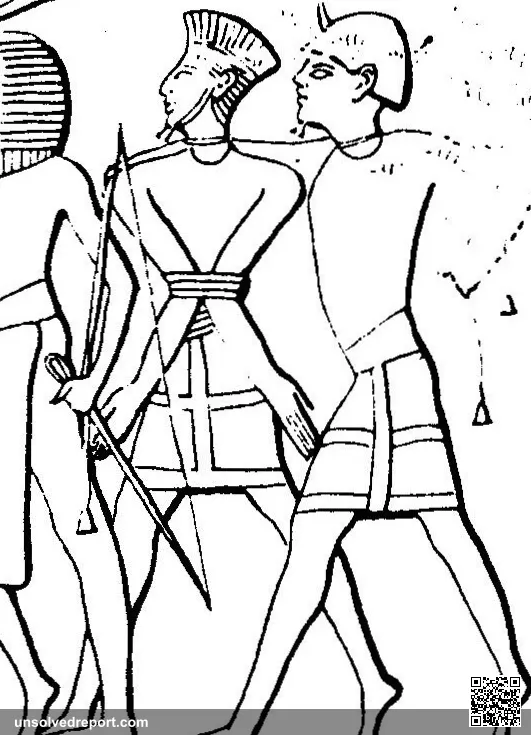
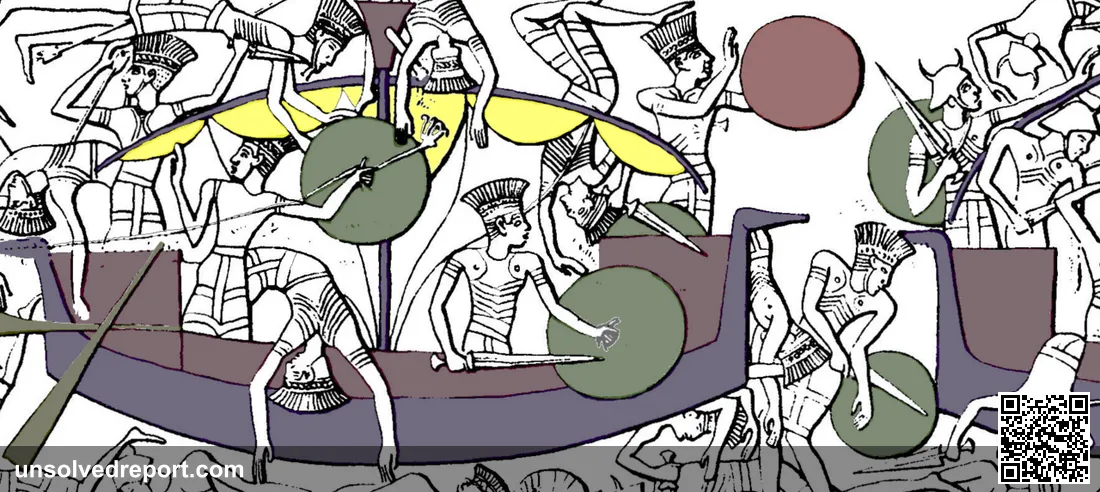
The best account survives at Medinet Habu, the towering mortuary temple of the pharaoh Ramesses III in western Thebes. Its inscriptions describe an invasion in the eighth year of his reign—usually dated to around 1177 BCE (World History Encyclopedia). The famous passage doesn't read like a dry report. It reads like a warning: "The foreign countries made a conspiracy in their islands. All at once the lands were removed and scattered in the fray. No land could stand before their arms, from Khatte, Qode, Carchemish, Arzawa, and Alashiya on... Their confederation was the Peleset, Tjekker, Shekelesh, Danuna, and Weshesh" (Wikipedia, Sea Peoples).
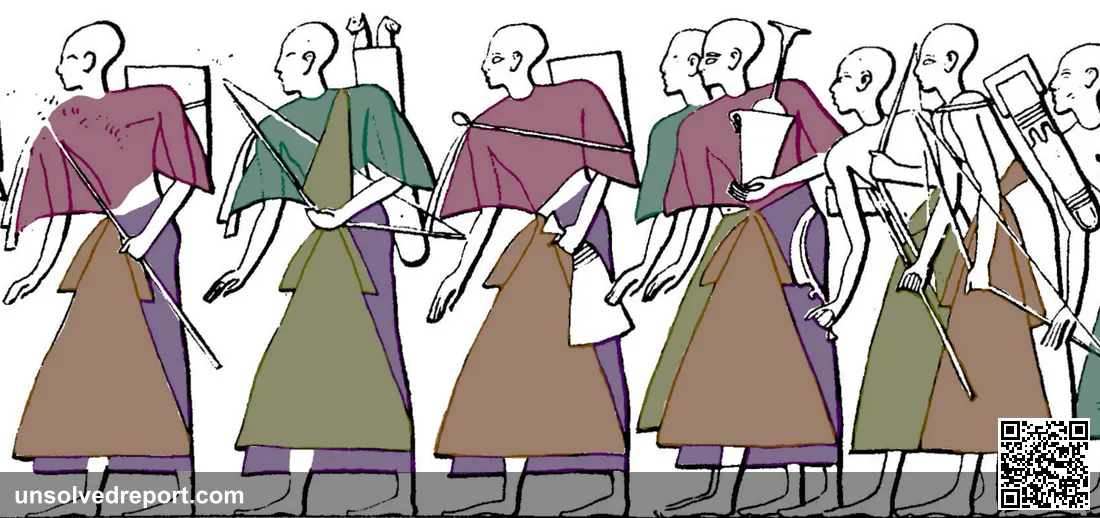
Read that again, because it's astonishing coming from the Egyptians themselves. A wave of destruction rolling through Anatolia (Khatte, the Hittite heartland), through Cyprus (Alashiya), through Syria—and only stopping when it hit the Nile Delta. Ramesses III says he beat them in two fights: a land battle and a sea clash in the Delta. The temple walls show it all in unusual detail. And there's one chilling detail in the carvings—ox-carts loaded with women and children. Not a raiding fleet looking for loot. A whole people on the move, dragging their families with them (The Collector).
Ramesses III wasn't even the first pharaoh to meet them. A generation earlier, the Great Karnak Inscription of Merneptah records a Libyan-led invasion in his fifth regnal year, around 1208 BCE—and riding along with it were allied bands named Ekwesh, Teresh, Lukka, Sherden, and Shekelesh, called "Northerners coming from all lands" (Wikipedia, Sea Peoples). Go back even further and Ramesses II had already traded blows with Sherden raiders along the coast. So this isn't one bad year. The Egyptian record stretches across roughly a century of on-and-off war with peoples who kept coming from the sea and the lands of the north.
Now here's where it stops being just Egyptian boasting—because someone else was screaming for help at the exact same time.
At Ugarit, a wealthy port on the Syrian coast, archaeologists pulled a clay tablet from the ruins (catalogued RS 18.147). It is a letter from the city's last king, Ammurapi, written as the disaster closed in around him. Read his words: "the enemy's ships came (here); my cities were burned, and they did evil things in my country." Worse, he admits his own troops were away—off in Hatti and Lukka—leaving the city wide open (Wikipedia, Ammurapi). Ugarit burned. It was never lived in again. The pottery in those scorched layers dates the city's death to around 1190–1192 BCE. Right around then, the Hittite Empire dissolved. The grand Mycenaean palaces of Greece were destroyed or simply walked away from. This wasn't a string of unlucky coincidences spread over centuries. It happened together—and that timing is real, and it's well documented.
One more thing worth knowing: the name "Sea Peoples" is a modern invention. The French Egyptologist Emmanuel de Rougé used the phrase peuples de la mer in 1855 while studying the Medinet Habu reliefs, and his successor Gaston Maspero ran with it—building a sweeping migration theory around it—in the late 1800s (World History Encyclopedia). The Egyptians never lumped them under one tidy word. They just listed the names of the groups, one after another.
The Question Nobody Can Answer
So who were they?
We don't know. That's the heart of it. Almost everything we have is Egyptian war propaganda—triumphant inscriptions built to make a pharaoh look like a god, not to carefully describe who the enemy actually was. As the historian Marc van de Mieroop has pointed out, their true identity may never be pinned down (World History Encyclopedia).
The group names are maddening. They almost tell you something. Scholars have spent generations chasing echoes between those names and later places on the map—the Sherden with Sardinia, the Shekelesh with Sicily, the Lukka with Lycia in Anatolia, the Ekwesh maybe with the Achaeans of Homer's Greece. But every one of those links leans mostly on words that sound alike, and every one is still argued over rather than settled. We have no Sea Peoples city to dig up with confidence. No writing in their own hand. And no agreement on whether they were one united confederation or just a convenient Egyptian basket for a dozen unrelated war bands.
Then comes the bigger question, the one that really matters. Did the Sea Peoples cause the Bronze Age to fall—a horde that toppled empires? Or were they just a symptom of a world that was already coming apart for its own reasons? On this, the scholarly tide has swung hard in one direction. But the case is not closed.
Three Ways to Read the Ruins
Theory 1: The destroyers (the old story). For most of the twentieth century, the Sea Peoples were the villains of the whole drama—a migrating tide that crushed the Hittites, torched Ugarit, and was only stopped at Egypt's doorstep. This version takes the Egyptian inscriptions pretty much at their word. It has fallen out of favor because it leans so heavily on one-sided sources and can't really explain why so many far-apart regions all collapsed at the same moment. This reading is increasingly disfavored among scholars.
Theory 2: A symptom, not a cause (where most experts now stand). Today, most scholars see the Sea Peoples as one piece of a much larger collapse rather than the thing that set it off. And there's hard science behind that shift. A 2013 study in the journal PLOS ONE, led by David Kaniewski, drilled into sediment cores at the Larnaca Salt Lake in Cyprus and read the ancient pollen trapped inside. It found a long dry spell kicking in around 1200 BCE. The authors tie that drought to crop failures, famine, and "regional human migrations at the end of the LBA in the Eastern Mediterranean" (Kaniewski et al., PLOS ONE 2013). Picture it: harvests failing, trade routes snapping, hungry populations pushed into motion, kings losing their grip—and the Sea Peoples among the people the chaos shook loose. This is well supported, though it's still a model, not a proven script.
Theory 3: Refugees who turned to raiding. A close cousin of that idea looks back at those ox-carts full of women and children at Medinet Habu and says: these weren't professional armies. They were whole communities running from a collapse somewhere else—migrants who took up raiding and settling when home became unlivable. The strongest hard proof comes from the Philistines, long linked to the Egyptian "Peleset." A 2019 study in Science Advances, led by Michal Feldman, pulled ancient DNA from skeletons at Ashkelon and caught it: a pulse of southern-European-related ancestry entering the population right around the Bronze-to-Iron Age transition—exactly what you'd expect from newcomers arriving across the Mediterranean and then mixing with the local Levantine people (Feldman et al., Science Advances 2019). That's direct evidence that at least one Sea Peoples group really did migrate and settle. But it lights up only a single corner of a far bigger mystery, and it speaks for the Philistines specifically.
So where does that leave us? Be honest with yourself here. We can prove the eastern Mediterranean suffered a real, widespread collapse around 1200 BCE. We can read the pharaoh's boasts and the last desperate letter from a doomed king. We can measure a 3,000-year-old drought and even trace foreign blood into one settled people. What we still cannot do is name the raiders, find their homelands on a map, or fully explain how a connected world unraveled so fast. And that's the reason they still grip us. Three thousand years later, the Sea Peoples are still out there—sails just over the horizon, just past the edge of everything we know.
Sources & Further Reading
- Sea Peoples — World History Encyclopedia
- Sea Peoples — Wikipedia
- Ammurapi — Wikipedia
- Kaniewski et al., "Environmental Roots of the Late Bronze Age Crisis," PLOS ONE (2013)
- Feldman et al., "Ancient DNA sheds light on the genetic origins of early Iron Age Philistines," Science Advances (2019)
- How the Mysterious Sea Peoples Erased the Bronze Age World — The Collector
Phaistos Disc: We Have It. We Just Can't Read It.
The Phaistos Disc: 4,000 years old, fully cataloged, completely unread. Every symbol is counted, every theory tested — so why can't anyone crack it?
Niya: The Silk Road Town the Desert Ate Alive
Niya ruins: a Silk Road town frozen mid-life in the Taklamakan Desert—houses standing, letters still legible after 1,700 years. So why did everyone just... walk away?
9 Megalithic Sites Nobody Can Fully Explain
Stones too heavy, too precise, too ancient. From Gobekli Tepe to Baalbek, here are 9 megalithic sites that still leave the experts genuinely stumped.