Ludwig Leichhardt: 7 Men Vanished, One Nameplate Came Back
In 1848, explorer Ludwig Leichhardt and six men rode into the outback and vanished. Only one brass relic ever came back. What happened to the men?
April 1848. A famous explorer turns his horse toward the blank middle of Australia and rides right off the edge of every map there is. Behind him: six companions and a long, snorting train of pack animals. Ahead: a continent nobody had ever crossed. Then the trail goes quiet. No graves. No campsite anyone can be sure of. No ragged survivor stumbling home with a tale to tell. Nearly two centuries on, Ludwig Leichhardt's last expedition is still one of the most stubborn cold cases in the whole history of exploration — rivaled only by cases like Percy Fawcett's disappearance in the Amazon nearly eighty years later. A whole continent opened its mouth and swallowed seven men.
How does that even happen? Start with what we actually know.
What We Actually Know
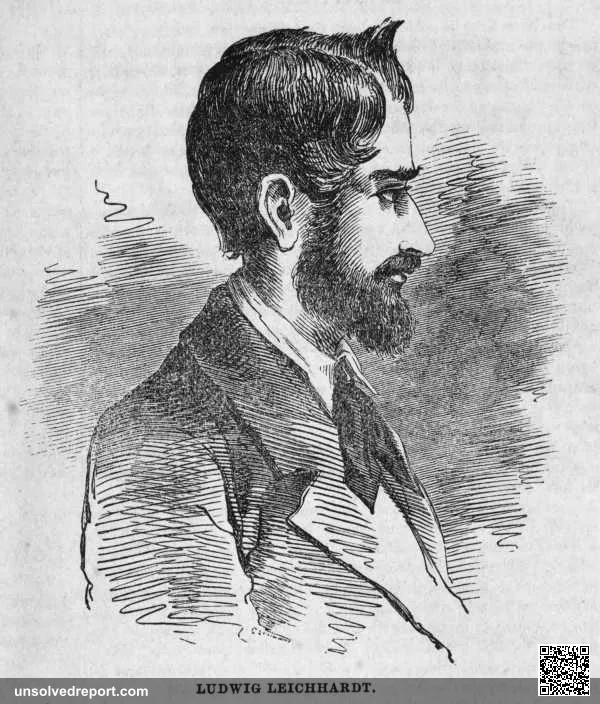
Meet the man at the center of it: Friedrich Wilhelm Ludwig Leichhardt, born October 23, 1813, at Trebatsch, in Prussia. He soaked up the natural sciences at the universities of Berlin and Göttingen — and then, classic Leichhardt, never bothered to finish a formal degree (Australian Dictionary of Biography). In 1842 he sailed to Australia, pulled across the world by one irresistible thing: a giant unmapped interior, just sitting there, waiting.
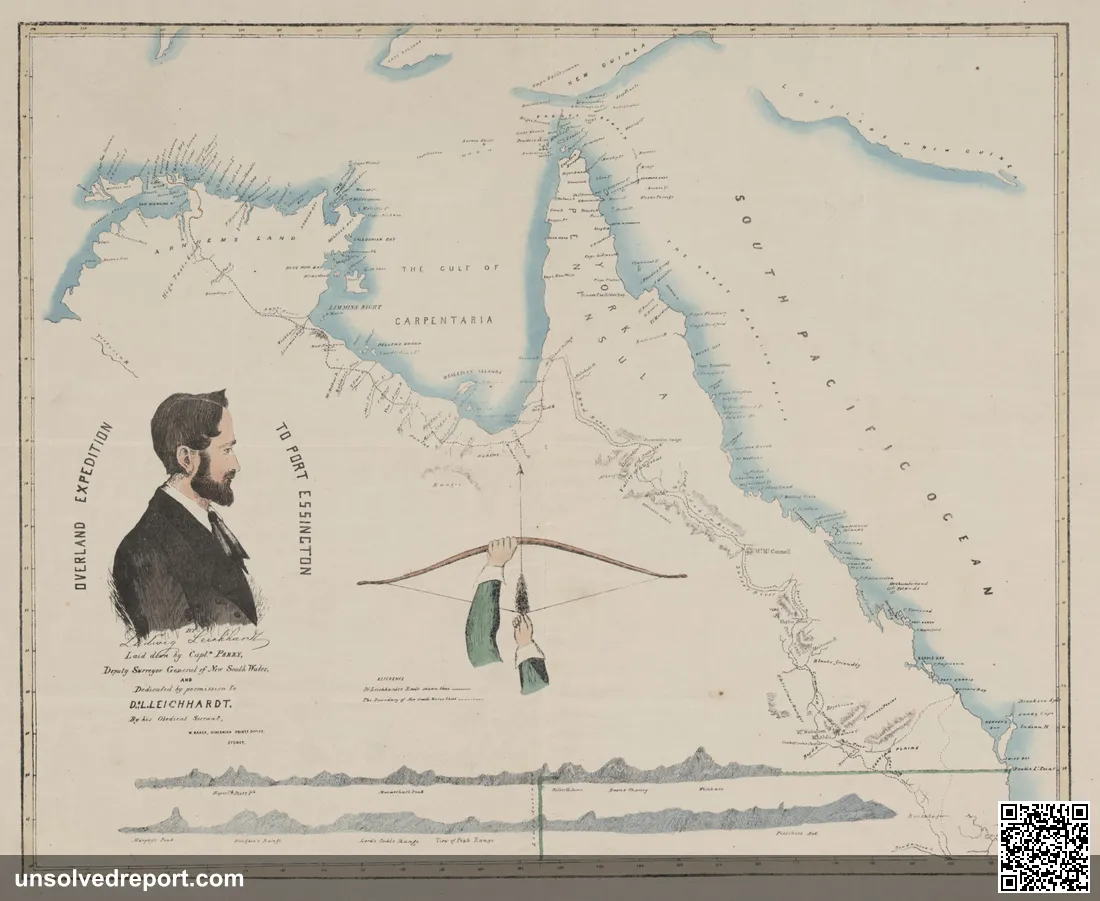
And he earned his fame the hard way. Starting in 1844, Leichhardt drove a party overland from the Darling Downs all the way to Port Essington on the far northern coast, near present-day Darwin. Do the math on that: nearly 3,000 miles — about 4,828 kilometers — on foot and hoof through country that fights you every step. They hit the coast on December 17, 1845, and he was back in Sydney by March 25, 1846 (Australian Dictionary of Biography). It cost a life: the naturalist John Gilbert was killed in a skirmish at camp on June 28, 1845. Even so, the trek made Leichhardt a star. The Australian Museum says he was crowned the "Prince of Explorers" and handed the Royal Geographical Society's Patron's Medal (Australian Museum).
Then he reached too far. In December 1846 he set out to cross the entire continent, east to west, all the way to the Swan River near Perth. It collapsed almost at once. By around June 1847, after roughly 500 miles, the party turned back — beaten by rain, sickness, and starving animals (Australian Dictionary of Biography).
Most men would have called it a career. Leichhardt rebuilt the whole thing and went for the exact same crossing again. According to the roster in the Wikipedia account, the final group was Leichhardt; the Europeans Adolph Classen, Arthur Hentig, Donald Stuart and Thomas Hands; and two Aboriginal guides, Wommai and Billy Bombat, from Port Stephens, New South Wales. With them rode a small living fortune: seven horses, 20 mules and 50 bullocks. The last anyone laid eyes on them was April 3, 1848, at Allan Macpherson's Cogoon run, an outlying station west of Roma on the Darling Downs (Wikipedia; Australian Dictionary of Biography). From there they pushed inland — and walked straight out of recorded history.
People looked. For decades. The Australian Museum records that several large search parties went out, partly fired up by a £1,000 reward later dangled by The Bulletin magazine (Australian Museum). And here's where the skin starts to prickle. Again and again, searchers found trees carved with a single letter — "L". Hovenden Hely, 1852: a campsite with a tree marked "L". Augustus Gregory, 1858: an "L"-marked tree near the Barcoo River. Duncan McIntyre, 1864: "L"-marked trees on the Flinders River near the Gulf of Carpentaria (Wikipedia). One letter, scratched into bark across hundreds of miles of nowhere. And not one of those marks could be pinned, for certain, to Leichhardt's missing men.
Then came the relic that stops you cold. Around 1900, an Aboriginal stockman known as Jackie, working with the prospector Charles Harding, picked up a small brass plate near Sturt Creek, way out on the edge of the Tanami and Great Sandy deserts. It was tiny — about 15 cm by 2 cm — and stamped with three words and a date: "LUDWIG LEICHHARDT 1848". It was bolted to a partly burnt firearm, and that firearm had been slung up in a boab tree carved, of course, with an "L". After roughly a year of historical and scientific testing, the National Museum of Australia ruled that the nameplate and the place it came from were genuine, and bought it in 2006 (National Museum of Australia). The Museum calls it the first — and so far the only — relic with proven provenance from the 1848 expedition.
Hold that little strip of brass in your mind. Because it answers one question and tears open a far bigger one.
The Question Nobody Can Answer
Here's the heart of it. The nameplate tells us where the expedition was. It tells us absolutely nothing about what happened to it.
And where it was is staggering. If the relic is real, Leichhardt's party didn't die early, in some ditch close to home. By some assessments they had crossed roughly two-thirds of the continent (Wikipedia) — far, far past anywhere the search parties could ever confirm. That little sliver of metal drags the vanishing point hundreds of miles deeper into the desert. Which somehow makes the silence afterward even harder to swallow. They got so close. And then?
Nothing. The Australian Dictionary of Biography puts it flat: after the expedition moved inland from Cogoon, "no evidence showing conclusively what happened to it has been found." Seven men. Seventy-seven animals. A mountain of gear. Gone — no verified grave, no skeleton, no recovered journal. And this wasn't some sealed cave, either. This is land later crawled over by drovers, prospectors, surveyors, and pastoralists for generations. They found that one brass plate. They never found the men. That total, surgical erasure is exactly what keeps the case breathing.
So what could have happened out there?
The Theories (And Where They Stop)
Quick warning before we wade in: everything below is interpretation and speculation, not proven fact. The hard record ends at Cogoon. After that, we're guessing — some guesses sharper than others.
The desert simply won. The plainest answer is also the bleakest. The party ran out of water, ran out of animals, and died trying to cross country that forgives nothing. It fits the facts. Leichhardt's 1846 attempt had already buckled under that exact kind of strain, and the inland route toward Sturt Creek slices through some of the harshest desert on Earth — the same brand of merciless terrain blamed for swallowing whole parties like the lost army of Cambyses in the Sahara. There's no physical proof nailing it down — but it needs no wild leaps, either. Sometimes the boring answer is the true one.
They were attacked. One account that gets cited a lot is an 1874 letter passing along Aboriginal oral history from the Maranoa River region. It describes a party being surrounded and killed, their belongings later scattered (Wikipedia). Oral histories can carry real events, faithfully, across generations. But this one can't be independently checked, and the details are disputed. Hear it as testimony worth weighing — not as a confirmed ending.
The scattered scraps. Over the years, later explorers kept tripping over objects they suspected belonged to Leichhardt's group. The explorer David Carnegie, for one, turned up an iron tent peg and saddle ironwork in 1896 — and even he could only guess they were connected (Wikipedia). None of it carries the proven provenance the nameplate does. Tempting clues, all of them. Solid evidence, none.
The men who never came back — or did they? Deep into the 20th century, searches were still partly driven by a haunting rumor: that survivors were out there, alive, living with Aboriginal communities far inland (Britannica). The "white men among the tribes" legend gripped the public for decades. It's exactly the kind of story you ache to be true. And it produced exactly zero verifiable survivors.
What outlasts all of it is the question itself. The nameplate plants Leichhardt deep in the western interior in his final year. Everything after that point is desert and silence. A famous name on one side, a single authenticated strip of brass on the other, and an unbridgeable gap in between — that gap is the mystery. Australia took seven men and gave back three words on a piece of metal. It has not said another word since — not unlike the way it swallowed the SS Waratah six decades later without a single confirmed trace. And somewhere out past Sturt Creek, the rest of the answer may still be lying in the sand right now, waiting for someone to walk right past it.
Sources & further reading
- Australian Dictionary of Biography — Ludwig Leichhardt
- Australian Museum — Ludwig Leichhardt (Trailblazers)
- Encyclopaedia Britannica — Ludwig Leichhardt
- National Museum of Australia — Leichhardt nameplate
- Wikipedia — Ludwig Leichhardt (expedition roster, search timeline, relic details)

Al Naslaa Rock: The Saudi Boulder Split Like a Laser
A Saudi boulder split by a perfectly straight gap that looks laser-cut. No tool marks, no debris — so what actually sliced Al Naslaa in two?
Undeciphered Texts and Codes: 13 Nobody Can Crack
13 undeciphered texts and codes — from the Voynich Manuscript to a killer's cipher — that have beaten every expert for centuries. Which falls first?
Crystal Skulls Debunked: The Speck That Exposed the Fakes
Crystal skulls debunked: museums called them ancient Aztec relics for 100 years. One speck of grit under a microscope proved otherwise. Here's how.